4. Arterial Wave Speed
 Call Kai
 Learn
Learn Practice Test
 Spaced Repetition
 Match
Match Flashcards
 Knowt Play
1/39

There's no tags or description
Looks like no tags are added yet.
Name | Mastery | Learn | Test | Matching | Spaced | Call with Kai |
|---|
No analytics yet
Send a link to your students to track their progress
40 Terms
What is pulse wave velocity
The speed at which pressure or velocity changes travel through blood in the arteries
What is arterial wave speed directly related to
arterial stiffness
Why is PWV clinically useful
It provides a quantitative surrogate measure of arterial stiffness and risk of cardiac/cerebral events
What are major cardiovascular risk factors that promote arterial stiffness
High cholesterol, high blood pressure, diabetes, smoking, and ageing
What serious consequences can increased arterial stiffness cause
Heart failure and stroke
What are the cardiovascular risk factors that promote arterial stiffness
high cholesterol, high blood pressure, diabetes, smoking and ageing
What are the three separate processes that increase stiffness in the arterial system
Structural Breakdown of Elastin Fibers, Damage to Endothelial Function, Increase in Mean Arterial Pressure
Structural Breakdown of Elastin Fibers
Occurs primarily in the aorta and Age driven

Damage to Endothelial Function
Occurs primarily in the smooth muscle conduit arteries
Disease driven (e.g. T2DM, hypercholesterolemia, atherosclerosis)
Increase in Mean Arterial Pressure
Occurs systematically throughout the arterial system
Wave Speed Definition
The speed by which the changes in the pressure or velocity travel in a certain medium, and in the context of arterial system, the medium is the blood.

Wave speed is a physical property of the arterial wall and can be either…
regional (along an arterial segment) and local (at the measurement site)
What has PWV been widely used in clinical practices as a surrogate marker for
cardiac and cerebral events
Arterial tree stiffness
How can wave speed be measured
Wave speed can be measured regionally or locally

What is foot-to-foot (called time-of-flight)
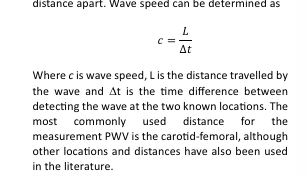
A method for the measurement of regional wave speed and has been used extensively clinically. It relies on measuring either the pressure or flow waveform at two locations that are at a known distance apart
Wave speed equation
c= 𝐿 /∆t
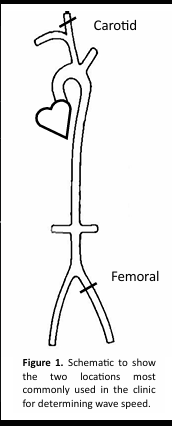
What is the most commonly used distance for the measurement PWV
carotid-femoral
Sphygmocor
instrument for the measurement of the foot-to-foot wave speed.
How is the ‘foot’ determined
The minimum pressure of each respective wave
How is the time difference determined
The femoral pressure is reversed backward in time until its foot superimposes the foot of the aorta pressure
How is the distance determined
estimate of the distance between the two measurement locations

Reimann Equation
c=sqrt(1/pDs)
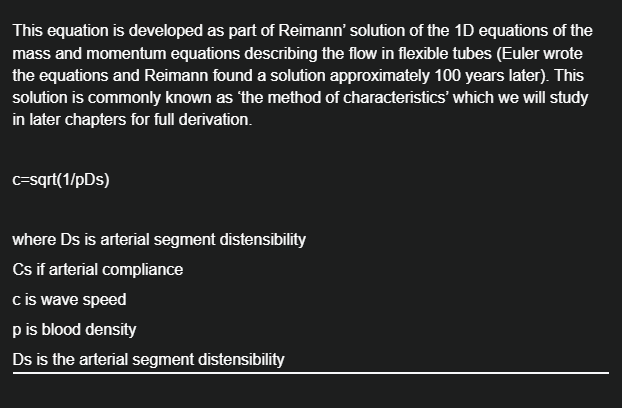
Arterial Segment Distensibility Equation
Ds=Cs/A
Ds (Arterial segment distensibility)
the fractional change of the cross sectional dA/A in response of a change in pressure dP
Moens-Kortweg Equation
c=sqrt(Eh/pD)
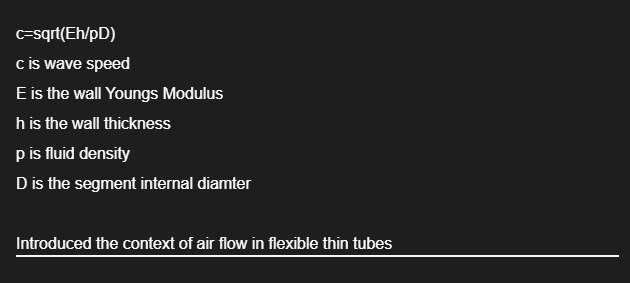
Assumptions in Moens-Kortweg Equation
h is very small with respect to D; h«D
The tube is perfectly elastic
The fluid is incompressible
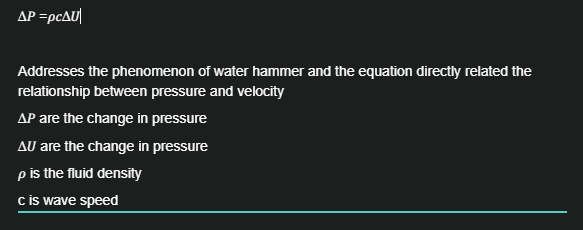
Jokowsky Equation
∆𝑃 =𝜌𝑐∆𝑈
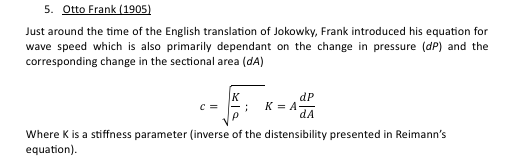
Otto Frank Equation
c=sqrt(k/p) ; K=A(dP/dA)
Bramwell-Hill equation
c=1/sqrt(pDs) ; Ds=1/A(dA/dP)
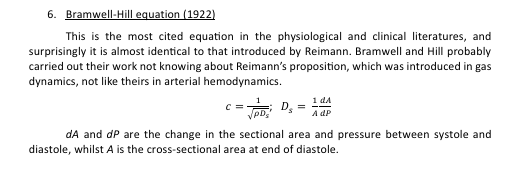
Richard Skalak equation
d𝑃±=𝜌𝑐 𝑑𝑈±
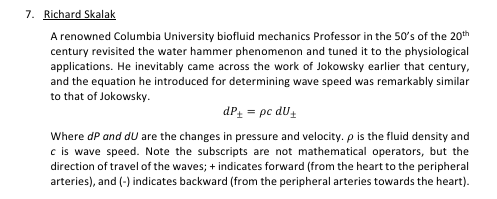
Nico Westerhof Equation
Z0=𝑃̅ / 𝑈̅
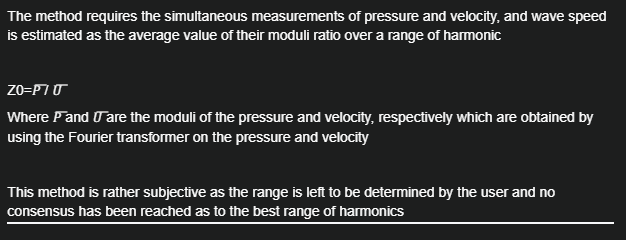
Pressure-velocity loop (PU-loop) equation
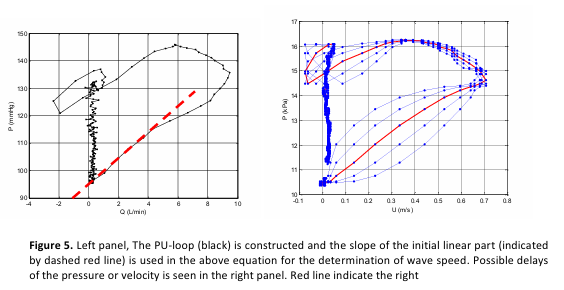
A PU-loop which provided a graphical as well as quantitative value of the wave speed. The method relied on the water hammer equation in the forward direction
d𝑃+ = 𝜌𝑐 𝑑𝑈+
d𝑃+ and 𝑑𝑈+ are the changes of the measured P and U in the forward direction
Integrating this equation gives
d𝑃+ = 𝜌𝑐 𝑑𝑈+ + P0
P+ are the pressure in the forward direction
𝑈+ are the velocity in the forward direction
P0 is an integration factor (reference pressure)
p is the blood density
c is the wave speed
This is an equation of a straight line, indicating during that during early part of systole when the relationship between P and U is linear, due to the absence of reflected waves
Wave Speed equation
c=+- 1/p (dP+/dU+)
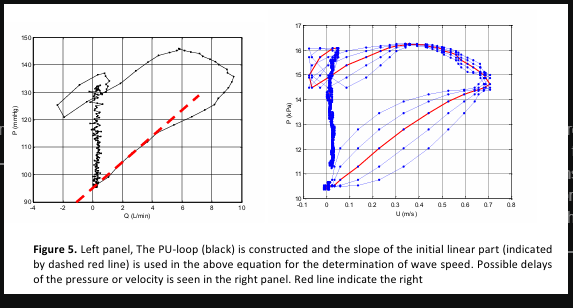
Why can obtaining simultaneous measurement of pressure and velocity be a challenge
Due to the difference in the frequency response of the equipment used for obtaining the measurements.
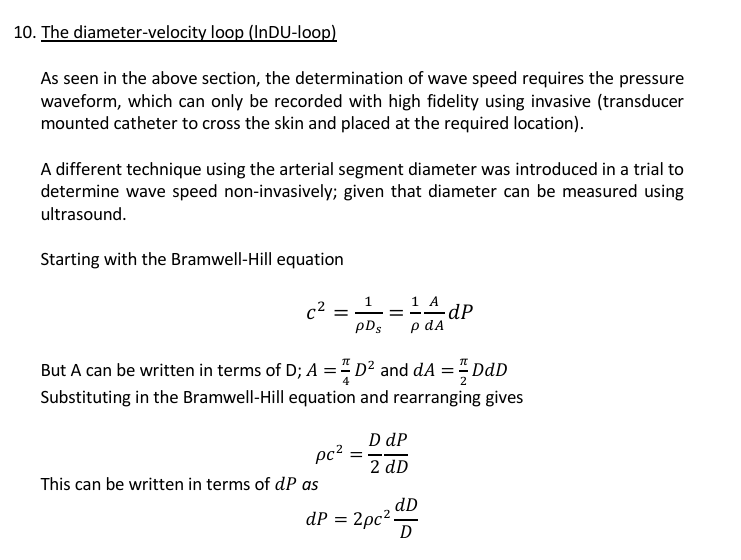
Diameter-velocity loop (InDU-loop)
c=±1/2 *(𝑑𝑈± /d𝑙𝑛𝐷 ±)
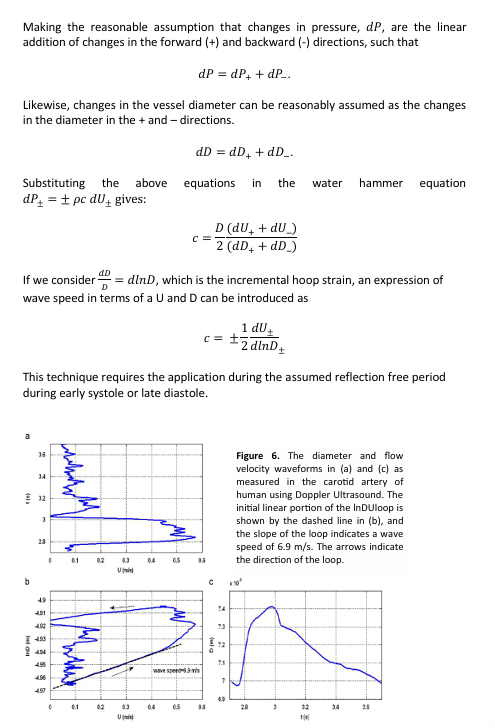
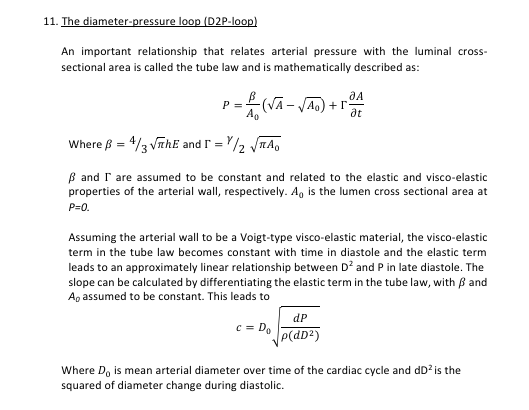
tube law
relating arterial pressure with the luminal cross-sectional area is called the tube law
P = 𝛽 𝐴0 (√𝐴 −√𝐴0 ) + Γ (𝜕𝐴 /𝜕t)
Where 𝛽 = 4 3 ⁄ √𝜋 ℎ𝐸 and Γ = 𝛾 2 ⁄ √𝜋𝐴0
𝛽 and Γ are assumed to be constant and related to the elastic and visco-elastic properties of the arterial wall. A0 is the lumen cross sectional area at P=0
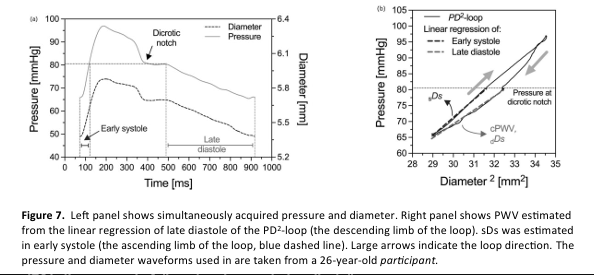
diameter-pressure loop (D2P-loop) equation
c=D0*sqrt(dP/p(dD²))
Theoretical determination of wave speed
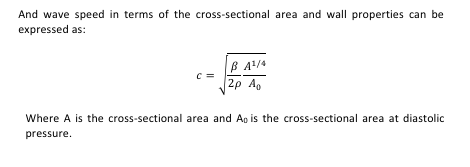
c=sqrt ((B/2p) (A^1/4/Ao))
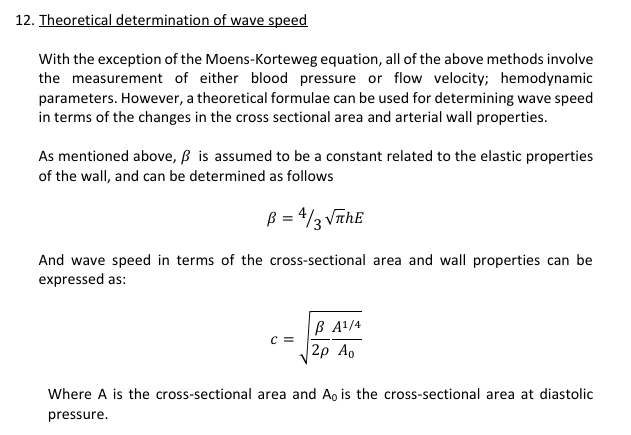
B constant
B=4/3*sqrt(pi) hE

wave speed in terms of cross-sectional area and wall properties
c=sqrt(B/2p * A^1/4/A0)