Psychology Approaches
 Call Kai
 Learn
Learn Practice Test
 Spaced Repetition
 Match
Match Flashcards
 Knowt Play
1/54

Earn XP
Description and Tags
A-level paper 2
Name | Mastery | Learn | Test | Matching | Spaced | Call with Kai |
|---|
No analytics yet
Send a link to your students to track their progress
55 Terms
What are the basic assumptions of the Behaviourist Approach?
Research should be limited to studying only observable behaviours.
We are all born Tabula Rasa (blank slate) and all behaviour is learned
there are 2 forms of learning classical and operant conditioning
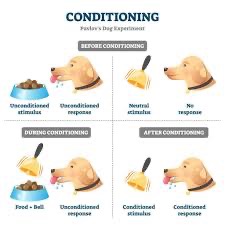
What is Classical Conditioning?
Learning through association. It involves pairing a neutral stimulus with an unconditioned stimulus to elicit a conditioned response.
Outline how Pavlov studied Classical conditioning
Pavlov classically conditioned dogs to salivate at the sound of a bell.
Outline operant conditioning
Learning through consequences. There are 2 main types of reinforcement: positive=rewarded for a behaviour and negative= avoids something negative by performing a behaviour
Punishment is when an animal receives something unpleasant for performing a behaviour.
Outline Skinner’s research
The Skinner box was used to investigate operant conditioning in rats.
Positive- rat receives food pellet every time it presses a lever. Therefore, the rat will continuously press the lever.
negative- rat avoids an electric shock every time it pressed the lever. Therefore, the rat will continuously press the lever.
punishment- rat receives a shock when it presses the lever. Therefore, the rat avoids the lever.
What are the strengths of the behaviourist approach?
Increased the scientific credibility of psychology- it has scientific rigour due to measuring observable behaviours within highly controlled lab settings. Therefore, behaviourism was influential in the development of psychology as a scientific discipline.
Real life application- Operant conditioning is the basis of token economy systems that have been successfully used in prisons and psych wards. They work by rewarding good behaviours with tokens that can be exchanged.
What are the limitations of the behaviourist approach?
Over simplistic- Behaviourists say that conditioning is the only factor to influence behaviour. Whilst this may be true of animals, human behaviour has multiple influences such as emotion. Therefore, this is not a full explanation.
Ethical issues- animals involved in research were exposed to stressful and aversive conditions. It can be argued that what we learn from these studies doesn’t justify the way in which the animals were treated.
What are the basic assumptions of the SLT?
SLT is a development of behaviourism. It argues that behaviour can also be learned indirectly through the observation and imitation of models.
Define Modelling - SLT
the demonstration of a behaviour that may be imitated
Define Imitation - SLT
The copying of a modelled behaviour
Outline Identification - SLT
The observer will identify with a model if the model has similar characteristics to them, or if the model is attractive and has high status.
Imitation is more likely if the observer identifies with the model.
Outline Vicarious Reinforcement - SLT
The observers learn about the consequences of a modelled behaviour by observing the model being reinforced or punished.
If they observe the model being reinforced, they are more likely to imitate the behaviour.
If they observe the model being punished, they are less likely to imitate the behaviour.
Outline Bandura’s research - SLT
Bobo Doll experiments:
3 groups of children aged 3-5
All the children watched a video of an adult model behaving aggressively towards the bobo doll.
Group 1 observed the behaviour being reinforced
Group 2 observed the behaviour being punished
Group 3 did not observe either. They acted as a control group.
The children were then left alone in the room with the bobo doll to play( they had a variety of toys) for 20 minutes and their behaviour was observed.
Group 1 behaved the most aggressively, group 2 behaved the least aggressively.
Outline the Mediational Processes - SLT
These occur between observation and imitation:
attention- the extent to which an observer notices a modelled behaviour.
retention- the extent to which an observer remembers a modelled behaviour.
motor reproduction- the ability of the observer to perform a modelled behaviour.
motivation- the will of the observer to perform a modelled behaviour
What are 2 strengths of SLT?
Explains cultural differences in behaviour- children learn from the individuals around them, this can explain how cultural norms are transmitted through particular societies. This is useful in understanding a range of behaviours, such as how children come to learn their gender role.
Evidence to support the importance of identification- Andsager et al (2001) found that perceived similarity to a model in an anti-alcohol advert was positively related to its effectiveness. Based on this, health campaign try to use models similar to their target audience to bring about greater social learning.
What are 2 limitations of SLT?
Ignores the importance of biological factors- For example, in the bobo doll experiments it was found that boys were more aggressive than girls. This can probably be explained by hormonal factors, such as the fact that boys have a higher level of testosterone which is linked to aggression.
ethical issues- Some of the behaviour learned by the children in the bobo doll experiment stayed with them, creating problems in the future. This suggests that the children were not protected from psychological harm.
What are the basic assumptions of the cognitive approach?
unobservable mental processes can be studied scientifically
mental processes are studied indirectly and inferences are made
Outline the use of theoretical models - cognitive
simplified representations of mental processes using boxes and arrows
Example: multi-store memory model and the working memory model
Outline the use of computer models - cognitive
the cognitive approach suggests that the mind works in a similar way to a computer - this is called the computer analogy
Both the mind an a computer: receive, code, process and store information and also give an output.
Outline the role of schema in the cognitive approach
schemas are packets of information that are developed through experiences
they act as a framework for the interpretation of incoming information
they enable us to take shortcuts in our thinking
however they may cause us to exclude important information and focus on only what confirms our pre-existing beliefs and ideas therefore they can lead us to make errors
Outline the role of cognitive neuroscience in the cognitive approach
cognitive neuroscience is the scientific study of the influence of brain structures on mental processes
it allows us to systematically observe and describe the neural basis of mental processes
What are 2 strengths of the cognitive approach?
highly controlled and rigorous- scientists have been able to collect reliable and objective data therefore allowing them to reach accurate conclusions about mental processes.This means that the study of the mind has has established a credible scientific basis.
applications- For example, the cognitive approach has shown that many psychological disorders can be traced back to faulty thinking. This has led to the development of successful treatments such as cognitive behavioural therapy where people are encourages to dispute their faulty thoughts.
What are 2 weaknesses of the cognitive approach?
research lacks validity- lab studies are often carried out using artificial stimuli that may not represent everyday experiences.
criticism of the computer analogy- it ignores the influence of human emotion on our ability to process information. For example, research has shown that human memory is affected by emotional factors such as anxiety. So the analogy is overly simplistic.
Outline the basic assumptions of the biological approach
explains all aspects of psychological functioning in terms of physical factors within the body
these include: genes, biological structures and neurochemistry
considers the influence of evolution on behaviour
Outline genotype and phenotype - Biological
genotype is the genetic makeup of an individual
phenotype is the observable characteristics of an individual (how the genes are expressed)
phenotype is influenced by environmental factors
Outline the influence of biological structures on behaviour - biological
the nervous system- specialised network of cells that enable communication.
the brain- 2 hemispheres, 4 lobes: frontal, parietal, temporal and occipital
Outline the influence of neurochemistry on behaviour - Biological
neurotransmitters influence behaviour
they act as messengers which travel across the synapse
imbalances are linked to psychological disorders
e.g. dopamine imbalance is linked to schizophrenia, serotonin imbalance is linked to depression
Outline the influence of evolution on behaviour
Darwin argues that biological organisms become adapted to their environment through evolution.
According to the theory of natural selection: variation exists due to mutation, certain variations give an advantage, those with this advantage are more likely to survive and reproduce…
The biological approach says that certain behaviours have evolved through natural selection for example the idea that humans are born with an innate drive to form an attachment to a caregiver
What are 2 strengths of the biological approach?
scientific methods- For example, brain-scanning techniques such as fMRI, EEGs and drug trials. These methods are highly controlled and objective, meaning that findings are reliable and valid.This suggests that the biological approach has increased the scientific credibility of psychology.
real-world applications- For example, research into the role of neurochemical imbalances in depression has led to the development of drug treatments to treat this imbalance.Although this is not effective for some patients, it has revolutionised treatment for many, allowing them to manage their condition.
What are 2 limitations of the biological approach?
problems with twin studies- A crucial assumption of twin studies is that the environments of MZ and DZ twins are equivalent. This allows us to assume that greater concordance between MZ twins is a result of genetic similarity. However, Joseph (2004) said that MZ twins are treated more similarly than DZ twins. Therefore differences in concordance could reflect nothing more than environmental differences.
reductionist- It only considers the influence of one factor, biology, on behaviour.Critics argue that we cannot fully understand behaviour without taking other factors into account such as emotional and cultural factors.
What are the basic assumptions of the psychodynamic approach?
emphasises the role of the unconscious motives and desires as well as early childhood experiences in shaping behaviour
Outline the role of the unconscious in the psychodynamic approach
The iceberg metaphor- the tip of the iceberg is the conscious mind, the part under the water is the unconscious mind
Freud believed that the unconscious mind stores drives and instincts that have a significant influence on our behaviour
Freud believed that the unconscious mind reveals itself in dreams and slips of the tongue
Outline the tripartite structure of personality in the psychodynamic approach
there are 3 parts in the personality: the ID, the Ego and the Superego
The ID: present from birth, operates only in the unconscious mind, operates on the pleasure principle, demands immediate gratification, selfish.
The Ego: develops around the age of 2, operates in both the conscious and unconscious mind, operates on the reality principle, rational part that mediates between the ID and the Superego
The Superego: develops between 3 and 6, operates in both conscious and unconscious minds, morality principle- our internal sense of right and wrong, passed on by our same-sex parent.
Outline defence mechanisms in the psychodynamic approach
Freud said that the ID and the Superego are in conflict, at an unconscious level, because they each represent a different motive, the ego mediates between them.
The ego uses defence mechanisms to protect the individual from anxiety by distorting reality.
The 3 types are repression, denial and displacement.
Outline repression in the psychodynamic approach
defence mechanism
forces distressing memory out of the conscious mind into the unconscious.
repressed thoughts continue to influence behaviour even in the unconscious mind.
For example, a person who was abused as a child, but does not remember this, may have trouble forming relationships.
Outline denial in the psychodynamic approach
defence mechanism
refusing to accept some aspect of reality to avoid dealing with any painful feelings.
for example, an alcoholic may deny that they have a drinking problem
Outline displacement in the psychodynamic approach
defence mechanism
redirecting thoughts or feelings to a substitute target
for example, slamming the door after an argument
Outline the psychosexual stages in the psychodynamic approach
Freud believed that personality develops through 5 stages
Freud believed that the most important driving force in development is the need to express sexual energy(libido)
Freud believed that each stage is marked by a different conflict that must be resolved before moving onto the next stage
any unresolved conflict leads to fixation
Define Fixation (psychodynamic approach)
When a child carries on certain behaviours associated with that psychosexual stage into adult life.
What are the 5 psychosexual stages of development (psychodynamic)
oral, anal, phallic, latency, genital
Outline the oral stage of Freud’s psychosexual stages of development
ages 0-1
focus of pleasure is the mouth (suckling)
conflict is weaning
difficulties with weaning lead to oral fixation
oral fixation adult behaviour: smoking, biting nails, overeating and drinking, over-critical, sarcastic
Outline the anal stage of Freud’s psychosexual stages of development
ages 1-3
focus of pleasure is the anus
conflict is potty training
anal fixation: early/harsh potty training can lead to a child becoming anal-retentive. This includes being perfectionist and obsessive as an adult. Late/liberal potty training can lead to the child being anal-expulsive. Adult behaviours involve being messy and disorganised.
Outline the phallic stage of Freud’s psychosexual stages of development
ages 3-5
focus of pleasure is the genital area
conflict is the oedipus/electra complex
failure to resolve leads to a phallic personality
adult behaviours include:reckless, narcissistic and homosexuality
Outline the latency stage of Freud’s psychosexual stages of development
ages 5-12
previous conflicts are suppressed and sexual urges sublimated into sports and hobbies.
focus is on developing same-sex friendships
Outline the genital stage of Freud’s psychosexual stages of development
age 12+
sexual desire become conscious alongside puberty
pleasure is gained through heterosexual intercourse
What are 2 strengths of the psychodynamic approach?
huge shift in psychological thinking- The Psychodynamic approach remained a dominant force in psychology for the first half of the 20th century. It has been used to explain a wide range of phenomena and the development of psychological disorders. It has also importantly drawn attention to the influence of childhood experiences. Significant influence on psychology.
development of psychoanalysis- psychoanalysis uses a range of techniques to assess the unconscious mind, including dream analysis and hypnosis. Research has shown that psychoanalysis has led to significant improvements in symptoms that were maintained in the years following treatment.
What are 2 weaknesses of the psychodynamic approach?
Does not meet the criteria for scientific falsification- Karl Popper argued that it doesn’t meet the criteria. Many of Freud’s concepts occur at an unconscious level making them hard to disprove. Therefore Popper labels Freud’s work as ‘pseudoscience’.
Studied single individuals, lacks generalisability- Freud’s theory was based upon intensive studies of single individuals. Therefore, it is not possible to make universal claims about human nature from the findings. Freud’s interpretations of his findings were highly subjective. This suggests that the theory lacks scientific rigour.
What are the basic assumptions of the humanistic approach?
Emphasises the importance of the subjective experience and each person’s capacity for self-determination.
Outline the role of free will in the humanistic approach
humans have the power to make conscious choices about their behaviour and control their own destiny
human behaviour is therefore unpredictable
humanists argue that all humans are unique meaning that psychologists should study individual cases
Outline Maslow’s Hierarchy of Needs (humanistic)
there are 5 main needs- physiological, safety, love and belongingness, esteem and self actualisation
it is represented as a pyramid with the most basic ones at the bottom
one level must be fulfilled before moving onto the next level
Outline self-actualisation (humanistic)
the most advanced of Maslow’s hierarchy of needs
all 4 lower needs must be fulfilled before moving on to self actualisation
self-actualisation is the fulfilment of one’s potential
according to Maslow, humans have an innate drive to self-actualise
Outline the self and congruence (humanistic)
the self refers to how an individual perceived themselves
Outline Conditions of Worth
What are 2 strengths of the Humanistic approach?
What are 2 weaknesses of the Humanistic Approach?