Introduction to Speech and Word Recognition
 Call Kai
 Learn
Learn Practice Test
 Spaced Repetition
 Match
Match Flashcards
 Knowt Play
1/20

There's no tags or description
Looks like no tags are added yet.
Name | Mastery | Learn | Test | Matching | Spaced | Call with Kai |
|---|
No analytics yet
Send a link to your students to track their progress
21 Terms
How do we experience language?
As a stream of sounds, so our minds need to turn that into words we recognise and understand.
What is speech segmentation?
When words are rarely produced in isolation (transient), we have to figure out where the boundaries are between words.
What type of variability is there between speakers?
Voices, non-native accents, speech rate, and how clear the speech signal is due to noise.
How carefully the words are pronounced, or variability in how phonemes sound.
Why is there variability in phonemes?
Phonemes can sound different depending on the surrounding phonemes (fundamental unit of speech sounds).
e.g. ‘don’t be silly’ can be ‘don be silly’
What are things that help the listener establish word boundaries?
Pauses, stress patterns, phonotactics and prosodic cues.
What are stress patterns?
English content words that usually start with a stressed syllable.
What are prosodic cues?
When the length of the initial syllable is influenced by word length cap/captain or when syllables at onset are longer than medial syllables.
Why is segmenting not a full explanation for understanding speech?
We still need to recognise words to access what they mean and integrate meanings of different words together to comprehend a whole utterance.
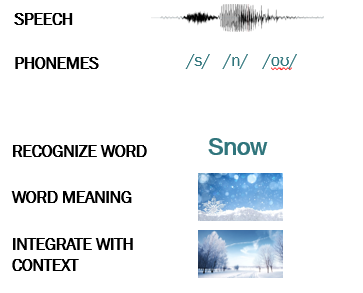
What is the serial access possibility?
When we find the exact match of a word and then retrieve the meaning AFTER hearing it.
What is the parallel/incremental access model?
When we identify the first sounds/letters and look for partial matches. Then we modify the shortlist as more input comes in.
What are the pros of serial access?
If you wait to hear the first word, you can identify correctly the word, ensuring accuracy
What is a con of serial access?
It is slow, and you might not know when the word ends. e.g. ‘snow’ or ‘snowstorm’
What is a pro of parallel/incremental access model?
It is fast.
What is a con of the parallel/incremental access model?
You might commit to the wrong word, so revision is needed.
Is evidence in favour of the serial or parallel option?
Parallel - we already try and recognise meaning of the words while it is being said.
What is a Gating study?
Listeners can consider multiple words for selection, telling us about stages of word recognition. However, it requires listeners to think which words they hear.
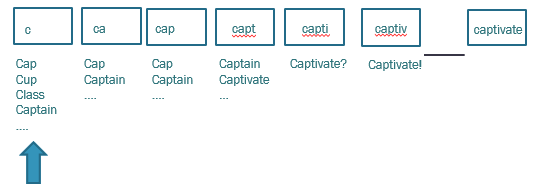
What is the isolation point in gating studies?
When listener chooses target words but with little confidence.
What is the recognition point in Gating studies?
When the listener recognises target word with confidence
What is a uniqueness point in Gating studies?
Theoretically derived point, when target word is the only possibility.
When do we use context and world knowledge in word recognition?
In noisy environments or in a pub, if someone says ‘bear/beer’ you can make an inference that they would like a beer.