POLS 207- Public Higher Education
 Call Kai
 Learn
Learn Practice Test
 Spaced Repetition
 Match
Match Flashcards
 Knowt Play
1/10

There's no tags or description
Looks like no tags are added yet.
Name | Mastery | Learn | Test | Matching | Spaced | Call with Kai |
|---|
No analytics yet
Send a link to your students to track their progress
11 Terms
Public Higher Education in the States
Primary & secondary education (K-12)
• Large role for local gov’ts
• School districts or city / county
• Variance in state centralization over education
Higher education
• Role of gov’t is largely at the state level
• More recently, expanded emphasis on local/community colleges (public junior colleges)
Roles of Govts in Higher Education
Local gov’ts
• May fund community colleges w/ local taxes
• May offer scholarships or reduced tuition to local residents
States
• Establish & share responsibility for funding public universities
• Allowed to charge different tuition for non-residents
• (Doesn’t violate U.S. Constitution’s privileges & immunities clause!)
Federal
• Accrediting bodies recognized by U.S. Dept. of Education
• Various federal grants are important sources of revenue
Key Federal Involvement in Higher Ed.
• Morrill Act (1862)
• Land-grant act aimed to open educational opportunities to farmers & working class
• Federal land donated to states to establish colleges & universities “for the benefit of agriculture & the mechanic arts”
Morrill Act (1890)
• Aimed to extend the Morrill Act to former Confederate states by addressing race restrictions
• Required states either to:
• Show race was not an admissions criterion
• -OR- Designate a separate institution for black students…
• Mixed legacy:
• Creation of HBCUs that provided educational opportunity for black Americans
• Allowed for the segregation of higher education
Hatch Act (1887)
• Federal grants-in-aid for agricultural research, writ broad
• Established of State Agricultural Experiment Stations to conduct research
• E.g. Texas A&M AgriLife Research
• Other federal grants
• Gov’t funding given directly to those providing a service
• E.g. NIH grants, NEH grants, DoE grants
• Increasingly important due to changing funding composition
• Funding environment uncertainty due to recent federal cuts
Role of States in Higher Education
Establish colleges & universities
State regulation of colleges & universities, including:
• Tuition, financing, reporting
• Research
• Admissions
• E.g. “Top 10% Rule”
• Some curriculum requirements
• E.g. Core Curriculum
• Share responsibility for funding
Board of Regents
Governing body for a Texas public university (or system)
• 9-member board, 6-year staggered terms
• Appointed by the Governor, confirmed by the TX Senate
Key functions:
• Provide financial oversight
• Final approval in tenure cases
• Control & direct university policy
Long-running debates regarding how “hands on” Regents should be in university governance
• Traditional role, few details in law, much left to interpretation
• 2025: Powers significantly expanded with S.B. 37
Funding Institutions of Higher Learning
Funding sources for Texas public universities:
• Appropriation in state budget
• Permanent University Fund (for UT & A&M)
• Texas University Fund (for “emerging research universities”)
• Endowments, donations, gifts, etc.
• Public & private grants
• …AND student tuition & fees
Rising Cost of Higher Education
Some drivers of rising cost of higher education:
1. Available supply of federal student aid & tuition inflation
2. Student demand for services & facilities
3. Declining state support
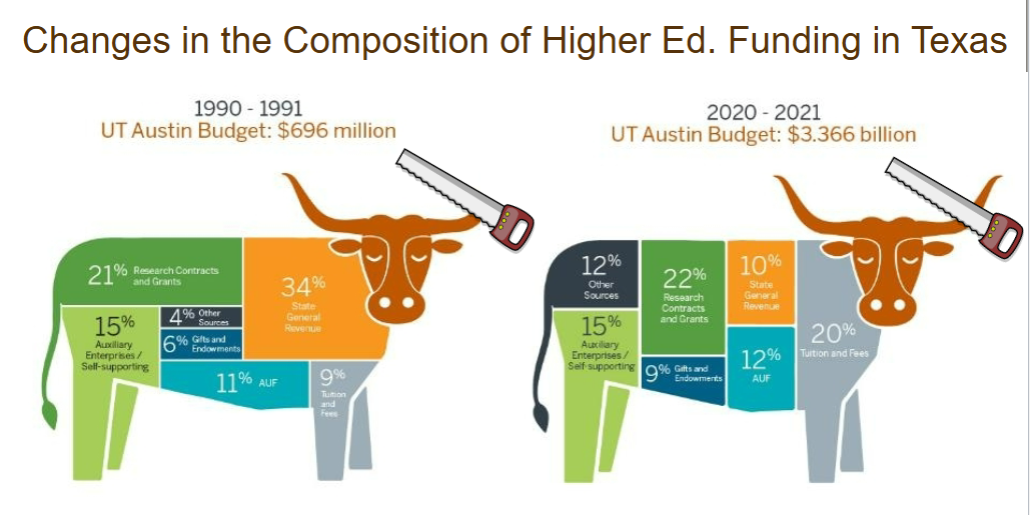
Changes in Composition of Higher Ed. Funding in TX
State Support for Higher Education
States are required to pass a balance budget
• In economic downturns, states cut funding
• Higher ed. funding generally easier to “cut” than K-12 ed.
During recoveries, states resume some of their funding
• But rarely does per-student funding return to former levels!
• Result: Change in composition of higher ed. funding over time
• % from state appropriation per FTE student has decreased
• % from tuition & fees fer FTE student has increased
Public Universities Becoming Less Public
2003: 78th Texas Legislature meets
• Texas faces a revenue shortfall
• Lege wants to balance budget w/o raising taxes!
Result: Tuition deregulation
• Legislature cedes control of setting tuition costs to colleges & universities to make up for higher ed. funding cuts
• The market sets the price (not the state legislature)
• Lawmakers insulated from political backlash when cost increases!
Ongoing attempts to address college affordability
• Policies considered include performance-based tuition increases, tuition freezes or caps, return to regulation
Assessing Education Policy in TX
Education is one of the states’ biggest spending items
Texas is a low-tax, low-spending state
• For K-12, state pushes costs to local gov’t
• Result is high local property taxes
• Use of property taxes also creates educational inequities
• For higher ed., costs pushed to students, families, etc.
“Winners” are arguably those who do not & will not utilize state-supported educational services
• And the losers…