ind rev and aus S1 EXAM
 Call Kai
 Learn
Learn Practice Test
 Spaced Repetition
 Match
Match Flashcards
 Knowt Play
1/22

There's no tags or description
Looks like no tags are added yet.
Name | Mastery | Learn | Test | Matching | Spaced | Call with Kai |
|---|
No analytics yet
Send a link to your students to track their progress
23 Terms
what was the industrial revolution
began in Britain in the mid 1700s. before this many ppl lived in rural areas and worked in farms. once machine were being made for mass production, it led to urbanisation, and transportation and economic changes.
Impacts of the industrial revolution- positive (3) and negative (4)
Positive-
Cities grew rapidly
Created many new job opportunities in factories
Mass production- cheaper things
Negative-
Overcrowding in urban cities
Unsanitary conditions and unsanitary society
Rapid disease spread
Child labour: many children worked in unsafe conditions with dangerous machines
the luddite movement
in the early 19th century, a group of english workers protest and destroyed machines thinking that it was a threat to their livelihood
key inventions, inventors and explain (5)
telegraph- Samuel Morse: made it easy to contact w long distance through morse code
steam engine- James Watt: powered trains, ships and factories
cotton gin- Eli Whitney: helped spreading cotton from seeds a lot faster
Power loom- Edmund Cartwright: mechanised weaving
Spinning jenny- James Hargreaves: allowed spinning thread faster
factory life:
working conditions-
child labour-
problems faced-
working conditions- low wages, long hours, harsh conditions, and cheaper labour for women and children
child labour- many children worked in dangerous environments, often for very low pay and long hours
problems faced- poor health due to unsafe conditions, lack of education, and exploitation by factory owners.
Why did the Industrial revolution start in Britain? (3)
large supply of coal which was good for factories
on an island so not much conflict between other countries
good banking system and trading companies
the assembly line
invented by henry ford so u js need to do the same think=g over and over and then pass it to the next person. easier and faster
Response to the industrial revolution (4)
New ideas like socialism and communism developed, arguing for fairer wealth distribution.
Workers began organising into trade unions to protect their rights.
Movements like Chartism formed, demanding political rights for working-class people (like voting rights).
Governments slowly introduced reforms, partly to reduce poverty
trade unions
workers formed trade unions to fight for better wages, less hours, better working conditions and for the factory owners to treat them more fairly
government reforms
fixed social and economic issues like the factory acts, child labour restrictions and working safety regulations
medical advancments
xray
thermometer
vaccines
stethoscope
syringe
anaesthesia
blood transfusion
indigenous life before colonisation (4)
abos owned different parts of land
moved seasonally and food availability
dancing, singing, storytelling, sport, cultural ceremonies
spiritual connection w the land
reasons for British colonisation (3)
overcrowding due to the ind rev
overcrowding in prisons
aus had needed reasourses
abo perspective on colonisation (3)
caused loss of land, disease and destruction of culture and tradition
their land was believed to be ‘terra nullius’- no mans land, and they ignored abo laws and their connection to the land
led to conflict, deaths and intergenerational trauma
british perspective on colonisation (3)impa
an opportunity to expand empire, establish convict colony and gain needed resources
land belonged to no one
they thought they were helping the abos by showing the real lifestyle and how to be ‘civilised’
push factors (reasons ppl left home) of migration to aus (5)
running away from crime
poverty and unemployment
famine
overcrowding
seeking safety
pull factors (reasons ppl were attracted) of migration to aus (5)
gold rush
job opportunities
free/cheap land
government assistance
fresh start and better living conditions
the first fleet:
how and when did it arrive?
conditions of the ship?.. which led to?
death toll?
first arrived at botany bay but Arthur Phillip said it was unsuitable to dock, then arrived at Sydney cove- 26th jan 1788
little ventilation, air, or light which led to spread of disease
low death toll
second fleet:
what did the ___ (#) ships carry?
conditions were ____ _____ and death toll was _____
after legal action….
6 ships ships carried over 1000 convicts
much worse, higher
docs were put on ships to supervise and treat convicts
what did the convicts do: earlier yrs VS later\
what were the rewards for good behaiviour? (4)
what happend to bad convicts?
build roads and buildings; later worked for prived employers and farms
a ticket to leave, the abilty to earn a wage, choose their own employers, buy their own lands
whipping or sent to solitary confinement, the harshest one was called Norfolk island
interactions between abos and british (4)
for the fisrt 12-15 months, it was peacful but then the baos realsied they were hear to stay—not to visit.
europens pushed abos of theor land to be used for housing and farming
conflcit became violent causing many deaths on both sides
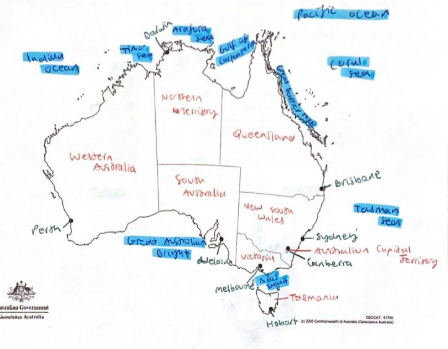
states, capital cities, bodies of water (10)