Learning and Memory
4.0(1)
Studied by 5 people Call Kai
 Learn
Learn Practice Test
 Spaced Repetition
 Match
Match Flashcards
 Knowt Play
Card Sorting
1/63

Earn XP
Description and Tags
Last updated 11:53 AM on 9/26/22
Name | Mastery | Learn | Test | Matching | Spaced | Call with Kai | Chat |
|---|
No analytics yet
Send a link to your students to track their progress
64 Terms
1
New cards
Learning
a relatively permanent change in an organism's behavior and cognitions due to experience
2
New cards
Memory
Active information processing system that encodes, stores and recovers information
3
New cards
Memory trace
physical change in the brain that occurs when a memory is formed, it's a new neural circuit or pthway that forms
For cells to create relationships with other cells, synaptogenisis needs to occur
For cells to create relationships with other cells, synaptogenisis needs to occur
4
New cards
Synaptogenesis
new synapses are formed
5
New cards
Neural plasticity
the ability of the brain to change in response to experience through out the life span
There's two
There's two
6
New cards
Developmental plasticity
Changes in neurons and synaptic connections, occuring due to DEVELOPMENTAL processes and environmental experience
- When you're young, there's more developmental plasticity because more neurons
- When you're young, there's more developmental plasticity because more neurons
7
New cards
Adaptive plasticity
Neurons altering connections between synapses to best suit environmental conditions
- Happens throughout life
- Either from learning or injury
- Occurs through sprouting (growth of bushier nerve fibgers to make new connection) and/or rerouting (undamages neurons seeking new neurons)
- Happens throughout life
- Either from learning or injury
- Occurs through sprouting (growth of bushier nerve fibgers to make new connection) and/or rerouting (undamages neurons seeking new neurons)
8
New cards
LTD
long term depression
- long lasting decrease in strength of transmission, happens from lack of stimulation.
- post-synaptic neuron is less active, less neuro-transmitters, less receptor sites, etc.
- Happens when info isn't access alot
- long lasting decrease in strength of transmission, happens from lack of stimulation.
- post-synaptic neuron is less active, less neuro-transmitters, less receptor sites, etc.
- Happens when info isn't access alot
9
New cards
LTP
long-term potentiation
- Enhanced synpatic connections that increases strength of synaptic transmission as it's more stimulation
- Happens through learning and studying, more neuron connections as it also strengthens memory trace
- Enhanced synpatic connections that increases strength of synaptic transmission as it's more stimulation
- Happens through learning and studying, more neuron connections as it also strengthens memory trace
10
New cards
Importance of LTD and LTP
- Both important, LTD weakens unimportant info that takes up space, making way for LTP to strengthen important info
11
New cards
Neurohormones
Chemical messengers manufactures by neurons, but it's released into the blood stream and carried to target connection
- Its slower and can dampen or enhance a response like neurotransmitter
- Its slower and can dampen or enhance a response like neurotransmitter
12
New cards
Glumate (learning)
A neurotransmitter that promotes growth and strengthens synpatic connections between neurons.
- Plays a vital role in LTP by exciting the adjacent neuron
- Plays a vital role in LTP by exciting the adjacent neuron
13
New cards
Adrenaline (learning)
A neurohormone that enhances long term memory consolidation.
- Emotional events are more likely to be remembered (but not accurate)
- Consolidation is time dependent, influenterm-13ced by other factors
- Emotional events are more likely to be remembered (but not accurate)
- Consolidation is time dependent, influenterm-13ced by other factors
14
New cards
Adrenaline and the amygdala
- Adrenaline is released during emotional arousal, and then induces noradrenaline
- Believed that presence of nora it during consolidation activates the amygdala, signals hippocampus that details are significant, making the emotional memory stand out
- Believed that presence of nora it during consolidation activates the amygdala, signals hippocampus that details are significant, making the emotional memory stand out
15
New cards
Classical conditioning (pavlov)
- Learning through which a neutral, stimlus (bell) comes to elicit a specific respone (salivating) as a result of being associated with an unconditioned stimulus (food)
16
New cards
Classicial conditioning terms
NS - Neutral stimulus (Ringing bell)
UCS - Unconditioned stimulus (meat power)_
UCR - Unconditioned response (salivating)
CS - Conditioned stimulus (ringing bell)
CR - Conditioned response (salivating)
UCS - Unconditioned stimulus (meat power)_
UCR - Unconditioned response (salivating)
CS - Conditioned stimulus (ringing bell)
CR - Conditioned response (salivating)
17
New cards
Three phase model
Before conditioning
- NS leads to no relevant response
- UCS leads to the UCR
During conditioning (acquisition)
- NS repeatedly paired and presented immediately prior to the UCS, leads to the UCR
After conditioning
- CS (formally the NS) leads to the CR (formally the UCR)
- NS leads to no relevant response
- UCS leads to the UCR
During conditioning (acquisition)
- NS repeatedly paired and presented immediately prior to the UCS, leads to the UCR
After conditioning
- CS (formally the NS) leads to the CR (formally the UCR)
18
New cards
Key processes in classical conditioning
Acquisition - Process of associating the NS and UCS together
Extinction - Repeated presentation of the CS without the UCS leads to a gradual decrease and eventual disappearance of the CR
Spontaneous recovery - After extinction and a rest period, CR appears at the presentation of the CS
Stimulus Generalisation - CR appears to a stimulus that's simliar to the CS
Stimulus Discrimination - CR only appears to the CS and nothing else
Extinction - Repeated presentation of the CS without the UCS leads to a gradual decrease and eventual disappearance of the CR
Spontaneous recovery - After extinction and a rest period, CR appears at the presentation of the CS
Stimulus Generalisation - CR appears to a stimulus that's simliar to the CS
Stimulus Discrimination - CR only appears to the CS and nothing else
19
New cards
Operant conditioning Vs Classical conditioning
OC is voluntary, learner is active and stimulus presented b4 response, while CC it's involuntary, learner is passive and stimulus presented after response
20
New cards
Operant conditioning
a type of learning in which behavior is strengthened if followed by a reinforcer or diminished if followed by a punisher
21
New cards
ABC
Antecedent - what prompts the behaviour, placing the organism in a certain environment or situation
Behavior - behaviour...
Consequence - what happens after, are you reinforced or punished?
Behavior - behaviour...
Consequence - what happens after, are you reinforced or punished?
22
New cards
Types of consequences
positive reinforcement
- reinforces the behaviour, a pleasant stimlus is given
negative reinforcement
- reinforces the behaviour, a unpleasant stimulus is taken away
Positive punishment
- decreases the behaviour or attempts to, a unpleasant stimlus is given
negative punishment or response cost
- decreases behavour, pleasant stimlus is taken away
- reinforces the behaviour, a pleasant stimlus is given
negative reinforcement
- reinforces the behaviour, a unpleasant stimulus is taken away
Positive punishment
- decreases the behaviour or attempts to, a unpleasant stimlus is given
negative punishment or response cost
- decreases behavour, pleasant stimlus is taken away
23
New cards
Timing of Reinforcement
continuous reinforcement
- given after every correct response, good for acquisiton stage
partial reinforcement
- reinforcing some response, used after acquistion stage
- given after every correct response, good for acquisiton stage
partial reinforcement
- reinforcing some response, used after acquistion stage
24
New cards
effectiveness of punishment
sometimes people like the attention, may actually be reinforcing the behaviour
25
New cards
OAT
Effectiveness of consqeuences
- Order of consequences, reinforces or punishment after response
- apprpriate, consequence matches behaviour?
- timing, punish or reinforce needs to be immediately after response
- Order of consequences, reinforces or punishment after response
- apprpriate, consequence matches behaviour?
- timing, punish or reinforce needs to be immediately after response
26
New cards
Observational learning or social learning theory
- learning by watching someone else (a model), it's various or indirect conditioning (because we're not getting getting the consequence) to learn how whether to avoid or do the behaviour
- Learner is more cognitive in this and it's the most active process
- Learner is more cognitive in this and it's the most active process
27
New cards
What makes someone more likely a model
Perceived postively to you
Attractive to you
Similar to you
Trust, you trust them
Attractive to you
Similar to you
Trust, you trust them
28
New cards
Processes
Attention, learner actively watches model
Retention, remembers it
Reproduction, has the mental and physical ability to do the behaviour
Motivation, makes the learner do the behaviour
Reinforcement, positive outcome makes the learner do the behaviour more likely
Retention, remembers it
Reproduction, has the mental and physical ability to do the behaviour
Motivation, makes the learner do the behaviour
Reinforcement, positive outcome makes the learner do the behaviour more likely
29
New cards
SL vs OC
Both learners are active and both have reinforcemnet
But, learner is direct in OB, while SL is indirect
OC you can see someone learning, but in SL it can remain hidden until reinforcemnet
SC has more thinking
But, learner is direct in OB, while SL is indirect
OC you can see someone learning, but in SL it can remain hidden until reinforcemnet
SC has more thinking
30
New cards
Conditioned emotional reponse
Emotional reaction (fear or anger) as reponse to stimulus, learned through CC
- reponse observed when ANS produced reaction to a stimlus that didn't directly trigger the reaction
- reponse observed when ANS produced reaction to a stimlus that didn't directly trigger the reaction
31
New cards
Little Albert ethical principles breached
Violated benefience
violated no harm policy and debriefing
unclear weather consent was obtained
withdrawal rights violated
Watson failed to follow confidentiality
violated particiation, mother was unaware of the subject of the experiment
violated no harm policy and debriefing
unclear weather consent was obtained
withdrawal rights violated
Watson failed to follow confidentiality
violated particiation, mother was unaware of the subject of the experiment
32
New cards
Informational processing model
Encoding
- converting info into a useable form for storage
storage
- retaining info for info over time for future use
retrieval
- acessing previously stores info for use
- converting info into a useable form for storage
storage
- retaining info for info over time for future use
retrieval
- acessing previously stores info for use
33
New cards
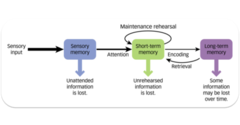
Atkinson-Shiffrin Model
sensory memory, short-term memory, long-term memory
34
New cards
Sensory memory
Senses like touch, smell. etc.info enters in exact replica
duration = 0.2-4 seconds depending on type of info
duration = 0.2-4 seconds depending on type of info
35
New cards
Iconic memory
Visual info
- duration = 0.2-0.4
- capacity = unlimited
- allows us to see the world as continious (omg hume!)
- duration = 0.2-0.4
- capacity = unlimited
- allows us to see the world as continious (omg hume!)
36
New cards
echoic memory
audio memory, sound lingers like an echo
- duration = 3-4
- capacity = unlimited
- duration = 3-4
- capacity = unlimited
37
New cards
short-term memory
activated memory that holds a few items briefly, where there we manipulate info and actively process it and makes use of it (whether it's retrived from LTM, or attention from sensory memrory)
- duration = 18-20 seconds (sometimes 30)
- capacity = only - 5-9 items that we can be consciously aware of at short period of times
- the info isn't an exact replica anymore
- duration = 18-20 seconds (sometimes 30)
- capacity = only - 5-9 items that we can be consciously aware of at short period of times
- the info isn't an exact replica anymore
38
New cards
Attention (STM Concept)
Paying attention to info from SENSORY memory it enters the STM
39
New cards
Retrieval (STM Concept)
Paying attention to info from LONG term meory enters the STM
40
New cards
Types of Long Term Memory
Explicit memory
- Factual memory like passwords, numbers that can be consciously retrieved
- It can include episodic memory (moments and events of your life) or semantic memory (memory of facts and knowledge)
Implicit memory
- Memory that you don't need to consciously retrieve, not always remembering (like how to brush your teeth, driving)
- It can include procedural memory (how to do something) or classical conditioned memories (conditioned responses to conditioned stimuli, learned through classical conditioning)
- Factual memory like passwords, numbers that can be consciously retrieved
- It can include episodic memory (moments and events of your life) or semantic memory (memory of facts and knowledge)
Implicit memory
- Memory that you don't need to consciously retrieve, not always remembering (like how to brush your teeth, driving)
- It can include procedural memory (how to do something) or classical conditioned memories (conditioned responses to conditioned stimuli, learned through classical conditioning)
41
New cards
Damage to the ceberal cortex impacts memory...
Of storing explicit and implicit memory and STM
42
New cards
Damage to the Hippocampus impacts memory...
LTM (consolidating and transferring) and encoding explicit memory
43
New cards
Damage to the cerebellum impacts
Encoding implicit memories, procedural memories and CC reflexive responses.
44
New cards
Damage to the Amygdala impacts..
The emotional component of memory, and not being able to remember CC emotional response, no fear reponse
45
New cards
Types of retrieval methods from lowest to highest sensitivity
Recall
Free call - Listing info with no order
Serial recall
- listing info in a particular order of when it's learned
Cued recall
- Listing info with a cue
Recognition
- Identifying correct info in a list
Relearning
- Relearning the info when you've previously learned that info and having a faster time doing it
Free call - Listing info with no order
Serial recall
- listing info in a particular order of when it's learned
Cued recall
- Listing info with a cue
Recognition
- Identifying correct info in a list
Relearning
- Relearning the info when you've previously learned that info and having a faster time doing it
46
New cards
Saving Score for relearning
Og Time - Relearning time/Og time X 100/1
47
New cards
Reconstruction
Combining stored info with other available info to make a more coherent and accurate memory.
48
New cards
Brain Trauma
Umbrella term that impairs the normal functioning of the brain
49
New cards
neurodegenerative disease
Progress decline of the brain
50
New cards
anterograde amnesia
an inability to form new memories due to brain trauma as they can't encode or store new info as it's forgotten after it's processed.
- Damage to the Hippocampus
- symptom of alzheimers disease for old ppl
- Damage to the Hippocampus
- symptom of alzheimers disease for old ppl
51
New cards
Alheimer's disease
Neurodegenerative disease that include memory decline (LTM-, deteroriation of personality and social skills and personality.
52
New cards
Structures affected
1st structure is the hippocampus, then the degeneration spreads to the ceberal cortex.
Due to amyloid plaques (protein that isn't cleaned and forms hard clumps within neurons that impairs neurons and synapses) neurofibrillary tangles (protein called tau gets tangled within the neurons and inhibits essential subtance within the neuron that leads to it's death)
It leads to the reduction of the neurotransmitters acetlycholine that has a role with memory, and as these proteins, all making neurons inactive and causing them to die off.
Due to amyloid plaques (protein that isn't cleaned and forms hard clumps within neurons that impairs neurons and synapses) neurofibrillary tangles (protein called tau gets tangled within the neurons and inhibits essential subtance within the neuron that leads to it's death)
It leads to the reduction of the neurotransmitters acetlycholine that has a role with memory, and as these proteins, all making neurons inactive and causing them to die off.
53
New cards
Damage to the Cerebellum impacts...
Procedural memory, CC reflexive reponses.
54
New cards
Symptoms
Memory loss
Personality change
Confusion and disorientation
Repition of words
Cortical shrinkage
Personality change
Confusion and disorientation
Repition of words
Cortical shrinkage
55
New cards
Forgetting
the inability to retrieve memory from long-term storage (it's there, you just cant access it)
56
New cards
Cues that help you with retrieving memory
Retrieval cues
- Stimulus that assists of recovering info from LTM and it includes
Context Dependent Cues
- Recreating the environment that you were in when learning
State Dependent Cues
- Recreating the physical or pyschological state that you were in when you were learning
- Stimulus that assists of recovering info from LTM and it includes
Context Dependent Cues
- Recreating the environment that you were in when learning
State Dependent Cues
- Recreating the physical or pyschological state that you were in when you were learning
57
New cards
Rehearsals that help with retrieving memory
Maintenance rehersal
- just simply rehearsing it, helps with STM
Elaborative rehearsal
- Adding meaning or linking it to other info while you're rehearsing, helps with LTM
- just simply rehearsing it, helps with STM
Elaborative rehearsal
- Adding meaning or linking it to other info while you're rehearsing, helps with LTM
58
New cards
Primary and Regency effect
"The tendency to remember the first (primary) and last (regency) items in a sequence
Primary is more into LTM, Regency is more into STM
Primary is more into LTM, Regency is more into STM
59
New cards
memory reconstruction
Remembering past events and features of these events and putting them together during memory recall.
60
New cards
Loftus has found that eyewitness testimony is not always...
accurate because when reconstructing memories can be manipulated by leading questions, thus leading to misleading information
61
New cards
leading question bias
sometimes questions are worded in a way that suggests a particular response
(Did you see THE man) assumes that there was a man in the fist place, manipulating memory reconstructing by adding false information
(Did you see THE man) assumes that there was a man in the fist place, manipulating memory reconstructing by adding false information
62
New cards
Loftus and Palmer (1974)
*students watched clips of car accidents and were then given questions- one of which was a leading question. (different people were given slightly different questions)
*the verb 'contacted' resulted in a mean estimate speed of 31.8 mph.
*the verb 'smashed' was 40.5 mph.
*the verb 'contacted' resulted in a mean estimate speed of 31.8 mph.
*the verb 'smashed' was 40.5 mph.
63
New cards
Conclusion of Loftus
According to lofus
1. Recalling memory is a reconstructive process
2. Process can be influences by leading question, info presented after event can lead to bias
3. Misinfo suggested can cause and updated rep of the memory trace (the neurons physically changing)
4. Leading to inaccuracies
1. Recalling memory is a reconstructive process
2. Process can be influences by leading question, info presented after event can lead to bias
3. Misinfo suggested can cause and updated rep of the memory trace (the neurons physically changing)
4. Leading to inaccuracies
64
New cards
Serial position effect
our tendency to recall best the last and first items in a list