AP Chem Unit 3: Properties of Substances and Mixtures Part 1
 Call Kai
 Learn
Learn Practice Test
 Spaced Repetition
 Match
Match Flashcards
 Knowt Play
1/15

There's no tags or description
Looks like no tags are added yet.
Name | Mastery | Learn | Test | Matching | Spaced | Call with Kai |
|---|
No analytics yet
Send a link to your students to track their progress
16 Terms
Intramolecular Forces vs Intermolecular Forces
chemical bonds within a single molecule
attractive forces between multiple molecules
Both are Coulombic forces but intermolecular forces are much weaker since intramolecular forces involve sharing or transferring electrons. As such, intramolecular forces determine chemical properties while intermolecular forces determine physical properties.
Molecular Structure and IMFs
While small molecules derive their shapes primarily from VSEPR theory, large macromolecules are also heavily influenced by IMFs.
How do intermolecular forces affect the characteristics of a molecule?
As intermolecular forces increase…
Melting point and boiling point increase
Heat of vaporization increases
Surface tension and viscosity increase
Vapor pressure decreases
Volatility decreases
Name 6 different types of intermolecular forces. Rank them in terms of strength from weakest to strongest.
London dispersion
Dipole-induced dipole
Ion-induced dipole
Dipole-dipole
Hydrogen bonding
Ion-dipole
For molecules that are very different in size, it is hard to tell which IMF is the strongest because of London dispersion forces.
What are Van der Waals forces?
relatively weak, short-range electrostatic attractive forces between neutral molecules
London Dispersion forces, dipole-dipole, dipole-induced dipole, ion-induced dipole
London Dispersion Forces
exists between all molecules and the only IMF between nonpolar molecules, always attractive
When electrons occupy positions that cause them to be unequally distributed, instantaneous/temporary dipoles form.
Molecules with larger electron clouds (more electrons) or greater surface area (more linear shape) or more double/triple bonds have stronger London Dispersion Forces.
Larger electron clouds make the molecule more polarizable because electrons are further away from the nucleus and thus easier to disperse/distort.
Larger surface areas maximize the overlap of electron clouds, forming more temporary dipoles.
Double or triple bonds have more electrons packed into a small region which increases polarizability.
Polarizability
the ability of an atom to form a temporary or induced dipole
Dipole-Induced Dipole Forces
between polar and nonpolar molecules, always attractive
When the electrons of neighboring molecules move in a way that causes a temporary induced dipole to form (a similar concept to dipole-dipole)
Dipole-Dipole Interactions
between polar molecules, can be attractive or repulsive
Molecular polarity (unequal electron distributions) creates permanent dipoles. The greater the polarity (dipole moment), the greater the dipole-dipole force.
Hydrogen Bonding Forces
a type of attractive dipole-dipole that occurs between molecules containing bonds between hydrogen and a highly electronegative atom (eg. nitrogen, oxygen, fluorine)
A hydrogen covalently bonded to a highly electronegative atom is attracted to the negative end of a dipole formed by another highly electronegative atom. For example, the H of an H-F bond will be attracted to the F of another H-F bond.
The more sites for hydrogen bonding, the greater the IMF.
Not actually a type of bond.
Ion-Dipole vs Ion-Induced Dipole Forces
Ion-dipole is between polar molecules and ions. Polar molecules have a permanent dipole that attracts ions.
Ion-induced dipole is between nonpolar molecules and ions. The ions’ charge attract/repulse electrons on the nonpolar molecule to create an induced dipole.
Both are always attractive IMFs.
Both are stronger the greater the ion charge, the smaller the ion size, and the more polar the molecules.
What are the 4 basic types of solids? Compare them in terms of melting points.
Ionic Solids
Covalent Network Solids
Molecular Solids
Metallic Solids
In terms of melting points, from lowest to highest:
molecular < ionic < metallic < covalent network
Covalent Network Solids
typically extremely strong due to lattices of covalent bonds (essentially one giant molecule)
In order to melt the solid, you must break the covalent bonds instead of simply overcoming intermolecular forces.
Ex. diamond, graphite, silica (SiO2), glass, silicon carbide SiC, BN
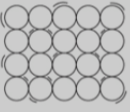
Solid (State of Matter)
particles can vibrate in their structure but cannot move around
rigid, fixed volume and shape, cannot be compressed
can either be crystalline (particles are ordered in a repeating geometric pattern) or amorphous (particles are disorganized)
Amorphous solids are less rigid and more flexible
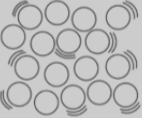
Liquid (State of Matter)
particles have enough kinetic energy to slide around
particles are still close together and cannot be compressed; as such, liquids and solids of the same substance are often about the same size
Gas (State of Matter)
particles can move quickly
particles are far apart and can easily be compressed