exam 3 anwser key - genetics
 Call Kai
 Learn
Learn Practice Test
 Spaced Repetition
 Match
Match Flashcards
 Knowt Play
1/34

There's no tags or description
Looks like no tags are added yet.
Name | Mastery | Learn | Test | Matching | Spaced | Call with Kai |
|---|
No analytics yet
Send a link to your students to track their progress
35 Terms
a - ability to synthesize a DNA from scratch without a primer
Which activity is NOT associated with DNA polymerases?
a. ability to synthesize a DNA from scratch without a primer
b. ability to synthesize new DNA in a 5′ to 3′ direction
c. ability to attach a DNA nucleotide to the 3′ end of previously incorporated DNA nucleotide
d. ability to "read" a template strand 3′ to 5′ and synthesize a complementary strand
e. ability to excise a newly incorporated nucleotide that does not match the template strand
e - the region between -10 and -35 consensus sequences
Mutations in which of the following regions upstream of the RNA coding sequence are LEAST likely to affect the transcription of a gene?
a. All mutations on the sequences upstream of a gene will have deleterious effects on gene transcription.
b. the upstream elements at -40 to -60 position
c. -10 consensus sequence within the promoter region
d. -35 consensus sequence within the promoter region
e. the region between -10 and -35 consensus sequences
c - aminoacyl (A)
During elongation, an incoming charged tRNA enters at the _____ site of the ribosome.
a. peptidyl (P)
b. Shine-Dalgarno
c. aminoacyl (A)
d. exit (E)
e. Kozak
b - b. 20, one for each amino acid
What is the minimum number of different aminoacyl-tRNA synthetases required by a cell?
a. 50, one for each different tRNA
b. 20, one for each amino acid
c. 64, one for each codon
d. 30, one for each different tRNA
e. 61, one for each sense codon
b - semiconservative system.
Meselson and Stahl showed that DNA is replicated by a:
a. conservative system in prokaryotes and dispersive system in eukaryotes.
b. semiconservative system.
c. conservative system.
d. semidispersive system.
e. dispersive system.
b - GTP
Which of the following is NOT required during the process of tRNA charging?
a. tRNA
b. GTP
c. ATP
d. amino acid
e. aminoacyl-tRNA synthetase
c - eukaryotic 5S rRNA
Which of the following rRNA components originates from a separate gene transcript rather than as a cleaved product of a long single precursor rRNA transcript?
a. eukaryotic 5.8S rRNA
b. prokaryotic 23S rRNA
c. eukaryotic 5S rRNA
d. eukaryotic 18S rRNA
e. prokaryotic 16S rRNA
a - They possess 5′ → 3′ exonuclease activity.
Which one of the following statements is NOT true for all E. coli DNA polymerases?
a. They possess 5′ → 3′ exonuclease activity.
b. They use dNTPs to synthesize new DNA.
c. They synthesize in the 5′ → 3′ direction by adding nucleotides to a 3′-OH group.
d. They produce newly synthesized strands that are complementary and antiparallel to the template strands.
e. They require a primer to initiate synthesis.
b - RNA
The discovery of ribozymes suggests that the original genetic material originated from a. protein.
b. RNA.
c. enzymes.
d. DNA
e. none of the above
e - there are more codons than amino acids.
The genetic code is said to be "degenerate" because:
a. different organisms use different codons to encode the same amino acid.
b. there are more amino acids than codons.
c. some codons specify more than one amino acid.
d. there are more tRNAs than amino acids.
e. there are more codons than amino acids.
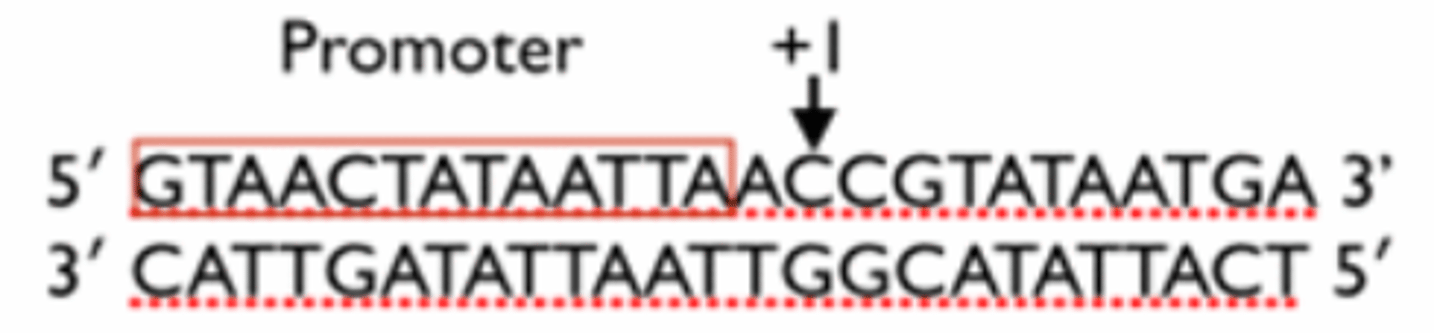
c - 5'-CCGUAUAAUGA-3'
What is the RNA sequence transcribed from the DNA shown below?
a. 3'-GGCATATTACT-5'
b. 5'-GGCAUAUUACA-3'
c. 5'-CCGUAUAAUGA-3'
d. 5'-CCGTATAATGA-3'
e. 3'-GGCAUAUUACU-5'
b - promoter
Which of the following is a sequence of DNA where transcription is initiated?
a. sigma factor
b. promoter
c. hairpin loop
d. TBP
e. initiator
e - tRNA and rRNA.
Translating an mRNA requires two other types of RNA:
a. tRNA and miRNA.
b. tRNA and mRNA.
c. snRNA and snoRNA.
d. rRNA and siRNA.
e. tRNA and rRNA.
d - CC
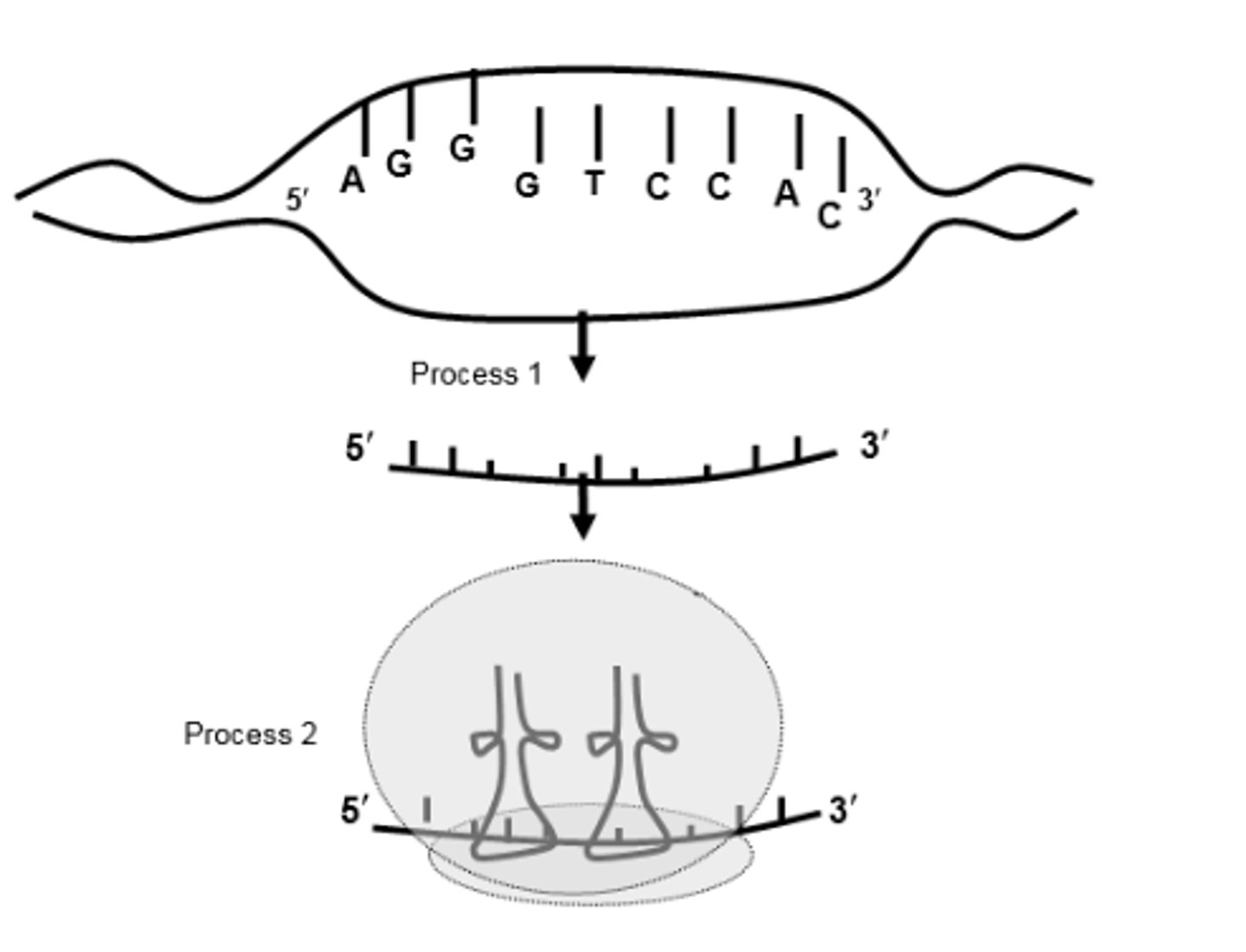
If the bottom strand of the DNA shown above is the template, the tRNA anticodon sequence for the first RNA codon, left to right or 5′ to 3′, is:
a. GGA.
b. UCC.
c. CAC.
d. CCU.
e. AUG.
a - A reading frameshift would occur. All codons (and thus amino acids) downstream of the codon in which the deletion occurred would be different, including the stop signal.
What would be the consequences of a two-nucleotide-deletion mutation in the middle of the first exon of a protein-coding gene?
a. A reading frameshift would occur. All codons (and thus amino acids) downstream of the codon in which the deletion occurred would be different, including the stop signal.
b. Since exons are not coding regions, no changes in the protein would occur.
c. The result would be no change in the protein, since deletions are very rare.
d. Some codons might be altered since there are changes in the bases of the DNA, but the stop codon would remain the same and the protein would still be made.
e. No change in the reading frame would occur due to the degeneracy of the genetic code.
e - e. The CFTR gene likely has many introns that are excised prior to translation of the CFTR protein.
Cystic fibrosis is caused by a mutation in the CFTR gene. The normal CFTR gene comprises approximately 190,000 nucleotides and produces an mRNA of 6128 nucleotides in length. What is a possible explanation for the difference in the sizes of the gene and the mRNA?
a. The 5' cap and the poly(A) tail get removed prior to translation of the CFTR protein.
b. Methylation of the 5' cap silences portions of the gene, preventing those regions from being transcribed
into mRNA.
c. The mutation that causes cystic fibrosis creates a new terminator sequence, resulting in a shorter mRNA.
d. The promoter of the CFTR gene is likely silenced by miRNAs prior to mRNA production.
e. The CFTR gene likely has many introns that are excised prior to translation of the CFTR protein.
b - In eukaryotes, the 5′ cap and the 3′ poly(A) tail are involved in translation initiation.
Which of the following statements about translation is CORRECT?
a. A special tRNA that does not have an attached amino acid binds to stop codons to terminate translation.
b. In eukaryotes, the 5′ cap and the 3′ poly(A) tail are involved in translation initiation.
c. Ribosomes move along an mRNA in the 3′ to 5′ direction.
d. The codon for methionine appears only at the beginning of the mRNA for a protein, not in the middle or in the end.
e. The first three bases at the 5′ end of an mRNA are the AUG at which translation begins.
d - d. A single DNA can be transcribed many times continuously, and the RNA transcript gets longer as the transcription apparatus moves down the DNA.
The following diagram represents the transcription unit and corresponding RNA transcripts as "Christmas-tree- like" structures captured in the electron micrograph.
Which of the following statements CORRECTLY describes the why the transcription unit looks like a "Christmas tree" with different length of tree branches along the DNA "tree trunk"?
a. Depending on where the transcription begins on the DNA template, different lengths of transcripts get generated.
b. Each position on the DNA dictates the specific length of the RNA transcript generated from that particular position.
c. There is no known reason for the transcription unit to assume the "Christmas-tree-like" shape.
d. A single DNA can be transcribed many times continuously, and the RNA transcript gets longer as the transcription apparatus moves down the DNA.
e. The transcript randomly grows from the DNA without any particular reason.
d - exons
Many eukaryotic genes contain RNA-coding regions called
a. interference.
b. transcription.
c. introns.
d. exons.
e. acquisition.
c - DNA
For a given gene, both strands of a DNA are used as a template when which of the following molecules is synthesized?
a. neither RNA nor DNA
b. RNA
c. DNA
d. both RNA and DNA
c - cytoplasm
Both tRNA and rRNA function only in the a. plasma membrane.
b. ribosome.
c. cytoplasm.
d. nucleus.
e. nucleolus.
a - Introns would not be removed from the pre-mRNA.
Suppose an organism ingests a drug that disassembles its spliceosomes, rendering them nonfunctional. Which of the following would be seen MOST immediately in this organism?
a. Introns would not be removed from the pre-mRNA.
b. rRNA would no longer be appropriately processed.
c. All translation would stop.
d. mRNA would not be able to bind the 5' cap.
e. tRNA bases would no longer be modified into rare bases.
c - phosphodiester
What types of bonds are created between nucleotides during the process of transcription?
a. ionic
b. both phosphodiester and hydrogen
c. phosphodiester
d. oxygen
e. hydrogen
a - ribonucleoside triphosphate.
In a transcription reaction, two phosphate groups are cleaved from the incoming:
a. ribonucleoside triphosphate.
b. deoxyribonucleoside triphosphate.
c. ribonucleoside diphosphate.
d. deoxyribonucleoside diphosphate.
e. ribozyme.
d - UAA
Which of the following codons will terminate translation?
a. AUG
b. GAA
c. AAU
d. UAA
e. UUU
e - The transcript may not be produced as the consensus sequence within region A may be important for the initiation of the transcription.
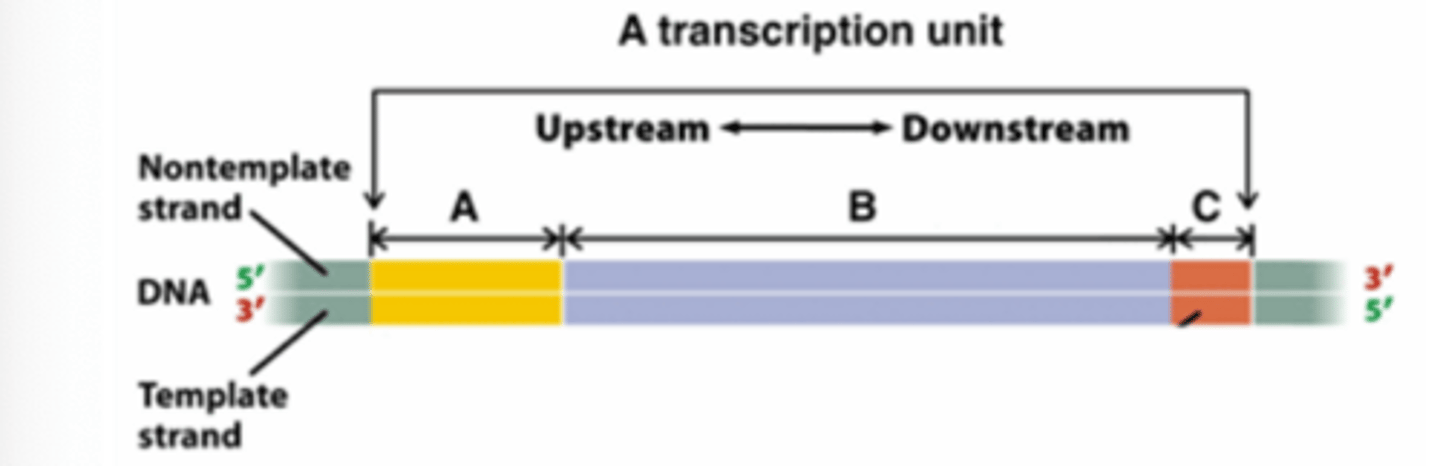
The following diagram represents a transcription unit.
What would likely happen to transcription of this transcription unit if a certain consensus sequence within region A is removed via deletion?
a. The mutation in region A would result in truncated RNA transcript that is shorter than expected RNA.
b. The transcript may get copied in reverse direction as the orientation of region A is important for the direction of the transcription.
c. The transcription occurs normally as there are other consensus sequences that would compensate for the loss of one.
d. The mutation in region A does not affect the transcription as the transcript is copied only from regions B and C.
e. The transcript may not be produced as the consensus sequence within region A may be important for the initiation of the transcription.
a - the peptidyl site
Where does fMET-tRNAiMet bind?
a. the peptidyl site
b. the exit site
c. the aminoacyl site
d. to the 70S initiation complex e. to the exit codon
c - core promoter
In eukaryotic cells, where does the basal transcription apparatus bind?
a. ribozyme
b. regulatory promoter
c. core promoter
d. enhancer
e. terminator
e - alternative RNA processing
The human gene encoding calcitonin contains six exons and five introns and is located on chromosome 11. The pre-mRNA transcript from this gene can generate either calcitonin or calcitonin gene-related peptide (CGRP) in a tissue-specific manner. Which of the following processes makes production of two functionally and structurally different proteins from the same gene possible?
a. self-spicing introns
b. differential transcription
c. alternative replication
d. 5′ capping and polyadenylation
e. alternative RNA processing
c - piRNAs
Which RNA molecule functions in inhibiting transposons?
a. eRNAs
b. miRNAs
c. piRNAs
d. mRNAs
e. tRNAs
e - translation
A drug that destroyed small nucleolar RNA (snoRNA) would inhibit which process?
a. replication
b. RNA splicing of pre-mRNA c. transcription
d. assembly of the nucleosome
e. translation
c - both RNA polymerase and DNA polymerase
Which of the following polymerase uses DNA as a template and synthesizes new strands from 5′ to 3′?
a. neither RNA polymerase nor DNA polymerase
b. RNA polymerase only
c. both RNA polymerase and DNA polymerase
d. DNA polymerase only
e - introns
Which of the following is found in the primary product of transcription but not in a mature mRNA molecule?
a. stop codon
b. start codon
c. exons
d. promoter
e. introns
b - after the process of initiation
When does sigma factor normally dissociate from RNA polymerase?
a. after transcription has terminated
b. after the process of initiation
c. following the addition of nucleosomes
d. after the binding of rho
e. after the addition of nucleosomes
a - DNA polymerase I
What polymerase removes and replaces primers?
a. DNA polymerase I
b. DNA polymerase IV
c. DNA polymerase III
d. DNA polymerase V
e. DNA polymerase II