math 3a
 Call Kai
 Learn
Learn Practice Test
 Spaced Repetition
 Match
Match Flashcards
 Knowt Play
1/21

There's no tags or description
Looks like no tags are added yet.
Name | Mastery | Learn | Test | Matching | Spaced | Call with Kai |
|---|
No analytics yet
Send a link to your students to track their progress
22 Terms
How to determine if set is a Linear combination?
Solve the matrices and if you get a row with 0 answer is yes.
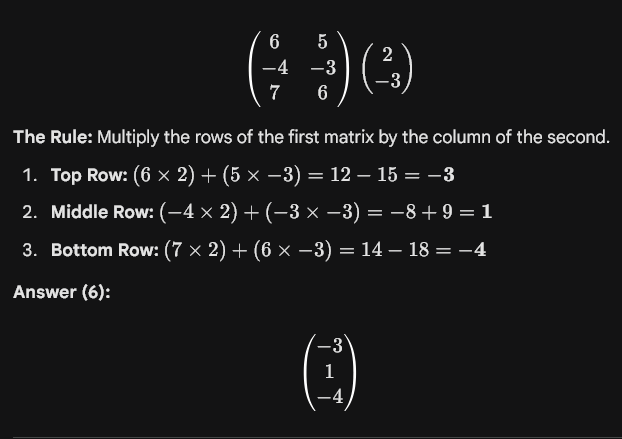
Matrix products
Amount of columns should be equal to the rows. Left to right, top to bottom
Equation consistent for all vectors in R3?
Only if there are 3 columns and 3 rows. If only 2, there would only be x1 and x2 which is left/right and up/down.
Linear transformation
L(cx) = cL(x)
L(x+y) = L(x) + L(y)
One to one
For any entry in range, there is at most one domain mapped to it
Onto
For any element in range there is at least one element domain mapped to it
Linear independence in one to one
One to one if columns of A are linearly independent. Meaning in c1v1+c2v2 etc coefficients of C all vanish.
How to tell if the lines have a common point of intersection?
Use reduced echelon form and the last row has to be all 0s.

Augmented Matrix
Augmented means the last column is what the rows are equal to, so in reality it is 3 variables and what they are equal to.

How to tell if vector b is a linear combination?
Solve the matrix using REF, if bottom row is all equal to 0, it guarantees a solution so it is a linear combination.
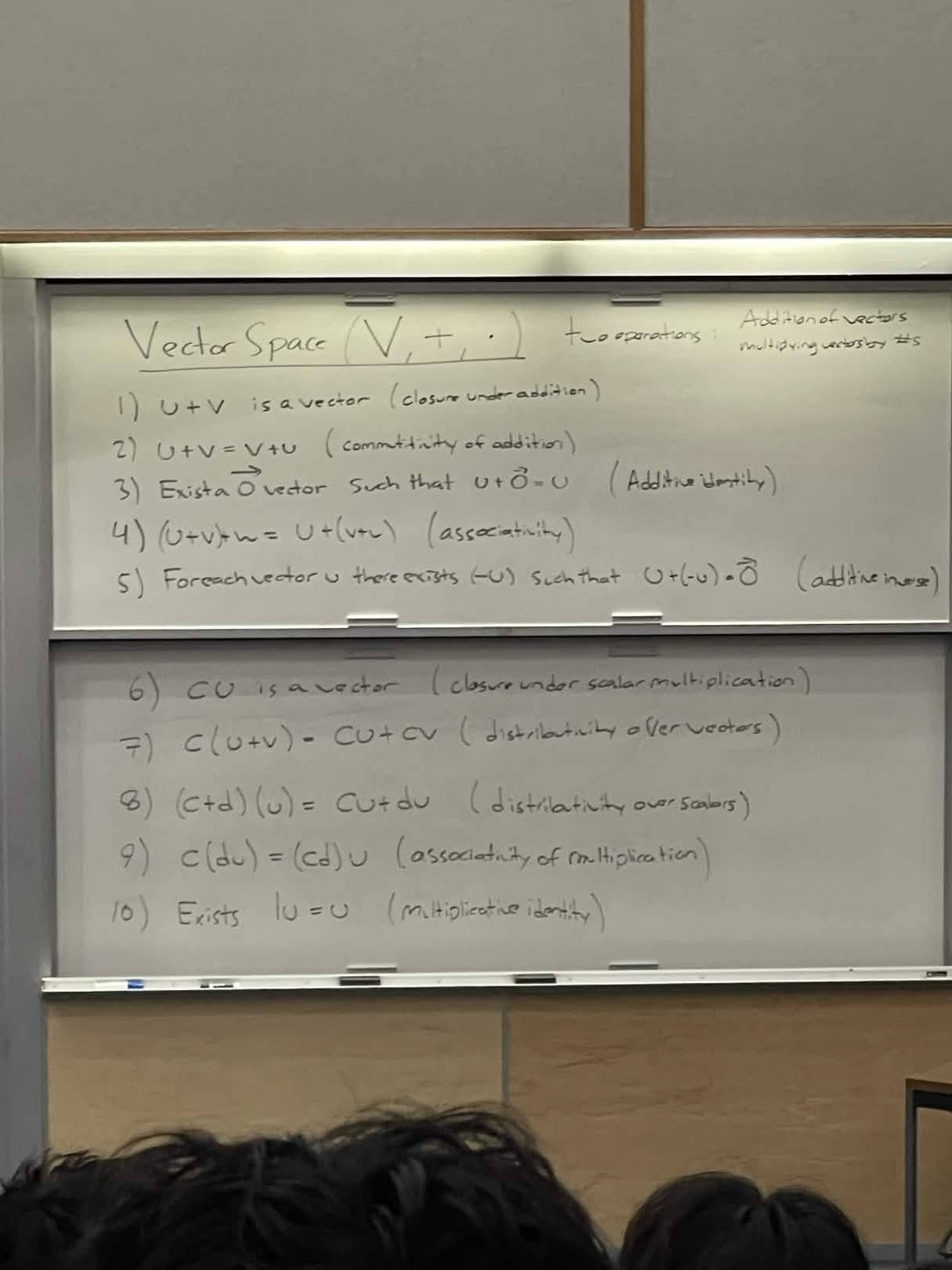
Vector space
Two operations, addition of vectors, multiplication of vectors by numbers
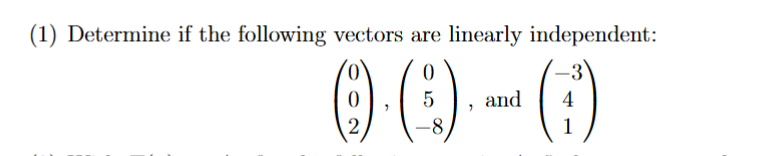
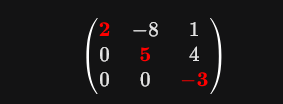
Linear independence example:
every column has a leading entry so yes.

compute product of matrices
3 rules of Vector subspace
1) any value of a that makes the collection p(t) = 0 for all of t?
2) is it closed under addition? (add 2 of the equations together, one with variable a and the other with b, the result should match the same format as original equation. ie. a+t2 shows constant plus one t2.
3) is it closed under scalar multiplication? multiply by c and if the format is not the same as original then it is not a subspace.

Vector Subspace problem:
1) plugging in values for a still leave t2 so first rule fails. the collection will not be equal to 0, instead would be equal to t2
2) adding (a+t2) + (b+t2) = (a+b) + 2t2 —> does not follow the original format of constant plus one t2 , it instead has 2t2
3) multiplication by c: lets just say 5: 5(a+t2) = 5a+5t2 —> does not follow original format.

Linear transformation example
only use the transformed values, the initial values are just distractions.

How to determine if a collection is a basis?
Must be linearly independent: must have leading entry for each column. (answer was no because REF showed 000 for the bottom row)
How to determine if vectors given constitute a basis?
Linear Independence, Spanning
It constitutes a basis if it is LINEARLY INDEPENDENT and span
Use reduced echelon form to make sure each column has a leading entry, or look at the amount of columns and rows. If # of columns does not equal # of rows then it is linearly dependent and is NOT a basis.
Understanding DImension
n amount of elements = dimension n
EX. 3 columns (vectors) = dimension 3
vector space is fixed, dimension n will have n elements.
Relationship between number of rows/columns of 2 matrices so that multiplication of matrices is defined?
Number of columns in first matrix = number of rows in the second matrix
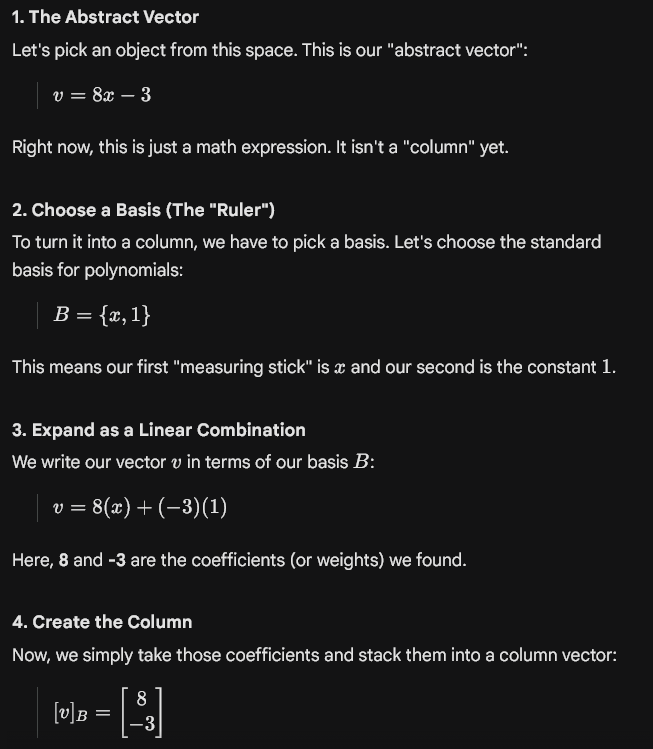
what is needed to identify a vector in an abstract vector space with a column of numbers?
make a choice of basis, expand the vector as a linear combination of basis elements, and make a column of the coefficients.
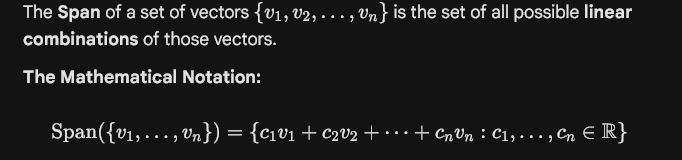
Define Span