Behavior Therapy
 Call Kai
 Learn
Learn Practice Test
 Spaced Repetition
 Match
Match Flashcards
 Knowt Play
1/14

There's no tags or description
Looks like no tags are added yet.
Name | Mastery | Learn | Test | Matching | Spaced | Call with Kai |
|---|
No analytics yet
Send a link to your students to track their progress
15 Terms
Behavior therapy is an
action oriented therapy
Four areas of development
classical conditioning
operant conditioning
social learning approach
cognitive behavior therapy
Classical conditioning
Turn neutral stimulus into a reaction-inducing stimulus
Operant conditioning
Reinforcement and punishment in response to actions
Developed due to the limitation of classical where it only related to reflexes and not voluntary behaviorsS
Social learning approach
We learn by observing others, what is acceptable/safe/good and unacceptable/unsafe/bad
Orient behavior based on what is observed
Cognitive behavior therapy
brings to light the connections between behaviors and thought patterns
historical context of behavior therapy
Can not measure Freud’s ideas
Too subjective, ex. everyone has their own dreams
Psychology criticized as not been a science since it is unreliable and unscientific
The rise of behaviorism as a reaction
1913 and beyond
Creating measurable outcomes in psychology
Animal experiments
John B. Watson
Said only observable behavior should be studied, not thoughts and emotions
Little Albert
Behaviors could be taught
B.F. skinner and operant conditioning
Father of operant conditioning
Focused on voluntary behavior of rats
Basic experiments of behavior therapy
Experiment based clinical procedures
Current problems
Observation or self-monitoring
Action-oriented and educational
Change happens without exploring root cause
Behavior therapist’s function
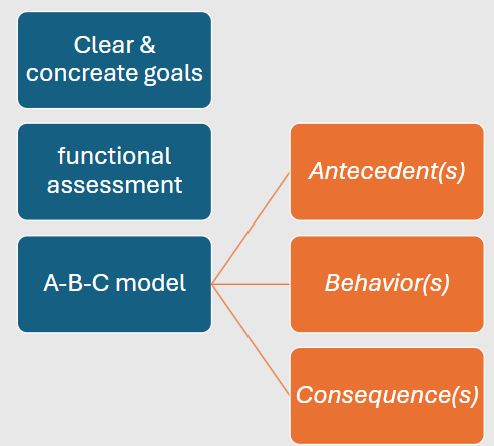
A-B-C
Antecedent
Trigger event, stimulus of behavior
Behavior
The internal, automatic interpretations of the situation
Consequences
Resulting feelings and actions
Behavior therapy application
Reinforcement
Extinction
Punishment
Systematic desensitization
Evidence based therapy used under classical conditioning
Create a fear hierarchy
Teach relaxation techniques
Gradually increase exposure to feared items
80-90% success rate
Eye movement desensitization and reprocessing (EMDR)
Exposure-based therapy
Imaginal flooding
Cognitive restructuring
Rhythmic eye movements to treat traumatic stress disorders