12. Peripheral Nervous System and Sensory Receptors
 Call Kai
 Learn
Learn Practice Test
 Spaced Repetition
 Match
Match Flashcards
 Knowt Play
1/65

Earn XP
Description and Tags
Flashcards covering key vocabulary and concepts related to the Peripheral Nervous System and sensory receptors.
Name | Mastery | Learn | Test | Matching | Spaced | Call with Kai |
|---|
No analytics yet
Send a link to your students to track their progress
66 Terms
Peripheral Nervous System (PNS)
consists of nerve cells responsible for communication to and from CNS
Afferent cells
signals into cell
Efferent cells
signals out of cell
What are the two subsystems of the PNS?
the somatic nervous system and the autonomic nervous system.
The somatic nervous system
communication between voluntary muscles actions performed by skeletal muscles
The autonomic nervous system
controls the unconscious/ involuntary body functions of the smooth muscle, cardiac muscle, and glands
How are afferent signals transmitted?
chemical, gastric, and internal mechanical stimuli
What are the parts of the SNS?
Spinal and cranial nerves
What is the function of spinal nerves?
carry sensory information into and motor commands out of the spinal cord
What is the function of the cranial nerves?
carry information into and out of the brains stem (such as all the senses)
What is the somatosensory system?
neurons and pathways that respond to both types of stimuli from the bodies surfaces and produce perception of touch, temperature, body position, and pain
Sensory receptor cells
neurons or adjacent neurons that convert physical stimuli into action potential
Location of sensory receptor cells
all over the body (skin, epithelial tissues, muscles, bones, ect)
Sensory info
processed locally in the spinal cord to reflex or sent to the brain for conscious perception of touch and proprioception
Mechanoreceptors
sense of touch or pressure or mechanical sensations
Proprioceptor
sense of relative position of the body and the strength of effort for movement
Nociceptors
sense response to harmful stimuli or pain (thermal, mechanical, chemical)
Thermoreceptors
sense changes in temperature
Chemoreceptors
sense chemical stimuli from different gasses
Photoreceptors
have a negative membrane potential change different responses to stimuli (mechanical deformation, ion channels, temperature changes, EM radiation
Mechanical deformation
stretches the membrane and opens ion channels
Chemical stimuli
open ion channels in response
Temperature changes
alters the membrane permeability
EM radiation
directly or indirectly changes membrane characteristics to allow ion transport
what happens when a receptor potential rises above threshold?
an action potential occurs in the nerve fiber
What is the relationship between threshold and the action potential
greater/increased threshold then an increase in the action potential frequency
Intensity of stimulus
info is sent to the brain by increasing the fire rate of the fiber or recruiting more sensory fibers
Spatial summation
increase in intensity will impact a larger number of sensory receptor to increase the strength of a signal
Temporal summation
increasing frequency of the nerve impulses in each fiber in response to a larger stimulus
Adaption of receptors
sensory receptors will change their response to a stimulus if it is constant
Slowly adapting receptors
also tonic receptors, rapid firing during initial contact and then slows over time
Rapidly adapting receptors
also phasic receptors, firing when stimuli starts and when it is finished and relays changes to stimuli
Timing(1)
non-adapting receptors
Timing(2)
Fast-adapting
Non-adapting
firing constantly to tell the brain something is happening
Location of receptors
the skin and muscles around the stomach/gut
Type A fibers
larger more myelinated fibers
Type C fibers
small unmyelinated fibers
Types of nerve fibers
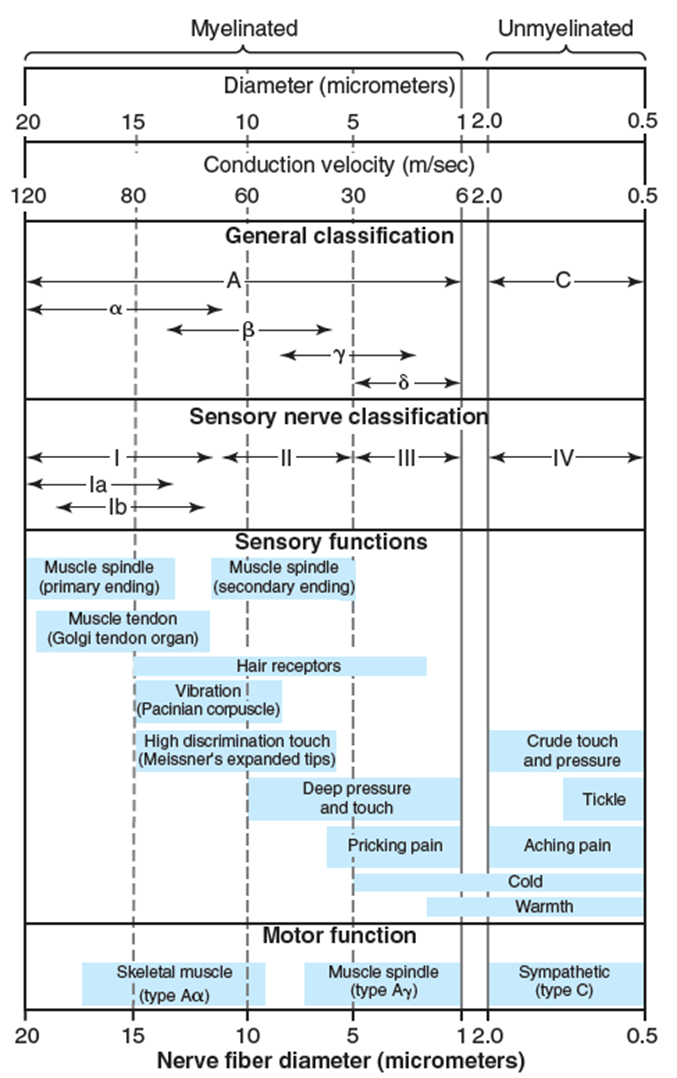
Location of mechanoreceptors
mostly skin
what are mechanoreceptors sensitive to
magnitude or rate(frequency) of motion/force
Golgi tendon receptors
detect muscle tension indirectly via detection of stretch of the ligaments and deep tissues around the joints
Muscle spindle sensory receptors
send info to the nervous system about the length of the muscle or rate of change of length
Fast pain receptors
transmit through Aδ nerve fibers at velocities between 6 and 30 m/sec
Slow pain receptors
of pain is elicited mostly by chemical stimuli is transmitted by type C fibers at velocities between 0.5 and 2 m/sec
Free nerve endings
serve as pain receptors on the skin surface but can be in deeper tissues
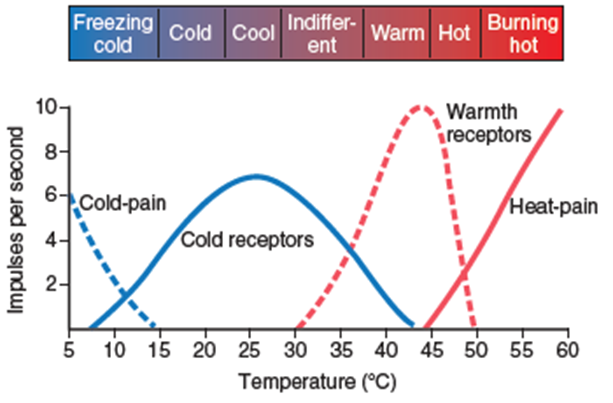
Warmth receptors
warming increases AP rate, cooling decreases
Cold receptors
cooling increases AP rate during, warming decreases
Adapting for thermoreceptors
slow
what else can thermoreceptors respond to?
chemicals
Graphical representation of thermal receptors
what does the distance chemoreceptor type do?
receive stimuli in gases in the olfactory system
what does the direct chemoreceptor type do?
detect stimuli in liquids include the taste buds in the gustatory system
Anterior half of the parietal lobe
used for reception and low-level interpretation of somatosensory signals
Posterior half of the parietal lobe
provides higher levels of interpretation
Exceptions
are visual signals terminate in the occipital lobe and auditory signals terminate in the temporal lobe
From right to left of signals
Sensory signals from the right side of the body terminate in the left side of the brain and visa versa
Anterior half of the parietal lobe
used for reception and low-level interpretation of somatosensory signals
Posterior half of the parietal lobe
provides higher levels of interpretation
Somatosensory area I
high degree of localization of the different parts of the body, most important of two parts
Somatosensory area II
poor localization
Sensory Cortex Homunculus
map of brain areas dedicated to sensory processing for different body parts
Multiple Cerebro-Spinal Sclerosis (MS)
an autoimmune disease resulting in damage to myelin covers (i.e., glial scars) of nerve cells in the white matter of the brain and spinal cord
Effects of MS
disrupts the nervous system's ability to transmit signals, resulting in a range of signs and symptoms
MS Physical symptoms
as double vision, vision loss, eye pain, muscle weakness, and loss of sensation or coordination, mental symptoms, and sometimes psychiatric problems
Causes of MS
either destruction by the immune system or inactivation of myelin-producing cells