IPS1- B4- Ionic Equilbria
 Call Kai
 Learn
Learn Practice Test
 Spaced Repetition
 Match
Match Flashcards
 Knowt Play
1/45

There's no tags or description
Looks like no tags are added yet.
Name | Mastery | Learn | Test | Matching | Spaced | Call with Kai |
|---|
No analytics yet
Send a link to your students to track their progress
46 Terms
Ionization
___- is a chemical process in which a neutral molecule forms new ions when dissolved in water.
Ionization
____ -
is a chemical process is when the subtance was not made of ions originally but reacts with water to form ions.
New charged particles are produced
a. Ionization
HCl + H2O → H3O+ + Cl−
a. Ionization
b. Dissociation
a. Ionization
neutral substance + water = new ion (charge particle)
a. Ionization
b. Dissociation
a. Ionization
Common with acids and weak bases
a. Ionization
b. Dissociation
Dissociation
____ - is a physical process where an ionic compound separates into its pre-existing ions in solution
b. Dissociation
NaCl → Na+ + Cl−
a. Ionization
b. Dissociation
b. Dissociation
No new ions are formed, just a separation of existing ones.
a. Ionization
b. Dissociation
b. Dissociation
Common with salts and strong bases
a. Ionization
b. Dissociation
base
An acid must have a _____ present in order to function as an acid, and vice versa.
Arrhenius
Bronsted-Lowry
Lewis
Acid Base Theories [3]
Arrhenius
[Acid Base Theories]
____-
all bout H+ and OH
Bronsted Lowry
[Acid Base Theories]
____-
about proton
Lewis
[Acid Base Theories]
___-
about electron
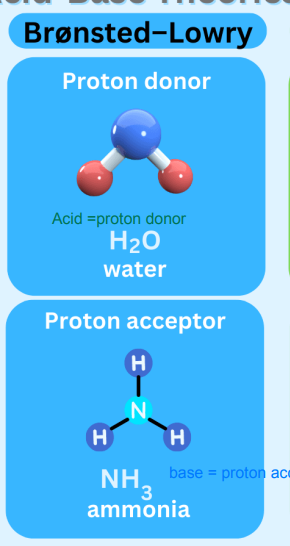
proton donor
proton acceptor
►Bronsted Lowry acid is a ____ [proton donor/ proton acceptor]
►Bronsted Lowry base is a____ [proton donor/ proton acceptor]
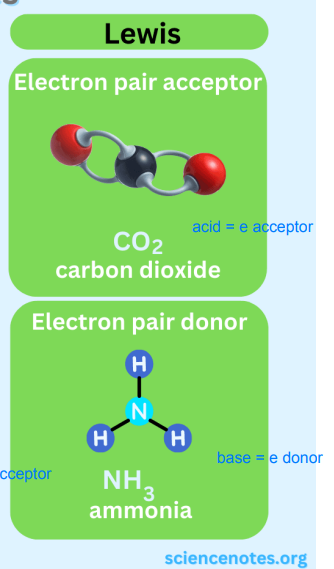
electron acceptor
electron donor
►Lewis acid is a ____ [ electron donor/ proton acceptor]
►Lewis base is a____ [ electron donor/ proton acceptor]
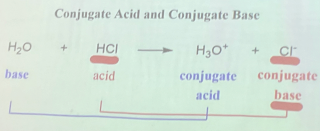
Conjugate Acid and Base
partial ionization
Weak acid/Weak base = ____ [partial ionization / complete ionization] in water
complete ionization
Strong acid/Strong base = ____ [partial ionization / complete ionization] in water
strong acid
weak acid
►large Ka = ___ [weak/strong] acid
►small Ka= ___ [weak/strong] acid
1 × 10¹⁴
Acid dissociation constant of water (Kw) at 25 °C is ___ ?
autoprotolysis
___- is a process where water react with its own water molecule
autoprotolysis
____ - is a chemical process where a substance acts as both an acid and a base at the same time
autoprotolysis
Water undergoes _____ [what process] to produce ions
a. Monoprotic
one proton transfer
a. Monoprotic
b. Polyprotic
a. Monoprotic
Acetic acid (HAc) with one Ka
a. Monoprotic
b. Polyprotic
b. Polyprotic
Multiple protons
a. Monoprotic
b. Polyprotic
Diprotic
Triprotic
Types of Polyprotic [2]
a. Diprotic
Carbonic acid (H2CO3) is an example of what Type of Polyptoric electrolyte
a. Diprotic
b. Triprotic
a. Diprotic
Sulfuric acid (H₂SO4) is an example of what Type of Polyptoric electrolyte
a. Diprotic
b. Triprotic
b. Triprotic
Phosphoric acid (H3PO4) has three Ka values is an example of what Type of Polyptoric electrolyte
a. Diprotic
b. Triprotic
two Ka values
three Ka values
Carbonic acid (H2CO3) has ___ Ka values
Phosphoric acid (H3PO4) has ___ Ka values
Ampholytes (Amphoteric electrolyte)
[KIND OF ELECTROLYTE] ____ - can function as an acid /base
Ampholytes
[KIND OF ELECTROLYTE] ____- are species that can functions either as an acid or as a base
True
[T/F] Ampholytes are amphoteric in nature
Amino acid
Proteins
Example of ampholytes [2]
a. Ampholyte
Amino acids and proteins are the classic example of
a. Ampholyte
b. Pedialyte
c. Ionization
d. hydrite
Zwitterion
[Kind of Ion] ____ - have both positive and negative charges
Amino acid
____ -
is a zwitterion
basic unit of protein
Sorensen
Ph scale is by ____ [who]?
acidic
neutral
basic /alkaline
pH <7 = ___ ?
pH = 7 = ___ ?
pH > 7 = ____ ?
a. 0-14
pH and pOH lie between ____?
a. 0-14
b. 0-12
c.1-5
d.2-20
low pH
higher pOH
higher pOH
Higher H = __ [high/low] Ph
Higher H = __ [high/low] pOH
Lower pH = Higher H = __ [high/low] pOH
the more acidic the substance is
low pOH
high pH
high pH
high OH = __ [high/low] pOH
high OH = __ [high/low] pH
low pOH = high OH = __ [high/low] pH
the more basic the substance is
HI (Hydroiodic acid)
HBr (Hydrobromic acid)
HCl (Hydrochloric acid)
HNO₃ (Nitric acid)
HClO₄ (Perchloric acid)
H₂SO₄ (Sulfuric acid, diprotic)
Strong acid [5]
LiOH – Lithium hydroxide
NaOH – Sodium hydroxide
KOH – Potassium hydroxide
Ca(OH)₂ – Calcium hydroxide
CsOH – Cesium hydroxide
RbOH – Rubidium hydroxide
Sr(OH)₂ – Strontium hydroxide
Ba(OH)₂ – Barium hydroxide
Strong bases [8]