Common Assesment #3
 Call Kai
 Learn
Learn Practice Test
 Spaced Repetition
 Match
Match Flashcards
 Knowt Play
1/45

There's no tags or description
Looks like no tags are added yet.
Name | Mastery | Learn | Test | Matching | Spaced | Call with Kai |
|---|
No analytics yet
Send a link to your students to track their progress
46 Terms
45-45-90 triangle formula
Leg x square root of 2 = hypotenuse
30-60-90 right triangle formula
short leg x square root of 3 = long leg
short leg x 2 = hypotenuse
Converse, inverse, and contrapositive
converse = flip hypothesis and conclusion (ex: original - if a polygon is a square, then it is a quadrilateral, converse - if a polygon is a quadrilateral, then it is a square)
inverse = negate hypothesis and conclusion (ex: original - if a polygon is a square, then it is a quadrilateral, inverse - if a polygon is not a sqaure, then it is not a quadrilateral)
contrapositive = negate and flip hypothesis and conclusion (ex: original - if a polygon is a square, then it is a quadrilateral, contrapositive - if a polygon is not a quadrilateral, then it is not a square)
Scale factors (perimiter and area)
scale factor = A/B
perimiter = A/B
area = A²/B²
Sine (sin)
angle = opposite leg/hypotenuse (remember opposite leg is NOT touching angle)
Cosine (cos)
angle = adjacent leg/hypotenuse (remember adjacent leg is touching angle)
Tangent (tan)
angle = opposite leg/adjacent leg
Regular polygons are
equilateral and equiangular
Convex polygons have all angles that are
less than 180
Regular polygon sum of interior angles formula
180(x-2)
x = # of sides
Measure of EACH interior angle for regular polygon formula
180(x-2)/x
x = # of sides
Exterior angle is _________ to the interior angle at that vertex
supplementary
The sum of the exterior angles of any polygon add up to
360
To find EACH exterior angle formula
360/x
x = # of sides
Order of shapes
Quadralateral
(2 parallel sides) Parallelogram | (One parallel side) Trapezoid | (Zero parallel sides) Kite ^
Rectangle Rhombus v Square
REMEMBER THAT GOING UP IS TRUE NOT DOWN (EX: all sqaures are rectangles/rhombuses, but not every rectangle/rhombus is a sqaure)
A parrallelogram is a _______ whose opposite sides are _________
quadrilateral, parallel
4 basic properties of a parallelogram
Opposite sides are congruent
Opposite angles are congruent
Consecutive angles are supplementary (consecutive is same side!)
The diagonals meet at a midpoint, so the diagonals bisect each other
5 ways to prove a quadrilateral is a parallelogram
Both sides of opposite sides are parallel
If both pairs of opposite sides of a quadrilateral are congruent, then the quadrilateral is a parallelogram
If one pair of opposite sides of a quadrilateral are both congruent and parallel, then the quadrilateral is a parallelogram
If both pairs of opposite angles of a quadrilateral are congruent, then the quadrilateral is a parallelogram
If the diagonals of a quadrilateral bisect each other, then the quadrilateral is a parallelogram
Rectangles
a quadrilateral with four right angles
7 properties of rectangles
Opposite sides are parallel
Opposite sides are congruent
Opposite angles are congruent
Consecutive angles are supplementary
Diagonals bisect each other
All angles are right angles
Diagonals are congruent
Rhombi
quadrilateral with four congruent sides
9 properties of a rhombus
Opposite sides are parallel
Opposite sides are congruent
Opposite angles are congruent
Consecutive angles are supplementary
Diagonals bisect each other
All four sides are congruent
Diagonals are perpendicular
Diagonals bisect the opposite angles
The small triangles formed by the diagonals are RIGHT and CONGRUENT
Squares
quadrilaterals with four congruent angles and four congruent sides
10 properties of squares
Opposite sides are parallel
Opposite sides are congruent
Opposite angles are congruent
Consecutive angles are supplementary
Diagonals bisect each other
Four right angles
Four sdes are congruent
Diagonals are congruent
Diagonals are perpendicular
Diagonals bisect opposite angles
Trapezoid
quadrilateral with exactly one pair of parallel sides
Median of a trapezoid
Segment that joins the midpoints on the legs (sometimes called midsegment), the median of a trapezoid is parallel to the bases and bisects the sides, the lengths of the median is one-half the sum of the lengths of the bases
Median formula
median = ½ (b1 + b2)
Isosceles trapezoid
a trapezoid with congruent legs, both pairs of base angles of an isosceles trapezoid are congruent, the diagonals of an isosceles trapezoid are congruent, consecutive angles are supplementary
Kites
quadrilateral with two pairs of congruent adjacent sides, the diagonals of a kite are perpendicular, the line of symmetry bisects the angles, two sets of congruent right triangles
Distance formula
d = square root (x2 - x1)² + (y2 - y1)² or square root of rise² + run²
Midpoint formula
M = x1 + x2 / 2 , y1 + y2 / 2
Slope formula
m = y2 - y1 / x2 - x1 or rise/run
To determine if a shape is a parallelogram use
slope formula to see if opposite sides are parallel
To determine if a shape is a rhombus
determine if the diagonals are perpendicular using slope formula or determine all four sides congruent using distance formula
To determine if a shape is a rectangle
determine if the diagonals are congruent using distance or determine if all four corners are right angles using slope formula
A shape is a square if
it is both a rhombus and a rectangle
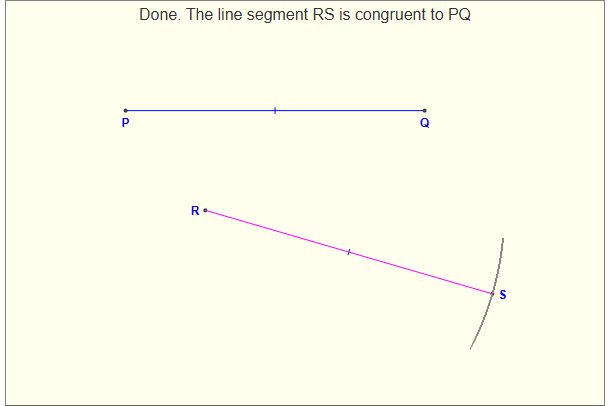
Line segment
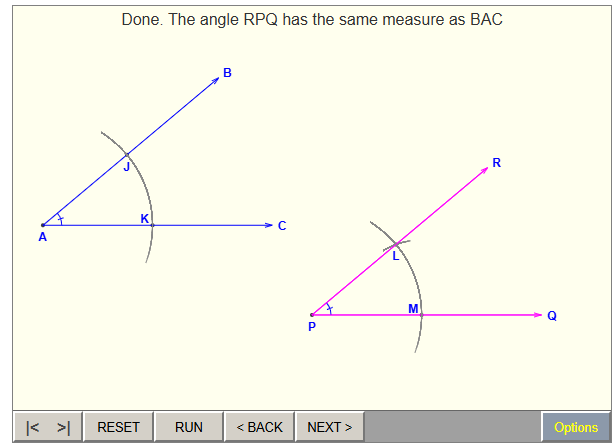
Angle
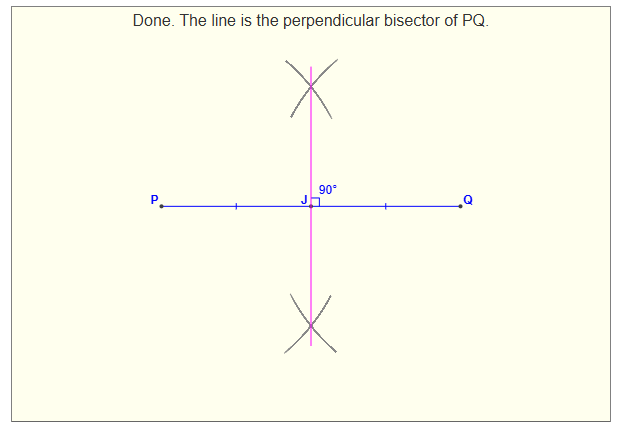
Perpendicular bisector
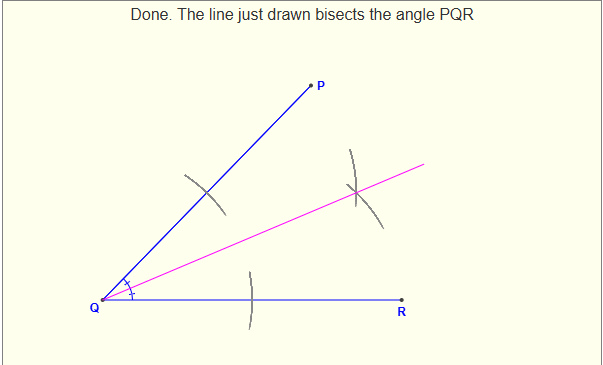
Angle bisector
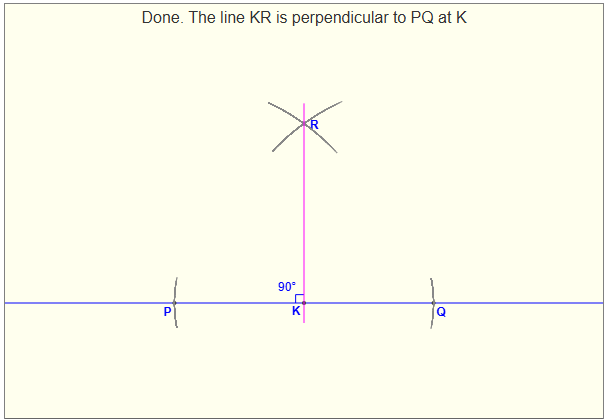
Perpendicular Through a Point On the Line
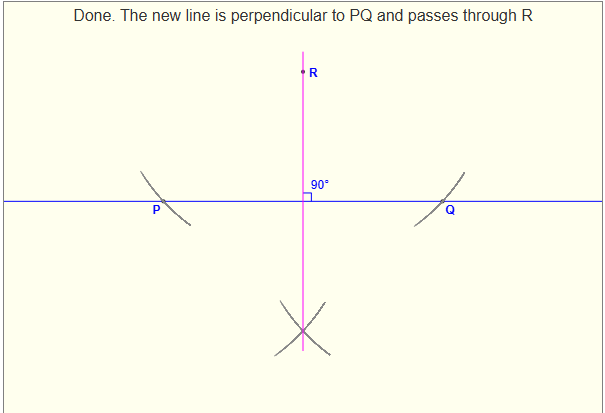
Perpendicular Through a Point NOT On the Line
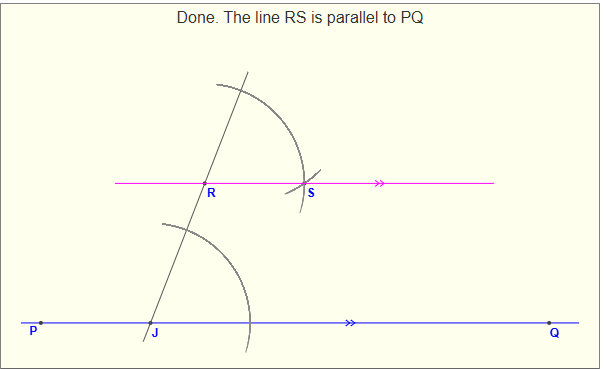
Parallel lines
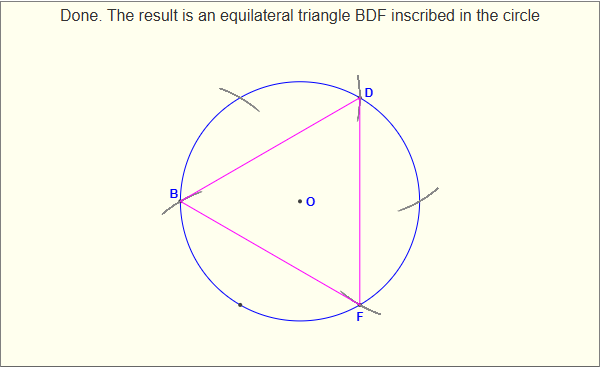
Equilateral Triangle Inscribed in a Circle
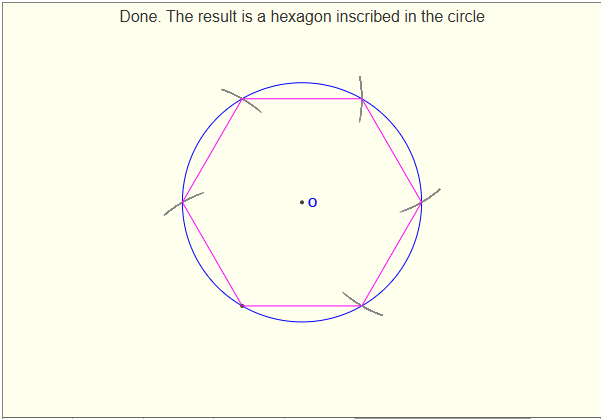
Regular Hexagon Inscribed in a Circle
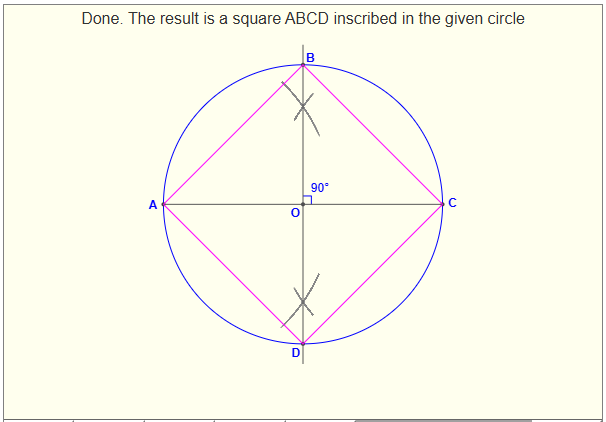
Square inscribed in a Circle