Fungi IV
 Call Kai
 Learn
Learn Practice Test
 Spaced Repetition
 Match
Match Flashcards
 Knowt Play
1/26

Earn XP
Description and Tags
A set of flashcards covering the biology, structure, life cycle, and human pathogenicity of Microsporidia based on the lecture transcript.
Name | Mastery | Learn | Test | Matching | Spaced | Call with Kai |
|---|
No analytics yet
Send a link to your students to track their progress
27 Terms
What is the approximate number of species identified within the phylum of Microsporidia?
Approximately 1500 species.
Why were Microsporidia originally thought to be primitive eukaryotes?
They lack mitochondria.
What evidence suggests that Microsporidia once possessed mitochondria but lost them?
The presence of some mitochondrial genes within their genome.
Why did Microsporidia lose their mitochondria?
Due to a switch to anaerobism while acting as parasites within a host.
How are Microsporidia classified in terms of their relationship with host cells?
Obligate intra-cellular parasites.
What is the gene count of the smallest microsporidian genome compared to Escherichia coli?
The smallest microsporidian genome has approximately 2000 genes, while E. coli has approximately 4500 genes.
What is the name of the intracellular form of Microsporidia?
Meront which has a plasma membrane often with projections to increase contact surface area with the host, contains one of two nuclei and has many ribosomes
What are the key characteristics of microsporidia
A thick protein wall, contain one or two nuclei, exhibit species-specific patterns of coiled up filaments
What is the function of the plasma membrane projections (vesicles or tubules) on the meront?
To increase the contact surface area with the host.
What are the terms for Microsporidia containing one or two nuclei?
One nucleus is a monokaryon, and two nuclei is a diplokaryon.
What materials make up the thick wall layers of a microsporidian spore?
Protein and chitin.
What do the mysterious rows of circles or ovals seen in a TEM of a microsporidian spore cross-section represent?
Cross-sections of the coiled-up polar filament or tube.
What is the pathogenicity of microsporidia
They can infect various tissues, cause increased mortality, influence sex determination in arthropods, and are often more severe in weakened individuals
What environmental cue triggers the germination of a microsporidian spore?
Osmotic pressure.
What is the structure of a microsporidia spore
The spore has a thick wall, one or two nuclei, rows of circles or ovals that are cross sections of the coiled polar filament
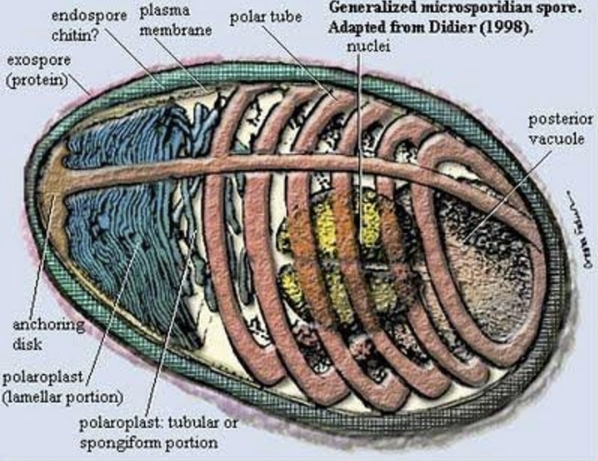
In which structure does osmotic pressure build up to trigger germination?
Pressure builds up in the polar vacuole (PV) which causes polar filament to pierce host cell and inject the sporoplasm (or polaroplasm) into the host cell
What is the term for the spore content injected into the host cell during germination?
Sporoplasm or polaroplasm.
What is the standard progression of the microsporidian life cycle?
Spore, meront, sporont, spore
How do simple and complex microsporidian life cycles differ?
Simple cycles involve one host and asexual reproduction, while complex cycles involve alternating hosts and a mixture of sexual and asexual reproduction.
When was the first human case of microsporidiosis recognized?
1959.
Microsporidiosis is typically characterized as what type of infection in humans?
An opportunistic infection, primarily affecting immuno-compromised individuals such as those with AIDS or organ transplants.
Approximately how many microsporidian species are known to infect humans?
About a dozen (12) species.
On which continent has microsporidiosis NOT been identified?
Antarctica.
What are the primary modes of microsporidiosis transmission?
Zoonotic (from animals like rabbits, parrots, or livestock), waterborne, and airborne.
What is the host specificity of microsporidia
Microsporidia exhibit varying degrees of host specificity, with some species having simple life cycles involving one host and asexual preproduction, while others have complex life cycles with alternating hosts
What us the role of polar vacuoles in microsporidia
The osmotic pressure in the polar vacuole causes the polar filament to pierce the host cell during infection
What is the primary method of transmission for microsporidia
The primary method of transmission is through environmental spores