Unit 26: The expression of doubt, hypothesis, condition and contrast
 Call Kai
 Learn
Learn Practice Test
 Spaced Repetition
 Match
Match Flashcards
 Knowt Play
1/45

There's no tags or description
Looks like no tags are added yet.
Name | Mastery | Learn | Test | Matching | Spaced | Call with Kai |
|---|
No analytics yet
Send a link to your students to track their progress
46 Terms
THE EXPRESSION OF DOUBT.
What must we mention in the introduction?
That there are several ways, both grammatically and lexical, to express doubt or certainty regarding the information given in an utterance. In the following, we will analyse modal auxiliaries, tag questions and some lexical items which convey UNCERTAINTY.
THE EXPRESSION OF DOUBT.
2.1. Modal auxiliaries: What do some grammarians and Quirk et al. mention about the functions of modal verbs?
Some make a distinction between primary functions and secondary functions, or meanings of modal verbs. Similarly, Quirk et al. speak of intrinsic and extrinsic modality. Both primary function and intrinsic modality refer to the meaning each modal has.
E.g.: May/might → permission; Can/could → ability, etc.
THE EXPRESSION OF DOUBT.
2.1. Modal auxiliaries: How many modals can be used?
9/12, including all the mains except SHALL → You must be very careless.
THE EXPRESSION OF DOUBT.
2.1. Modal auxiliaries: How can modals be arranged in their SECONDARY FUNCTION?
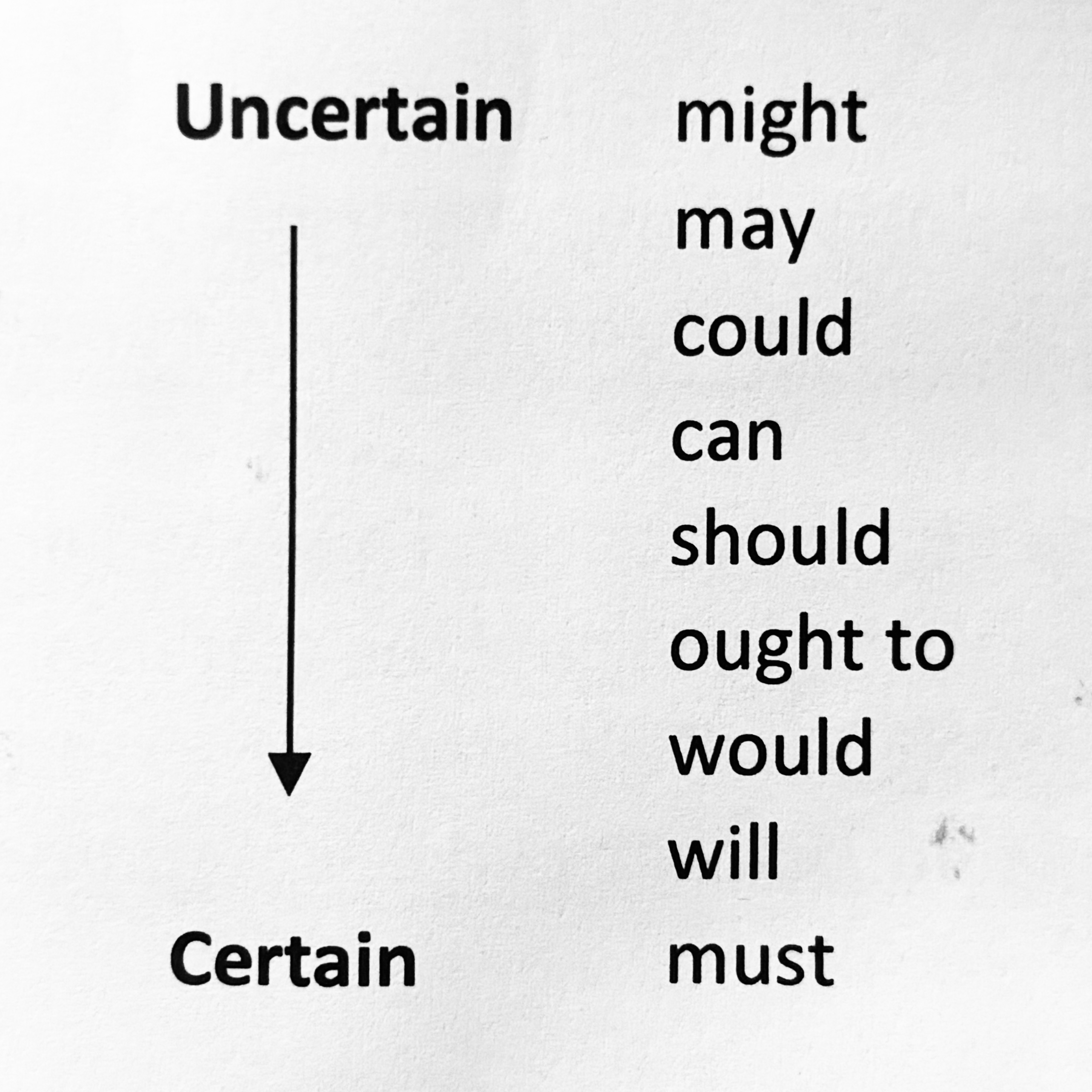
According to the degrees of certainty/uncertainty the speaker feels.
THE EXPRESSION OF DOUBT.
2.1. Modal auxiliaries: Scale?
Some authors give the following scale, although it may vary from one speaker to another:
THE EXPRESSION OF DOUBT.
2.1. Modal auxiliaries: Can could and might.
Refer to a present or future possibility: If it’s raining tomorrow, the game could be suspended/ The road may be blocked.
THE EXPRESSION OF DOUBT.
2.1. Modal auxiliaries: Past of the nine modals
Is formed by retaining the modal and adding have+past participle: That might have been George; He must have gone. (Either I am sure he has gone or I’m sure he went.)
THE EXPRESSION OF DOUBT.
2.1. Modal auxiliaries: The negative
The negative is formed by adding not with every one of the modals except must, for which the negative is can’t:
Certain positive: This can’t be difficult.
Certain negative: This can’t have been difficult.
THE EXPRESSION OF DOUBT.
2.2. Question tags. Introduction
Many languages have fixed expressions to convey the idea of “Isn’t that so?”: (Spanish “¿no?, ¿verdad”; Italian “vero?”, “no?”)
English uses a tag system and typically used in conversational style.
THE EXPRESSION OF DOUBT.
2.2. Question tags. 2.2.1. Structure
Whatever meaning of the tag → verb ALWAYS echoes the operator in the statement.
When echoing the operator, it’s almost always going to be the opposite (+ or -): have…haven’t
If there is no operator visible → do.: You liked that, didn’t you?
In “there-sentence”, there acts as the subject: There was something inside the house, wasn’t it?
If indefinite pronoun is the subject, tag is ‘THEY’→ Everyone has been told what to do, haven’t they?
THE EXPRESSION OF DOUBT.
2.2. Question tags. 2.2.2. Types. What types do we have?
2.2.2.1. Affirmative sentence followed by negative or vice-versa (falling vs rising intonation)
2.2.2.2. Both statement and question tag are positive (sarcastic tone)
2.2.2.3. Several tag questions are invariant (isn’t that so?/ don’t you think?/ right?)
THE EXPRESSION OF DOUBT.
2.3. Other ways of expressing uncertainty
2.3.1. Adjectives used impersonally → It’s not clear/obvious whether/if he has won the race.
2.3.2. Adjectives used to qualify a noun or a personal pronoun → I’m not sure if/whether/certain… who/where… convinced of/about…positive.
2.3.3. Doubt (noun and verb)→ I doubt if he will ever come back/ We have some doubts about the new project.
CONDITION AND HYPOTHESIS
How do we start this section?
By saying that both condition and hypothesis are expressed by means of CONDITIONAL SENTENCES.
CONDITION AND HYPOTHESIS.
What is a conditional sentence? What do they imply?
A complex sentence with a main clause and a dependent clause introduced by a subordinator.
It implies a supposed cause or condition, which implies a supposed result in the main clause (the fulfilment of an action in the main clause depends on the fulfilment of the condition)
CONDITION AND HYPOTHESIS.
How can we classify conditionals?
Several forms of categorisation have been suggested. The problem? That there is a great variety of sentences that can be found, and that any tense sequence is possible (sense and context permitting). To add to that, grammarians have their own classifications, so this section will delve into the classification provided by most grammar books.
CONDITION AND HYPOTHESIS.
3.1. Conjunctions.
Conditional clauses are frequently introduced by: if, unless.
“Unless” conveys the meaning of “except, on condition that”, in some way equivalent to “if not”. Unless we repair the damages, he will not feel well.
Alternative clauses of condition are expressed by “whether…or”: He has to choose whether to go there and help or stay at home.
CONDITION AND HYPOTHESIS.
3.1. Conjunctions. What are some other constructions?
“In case/supposing that/ if only” → expresses wish or hope.
“On condition that” → restriction
“So/as long as”/ “provided that” → stronger restriction
Negative condition (“Otherwise”→ also express condition.
CONDITION AND HYPOTHESIS.
3.1. Conjunctions.
3.1.1. Order
It doesn’t really matter whether the conditional clause comes first or second.
HOWEVER: If it comes first = convey special emphasis, and separated from main clause by a comma.
CONDITION AND HYPOTHESIS.
3.1. Conjunctions.
3.1.2. Certainty
The speaker can also express, by using conditionals and to a certain degree, his certainty about the content being possible.
When present or future conditions → probable conditional sentence (type 1), a hypothetical conditional sentence (type 2)
When past → type 3
CONDITION AND HYPOTHESIS.
3.1. Conjunctions.
3.1.3. Assertion.
Conditionals, besides indicating uncertainty, contain non-assertive forms such as: any and ever instead of assertive ones. However, positive assertion is also possible.
CONDITION AND HYPOTHESIS.
3.2. Types
3.2.1. Type 0
Considered by some grammarians as a variety of type 1.
Two present simples combined
Facts which are ALWAYS TRUE: If you heat water, it boils.
Particle if equivalent to whenever.
CONDITION AND HYPOTHESIS.
3.2. Types
3.2.2. Type 1
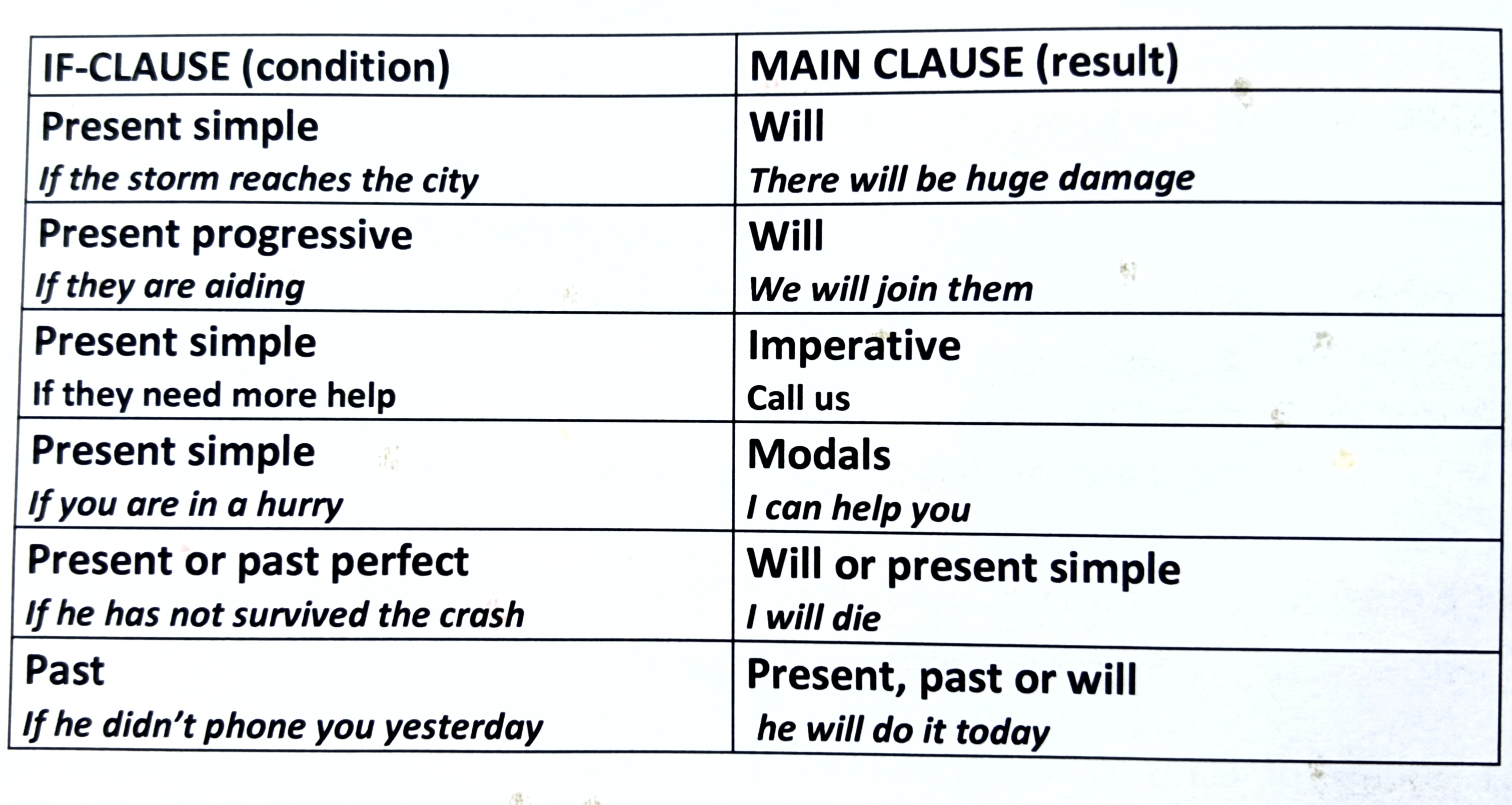
They are real, probable, open conditions in which the condition may or may not be fulfilled.
Express a possible condition in present/future.
If the storm reaches the city, there will be huge damage → if the situation in the if-clause is fulfilled, the event on the other clause will also be fulfilled.
Present simple (in the if-clause) + will (in the main clause).
CONDITION AND HYPOTHESIS.
3.2. Types
3.2.2. Type 1: Other possibilities
Given the context, when we use will, it conveys VOLITION RATHER THAN FUTURITY.
We can use SHOULD in the if-clause to denote uncertainty: Should you need more help, call us.
CONDITION AND HYPOTHESIS.
3.2. Types
3.2.3. Type 2.
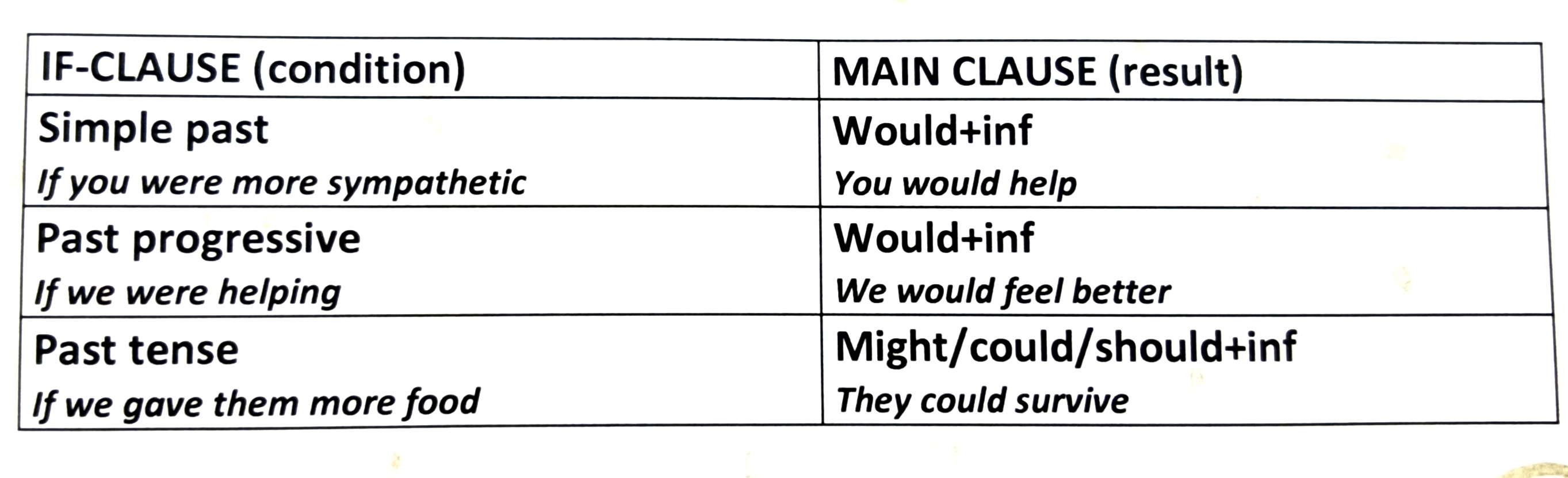
They express improbable, imaginary, or hypothetical conditions.
Although the verb in type 2 is in past tense, real-time reference to the present or future (as we’re talking about a hypothetical situation).
Situation in the if-clause: unlikely to happen. THUS situation in the main clause ALSO UNLIKELY TO HAPPEN.
CONDITION AND HYPOTHESIS.
3.2. Types
3.2.3. Type 2. Further possibilities:
When we use the verb “to be” in the if clause, we use the subjunctive (were) for all persons.
In this type of conditional, should and were to can also be used in the if-clause, but they would express a present desire or supposition with future reference.
CONDITION AND HYPOTHESIS.
3.2. Types
3.2.4. Type 3.
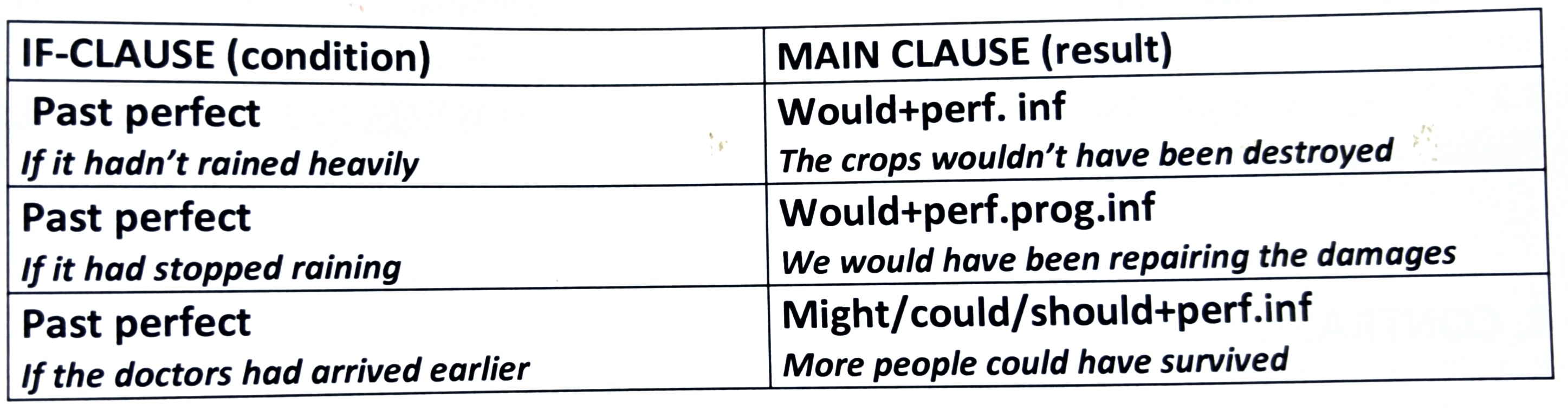
They talk about impossible scenarios since they refer to a past action.
It CANNOT BE CHANGED, as the condition was already fulfilled or not in the past.
In if-clause = verb in the past sentence. In the main clause there are many options which we will observe.
CONDITION AND HYPOTHESIS.
3.2. Types
3.2.4. Type 3. Further possibilities
CONDITION AND HYPOTHESIS.
3.2. Types
3.2.5. Mixed conditional
Result of a mixture between type 2 and type 3: in the if-clause, past perfect is used. In main clause would + inf.
Imagine a hypothetical situation in the present that would be the result of the fulfilment (or not) of a condition in the past: If we hadn’t rescued you, you would be dead now. → condition already fulfilled in the past, the hypothesis about the present is regretting it.
CONDITION AND HYPOTHESIS.
3.2. Types
3.2.6. Special types. Which ones do we have?
3.2.6.1. Inversion
3.2.6.2. Two coordinated sentences
3.2.6.3. “I wish/ if only”
CONDITION AND HYPOTHESIS.
3.2. Types
3.2.6. Special types. 3.2.6.1. Inversion.
In the subordinate clause of the conditional, it is possible to find operator-subject inversion, but only with the operators had, were and should. : Had I not rescued you, you would be dead.
CONDITION AND HYPOTHESIS.
3.2. Types
3.2.6. Special types. 3.2.6.2. Two coordinated sentences
Another form of expressing condition is by means of sentence coordination with “AND” (for positive condition) and “OR” (for negative condition).
Sometimes coordination is omitted. Eg: If you help the poor, you will feel better instead of Help the poor AND you will feel better.
CONDITION AND HYPOTHESIS.
3.2. Types
3.2.6. Special types. 3.2.6.3. “I wish/if only”.
This suggests condition and desirability. An “I wish” structure can be replaced by “if only” in literary register. Used to express different meanings:
Expression of a wish about the present + simple past: I wish I won the lottery.
Expression of regrets + past perfect: If only it hadn’t rained so heavily.
Expression of complaint + (would + infinitive): I wish my neighbor wouldn’t make so much noise.
CONDITION AND HYPOTHESIS.
3.2. Types
3.2.6. Special types. 3.2.6.4. Participles
In formal language, it is possible to find a last type of conditional. This is the case of participial phrases such as: Solved the problem, we will feel better.
CONDITION AND HYPOTHESIS.
3.2. Types
3.2.6. Special types. 3.2.6.5. Hypothetical meaning and special constructions
Can also be expressed through special constructions such as: “as if”, “as though”, “suppose, in your place…”
CONTRAST
What must we mention in the introduction? Condition vs contrast.
Sometimes condition (something that must happen first) and contrast (a difference or oposition between ideas) can look similar.
e.g. Even if you don’t like it, I am going to the affected area/ I’m going to the affected area whether you like it or not.
Both sentences mean: Your opinion will NOT change my decision.
Even though they seem like conditional sentences (if…) the real meaning is contrast (my decision contrasts with your dislike).
CONTRAST
What is a clause of contrast.
It shows a clear difference between two ideas.
I like difficult situations, whereas my mother hates them.
This sentence shows two opposite attitudes:
I like difficult situations
My mother hates them
The word whereas connects the two.
CONTRAST
What must we mention in the introduction? What is a concessive clause.
This clause gives information that seems surprising or unexpected when compared to the main sentence:
Tina is an excellent pianist, although she’s only 12.
It’s surprising because Tina is only 12 years old. The word ALTHOUGH introduces the surprising or contrasting idea.
CONTRAST
4.1. While, whilst, whereas
While and whereas → show contrast between 2 ideas.
Whilst → only seen in formal (while), sometimes BrE.
They compare two different ideas side by side. They can sometimes also show concession but this is rare.
Word BUT can also show contrast: I wanted to go, but I was too tired.
CONTRAST
4.2. Although and though
Though → more informal
Both show concession. Although it was raining, we went out.
WITH THESE WORDS IT DOESN’T MATTER (USUALLY) WHICH CLAUSE COMES FIRST: We went out, though it was raining.
CONTRAST
4.3. Even though, even when, when, even if.
Stronger than although and though.
Even though → very strong contrast.
Even when → something happens at the same time: Even when they work all day, they still look energetic (They work all day AND still look energetic)
Even if → hypothetical situation Even if it rains tomorrow, I’ll go.
CONTRAST
4.4. Adjective + though/as/that
Sometimes English puts an adjective at the beginning for contrast. (formality)
Responsible as she is, I can’t stand him.
Meaning: even though she is responsible, I don’t like her.
If situation is real → normal tense used
If it’s hypothetical → subjunctive or should may be used.
CONTRAST
4.5. Whether…or
Shows contrast and also gives two alternatives:
I’m going out whether you like it or not → Your opinion won’t change my decission.
We can also use:
No matter + wh word. → No matter what happens, I’ll go.
Wh word + ever. → Whatever happens, I’ll go.
These mean: the result won’t change, under any condition.
CONTRAST
4.6. Despite, in spite of, notwithstanding, for all, regardless of
They ALL show contrast and are followed by:
A noun
An -ing form
Or “the fact that"+clause
Despite the rain, we went out.
CONTRAST
4.6. However, yet, still, nevertheless, nonetheless, on the other hand, anyhow, anyway
These are not conjunctions: they are connecting words (CONJUNCTS)
which usually connect:
Two independent sentences
Two paragraphs
I decided to go. However, I felt guilty.
CONTRAST
Extra note…
Most subordinators (although, while, even though..) can be followed by:
-ing clauses: Although feeling tired, she continued.
-ed clauses: Although exhausted, she continued
verbless clauses: Although tired, she continued.
But NOT USUALLY WITH when AND whereas.
CONTRAST
Final point (Contrast in spoken English)
In speaking, contrast can also be shown through intonation (voice stress).
Normally, English stresses the end of the sentece, but to show contrast we can stress a different word: I wanted TEA not coffee.