(9) Midlife transition
 Call Kai
 Learn
Learn Practice Test
 Spaced Repetition
 Match
Match Flashcards
 Knowt Play
1/33

There's no tags or description
Looks like no tags are added yet.
Name | Mastery | Learn | Test | Matching | Spaced | Call with Kai |
|---|
No analytics yet
Send a link to your students to track their progress
34 Terms
What is midlife typically considered to be?
Approximately ages 40–60, though it varies and is not exactly the midpoint of life.
How do people subjectively perceive their age in midlife?
Middle-aged individuals often report feeling about 10 years younger than their actual age.
1/3 of people aged 70-80 believed they were middle aged
Why is midlife difficult to define precisely?
Experiences vary greatly between individuals and are influenced more by social roles than exact age.
What is meant by midlife as a transition?
A shift from young adulthood (growth and building) to older adulthood (reflection and decline in some capacities).
What are key features of early versus later midlife?
Early: career building, large social networks, physical peak; Later: reduced networks, retirement planning, reflection, legacy thinking.
Why is midlife considered a diverse period?
Differences in relationships, work, health, family roles, finances, and personality create varied experiences.
What is a defining feature of midlife according to research?
Balancing multiple roles such as family, career, caregiving, and social responsibilities. - children and ageing parents
infurna et al. 2020
What life transitions commonly occur in midlife?
Marriage, divorce, parenting changes, career changes, and retirement planning.
What challenges are associated with midlife?
High responsibility, stress, financial pressures, and increased risk of mental health issues.
What opportunities can midlife offer?
Career success, leadership roles, higher earnings, improved decision making, and increased self-confidence.
How do cohort effects influence midlife experience?
Different generations (e.g. Baby Boomers vs Gen X) have different social, economic, and cultural experiences.
How do social relationships change in midlife?
People spend more time alone or with partners/colleagues and less with friends and extended family.
What roles might individuals have in midlife?
Spouse, parent, grandparent, caregiver to ageing parents, worker, colleague, and community member.
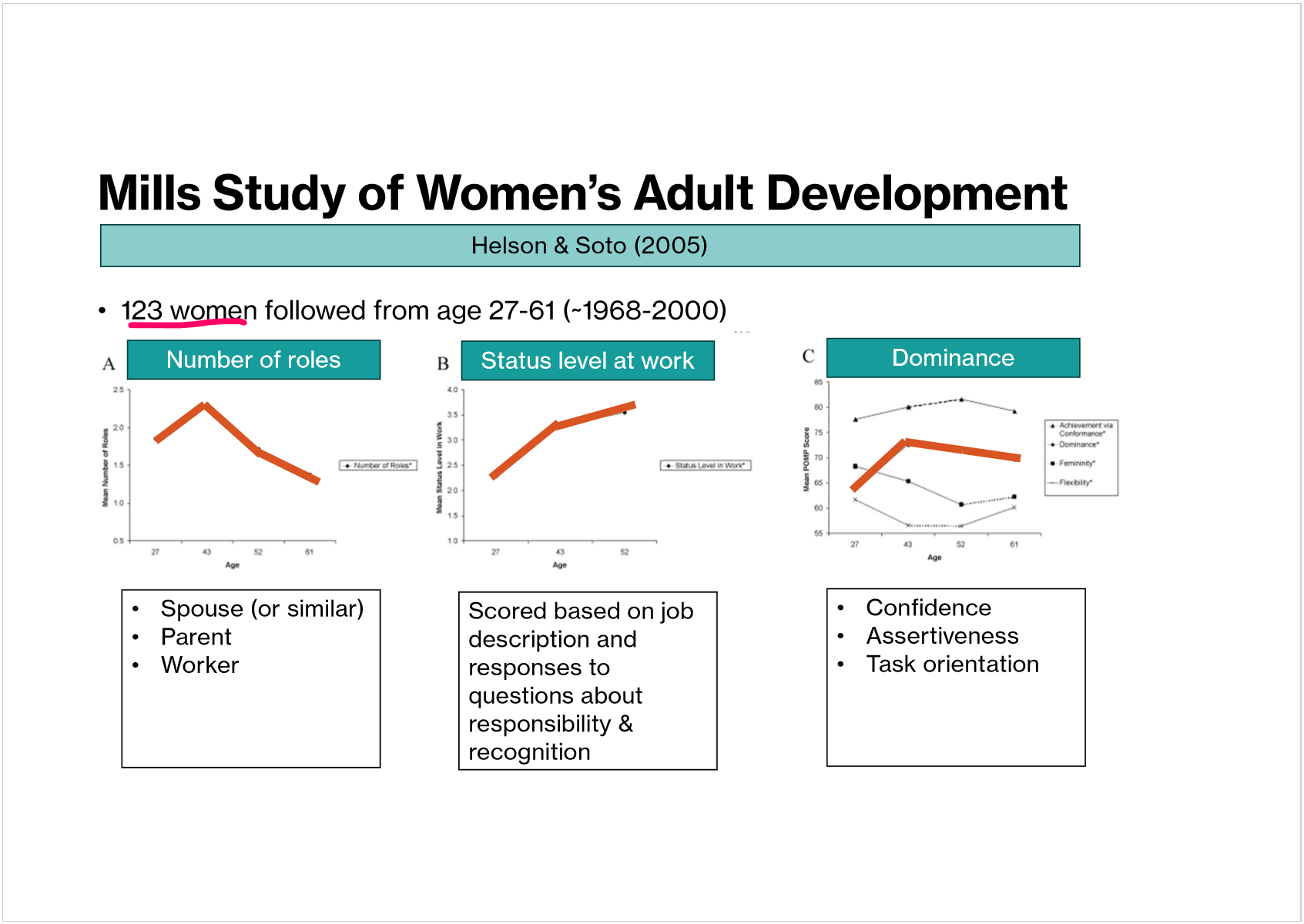
What did the Mills Study find about women in midlife?
Roles and work status are linked to traits like confidence, assertiveness, and task orientation.
What becomes more important in midlife according to research on meaning?
Health, financial security, leisure time, and harmony increase in importance.
karwetzsky et al. 2021
What becomes less important in midlife?
Social networks, career success, and love decrease slightly in importance compared to earlier life stages.
What is the pattern of life satisfaction in midlife?
Cross-sectional studies show a dip, but longitudinal studies suggest stable wellbeing.
How does stress exposure change with age?
Exposure to stress tends to decrease, though responsibilities remain high.
What are stressful life events common in midlife?
Divorce, job changes, death of friends, children leaving home, and lifestyle changes.
How stable is personality during midlife?
Personality is generally stable, with small changes in traits like extraversion and neuroticism.
How can life events affect personality in midlife?
Negative life changes can increase neuroticism and reduce extraversion.
extraversion and openess increased in women who got divroced
neurotisim increased when fired and consiousitness decreased
What is the role of optimism in midlife?
Optimism is linked to better physical health, mental wellbeing, and memory performance.
correlates with higher lipid profiels = better choloestrol
How does optimism change over time?
It generally increases into midlife and plateaus around age 55.
can be predicited (maybe) from todler behaviour and extraversion in adoloscence
What is a midlife crisis?
A period of reflection and potential lifestyle changes linked to awareness of ageing and mortality.
How common is a midlife crisis?
Occurs in about 10–20% of individuals, more often in men, but is controversial.
What are “turning points” in midlife?
Significant life events that reshape personal identity and life direction.
midlife crisis in men came from maritial satisifcation and quality of relationship with child
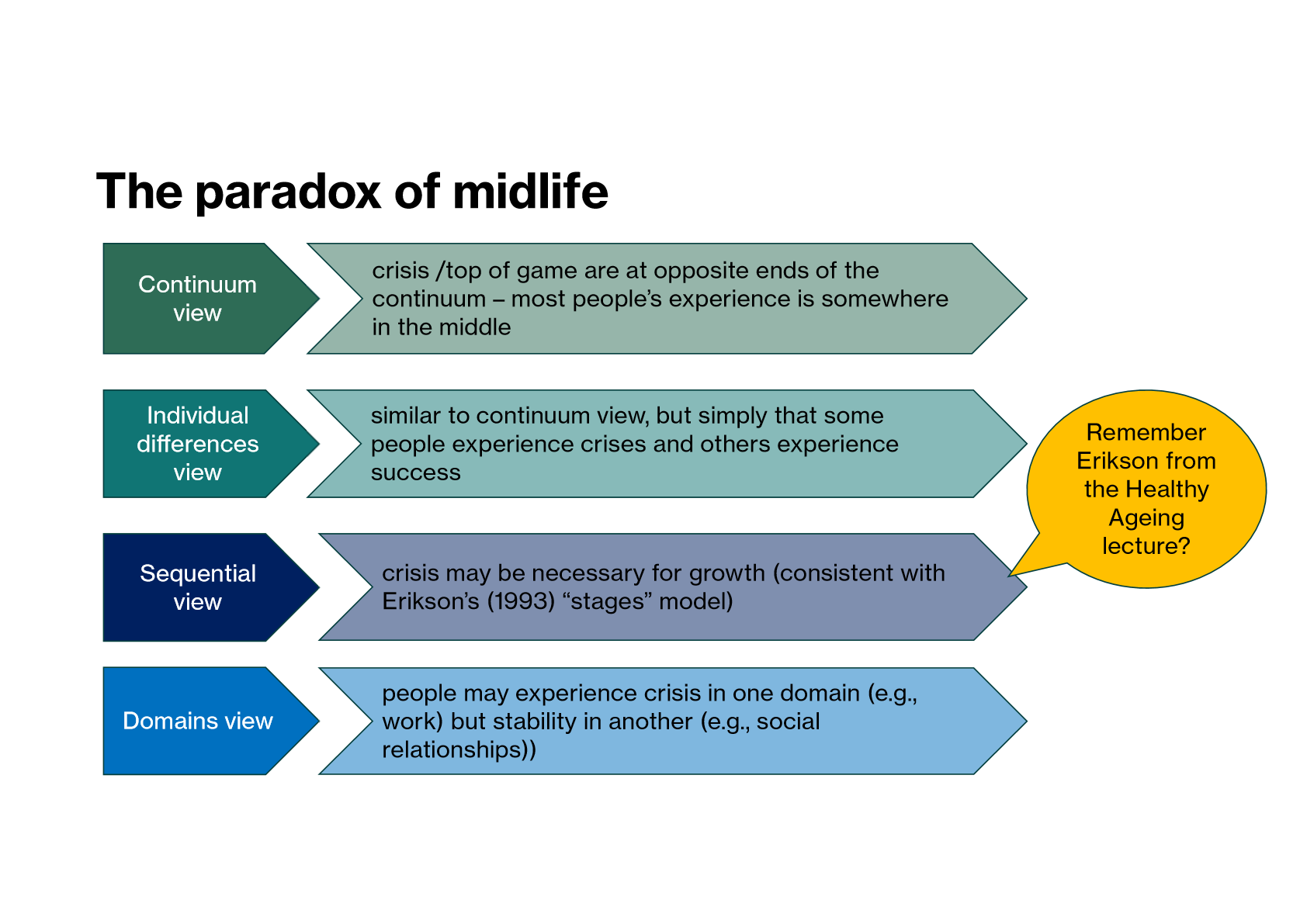
What is the paradox of midlife?
It can involve both high distress (e.g. anxiety, depression) and peak success (e.g. earnings, stability).
What are the four views of midlife experience?
Continuum, individual differences, sequential (crisis leads to growth), and domain-specific views.
What health changes occur during midlife?
Increased chronic illness risk, weight gain, less sleep, and declining physical capacity.
What hormonal changes occur in midlife?
Menopause in women and gradual testosterone decline in men (after 30) affecting mood, energy, and body composition.
What brain changes occur in midlife?
Hippocampal shrinkage accelerates and white matter begins to decline after peaking.
How does cognition change in midlife?
Declines in memory and processing speed, but improvements in reasoning, verbal skills, and decision making.
How does work influence cognitive ability in midlife?
More cognitively demanding jobs are associated with higher cognitive ability.
Why is midlife important for long-term outcomes?
It predicts health and cognitive function in old age and is key for early interventions.
e.g. high blood pressure in midlife but not old age predicited old age cognitive decline