Micro Lab Exam 2
 Call Kai
 Learn
Learn Practice Test
 Spaced Repetition
 Match
Match Flashcards
 Knowt Play
1/8

There's no tags or description
Looks like no tags are added yet.
Name | Mastery | Learn | Test | Matching | Spaced | Call with Kai |
|---|
No analytics yet
Send a link to your students to track their progress
9 Terms
Urea test
Purpose: To determine whether bacteria produce urease (a protease).
Content: Urea
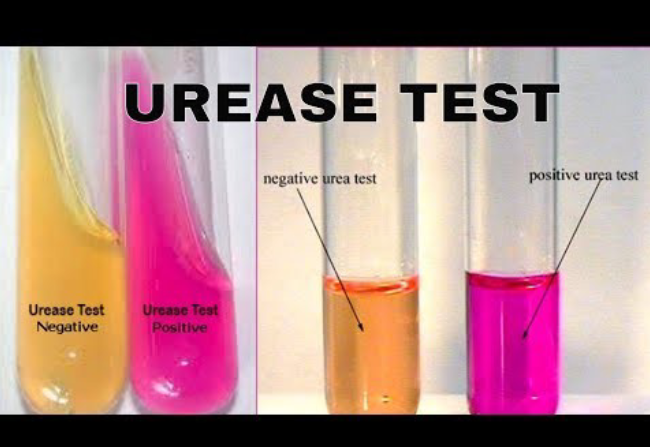
Detection method: pH indicator. When bacteria secrete urease, it hydrolyzes urea into ammonia (alkaline) and carbon dioxide changing the color of the media from yellow to pink
Original test color/physical appearance: Yellow slant
Positive result appearance: Media turned pink
Positive result interpretation: Urease was produced, breaking down the urea to form ammonia. This raised the pH (alkaline), causing the phenol red indicator to turn pink
Negative result appearance: Media stayed yellow
Negative result interpretation: Urease was not produced. Therefore, urea was not hydrolyzed, no ammonia was produced, and pH did not increase
Reagents: None. Media already contains pH indicator (phenol red)
Gelatin test
Purpose: To determine whether bacteria produce gelatin hydrolase (a protease)
Content: Protein gelatin
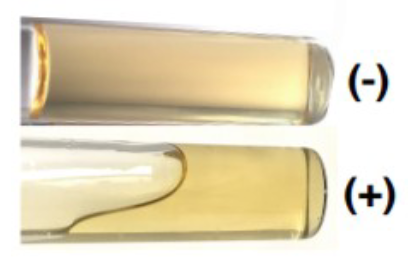
Detection Method: When bacteria secrete gelatin hydrolase into the media, the gelatin liquefies and the deep will no longer appear solid
Original test color/physical appearance: Clear/slightly amber solid medium (nutrient gelatin) in test tube
Positive result appearance: Medium becomes liquid (even if only top layer is liquid)
Positive result interpretation: Gelatin hydrolase was produced, hydrolyzing the gelatin and destroying its ability to solidify
Negative result appearance: Medium remains solid
Negative result interpretation: Gelatin hydrolase was not produced. Gelatin molecules remained intact, allowing medium to stay solid
Reagents: None
SIM test
Purpose: To determine if bacteria produce tryptophanase, are able to move and produce desulfhydrase
Content: Kovac’s reagent turns reed in the presence of indole. Reduced concentration of agar for motility. Sulfur-containing amino acids (methionine and cysteine) that can be desulfurylated (by enzymes like cysteine desulfhydrase)
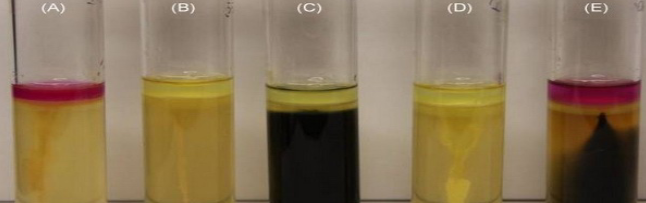
Detection Method: Kovac’s reagent turns red in the presence of indole. Media turned black if hydrogen sulfide was produced and you will see a cloudy or fuzzy growth throughout the agar if the bacteria are motile
Original test color/physical appearance: Semi-solid agar deep that is transparent and amber/straw-colored with a single stab line
Positive result appearance:
Indole - Media turned red (red/pink ring at the top after adding reagent)
Hydrogen sulfide - Media turned black
Motility - Cloudy growth spreading away from the stab line
Positive result interpretation: The organism can reduce sulfur to H2S, (meaning it possesses cysteine desulfhydrase), possesses the enzyme tryptophanase to produce indole, and/or has flagella allowing it to swim through the agar
Negative result appearance:
Indole - Reagent remains yellow/green at the top
Hydrogen sulfide - No black color (remains amber)
Motility - Growth is restricted only to the original stab line
Negative result interpretation: The organism cannot reduce sulfur (does not possess cysteine desulfhydrase), does not produce the enzyme tryptophanase, and/or lacks the ability to move (non-motile)
Reagents: Hydrogen sulfide and motility are read visually, but 4-5 drops of Kovac’s Reagent must be added to the top of the tube after incubation to detect the presence of indole
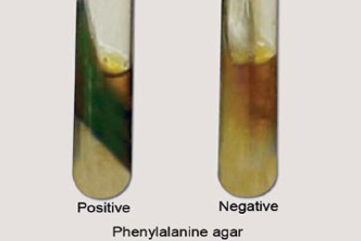
Phenylalanine test
Purpose: To determine whether bacteria produce phenylalanine deaminase (enzyme). This allows it to remove the amino group from the amino acid phenylalanine to produce phenylpyruvic acid (PPA) and ammonia
Content: Amino acid phenylalanine
Detection Method: PPA (phenylpyruvic acid) can be detected by ferric chloride. The ferric ion reacts with PPA to produce a green color
Original test color/physical appearance: Solid agar slant that is transparent and straw-colored/light yellow
Positive result appearance: Slant color changes from yellow to green
Positive result interpretation: Phenylalanine deaminase was produced, allowing it to deaminate phenylalanine into phenylpyruvic acid. This acid reacted with the added reagent to form a green-colored complex
Negative result appearance: Slant color stays yellow
Negative result interpretation: Phenylalanine deaminase was not produced, so no phenylpyruvic acid was formed to react with the reagent
Reagents: Add 4-5 drops of 10% Ferric Chloride (FeCl3) to the slant after incubation
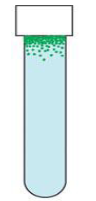
Obligate aerobe
Oxygen requirement: requires oxygen for growth (used in metabolism)
Oxygen tolerance: High
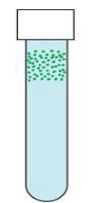
Growth pattern: Only at top (where oxygen is highest)
Metabolism: Aerobic respiration
Use oxygen in metabolism
+ for catalase
+ for cytochrome c oxidase
Possesses enzymes needed to process toxic oxygen products
Makes catalase
Makes superoxide dismutase
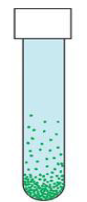
Obligate anaerobe
Oxygen requirement: Oxygen is toxic, cannot grow in its presence
Oxygen tolerance: None
Growth pattern: Only at bottom (away from oxygen)
Metabolism: Anaerobic respiration or fermentation
Lack the metabolic enzymes for using oxygen in respiration
- for catalase
- for oxidase
Lack the enzymes for processing toxic oxygen
Does not make catalase
Does not make superoxide dismutase
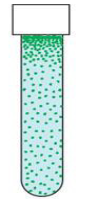
Facultative anaerobe
Oxygen requirement: Don’t require oxygen but use it when it is present, grows better with it (aerobic respiration), switches to fermentation/anaerobic respiration if not present
Oxygen tolerance: High
Growth pattern: All throughout tube but denser at top
Metabolism: Aerobic respiration (O2 present), anaerobic respiration and fermentation (O2 not present)
Possess the enzymes needed to use oxygen in respiration
+ for catalase
Can be +, - for cytochrome c oxidase (usually negative)
Possess the enzymes needed to process toxic oxygen products
Makes catalase
Makes superoxide dismutase
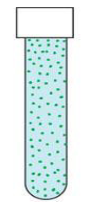
Aerotolerant anaerobe
Oxygen requirement: Does not use oxygen for growth (fermentation) but can survive and grow to a limited extent in its presence (block reactive oxygen species)
Oxygen tolerance: Moderate to high
Growth pattern: Evenly throughout tube
Metabolism: Fermentation
Do not possess the enzymes needed to use oxygen in respiration
- for catalase
- for cytochrome c oxidase
Possess some enzymes needed to process toxic oxygen products (have alternate mechanisms for breaking down peroxides and superoxide)
Does not make catalase
Makes superoxide dismutase
Microaerophile
Oxygen requirement: Grows best with CO2 and minimum oxygen. Harmed by normal atmospheric concentrations of oxygen. Require a small amount of it in metabolism
Oxygen tolerance: Low (high levels are toxic)
Growth pattern: Strip of growth not quite at top but close
Metabolism: Aerobic respiration
Possess the enzymes needed to use oxygen in respiration
+ for catalase (often weak)
+ for cytochrome c oxidase
Possess the enzymes needed to process toxic oxygen products
Makes catalase (low levels)
Makes superoxide dismutase (low levels)