Paper 2 : Sport Psychology
 Call Kai
 Learn
Learn Practice Test
 Spaced Repetition
 Match
Match Flashcards
 Knowt Play
1/49

There's no tags or description
Looks like no tags are added yet.
Name | Mastery | Learn | Test | Matching | Spaced | Call with Kai |
|---|
No analytics yet
Send a link to your students to track their progress
50 Terms
Explain why girls may form a negative attitude towards the sport of cricket.
(2)
• Negative opinions about cricket not being for girls from family/peers/significant others/not complying to social norm (1)
• Girls may have had a bad experience when previously playing cricket/becoming bored/disinterested (1)
• Lack of female role models in cricket – players/coaches/teachers (1)
• Lack of media coverage of female cricket – less promotion of the game (1)
The Triadic model helps to explain attitudes and how they are formed.
Describe how attitudes can be changed through cognitive dissonance.
(3)
Create a feeling of psychological discomfort / unease / conflict / disharmony (1) (through) putting pressure / challenging beliefs (cognitive) / emotions (affective) / behaviour through new information (1)
Changing one of the components so attitudes are aligned / discomfort is resolved (1)
Changing the cognitive component by adding new information to change what we know about sport (1)
Changing the affective component by adding rewards like praise to change how we feel (1)
Changing the behavioural component by breaking down the sill to increase success rare to change what we do (1)
Describe the three named components of the triadic model. (3)
• Cognitive − What you believe to be true (1)
• Affective − Your feelings or emotional response (1)
• Behavioural − Your intended behaviour dependent on your attitude (1)
Describe the factors that need to be considered to change the negative attitude of a performer using persuasive communication. (3)
• Ensure the messenger is of high status/significant other/credible so that the performer values their opinion (1)
• New information given so that old beliefs are outweighed allowing a change in attitude (1)
• Current strength of attitude will impact because if the performer values their belief highly they will be more resilient to change (1)
Describe how the negative attitude of players can impact on the cohesion of a team. (4)
Decrease in actual productivity of the team / players become part of a faulty process / actual productivity = potential productivity – losses due to faulty processes.
Poor coordination / poor motivation.
Social loafing – performer ‘hides’ within the team / reduced effort.
Ringlemann effect – performance / cohesion may decrease as group size increases.
(Poor task cohesion) – fail to work within the group to achieve a common goal / fail to follow tactics or equiv.
(Poor social cohesion) – poor social interaction within the group, causes cliques or equiv.
Describe the factors which affect whether a negative attitude may be changed using persuasive communication. (4)
Cognitive dissonance.
Persuasive communication.
Status of the messenger / person delivering the information / significant other.
Quality of the message / new information.
Situation / time when message is delivered.
Individual’s resistance to change / strength of current attitude.
Applied example – e.g. the head coach talks to the player individually and explains the need to change the tactics normally used to help team mates succeed or equiv.
(A & B must be identified to be awarded marks)
Describe how attitudes are formed. (3)
Attitudes are beliefs / values / feelings / behaviour linked to an attitude object (or equivalent)
Triadic Model / cognitive, affective, behavioural components
(Past experiences) – eg success creates positive emotions / negative experience a negative attitude / fear or failure or equiv
(Social learning / socialisation) – watching and copying others / peer groups / role models / family / teachers / coaches / media / cultural beliefs / traditions or equiv / cognitive dissonance / persuasive communication
(Conditioning) – behaviour followed by rewards encourages repeat behaviour / praise / rewards or equiv
(Familiarity / frequent exposure) – increased exposure more liked to form positive attitude eg attendance at a club or equiv
Identify four factors which determine whether the negative attitude of an individual can be changed using persuasive communication.
(4)
Status of messenger / person delivering information / significant other.
Quality of message / new information.
Situation / time when message is given.
Individual’s resistance to change.
Give examples of how a tennis player would display a positive ‘attitude’.
Refer to the component of the triadic model in your answer.
(3)
(Cognitive component) – believe / think they are training and playing in the correct manner or eq;
(Affective component) – positive feelings / emotions / enjoyment or eq.
(Behavioural component) – actions of the player / train regularly / compete fairly or eq.
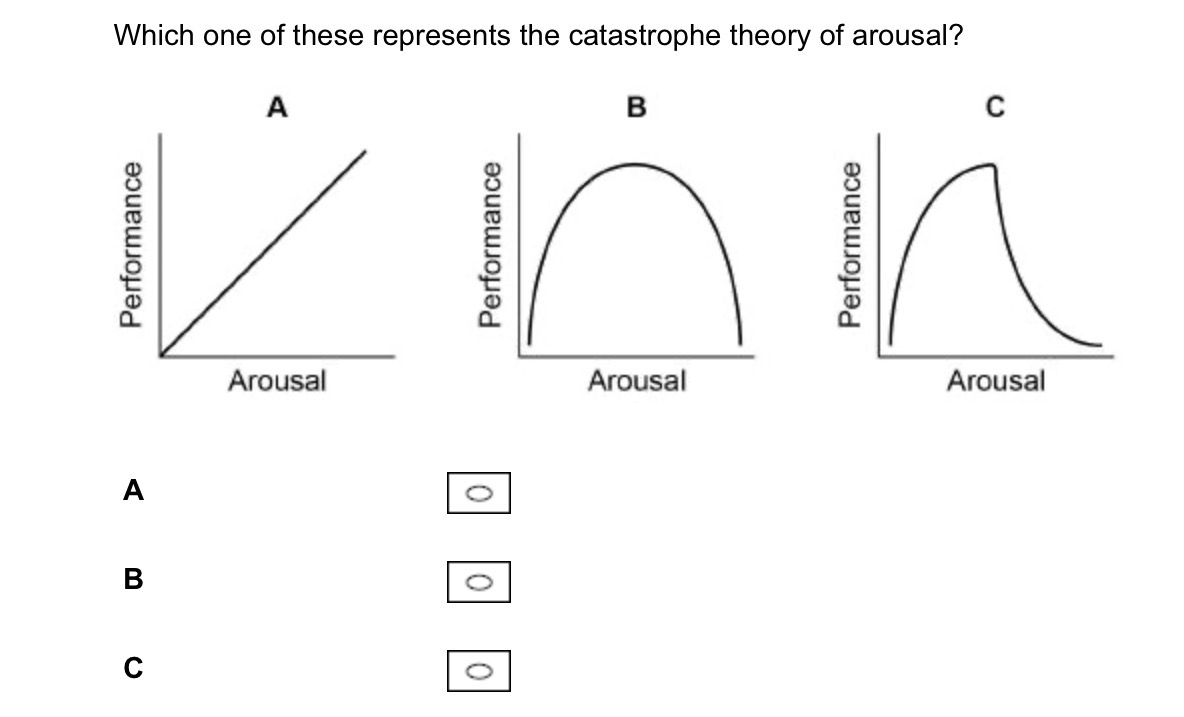
C
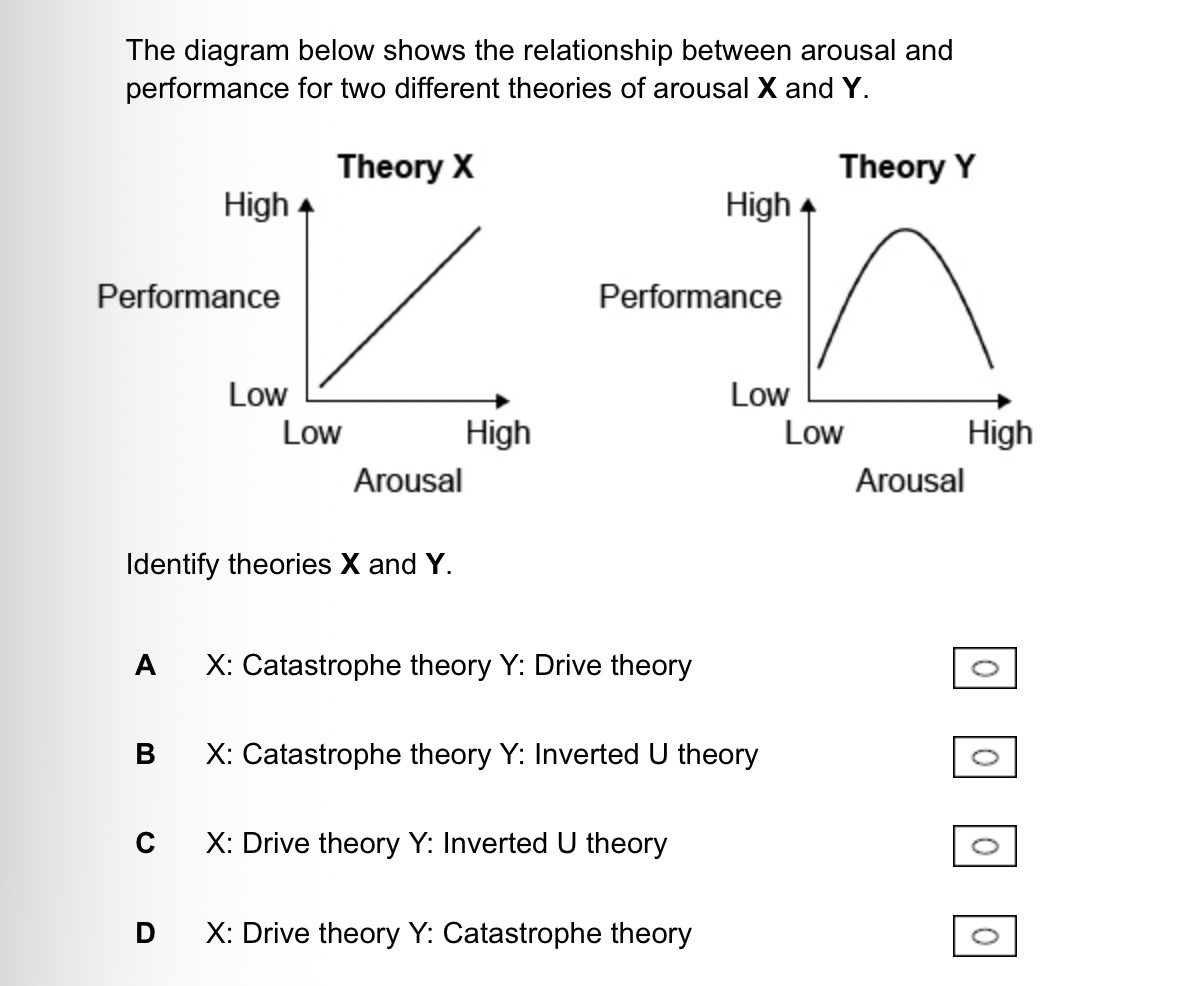
C
(4)
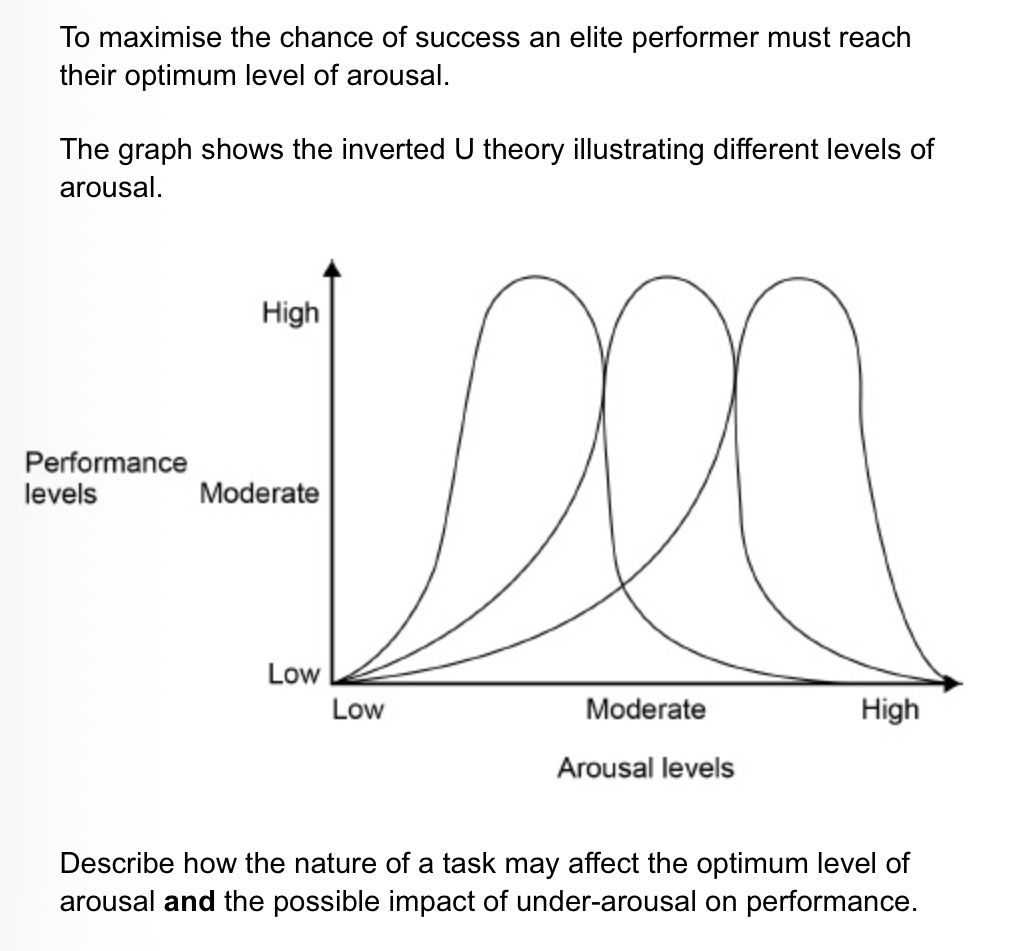
(Nature of the Task) complex or fine skills need lower levels of arousal
(Nature of the Task) simple or gross skills need higher levels of arousal
(Impact on performance) poor selective attention / cues missed
(Impact on performance) lack of concentration/focus
(Impact on performance) social loafing / social loafer
(Impact on performance) Ringelmann effect
(Impact on performance) slower / poor reaction time / response time/slower decision making
Attentional wastage
Attentional narrowing
Failed to reach zone of optimal functioning / peak flow experience
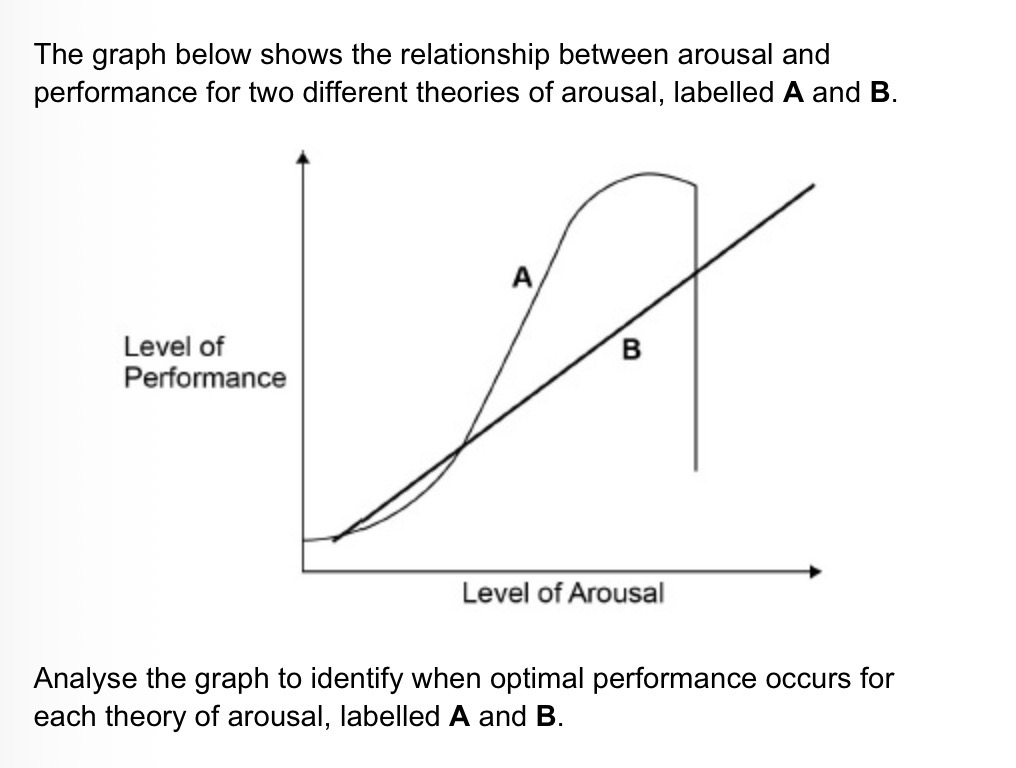
A – (Catastrophe theory) – at the top of the curve / equiv. (1).
B – (Drive theory) – at the top right end of the line / highest level of arousal (1).
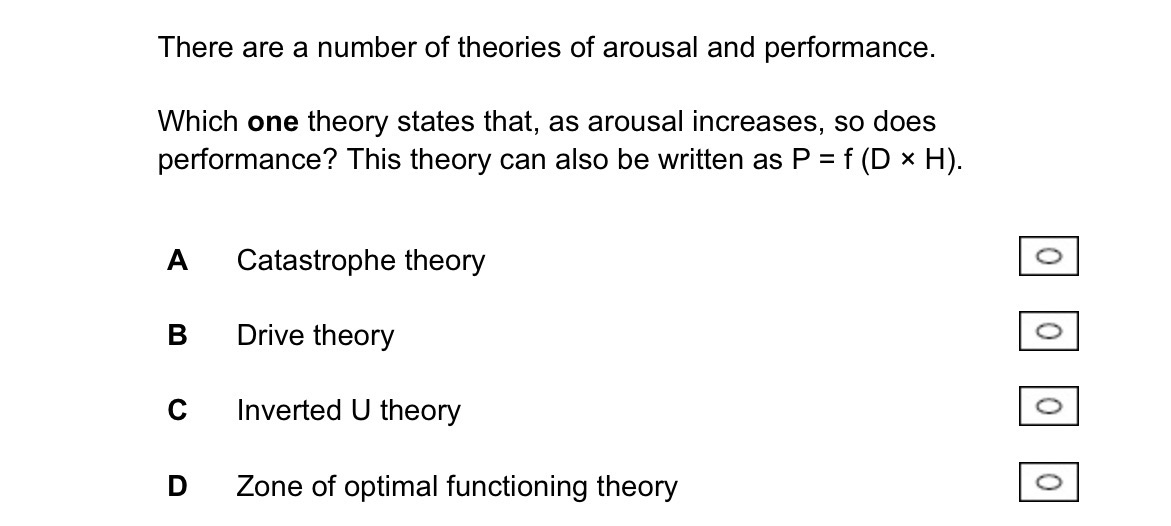
B
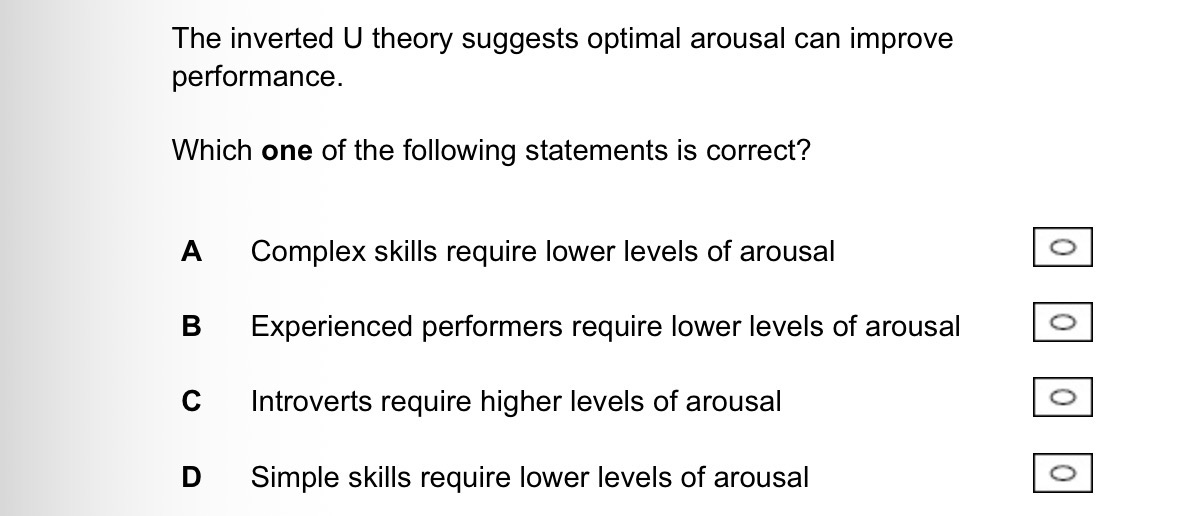
A
Apart from aggression, using appropriate psychological terms, explain the impact of over-arousal on the performer.
(4)
Anxiety - drop in performance
State anxiety / competitive state anxiety – increased level of anxiety at a specific time.
Cognitive anxiety – negative thoughts / emotions / accept suitable examples.
Somatic anxiety – increased physiological responses / accept suitable examples.
Evaluation apprehension – fear of performance being judged.
Social inhibition – increased anxiety due to others being present.
Selective attention / information processing – unable to focus on relevant cues.
Attentional narrowing – only focusing on specific cues rather than all those that are relevant.
Attentional wastage – focusing on cues that are irrelevant.
Elite performers must control their arousal levels in high pressure sporting situations, often in front of large audiences.
The inverted U theory suggests that performers have an optimal level of arousal.
Describe how three factors may influence different optimal levels of arousal.
(3)
(Skill level) – novice / cognitive performers lower levels of arousal / experienced / autonomous performers high levels
(Type of skill) – fine skills lower levels / gross skills higher levels
(Type of skill) – complex skills lower levels / simple skills higher levels
(Personality of the performer) – introverts lower levels / extroverts higher levels
The performer and the coach must work together so that the performer can control their arousal levels during a competition.
Identify three characteristics of the peak flow experience.
(3)
Highly focussed on the task / good selective attention / fully absorbed / involved in activity
Movement or skill feels effortless / physical and mental harmony
Clear goals
High levels of confidence / self-efficacy / sense of well being
Sub-conscious feelings of control / being on autopilot / automatic / optimal levels of arousal / zone of optimal functioning / ZOF
Explain why performers may have different levels of optimal arousal.
Refer to appropriate psychological theories throughout your answer.
(4)
Drive Theory
As arousal increases so does likelihood of dominant response/ habit
Experienced players perform better with higher levels of arousal/the more experienced players in a team require higher levels of arousal
Novice players perform better with lower levels of arousal
Inverted U Theory
As arousal increases so does performance but only to certain level
Optimal arousal occurs at moderate levels
(Personality of performer) - extroverts higher levels of arousal/introverts lower levels of arousal
(Nature of the Task) - complex or fine skills lower need lower levels of arousal/simple or gross skills need higher levels of arousal - Accept relevant sporting examples if used in correct context
(Skill of performer) - experienced higher levels of arousal/novices lower levels of arousal
Zone of Optimal Functioning
Some performers have a wider range of optimal arousal levels/different band widths of optimal arousal
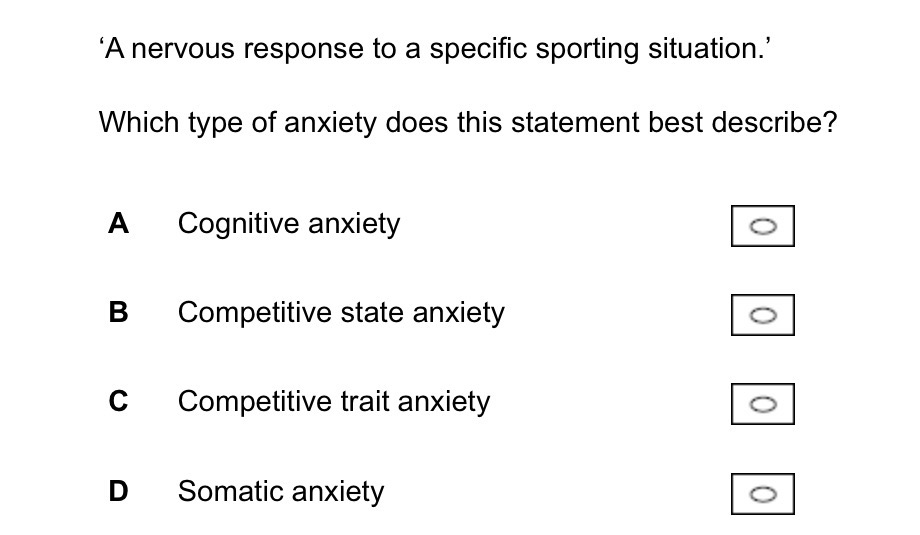
B
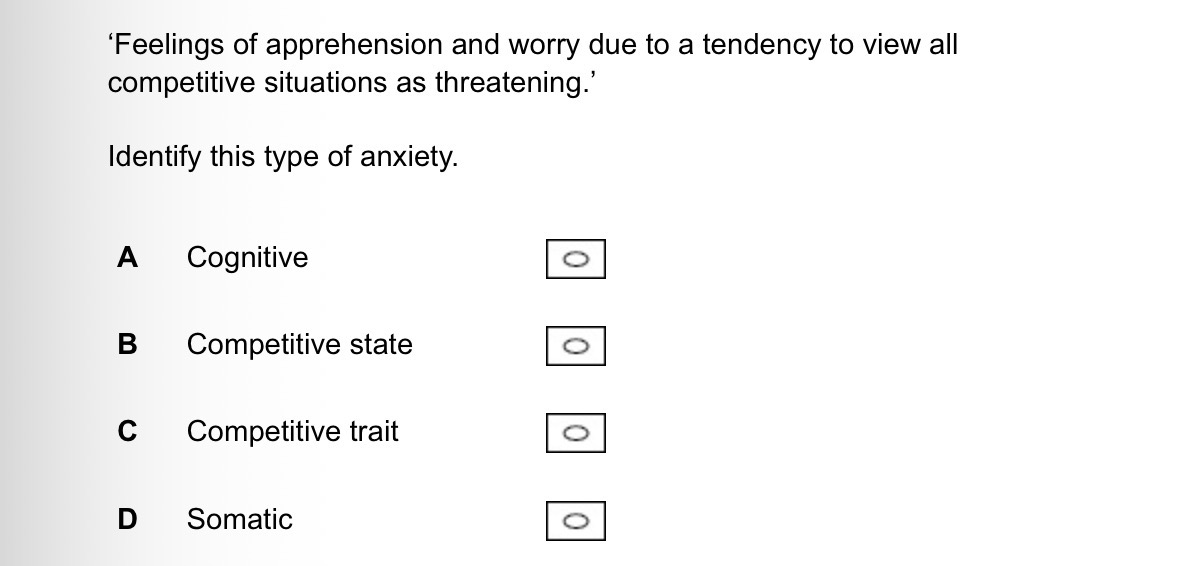
C
Describe what you understand by the term ‘competitive state anxiety’. (2)
• Anxiety experienced at a specific time during a competitive situation (1)
• May be cognitive and/or somatic anxiety (1)
Name one self-report questionnaire often used to measure anxiety and outline the disadvantages of using this form of data collection.
(3)
Sport Competition Anxiety Test / SCAT
State Trait Anxiety Inventory / STAI
Disadvantages
Misinterpretation of questions / lack of understanding
Answers may not be truthful / provide socially desirable answers
Questions may not allow for full answers / limited options to express emotions
Inappropriate questions / biased questions
Situation when completed may not be ideal / may rush to complete questionnaire
Outline three disadvantages of using observation as a method to assess anxiety.
(3)
Subjective / not objective.
Reliant on skill of the observer.
Time consuming / expensive / needs to be completed several times.
Observer needs to know normal behaviour patterns of performer for comparison.
May need several observers (at the same time).
If performer knows observation is occurring they may behave differently / become more
anxious / increased state anxiety / experience evaluation apprehension / social inhibition.
Name and describe two different types of anxiety that may affect a performer.
(4)
Competitive Trait Anxiety (1) – performer generally perceives competitive situations as threatening. (1)
Competitive State Anxiety (1) – level of anxiety during competitive situations. (1)
Cognitive anxiety (1) – psychological responses / thoughts and worries of performer / doubts in their ability to complete the task. (1)
Somatic anxiety (1) – physiological responses of performer / increased heart rate / sweating or eq. (1)
State three strategies a coach can use to prevent a performer behaving aggressively in a competitive situation.
(3)
• Punish/substitute the performer for behaving aggressively (1)
• Reinforce non-aggressive behaviour/promote non-aggressive role models (1)
• Talk to the performer during a break in play (1)
• Practice thought-stopping/mental rehearsal/imagery/other stress management techniques in training/before the match (1)
• Assign the performer to a position of responsibility in the team (1)
Outline three strategies a coach could use to eliminate aggressive behaviour.
(3)
• Punish aggressive acts/fine player/drop for next match or equiv (1)
• Develop players’ code of conduct/promote fair play (1)
• Remove from situation/change position/substitution/change tactics (1)
• Encourage peer support/group pressure (1)
• Give role of responsibility/set performance goals/process goals (1)
• Highlight non-aggressive/positive role models (1)
• Reduce importance of event/avoid ‘win at all cost’ attitude (1)
• Stress management techniques/accept named examples (1)
• Rewards/positive reinforcement for assertive play (1)
• Develop fitness levels (1)
The photograph below shows a bad tackle during a football match.
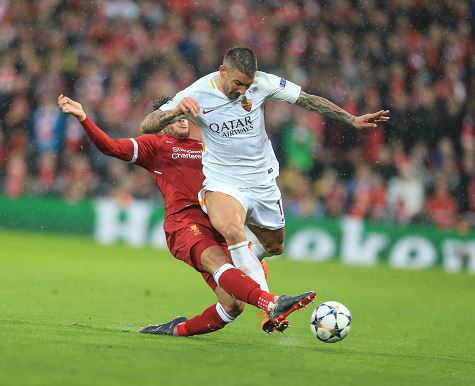
(a) Describe the frustration-aggression hypothesis. (1)
Frustration aggression theory states that when goals are blocked frustration occurs, which then leads to aggression (1)
The photograph below shows a bad tackle during a football match.
(b) Suggest why a bad tackle may take place. Refer to the frustration-aggression hypothesis. (2)
• (The player may have been prevented from achieving their goal) e.g. beating their opponent which leads to a blocked goal, which results in frustration (1)
• This leads to an aggressive act of a bad tackle (which leads to catharsis) (1)
• Catharsis only achieved when aggressive act e.g. bad tackle is achieved / aggression released / frustration lowered (1)
• However, if the player is unable to release this aggression then they may try to retaliate or release at another time as they remain frustrated (1)
• If the player is punished this could lead to further frustration and subsequent further aggression (1)
Define ‘aggression’ and ‘assertive behaviour’. Give a sporting example of each.
(4)
Aggression:
• intent to cause harm outside of the rules of the sport (1)
• eg punching/kicking an opponent in rugby/football (1)
Assertive behaviour:
• a forceful act within the rules of the sport (1)
• eg tackling an opponent forcefully, but legally in football/rugby/hockey (1)
Describe the ‘frustration-aggression hypothesis’ of aggression.
Give a sporting example in your answer.
(4)
AO1 (sub-max 3 marks)
• Blocked goal causes frustration (1).
• Frustration causes aggression (1).
• Release of aggression has cathartic effect/catharsis (1).
AO2 (sub-max 1 mark)
• Opponent in football consistently blocks your path, resultant frustration leads to aggressive act, eg pushing the opponent (1).
The diagram shows the frustration-aggression hypothesis, which offers one explanation for the cause of aggressive behaviour.
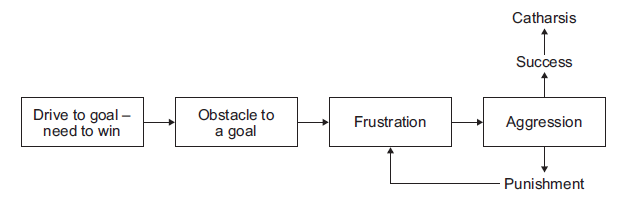
Describe the weaknesses of the frustration-aggression hypothesis.
Refer to other theories of aggression in your response.
(4)
Not all frustration leads to aggression
Not all aggression is the result of frustration
No allowance for situation/environment
Cue-arousal theory/aggressive cue hypothesis suggests aggression occurs when specific cues are present
Instinct/Trait Theory suggests aggression is innate
Instinct/Trait Theory suggests built up energy has to be released/cathartic effect
Social learning Theory/Observational Learning suggests behaviour is copied from others
Outline four strategies that a coach could use to develop the assertive behaviour of a performer.
(4)
Punish aggressive acts / fine player / drop for next match
Develop player’s code of conduct / promote fair play
Remove from situation / change position / substitution / change tactics
Encourage peer support / group pressure
Give role of responsibility / set performance goals / process goals
Highlight non-aggressive / positive role models
Reduce importance of event / avoid ‘win at all cost’ attitude
Stress management techniques / accept named examples
Rewards / positive reinforcement for assertive play
Develop fitness levels
Tuckman suggested that there are four stages of group formation.
Name the second and third stages of group formation.
(2)
Second : Storming
Third : Norming
Describe how faulty processes can have a negative impact on group productivity.
(4)
Actual / group productivity = Potential productivity - losses due to faulty processes
(Faulty process) Co-ordination losses
poor tactics / lack of communication / poor teamwork or equiv
Ringlemann Effect : as the group size increases the individual contribution decreases / more opportunity for communication breakdown
(Faulty process) Motivational losses
incorrect arousal levels / feeling under-valued / low self- efficacy / poor concentration / avoidance behaviour / fear of failure
Must be linked to the correct term
Social loafing : reduction in motivation and individual effort / individual hides in the group / coasts
Cohesion / Task cohesion decreases / actual productivity decreases
Social Cohesion is poor - social cliques formed
Identify three of Carron’s antecedents (factors) that contribute to the cohesiveness of a group.
(3)
Environment / situational factors – size of group / time / facilities / age or equivalent.
Member / personal factors – ability / motivation / satisfaction / similarity of group or equivalent.
Leadership factors – style / behaviour / personality / relationship with group or equivalent.
Team factors – task / motivation / stability / ability / shared experiences or equivalent.
Outline four factors which may impact group productivity. (4)
Co-ordination losses/faulty processes eg poor teamwork/ poor tactics
Motivational losses/faulty processes eg loss of concentration/low self-confidence
Social loafing – performer ‘hides’ within a team
Ringelmann effect – Performance/cohesion may decrease as group size increases
Task cohesion – ability of group to work together to achieve a common goal
Social cohesion – interaction of players and their interpersonal relationships
Outline four possible strategies that can be used to reduce the negative impact of faulty processes on performance.
(4)
Practice/training to ensure all understand the tactics
Give individuals specific responsibility/set goals
Explain specific roles within the team
Give feedback/video analysis of performance/ reinforcement
Develop peer support/encourage each other/encourage open discussion/an effective leader
Vary practice to maintain motivation/train in small groups
Improve fitness levels
Team bonding exercises/social outings
Avoid social cliques
Create a group identity eg team kit
Develop self-confidence/self-efficacy/self-esteem/ credit use of attributions
Maintain team stability if possible/limit change
Outline why ‘task cohesion’ is vital for success in any game.
(4)
Players need to be able to interact effectively / good communication;
Understand own role / other’s role / good co-ordination;
Poor cohesion can be classed as a faulty process;
Good task cohesion can help social cohesion;
Social cohesion – the ability of the group to relate well to each other / get along socially;
Social cohesion is not vital for group success / task cohesion is more important than social cohesion.
Elite performers may display different levels of confidence.
Outline how learned helplessness can affect the performance of an individual.
(3)
Performer perceives failure is inevitable / only option
Feel they have no control over the situation
(Causes) avoidance behaviour / no task persistence / giving up is the only option / lack of effort
(Causes) Global / general learned helplessness – general sporting situations, e.g. not good at racket sports
(Causes) Specific/Situational learned helplessness – specific sporting situations, e.g. not good at serving to win the match
During a basketball training session, a coach hears one of the performers saying:
“I just can’t do lay-up shots anymore”.
Exlpain how the basketball player is likely to respond to the rest of the training session.
Refer to learned helplessness in your answer.
(3)
• Performer appears to have situation specificlearned helplessness (1).
• Performer appears to perceive that failure is inevitable/only option/will always miss (1).
• Performer believes that they have no control over their ability to lay-up / shoot (1).
• May cause ‘avoidance behaviour’ / refuse to do lay-ups / shots / reduced task persistence / giving up is the only option/lack of effort when shooting (1).
• Potentially caused by attributing failure to ability / internal stable factors, eg ‘I can’t shoot because of my ability’ (1).
Outline four strategies a coach could use to avoid a performer experiencing learned helplessness.
(4)
Performance accomplishments / success from previous performances / reminding performer of previous success / or equivalent
Ensure success / gradually increase task difficulty / make task easier / avoid failure
Vicarious experiences / watching successful performances
Verbal persuasion / encouragement / positive feedback / reinforcement from coach
Control Emotional arousal / stress management techniques / mental rehearsal / establish set routines
Set goals / targets / performance goals rather than outcome goals / reduce importance of the outcome
Avoid social comparison with other performers
Use attributions correctly / attribution retraining / encourage self-serving bias
Describe how a captain may use knowledge of self-serving bias to motivate their team.
(4)
(self-serving bias) correct use of attributions to protect self-esteem / self-efficacy / self-confidence / avoid learned helplessness.
Attributing success to internal – stable factors / ability.
Attributing success to internal – unstable factors / effort.
Attribute failure to controllable factors.
Attributing failure to internal – unstable factors / effort.
Attributing failure to external – stable factors / task difficulty.
Attributing failure to external – unstable factors / luck.
Explain how a coach can use attributions to maintain high levels of motivation following a defeat.
(3)
Never attribute failure to internal-stable factors / ability as this leads to learned helplessness.
Promote a self-serving bias by:
(Attribute loss to) internal-unstable factors / effort.
(Attribute loss to) external-stable factors / task difficulty.
(Attribute loss to) external-unstable factors / luck.
Achieve this through the use of attribution retraining.
Describe what you understand by the term learned helplessness
(3)
Performer perceives failure is inevitable / only option
No control over the situation
Causes avoidance behaviour / no task persistence / giving up is the only option / lack of effort
Caused by attributing failure to ability / internal stable factors
Global / general learned helplessness – general sporting situations, eg not good at water sports
Specific / Situational learned helplessness – specific situations, eg not good at diving in the pool
Define the term attribution.
(1)
Perceived reason/cause/blame for success/failure of performance (1).
The table below shows Weiner’s Model of attribution.
| Locus of Causality | ||
Locus of Stability |
| Internal | External |
Stable | Ability | C | |
Unstable | B | D | |
(b) Give sporting examples of different attributions labelled B, Cand D.
(3)
• (B – effort) amount of practice/preparation given for performance by the performer (1).
• (C – task difficulty) standard of competition/opposition (1).
• (D – luck – factors beyond performer’s control) – poor weather/ windy weather blowing shots off target/poor refereeing decisions, eg disallowing a goal (1).
Learned helplessness can be general or specific.
Define both of these terms.
(2)
General learned helplessness:
Self-doubt, or a lack of belief that affects an individual in a range of situations/the belief they’re unable to perform in all aspects of a sport or even all sports (1)
Specific learned helplessness:
Self-doubt, or a lack of belief that affects an individual in a situation/a performer feeling they’re unable to perform well in one particular position or when executing one type of tactic (1)