5.1 Photosynthesis
 Call Kai
 Learn
Learn Practice Test
 Spaced Repetition
 Match
Match Flashcards
 Knowt Play
1/109

There's no tags or description
Looks like no tags are added yet.
Name | Mastery | Learn | Test | Matching | Spaced | Call with Kai |
|---|
No analytics yet
Send a link to your students to track their progress
110 Terms
What is photosynthesis?
CO₂ + H₂O is used to form glucose, using light energy.
The light energy is converted into chemical energy.
6CO₂ + H₂O → C₆H₁₂O₆ + 6O₂
What are the main stages of photosynthesis?
1. Capturing of light energy
2. Light dependent reaction
3. Light independent reaction
Adaptations of a leaf for photosynthesis
● Many stomata give a large surface area - absorbs as much sunlight as possible
● Thin - short diffusion distance for gases
● Transparent epidermis - let light through to the photosynthetic mesophyll cells beneath
● Long, narrow upper mesophyll cells - packed with chloroplasts that collect sunlight
● Stomata - open and close in response to changes in light intensity
● Many air spaces in spongy lower mesophyll layer - allow rapid diffusion in the gas phase of carbon dioxide and oxygen
● Network of xylem + phloem - brings water, carries away the sugars produced during photosynthesis.
Briefly describe the main stages of photosynthesis.
1. Capturing of light energy - by chloroplast pigments such as chlorophyll
2. Light dependent reaction - Thylakoid membrane of chloroplast, produce ATP + NADPH
3. Light independent reaction - Stroma of chloroplast. Protons are used to produce sugars/other organic molecules.
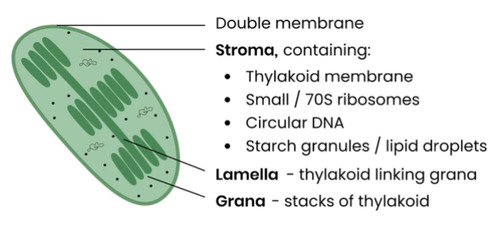
Structure of chloroplasts
● Double membrane and disk shaped
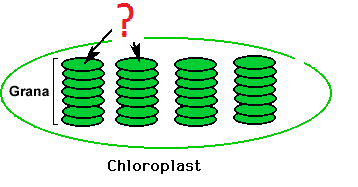
● Thylakoids- folded membranes embedded with pigment/chlorophyll
● Thylakoids (singular pancake) Grana (Stack of pancakes)
● Lamellae- flattened membranes which connect grana to transport chemicals
● Fluid-filled stroma with starch grains for energy storage
Adaptations for the Chloroplast internal structure
● Stroma contains DNA & ribosomes → for protein synthesis
● Stroma contains enzymes → for photosynthesis
● Stroma contains starch grains → for energy storage
● Thylakoids are flattened sacs → increase surface area for photosynthesis
● Chlorophyll → absorbs light for photosynthesis
What does chlorophyll do?
Thylakoids contain many pigments e.g. chlorophyll.
Different pigments absorb different wavelengths of light, otherwise are reflected.
Adaptations of chloroplasts for the light-dependent reaction
● Chloroplasts contain both DNA & ribosomes for protein synthesis.
● Chlorophyll is arranged in a way that maximises light absorption.
● Thylakoid membranes are selectively permeable.
● Large surface area of thylakoid membrane for ETC.
● Granal membranes contain ATP synthase to catalyse the production of ATP for photosynthesis
Give an overview of the light dependent reaction.
Light energy and water are used to create ATP and reduced NADP, which are needed for the LIR.
Non cyclic phosphorylation:
● Photoionisation of chlorophyll
● Photolysis of water
● Production of ATP and reduced NADP (NADPH)
● Chemiosmosis
Cyclic phosphorylation
Where does the light dependent reaction occur?
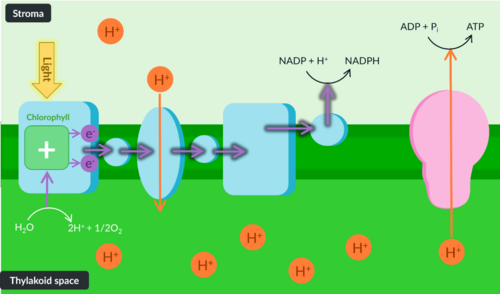
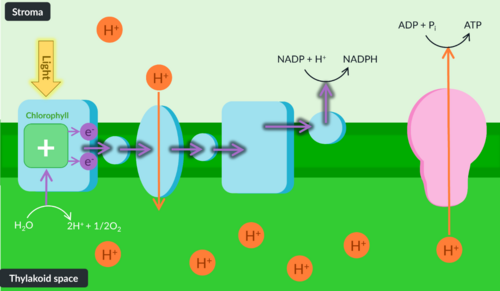
Thylakoid membrane - sits between the thylakoid space and the stroma
Oxidation
- Loss of electrons
- Loss of hydrogen
- Gain of oxygen
- Energy given out
Reduction
- Gain of electrons
- Gain of hydrogen
- Loss of oxygen
- Energy taken in
Chemiosmosis
A process for synthesising ATP using the energy of a proton gradient and diffusion of H+ ions down the ATP synthase enzyme from an area of high to low concentration
H+ are actively transported across parially permeable thylakoid membrane from stroma to thylakoid space using energy from electron transport chain
What allows ATP to be produced in the LDR ?
Diffusion of protons down concentration/proton gradient through ATP synthase, provides energy for ATP production
Describe how ATP is produced in the light dependent reaction.
●Via a process called photophosphorelation and occurs in the thylakoid membrane
● Energy is transferred to ATP synthase enzyme by the diffusion of protons down a proton gradient via chemiosmosis
● The protons move from the thylakoid space into the stroma.
Photophosphorylation
● Method of producing ATP from ADP + Pi (ADP is phosphorylated)
● By diffusion of protons from the thylakoid membrane of the chloroplast to the stroma (Think TS)
● During the LDR of photosynthesis.
Where does ATP synthase get the energy to produce ATP ?
By chemiosmosis: the diffusion of protons down the proton gradient through ATP synthase.
How Is the Proton Gradient maintained in the Thylakoid?
● Protons are actively transported from the stroma to the thylakoid space.
● To ensure there's always a higher concentration of protons in the thylakoid space compared to the stroma.
● Active transport requires energy
Describe the role of electron transport chains in the light dependent reactions of photosynthesis. (5)
1. electron transport chain accepts excited electrons;
2. from chlorophyll /
3. electrons lose energy along chain
4. ATP produced;
5. from ADP and Pi;
6. reduced NADP formed;
7. when electrons (from transport chain) and H+ combine with NADP;
8. H+ from photolysis;
Give the order in which you should write the LDR
1. Photoionisation
2. Electron transfer chain
Photoionisation
● Chlorophyll absorbs light energy which excites it's electrons (higher energy level), is oxidised,
● So electrons released from chlorophyll, go to electron transfer chain (chlorophyll is oxidised and becomes positively charged)
Electron transfer chain
● Electron transport chain accepts excited electrons from chlorophyll
● Series of oxidation-reduction reactions which cause electrons to lose energy along chain
● Energy transferred to protein complex, which enables it to actively transport protons (from stroma to thylakoid, against conc grad)
Describe what happens after photoionisation in the LDR.
Some energy from electrons released in photoionisation is conserved in the production of ATP / reduced NADP (chemiosmotic theory):
1. Electrons move along electron transfer chain (electron carriers), releasing energy, series of redox reactions
2. Energy released is used to actively pump H⁺ from stroma into thylakoid
3. Protons move by facilitated diffusion, down proton gradient into stroma, via ATP synthase
4. Energy used to join ADP and Pi to form ATP (photophosphorylation)
5. NADP accepts a H⁺ and an e⁻ to become reduced NADP
Describe photolysis of water in the LDR.
● Light energy is absorbed by chlorophyll, water splits into protons, electrons and oxygen (H₂O → 2H⁺ + 2e⁻ + ½O₂)
○ Electrons replace those lost from chlorophyll during photoionisation.
Give the uses of the products from photolysis of water.
H⁺ ion - NADP picks it up and is reduced to form NADPH, which is used in LIR. Maintains high conc H⁺ in thylakoid space.
Electron - Replaces electrons in chlorophyll which were lost by photoionisation
Oxygen - Used in respiration or released out stomata by diffusion
Why is reduced NADP called NADPH ?
NADP picks up an e⁻ and a H⁺ so is reduced
e⁻ + H⁺ → Hydrogen atom
What is a hydrogen atom (H) ?
A proton and an electron
True or false - photolysis occurs in the thylakoid space.
True
NADP
A coenzyme used in photosynthesis that transfers hydrogen ions and electrons, being reduced to NADPH in the light-dependent reactions.
Coenzyme
A non-protein compound which helps an enzyme to carry out it's function
Photolysis
The splitting of water molecules during the light-dependent reactions, releasing protons (H+), electrons, and oxygen.
Final electron acceptor
NADP, which accepts electrons at the end of the electron transport chain, as well as a proton from the stroma to form NADPH.
NADPH
Reduced NADP
2 products produced by the LDR
ATP
NADPH (reduced NADP)
How is a proton concentration gradient established during chemiosmosis?
Some energy released from the ETC is coupled to the active transport of H+ ions (protons) from the stroma into the thylakoid space.
Why can protons only cross membrane through ATP synthase channels ?
The rest of the membrane is impermeable to protons; selectively permeable.
The complete light dependent reaction
● Photoionisation: Chlorophyll absorbs light energy which hits leaf, exciting it's electrons
● Electrons leave chlorophyll, chlorophyll is oxidised (now +ve)
● Photolysis: Light splits H₂O into 2H⁺ + 2e⁻ + ½O₂
Electrons replace those lost from chlorophyll
● Electrons that left chlorophyll move along electron transfer chain via redox reactions, releasing energy
● This energy is used to actively transport H⁺ from stroma to thylakoid space (maintain proton gradient)
● Electrons (at end of electron transfer chain) react with NADP and H⁺ to form NADPH
● Proton gradient allows diffusion of protons from thylakoid space to stroma via ATP synthase, supplies it with energy to catalyse reaction of ADP + Pi → ATP (chemiosmosis)
The student used a redox indicator called methylene blue to investigate the light-dependent reaction. Methylene blue is blue when oxidised and colourless when reduced.
3 test tubes set up as follows:
Tube 1: 1cm³ of the suspension without chloroplasts and 9 cm³ of methylene blue, without tinfoil around the tube.
Tube 2 :1cm³ of chloroplast suspension and 9 cm³ of methylene blue, with tinfoil around the tube.
Tube 3: 1cm³ of chloroplast suspension and 9 cm³ of methylene blue, without tinfoil around the tube.
All three test tubes were placed in a water bath at 25°C for 20 minutes.
The student recorded the colour of the solution in each test tube after 20 minutes. All three test tubes appeared blue initially.
After 20 minutes, Tube 1 and Tube 2 remained blue while the solution in Tube 3 turned green.
a. Explain why Tube 2 remained blue but Tube 3 turned green.
b. What is the purpose of Tube 1?
a. In Tube 3, methylene blue was reduced by electrons from the electron transfer chain in the light-dependent reaction. Methylene blue turns colourless when it is reduced but Tube 3 appears green because chlorophyll in chloroplasts has a green colour.
In Tube 2, no colour change as tube is covered in tinfoil, prevents light entering tube and reaching the chloroplasts. No light = no LDR so there are no electrons to reduce methylene blue. Therefore, methylene remains oxidised and remains blue.
b. Tube 1 contains methylene blue but no chloroplasts. This acts as a negative control to show that methylene blue does not change colour in the absence of chloroplasts. It shows that it is electrons from the LDR that are responsible for reducing methylene blue and making it colourless.
LIGHT INDEPENDENT REACTION - CALVIN CYCLE
What is the light independent reaction ?
Calvin Cycle
● Products of LDR (ATP + NADPH) used to reduce GP
● Doesn't require light DIRECTLY but requires the products of the LDR, so ceases when light is absent
Name the 3 main stages in the Calvin cycle.
1. Carbon fixation
2. Reduction
3. Regeneration
State the number of carbon atoms in RuBP, GP, and triose phosphate
RuBP: 5
GP: 3
Triose phosphate: 3
What affects the LIR ?
Temperature - as it involves ENZYMES
Where precisely in a cell does the Calvin cycle take place ?
Stroma of chloroplasts
Where precisely is rubisco found in a cell?
Stroma of chloroplast
How are chloroplasts adapted to carry out light-independent reactions ?
● Own DNA & ribosomes for synthesis of enzymes e.g. rubisco.
● High concentration of enzymes & substrates in stroma
○ Stroma fluid is membrane-bound in the chloroplast, so a chemical environment (with high concentration of enzymes and substrates) can be maintained within it - as distinct from the environment of the cytoplasm.
● The stroma fluid surrounds the grana so the products of the LDR in the grana can readily diffuse into the stroma
How does the structure of the chloroplast maximise the rate of the light-independent reaction?
● Own DNA & ribosomes for synthesis of enzymes e.g. rubisco.
● High concentration of enzymes & substrates in stroma
Overview of LIR
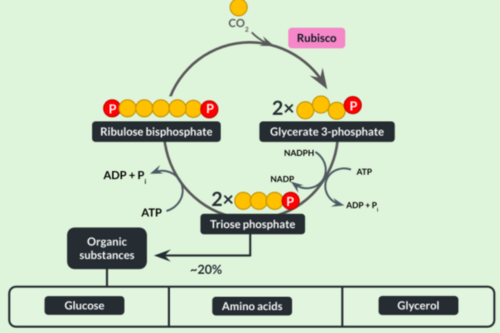
CO₂ combines with RuBP to make TP.
TP can then be used to make glucose (and other organic substances for plant).
1. Formation of GP
2. Formation of TP
3. Regeneration of RuBP
Give the number of carbons throughout the Calvin cycle.
RuBP = 5C
x2 GP = 3C (each)
x2 TP = 3C (each)
RuBP
Ribulose bisphosphate
● 5-carbon sugar, with 2 phosphates
● Reacts with CO₂, catalysed by enzyme rubisco, to form 2x GP
2x Glycerate 3-phosphate (GP)
2 lots of Glycerate 3-phosphate (GP)
● Each contains 3 carbons and 1 phosphate
● 6 carbons in total
2x Triose phosphate (TP)
2 lots of triose phosphate (TP)
● Each contains 3 carbons and 1 phosphate
How is GP reduced to TP
● Using the H from NADPH
● Using energy from hydrolysis of ATP → ADP + Pi
What happens to NADP, and ADP + Pi after the LIR ?
● (In stroma) return to thylakoid membrane
● Where they can form new ATP and NADPH in the LDR,
● Which can then return to the stroma for the LIR
● Creates a loop
What happens to TP once it's produced?
● ⅚ of TP is used to regenerate ribulose bisphosphate (RuBP) to ensure cycle continues
● This requires energy from ATP
● Where the ADP + Pi can also return to thylakoid for LDR
Which organic substances does TP go on to produce?
● Glucose
Which is used in respiration
C₆H₁₂O₆ + 6O₂ → 6CO₂ + 6H₂O + ATP
● Amino acids
To produce proteins
● Glycerol
Combines with 3 fatty acids to form triglycerides (storage, energy + water source)
The majority of triose phosphate molecules produced in the light-independent reaction are used to reform ribulose bisphosphate. This reaction requires...
ATP
Describe the light-independent reaction of photosynthesis (Calvin cycle)
1. CO₂ reacts with ribulose bisphosphate (RuBP - 5C)
○ Catalysed by enzyme rubisco
2. Forming 2x glycerate 3-phosphate (GP) molecules
3. GP reduced to triose phosphate (TP)
○ Using products from LDR - reduced NADP (NADPH) and energy from hydrolysis of ATP
4. ⅚ TP used to regenerate RuBP in the Calvin cycle (using energy from ATP)
5. ⅙ TP converted to useful organic substances (e.g. glucose, amino acids, glycerol)
Calvin cycle - more depth (don't need to learn this one)
1. CO₂ enters leaf through stomata and diffuses into stroma.
2. Combines with RuBP (5C)
3. Reaction catalysed by rubisco enzyme.
4. Forms 2 molecules of glycerate-3-phosphate (2x 3C)
5. Hydrolysis of ATP → ADP + Pi (from LDR) provides energy to reduce GP into TP (2x 3C).
6. Reaction requires H+ ions from NADPH, which is oxidised and recycled to form NADP and returns to LDR to be reduced again by accepting more protons
7. ⅙ TP converted into useful organic hexose sugars e.g. glucose and ⅚ continues to regenerate RuBP - this uses the rest of the ATP produced by the LDR
8. Each cycle releases 1 carbon from TP, the other 5 carbon go to next step
Explain the inefficiency of the Calvin cycle.
Requires 6 turns to make 1 hexose sugar.
● 1 CO₂ cycle produces 2 TP
● 3 cycles produces 6 TP
● ⅙ of TP produced is actually used for sugar formation
● So for 3 turns, 1 useful TP is produced
● So 6 turns, 2 useful TP is produced
● 2x TP = hexose sugar
● So need 6 turns of the cycle
● 6 turns of the cycle needs from the LDR:
○ 18 ATP
○ 12 reduced NADP
How does the light independent reaction result in the production of useful organic substances?
1C leaves the cycle (i.e. some of the TP is converted into useful organic molecules).
LIMITING FACTORS
State the limiting factors of photosynthesis.
Temperature
Light intensity
Carbon dioxide concentration
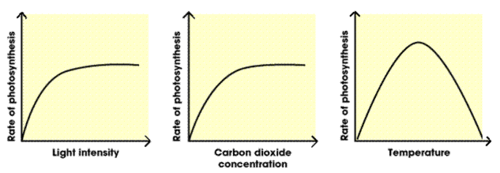
Describe and explain how temperature affects rate of photosynthesis.
1. As temperature increases, rate increases
○ Enzymes (e.g. rubisco, ATP synthase) gain kinetic energy
○ So more E-S complexes form
2. Above an optimum temperature, rate decreases
○ Enzymes in LIR denature as H bonds in tertiary structure break
○ So fewer E-S complexes form
○ And proteins in thylakoid membrane can get damaged
Temp below 10°C enzyme becomes inactive.
Temp above 45°C enzyme denatures.
Describe and explain how light intensity affects rate of photosynthesis.
1. As light intensity increases, rate increases
○ LDR increases (e.g. more photolysis of water and photoionisation of chlorophyll) so more ATP and NADPH produced
○ So LIR increases as more GP reduced to TP and more TP regenerates RuBP
2. Above a certain light intensity, rate stops increasing
○ Another factor is limiting e.g. temperature / CO₂ concentration
● When light is limiting factor, the rate of photosynthesis is directly proportional to light intensity.
Light compensation point
● As light intensity is increased, the volume of O₂ produced and CO₂ absorbed due to photosynthesis will increase
● Photosynthesis and respiration are balanced
● No net exchange of gases into/ out of the plant.
Describe and explain how CO₂ concentration affects rate of photosynthesis
1. As CO₂ concentration increases, rate increases
○ LDR increases
○ As more CO₂ combines with RuBP to form GP
○ So more GP reduced to TP
○ So more TP converted to organic substances and more RuBP regenerated
2. Above a certain CO₂ concentration, rate stops increasing
○ Another factor is limiting e.g. temperature / light intensity
What else can inhibit the rate of photosynthesis?
Water; Plants need a constant supply of water as it is a reactant for photosynthesis, but too much causes waterlogged soils, reducing the uptake of minerals like magnesium, required for formation of chlorophyll, as it is a more hypotonic solution.
Explain the key consideration when evaluating data relating to agricultural practices used to overcome the effect of limiting factors.
● Agricultural practice should increase rate of photosynthesis, leading to increased yield.
○ As more glucose produced for faster respiration.
○ So more ATP to release energy for growth e.g. cell division, protein synthesis.
● But profit from extra yield should be greater than costs (money & environmental costs).
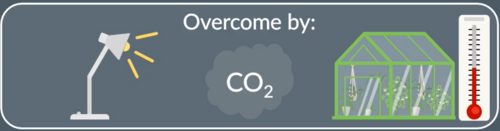
List 3 ways farmers can overcome some of the limiting factors of photosynthesis.
● Artificial / LED lighting to maintain a high light intensity.
● Re-use CO₂ waste / burn fuels to maintain a high CO₂ concentration.
● Use greenhouses kept at specific temperatures.
Suggest how a student could investigate the effect of a named variable on the rate of photosynthesis.
Dependent variable: rate of O₂ production/ CO₂ consumption
1. Use a potometer
2. Place balls of calcium alginate containing green algae in hydrogencarbonate indicator (colour change orange → magenta as CO2 is consumed & pH increases).
In addition to phospholipids, thylakoid membranes also have phytosterols. Phytosterols behave like cholesterol in the phospholipid bilayers of animal cells.
O. caespitosa has a greater amount of phytosterols than A. thaliana.
There is a difference in how temperature affects the rate of photosynthesis of O. caespitosa and A. thaliana.
Suggest a reason for this difference.
- O. caespitosa is able to continue to photosynthesise at higher temperatures compared to A. thaliana. Can be explained by the composition of its thylakoid membrane.
- O. caespitosa has a greater amount of phytosterols in its phospholipid bilayer, stabilises the thylakoid membrane at higher temperatures by stopping the membrane from becoming too fluid.
- Phytosterol molecules bind to the hydrophobic tails of phospholipids, stabilising them and causing phospholipids to pack more closely together.
- This means that the thylakoid membrane is stabilised at higher temperatures and the light-dependent reaction of photosynthesis can continue to occur at higher temperatures.
- However, eventually, the temperature is too high for the phytosterol molecules to continue to stabilise the thylakoid membrane.
- At this point, the membrane is disrupted, the rate of the light-dependent reaction decreases and the rate of photosynthesis decreases.
In natural ecosystems, most of the light falling on producers is not used in photosynthesis.
Suggest 2 reasons why.
1. (Light is) reflected
2. (Light is) wrong wavelength;
3. (Light) misses chlorophyll/ chloroplasts;
4. CO₂ conc or temperature is a limiting factor.
The herbicide atrazine binds to proteins in the electron transfer chain in chloroplasts of weeds, reducing the transfer of electrons down the chain. Explain how this reduces the rate of photosynthesis in weeds.
1. Reduced transfer of protons across thylakoid membrane OR
Reduced chemiosomotic / proton gradient across thylakoid membrane;
2. (So) less ATP produced;
3. (So) less reduced NADP produced (NADPH)
4. (So) light-independent reaction slows / stops;
OR
Less reduction of GP to triose phosphate.
When treated with Atrazine, weeds have been shown to give off small amounts of heat.
Suggest an explanation for this observation.
Idea that energy is released from high energy / excited electrons (that were lost from chlorophyll)
The production of glucose from the light-independent reaction will drop significantly when a plant is left in the dark for several hours.
Explain why.
• 1. LIR/Calvin cycle requires products of the LDR;
• 2. (Energy from) ATP (produced in LDR);
• 3. Needed for regeneration of RuBP from triose phosphate;
• 4. (Hydrogen/H⁺ from) reduced NADP (produced in LDR);
• 5. Needed for reduction of GP to triose phosphate;
• 6. There is a limited supply of coenzymes/NADP.
State the purpose and principle of paper chromatography.
Molecules in a mixture are separated based on their relative attraction to the mobile phase (running solvent) vs the stationary phase (chromatography paper).
The different pigments/molecules have different affinities for/different solubilities in/spend different amounts of time in the mobile phase/solvent
Outline a method for extracting photosynthetic pigments.
Use a pestle and mortar to grind a leaf with an extraction solvent e.g. propanone.
Why should a pencil be used to draw the line rather than a pen?
Pen ink will separate into pigments and interfere with the results.
Acetone, an organic solvent, was added to each mortar and a pestle was used to grind the leaf samples.
How could acetone help extract pigments from leaves?
Dissolved the lipid membrane of (leaf) cells/chloroplasts/thylakoids/grana
Mobile phase
A liquid (or a gas in gas chromatography) that moves through the stationary phase/filter paper
Stationary phase
The phase that does not move in chromatography; filter paper
Outline how paper chromatography can be used to separate photosynthetic pigments.
1. Use a capillary tube to spot pigment extract onto pencil 'start line' (origin) 1 cm above bottom of paper.
2. Place chromatography paper in solvent, with origin above solvent level.
3. Allow solvent to run until it almost touches the other end of the paper. Pigments move different distances.
What are Rf values? How can they be calculated?
● Ratios that allow comparison of how far molecules have moved in chromatograms.
● Rf value = distance between origin and centre of pigment spot / distance between origin and solvent front.
If comparing photosynthetic pigments found in shade tolerant and shade intolerant plants, what does it mean if one plant contains more dots (once pigment rises) than the other?
The plant with more dots has a greater range of pigments
What does it mean if a plant has many different types of pigments in its leaves?
1. Different pigments absorb different wavelengths of light
2. So shade tolerant leaf can absorb more wavelengths of light
3. So more light energy available for photosynthesis
RP7
Use of chromatography to investigate the pigments isolated from leaves of different plants, e.g. leaves from shade-tolerant and shade-intolerant plants or leaves of different colours.
Describe how pigments from a leaf of a plant can be
isolated with paper chromatography.
1. Crush leaves with solvent to extract pigments
2. Draw a pencil line on filter / chromatography paper, 1 cm above bottom
3. Add a drop of extract to line (point of origin)
4. Stand paper in boiling tube of (organic) solvent below point of origin
5. Add lid and leave to run (solvent moves up, carrying dissolved pigments)
6. Remove before solvent reaches top and mark solvent front with pencil
Explain why the origin should be drawn in pencil rather than ink. (2)
● Ink is soluble in solvent
● So ink would mix with pigments / line would move
Explain why the point of origin should be above the level of the solvent. (2)
● Pigments are soluble in solvent
● So would run off paper / spots dissolve into solvent
Explain why a pigment may not move up the chromatography paper in one solvent. (1)
● May be soluble in one solvent but insoluble in another
Describe how pigments can be identified.
● Rf value = distance moved by spot / distance moved by solvent front
● Compare Rf value to published value
Explain why the solvent front should be marked quickly once chromatography paper is removed. (1)
● Once solvent evaporates, solvent front not visible
Explain why the centre of each pigment spot should be measured. (1)
● Standardises readings as pigment is spread out
● So allows comparisons to be made
Explain why the obtained Rf values were similar, but not identical, to the published values. (1)
● Different solvent / paper / running conditions may
affect Rf value
Explain why Rf values are used and not the distances moved by pigment spots. (2)
● Solvent / pigment moves different distances
● Rf value is constant for same pigment / can be
compared
RP8
Investigation into the effect of a named factor on the
rate of dehydrogenase activity in extracts of chloroplasts.