ALL Research Design
 Call Kai
 Learn
Learn Practice Test
 Spaced Repetition
 Match
Match Flashcards
 Knowt Play
1/236

There's no tags or description
Looks like no tags are added yet.
Name | Mastery | Learn | Test | Matching | Spaced | Call with Kai |
|---|
No analytics yet
Send a link to your students to track their progress
237 Terms
Small N-Comparative design
hybrid design
combines features within case analysis with logic of large N comparative research
Logic of small N Designs
1) approximate counterfactual
2) selection of cases
3) conditioning via blocking or balancing
How to approximate counterfactual
1) narrow down range of possible relevant factors
2) test specific hypothesis
3) rule out alternative explanations
4) explore internal validity of conclusions
5) question external validity, generalizability
Conditioning via blocking or balancing
keeping everything the same
let MEV vary across cases
Goals of Small N Designs
1) theory testing = retrospectively account for outcomes
2) theory generation = derive hypotheses
Different logics of goals of small n designs
1) deductive logic
2) Inductive logic
Small N cases - Deductive logic
Theoretically motivated research question
researchers select from available cases
confirming/disconfirming the hypotheses
Small N cases - Deductive logic - RQ
does variable X account for outcome Y?
Small N cases - Deductive logic - type of design
MSSD with variation only of main explanatory variable
Small N cases - Inductive Logic
Set of cases
Inference made about the possible causal relationship
new theoretical hypotheses
Small N cases - Inductive Logic - RQ
what explains outcome Y?
Small N cases - Inductive Logic - type of design
MSSD with searching X
MDSD
Most Similar Systems Design 1
focus on one major hypothesised causal relationship with variation on the main explanatory variable
while other values remain constant
Most Similar Systems Design 1 - logic
blocking and conditioning strategy
Most Similar Systems Design 1 - Steps
1) cases are matched on relevant characteristics
2) cases differ in the value of the MEV
3) no matching on mediators or effects of outcome
Most Similar Systems Design 1 - Outcome variable
we do not know the outcome variable before
Most Similar Systems Design 1 - relevant characteristics of cases
confounders
alternative causal factors
Most Similar Systems Design 1 - variables
should be as similar as possible ON alternative causal factors
Most Similar Systems Design 1 - results + interpretation
1) outcome is the same = MEV is not the cause
2) outcome is different = hypothesis that MEV is not the cause not rejected
Most Similar Systems Design 1 - Limitations
1) small measurement errors/random variability = wrong conclusions
2) design cannot accommodate complex relationships
Equifinality
outcomes can result from different processes
conjunctional causation
causal factors are not relevant in isolation but are in certain combinations
Most Similar Systems Design 1 - Address Limitations
1) add more cases
2) add within evidence to evaluate hypotheses
Most Similar Systems Design 2
focus on both values of control and the outcome variable
Most Similar Systems Design 2 - case selection
picking cases that are as similar as possible but differ in the outcome of interest
Most Similar Systems Design 2 - starting points
1) we know that outcome variable differs
2) cases are similar on relevant characteristics
3) we dont know the MEV
Most Similar Systems Design 2 - logic
nothing that is common between the cases can be responsible for the difference in the outcomes
= we have to find smth that is NOT common
Most Similar Systems Design 2 - Steps
1) find very different cases that share the same outcome
2) find what it is that is common between these cases that can account for their shared outcome
Qualitative Comparative Analysis
formalises comparisons among medium number of cases
Qualitative Comparative Analysis - mathematical foundation
Boolean minimisation
Qualitative Comparative Analysis - logic
generalises the idea of the small N comparisons based on varied comparisons
Qualitative Comparative Analysis - theory
set theory
Qualitative Comparative Analysis - Varieties
1) crisp-set
2) multi-variate
3) fuzzy-set
Concepts of causality in QCA
1) conjunctoral/combinatorial causality
2) equifinality
Necessary conditions
if the condition is absent, the outcome will not occur
Sufficient conditions
if the condition is present, the outcome will occur
INUS condition
Insufficient but necessary part of an unnecessary but sufficient condition
Measurement
evaluation of cases with respect to variables
Case
spatially, temporally bounded object, phenomenon or event in the world
A case must be
1) bounded and separable
2) homogenous & stable
Variable
1) operationalised dimension of a concept
2) attribute of a case
Measurement requires consideration of
1) cases (observations)
2) variables of those cases
Levels of Measurement
1) Binary
2) Nominal/categorical
3) Ordinal
4) Interval
5) Ratio
Advantages of Large N Design
1) identify and estimate weak and heterogenous relationships
2) power of many observations to detect a systematic “signal” from the “noisy” data
Caution of Large N Design
1) statistical analysis alone insufficient for causal inference
2) must be coupled with appropriate research design
Pitfalls from Causation to Association
1) causal effect is heterogenous
2) Confounder conceals the association between two variables
Large N design can rule out
1) reversed causality
2) confounders
3) collider bias
WHEN appropriate research design
How does large-N research work?
comparative approach in which evidence across cases (cross-case) is used to evaluate a causal hypothesis
Association between two variables (5 reasons)
1) chance (randomness)
2) X causes Y
3) Y causes X (reverse causality)
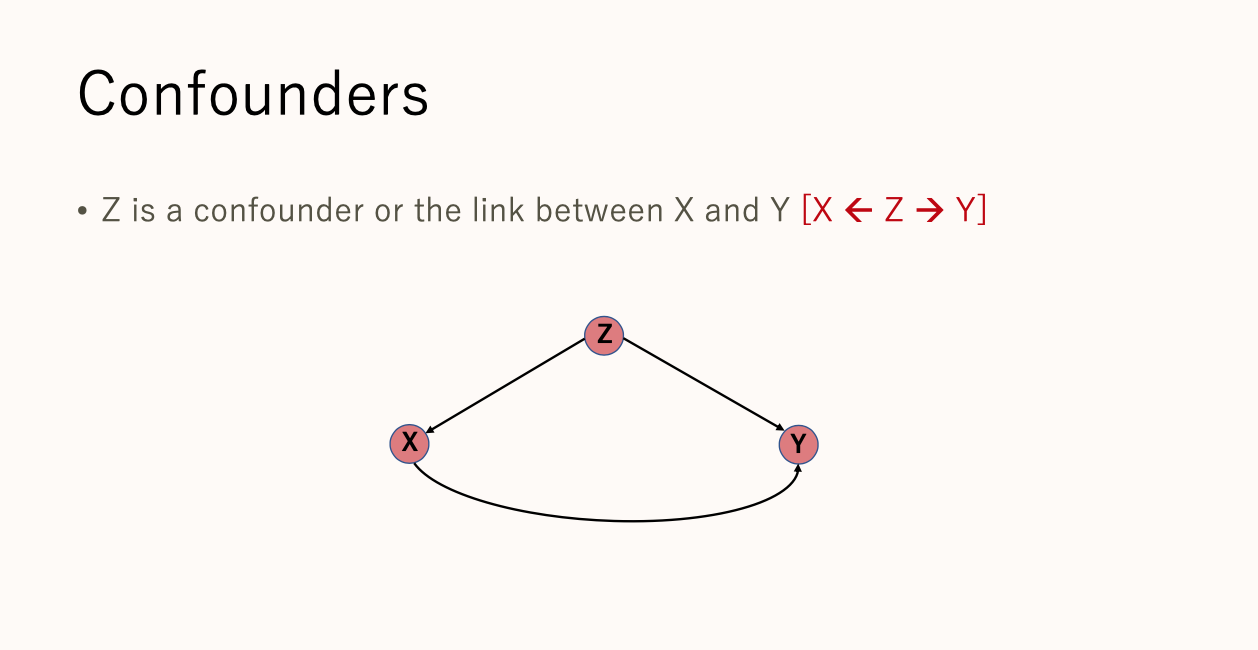
4) Z causes X and Y (confounder bias/omitted variable)
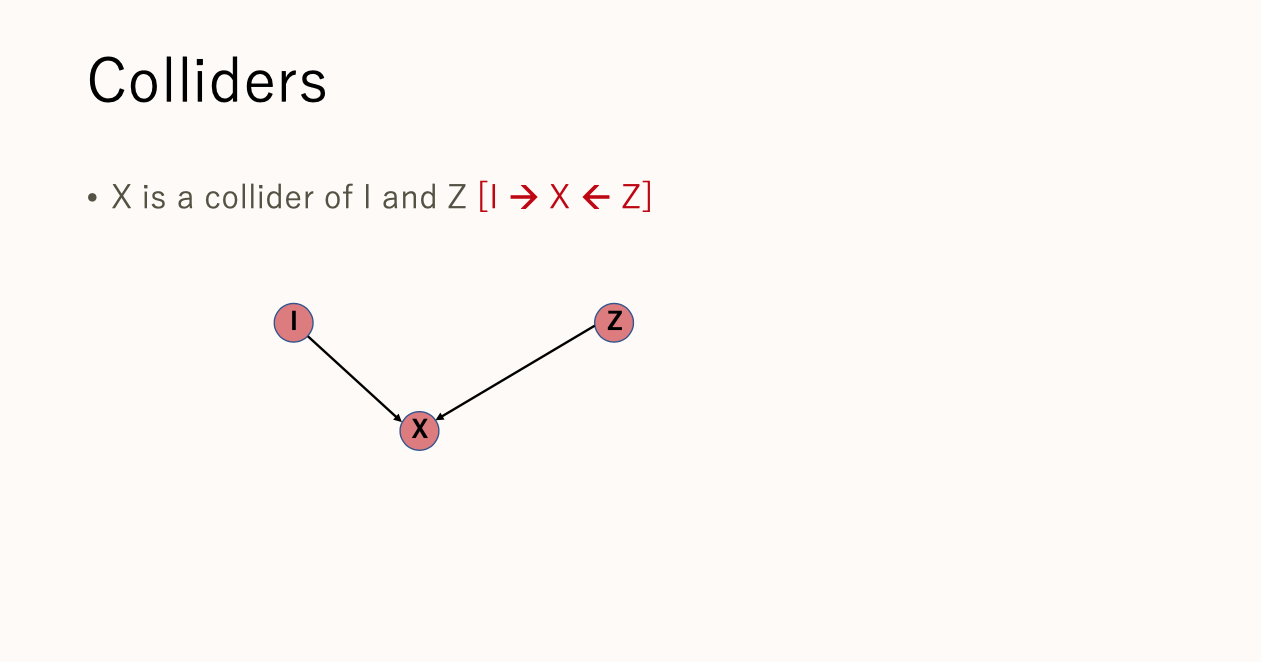
5) we condition on a shared effect of X and Y (collider bias)
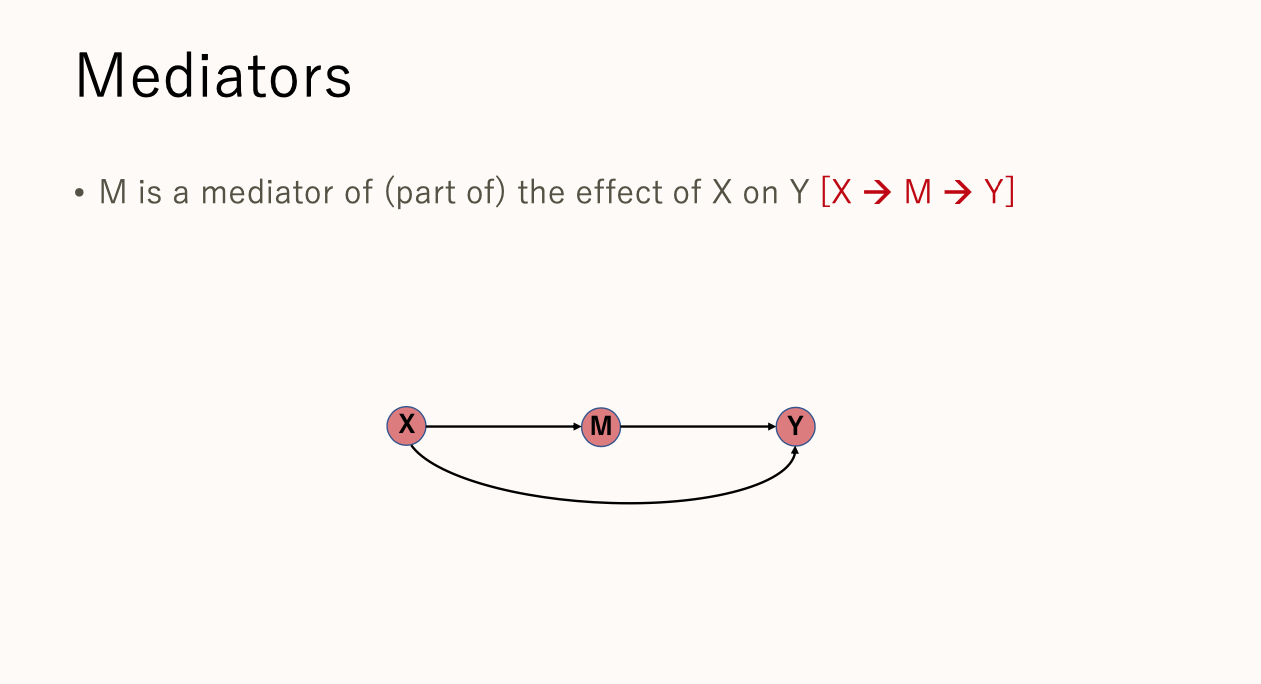
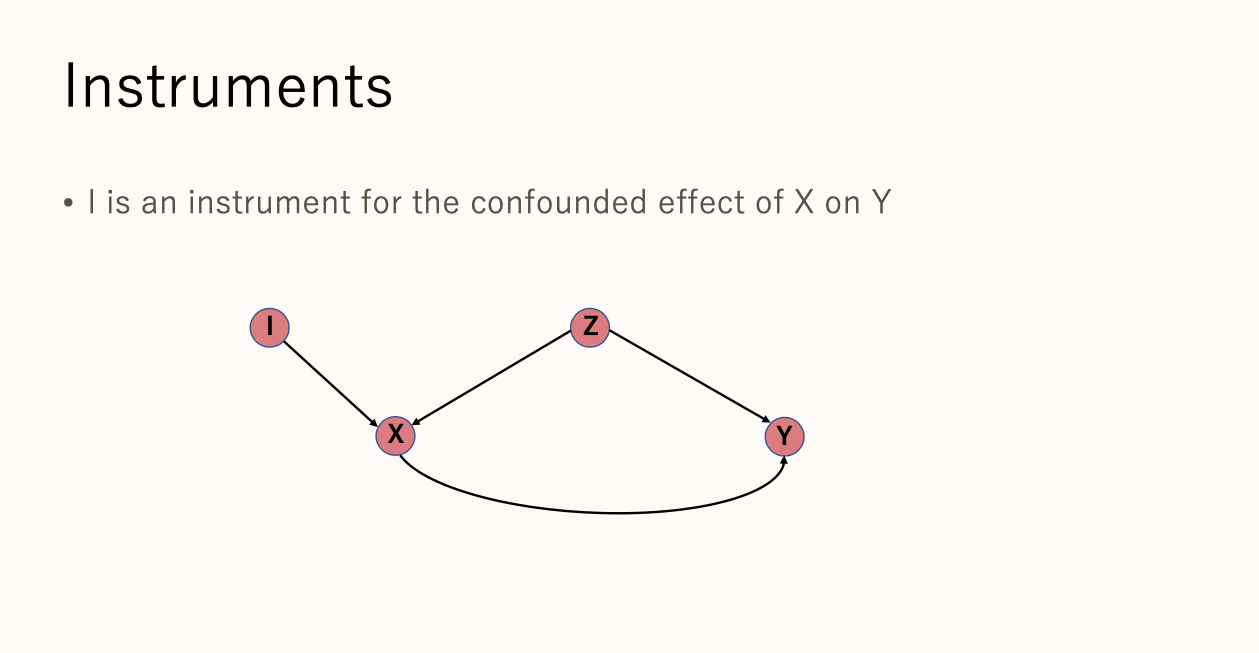
Causal graphs/diagramms
representations of causal models
DAG - Confounders
DAG - Colliders
DAG - Mediators
DAG - Instruments
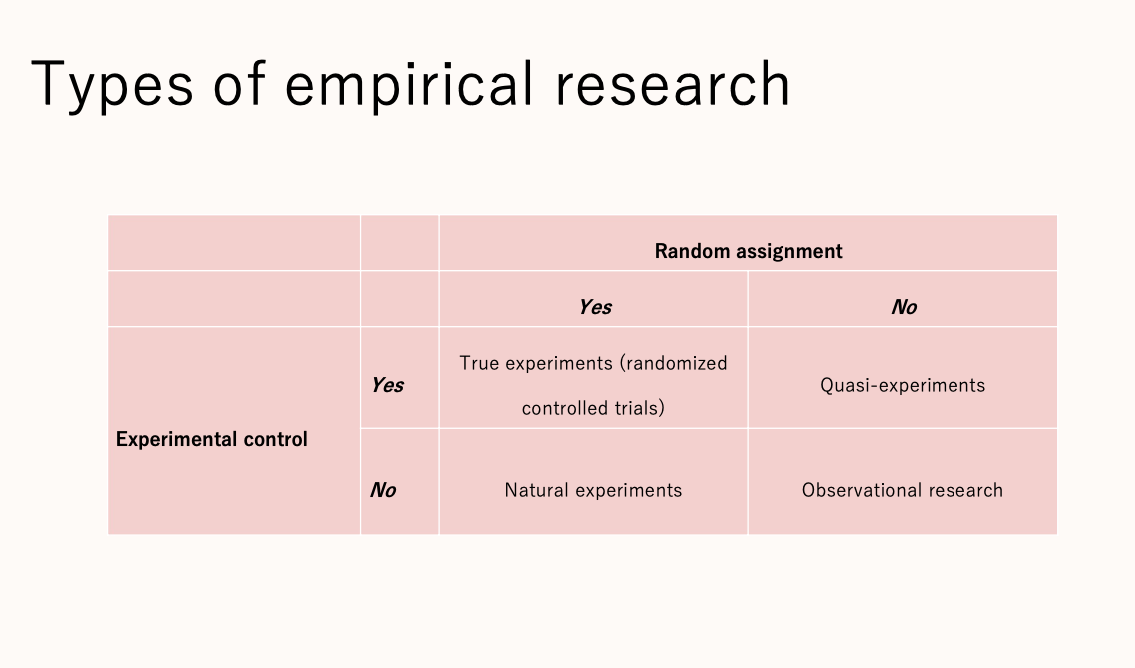
Experiment Def
type of research where the researcher has some form of control over the environment
True experiment
randomized controlled trials
researchers control who gets the treatment and who doesn’t and assign the treatment randomly
Quasi-experimental research
there is some form of intervention in the environment but no control of the treatment assignment
Observational research
no control of the environment, only passive observation
Natural experiment
researchers have no control over the environment but there is still random allocation of units into treatment and control
(lottery)
Types of empirical research
Experiments are powerful for
1) Identifying and estimating causal effects
2) Theory and hypothesis testing
3) Studying individual-level mechanisms of aggregate level effects
Steps in experimental research
1) Sample
2) Pre-test
3) assign treatment
4) Deliver treatment
5) conduct post-test
6) Analyse data
7) draw conclusion
Randomness in experimental design
1) selection of sample
2) assignment of treatment
Random assignment as solution to
concerns about internal or causal validity
Random selection as solution to
concerns about external validity (generalisability, transportability) of experimental results
Bigger Sample size relevant for
1) smaller effects
2) more variable effects
3) effects measured with more error
4) effects of treatments with more levels
5) effects of more treatments
6) effects subject to spillover, non-compliance and other compliance
Types of errors
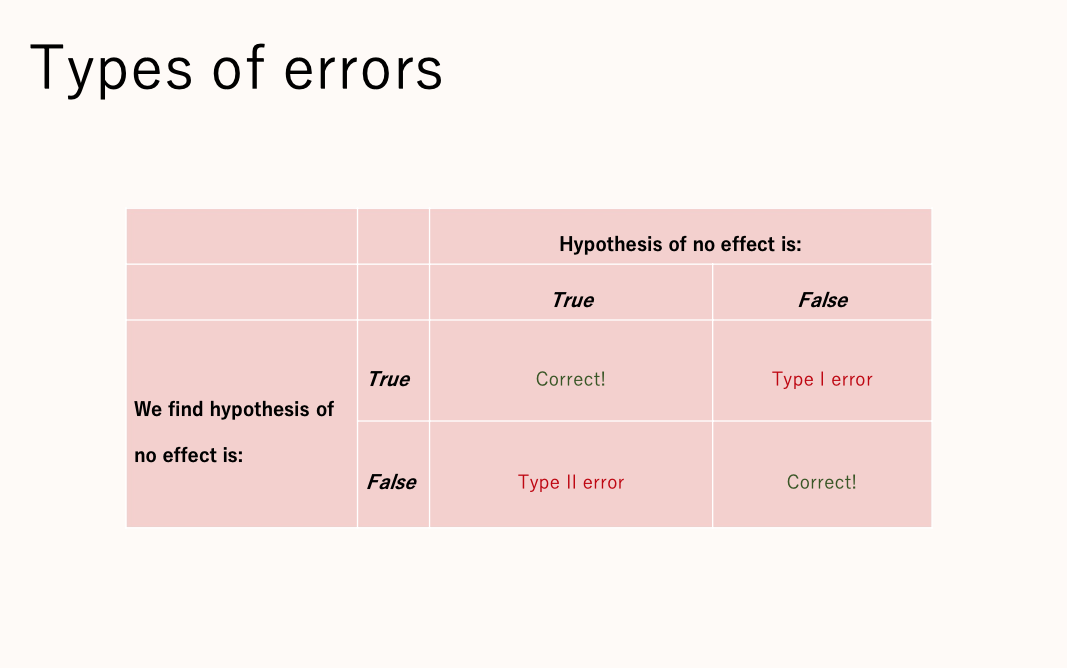
What happens if our study is underpowered?
more chance of Type 2 error
Type 2 error
we conclude that there is no effect, while in reality there is one but our study cannot detect it
Blocked randomization
1) separate participants in groups by some possible confounder (gender)
2) random assignment within each block
Pairwise randomization
1) create pairs of participants that are matched on relevant characteristics
2) randomise treatment with the pair
Types of experimental setting
1) laboratory experiments
2) Field experiments
3) survey experiments
Complications of experimental design
1) noncompliance
2) nonresponse
3) attrition
4) spillover
5) Demand effects
Noncompliance
participants do not follow the course of actin prescribed by their assigned experimental status
Types of participants
1) always takers
2) complier
3) Always-defier
4) Never-taker
Non response
problem of missing data for the outcome variable (post-test) for some participants
Attrition
experiments have several waves and participants quit before the end
Solution to Non response/attrition
model and adjust for it with help of covariates measured before the treatment is applied
Spillover
treatment diffusing from treated units to others
Solution to spillover
define unit of analysis at more aggregate level
collect data to model spillover effects
Demand effects
1) learning
2) social desirability
3) Anticipation
Technique to reduce social desirability bias
List experiments
What kind of causal effects are estimated by experiments?
average treatment effects across treatment and control groups
(difference in post-test scores of two groups)
Alternative estimands
1) intent to treat
2) Effect of treatment on the treated
3) Local average treatment effect
Intent to treat
ATE in a sample with non compliance
Effect on treatment on the treated
ATE among compliers and always takers
Local average treatment effect
ATE among compliers
Limits to experimental research
1) expensive
2) identify only average causal effects, no individual level causal effects
3) not relevant for retrospective questions
4) not suited to study organization and states
Addressing Non-Compliance in Surveys
adjusting intent-to-treat in order to estimate the average effect of intention to treat
relevance depends on purpose (science or policy)
Large-N research counterfactual
is approximated by cross-case data (what has happened to some of the units)
AND assumptions (research design!)
Strategies for causal inference with large-N data
1) Natural experiments
2) Conditioning strategies
3) Mediating
4) Instrumental variables
Conditioning strategies
1) block (keep constant)
2) measure and include in analysis
Mediating
focus on the mechanism
Instrumental variables
find exogenous variation in the explanatory variable (the treatment) that is unrelated to the outcome
Natural experiments - speciality
Random assignment is produced by nature, and not by the researcher
Natural experiments - similar approach
Regression discontinuity
Regression discontinuity
quasi-random threshold that sorts cases in two groups, and examine the variable of interest in these two groups
Natural experiments - Disadvantage
mechanisms are rare
Instrumental variable - steps
1) Chose instrumental variable
2) establish effect of instrument on explanatory
3) effect of explanatory on outcome (residuals from stage 2)
Choose intrsumental variable such that
1) IV is related to X
2) IV is NOT related to Y
3) no common cause Z of both IV and Y