Week 5 L2 - CNS, Anxiety, and Sleep Disorders
 Call Kai
 Learn
Learn Practice Test
 Spaced Repetition
 Match
Match Flashcards
 Knowt Play
1/72

Earn XP
Description and Tags
Dan
Name | Mastery | Learn | Test | Matching | Spaced | Call with Kai |
|---|
No analytics yet
Send a link to your students to track their progress
73 Terms
What anatomical structures comprise the Central Nervous System (CNS)?
The brain and the upper spinal cord.
How do CNS neurotransmission processes compare generally to the peripheral nervous system (PNS)?
The underlying processes are similar, utilizing many of the same neurotransmitters (e.g., acetylcholine) and analogous transmitter roles.
What is a key pharmacological difference between endogenous receptor subtypes found in the CNS versus the periphery?
CNS receptor subtypes are often pharmacologically distinct from their peripheral counterparts, despite responding to the same endogenous ligands.
Contrast the structural pathway of central neurotransmission with peripheral neurotransmission.
Central transmission processes are non-linear, whereas peripheral neurotransmission is typically linear.
Why is central nervous system control described as more nuanced, subtle, and complex than peripheral control?
Due to the vastly more complex network and structural organization of neurons within the CNS.
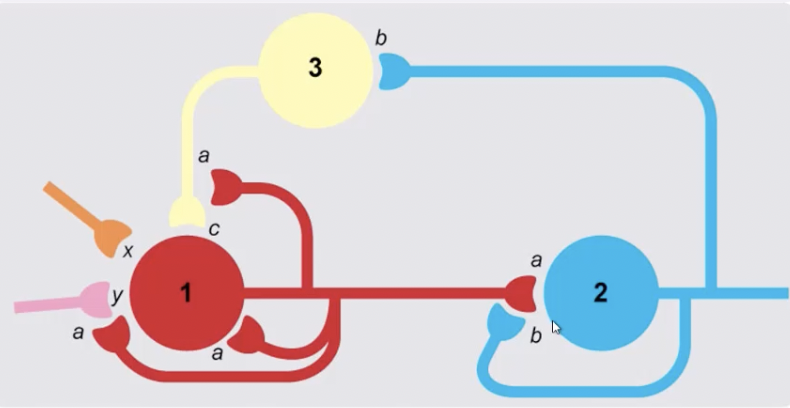
In a central transmission network, what role does an "interneuron" (such as neuron 3 in the diagram) play?
It completes a feedback loop that modulates or interrupts the otherwise linear transmission between primary neurons (e.g., neurons 1 and 2).
Why are the effects of drug-induced interference with specific central neurotransmitter systems difficult to predict?
Because even in a relatively simple CNS network, affecting just one transmitter can disrupt feedback loops and complex interconnections, leading to substantial, widespread consequences.
Why does the complexity of neuronal interconnections make CNS drug discovery challenging?
It makes the prediction of therapeutic outcomes highly challenging.
What types of endogenous adaptations can a complex neuronal network trigger in response to drug-induced changes?
Adaptations in neurotransmitter synthesis, signaling pathways, and precursor/neurotransmitter uptake mechanisms.
What are four unpredictable and often unhelpful clinical situations that can arise from CNS endogenous adaptations to drugs?
1. Tolerance
2. Dependence
3. Side effects
4. Slow onset of therapeutic benefit
How do the unpredictable effects of CNS drugs impact clinical patient management?
It leads to frustrating and prolonged clinical management while trying to identify the most appropriate, personalised therapy, which cannot always be predicted.
What are three key examples of fast neurotransmitters in the Central Nervous System?
Glutamate, GABA, and glycine.
What type of receptors do fast neurotransmitters typically bind to upon release from nerve terminals?
Ligand-gated ion channels.
What are two prominent examples of slow neurotransmitters in the CNS?
Noradrenaline and dopamine.
What type of receptors do slow neurotransmitters primarily act upon?
G-protein coupled receptors
Name two neurotransmitters that can act as both fast and slow mediators depending on the receptor type they encounter.
Serotonin and acetylcholine.
What are the three main classes of substances that function as neuromodulators?
Neuropeptides, gaseous and lipid mediators, and steroids
Unlike typical neurotransmitters, what distinct variety of cellular sources can release neuromodulators?
A number of different cells, including neurons, astrocytes, and glial cells.
What are some conditions that affect the CNS
neurodegenerative diseases - e.g Parkinson’s/ Alzheimers
Anxiety and sleep disorders
Depression
Schizophrenia
Epilepsy
Pain
Define Generalised Anxiety Disorder (GAD)
Excessive anxiety that occurs without a specific reason or target focus.
What is the defining characteristic of panic disorder?
Sudden attacks of overwhelming fear.
What does the acronym PTSD stand for within the context of clinical anxiety disorders?
Post-traumatic stress disorder.
How is Obsessive Compulsive Disorder (OCD) characterized, and what drives its presentation?
Compulsive or ritualistic behavior driven by anxiety around specific but unlikely outcomes (e.g., fear of burglary).
What is the relationship between sleep disorders/insomnia and clinical anxiety?
What is the relationship between sleep disorders/insomnia and clinical anxiety?
While transient anxiety can be felt by anyone, when do these specific conditions become clinically significant?
When they become prolonged and debilitating.
What are three broader long-term consequences linked to prolonged and debilitating anxiety disorders?
1. Negative health outcomes
2. Poor quality of life
3. Increased risk of developing other disorders
Name some anxiety disorders
Generalised Anxiety Disorder (GAD)
Panic Disorder
Phobias
PTSD and OCD used to count as them but no longer
How is GABA classified as a neurotransmitter, and where is it exclusively located?
It is a powerful, fast, inhibitory amino acid neurotransmitter located exclusively in the Central Nervous System (CNS).
What proportion of all CNS synapses utilise GABA, and in what specific cell types is it largely found?
It is present at around 30% of all CNS synapses, largely localised within short, regulatory interneurons
Which principal excitatory neurotransmitter shares a common metabolic precursor pathway with GABA?
Glutamate
Describe the enzymatic reaction that converts glutamine into glutamate.
Glutamine is converted to glutamate via the enzyme glutaminase, a reaction that releases an amino group as an ammonium ion.
What specific enzyme is responsible for synthesizing GABA from glutamate?
Glutamic acid decarboxylase (GAD).
By what two primary cellular mechanisms is the GABA synaptic signal terminated?
By reuptake into either the presynaptic nerve terminal or surrounding Glial cells (prior to recycling or metabolic breakdown).
How is the GABAA receptor classified structurally and functionally?
It is a post-synaptic ligand-gated ion channel that mediates fast inhibition.
What peripheral nervous system receptor shares structural similarities with the central GABAA receptor?
The nicotinic acetylcholine receptor (nAChR).
permeable to NA ions
GABAA permeable to Cl ions
What specific ion is the GABAA receptor channel permeable to, and what electrical change does its influx cause?
Permeable to chloride ions, causing hyperpolarization and reduced excitation of the post-synaptic cell.
increasing intracellular negative charge
How is the GABAB receptor classified, and where is it predominantly located?
It is a GPCR that is mostly pre-synaptic (though occasionally found post-synaptically).
By what mechanism do pre-synaptic GABAB receptors provide a negative feedback loop?
They inhibit voltage-gated calcium ion channels, which directly reduces further GABA release.
Which class of GABA receptors is the primary target for clinical pharmacology interventions?
GABAA receptors
Detail the specific subunit stoichiometry of the pentameric GABAA receptor complex.
2 alpha
2 beta
1 gamma
Describe the secondary structure topology of an individual GABAA receptor subunit.
Each subunit comprises 4 transmembrane domains (TM1-TM4) with both the N- and C-terminus located in the extracellular space.
Contrast the ion permeability of GABAA receptors with nicotinic acetylcholine receptors (nAChRs) upon ligand gating.
GABAA channels are selectively permeable to chloride ions (Cl-), whereas nAChRs are permeable to sodium ions (Na+).
What causes membrane hyperpolarization following GABAA receptor activation?
An influx of Cl- increases the intracellular negative charge, shifting the membrane potential further away from the threshold required to fire an action potential.
What neural architecture is primarily responsible for mediating the reduction of transmission within these neural networks?
Inhibition of localized pathways by GABA-ergic interneurons.
At which specific subunit interface is the orthosteric GABA binding site located on the GABAA receptor?
At the interface between the alpha and beta subunits.
At which specific subunit interface is the primary allosteric modulatory site for Benzodiazepines (BDZs) located on the GABAA receptor?
At the interface between the alpha and gamma subunits.
What physical mechanism occurs directly at the GABAA receptor complex when GABA binds to its active site?
It induces a conformational change that opens the integral chloride ion channel.
Where do channel-blocking drugs act on the GABAA receptor compared to benzodiazepines?
Channel-blocking drugs act directly inside the channel pore to physically obstruct ion flow, whereas benzodiazepines bind to an extracellular modulatory interface.
What type of binding site is the benzodiazepine (BDZ) site classified as, and what occurs structurally when a ligand binds to it?
It is an allosteric modulatory site; ligand binding induces a conformational change in the receptor complex.
How do different allosteric ligands at the BDZ site alter GABA activity?
Depending on the specific ligand, they can either enhance or suppress GABA activity by directly affecting GABA binding affinity or efficacy.
What is the specific biophysical mechanism of action for classic benzodiazepine drugs at the GABAA receptor?
They facilitate GABA binding and increase the frequency of GABAA chloride channel opening.
What is the ultimate downstream cellular result of benzodiazepine-facilitated GABA channel gating?
It facilitates the increased transport of chloride ions (Cl−) across the membrane, promoting hyperpolarization of the post-synaptic cell.
Name two classic benzodiazepines and describe how they alter GABA kinetics at the GABAA receptor.
Examples include diazepam and temazepam. They bind to the BDZ allosteric site to increase the affinity of GABA for its receptor, facilitating channel opening only in the presence of endogenous GABA.
Contrast the gating mechanism of Barbiturates (e.g., phenobarbital) with Benzodiazepines at the GABAA receptor.
Barbiturates can directly open the GABAA receptor chloride channel even in the absence of GABA, whereas benzodiazepines merely modulate/enhance the effects of bound GABA.
What is the major clinical consequence of the mechanistic difference between benzodiazepines and barbiturates?
There is a substantial difference in their therapeutic windows; barbiturate overdosing can easily result in respiratory depression and death, while benzodiazepines are significantly less toxic on their own.
What structural feature accounts for the existence of distinct GABAA receptor variants with differing anatomical locations, kinetics, and drug responses?
The expression of different splice variants and combinations of the receptor subunits.
can lead to varied pharmacological effects (drug selectivity)
What are the three primary clinical indications for Benzodiazepines?
Sleep disorders, anxiety, and as an anti-convulsant.
Why are benzodiazepines considered less dangerous than other anxiolytic or hypnotic drugs in an acute overdose scenario?
They cause limited depression of respiratory and cardiovascular function while still offering effective sedation.
Under what specific condition can a benzodiazepine overdose become life-threatening
In the presence of other CNS depressants, such as alcohol.
What are the two primary clinical indications listed for Barbiturates?
Seizures and pre-operative sedation.
Why must barbiturates often be administered under strict clinical supervision?
Because their therapeutic window is narrow.
What specific drug serves as an effective competitive antagonist to reverse a benzodiazepine overdose?
Flumazenil
How does ethanol (alcohol) compare to benzodiazepines in its presentation and dosing regarding GABA transmission?
It has a similar but weaker effect on GABA transmission than BDZs, meaning it requires significantly higher doses to achieve comparable effects.
What behavioral effect occurs at lower doses of ethanol, and through what mechanism?
It reduces behavioural inhibitions through a range of non-specific effects.
Define pharmacological tolerance
A state where higher doses of a substance are required over time to achieve the same desired therapeutic effect.
seen with BZDs so try to keep treatment short
What defines dependence on a drug or substance?
A state where an individual persists in using a substance despite experiencing negative problems related to its use, or despite lacking a valid medical/therapeutic indication.
How do benzodiazepines compare to barbiturates regarding the severity of tolerance and dependence?
Tolerance and dependence are less pronounced with benzodiazepines compared to barbiturates.
Despite being less severe than barbiturates, what two clinical management strategies are essential to minimise risk when prescribing benzodiazepines?
Careful dosage adjustment during treatment and careful, gradual withdrawal when stopping the medication.
What type of neurotransmitter is glycine, and what mechanism does it utilise to mediate fast inhibitory neurotransmission in the CNS?
It is an amino acid neurotransmitter that acts directly via a ligand-gated ion channel.
What is Strychnine, and what is its specific molecular mechanism of action?
It is a convulsant poison that acts as a competitive glycine receptor antagonist.
What lethal clinical condition and primary cause of death result from Strychnine poisoning?
It leads to opisthotonus (severe, rigid hyperextension of the body) and death by asphyxiation.
What physiological effect do GABAA receptor antagonists have on the central nervous system?
They act as powerful convulsants by removing crucial background inhibitory control.
What is Muscimol, and how is it classified both pharmacologically and naturally?
It is a GABAA receptor agonist that serves as the active component of hallucinogenic mushrooms, while also exhibiting analgesic properties.