IGCSE Edexcel Geography - Economic Activity and Energy
 Call Kai
 Learn
Learn Practice Test
 Spaced Repetition
 Match
Match Flashcards
 Knowt Play
1/47

There's no tags or description
Looks like no tags are added yet.
Name | Mastery | Learn | Test | Matching | Spaced | Call with Kai |
|---|
No analytics yet
Send a link to your students to track their progress
48 Terms
Define industrialisation and give a named example:
The process of which a country's economy is developed by changing from a primarily agricultural workforce to a one based on manufacturing. (E.g China)
Define deindustrialisation
A country's decline in industrial activity in a region or economy.
What is the primary sector?
The part of the economy that extracts of raw materials or natural resources from land.
What is the secondary sector?
The part of the economy that transforms raw materials into manufactured goods.
What is the tertiary sector?
The part of the economy that provides services.
What is the quaternary sector?
The part of the economy that conducts research and development.
What is the informal economy? Give examples.
Workers that create their own employment that is not registered. It is unregulated (E.g street performers, street vendors and drug traffickers)
Give pros of the informal economy:
- Flexible working hours
- Keeps unemployment figures down
- Can feed back into the economy via the tertiary sector
- Keep all earnings (as their is no taxes)
Give cons of the informal economy:
- Little job stability
- No economic growth as no taxes are paid
- Long hours as income is low
- No benefits
How do the employment sectors look within a developing country?
Primary: The largest sector due to little education needed for jobs such as farming.
Secondary: Less people work in this sector, as the country has likely not industrialised yet.
Tertiary & Quaternary: Less people work in this sector as higher education is usually required.
How do the employment sectors look within an emerging country?
Primary: This becomes the smallest sector due to industrialisation and many raw materials become imported from developing countries.
Secondary: This sector rapidly grows due to industrialisation and large cooperatives moving factories from developed countries to emerging ones.
Tertiary & Quaternary: This sector also grows due to education being more accessible and as the GDP increases, so does the demand for services.
How do the employment sectors look within a developed country?
Primary: This is the smallest sector, due to low pay and widely accessible education as well as majority of raw materials being imported.
Secondary: This sector becomes smaller as large companies move their factories to emerging companies.
Tertiary & Quaternary: These become the largest sectors, as demand for services is very high, creating many more jobs. Additionally higher education is more accessible so jobs in quaternary sectors are created.
Why have services started to locate on the urban fringe?
- Near motorways.
- More appealing surroundings.
- Room for expansion.
- Land prices are cheaper.
- Less traffic/congestion as it's not in CBD.
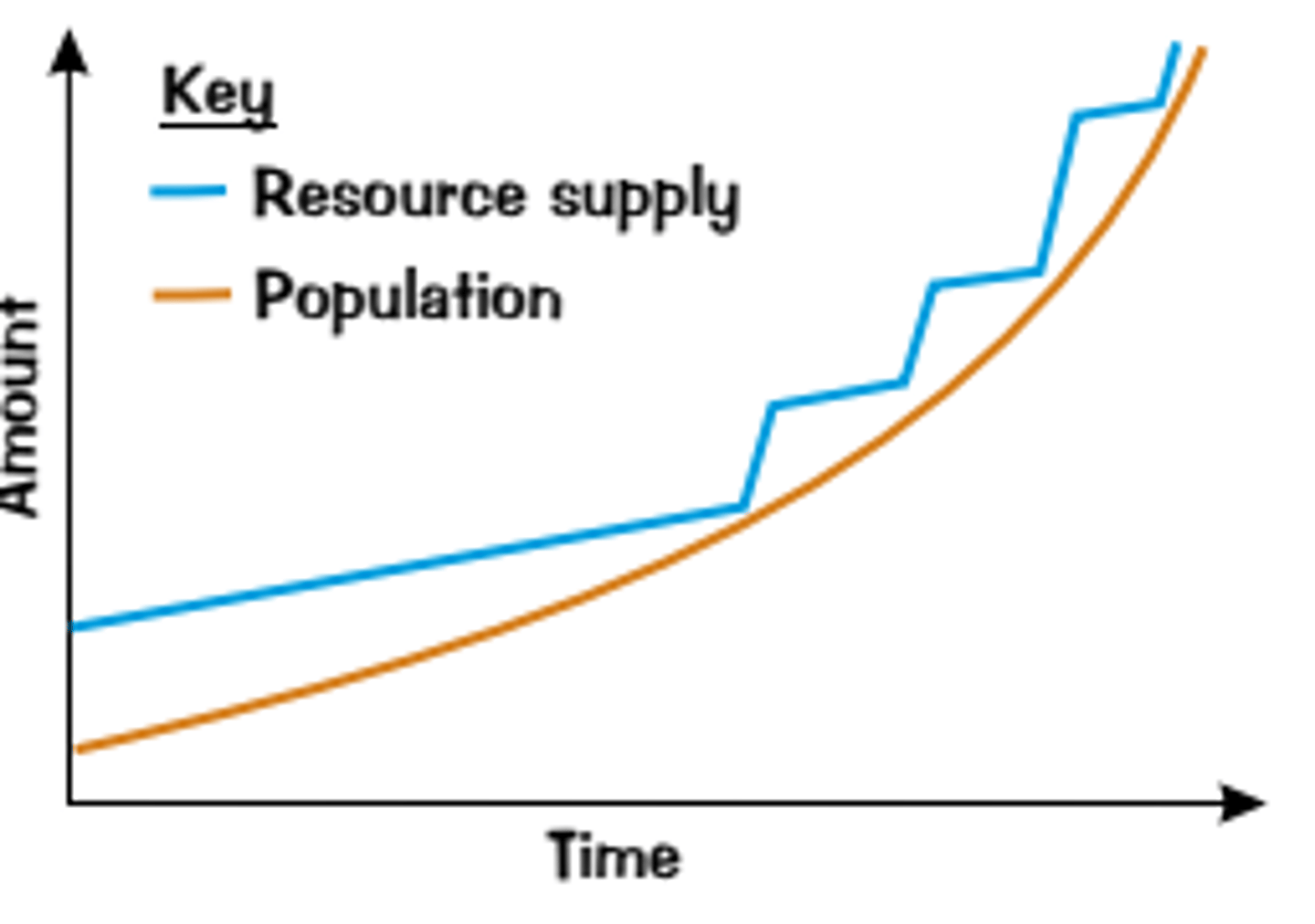
Boserup's theory of population:
-Optimistic
-Human innovation and technological advances would allow food production to keep up with the population.
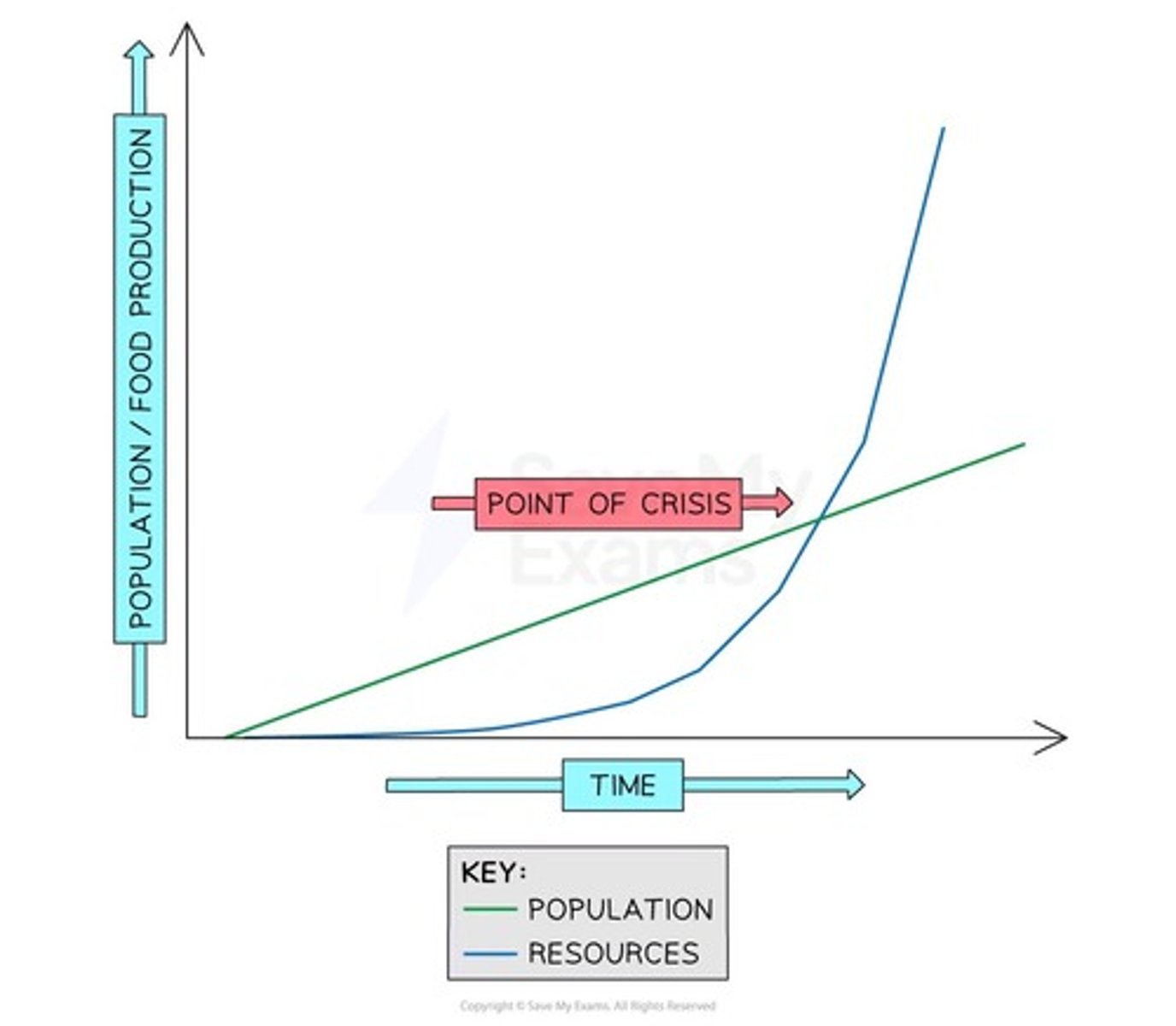
Malthus's theory of population;
-Pessimistic
-Population grows at a faster rate than food/resources can supply resulting in food shortages
Hydroelectricity:
-Renewable
-Electricity generated by the kinetic energy of moving water. (E.g Hoover Dam USA)
Hydroelectricity advantages and disadvantages:
Advantages:
- Cheapest to run
- Renewable
- Reduces carbon emissions
- Provides jobs
Disadvantages:
- Made of concrete
- Flooding
- Displaces homes
- Expensive to build
- Potential of drought
- Destruction of habitats
Fossil fuel Energy:
-non renewable
-Energy that comes from the burning of coal, oil or gas, creating steam which spins a turbine, creating electricity.
Fossil fuel Energy advantages and disadvantages:
Advantages:
- Many jobs available
- Lots of power
- Affordable
- Reliable
Disadvantages:
- Global warming
- Climate change
- Damage to environment
Tidal Energy:
-Renewable
-The energy captured by transforming the wave motion of water into electrical energy using a turbine.
Tidal Energy advantages and disadvantages:
Advantages:
- Cost of manufacturing an maintaining are low
- Predictable
- Renewable
- High power output
Disadvantages:
- Marine life can be harmed
- Specific requirements
- Not consistent production
Solar Energy:
-Renewable
-Energy from the sun that is converted into thermal or electrical energy.
Solar Energy advantages and disadvantages:
Advantages:
- Renewable
- Little maintenance
- Mass energy production
- Multipurpose
Disadvantages:
- Takes up space
- Expensive
- Unpredictable
Nuclear energy:
-non renewable
-generated via nuclear fission of uranium to heat water and then turn turbines
Nuclear energy advantages and disadvantages:
advantages:
-large amounts produced from small quantities of uranium
-reliable
disadvantages:
-produces toxic/radioactive waste
-high chance of accidents/ so must spend money to reine
What is the energy gap:
The difference between the energy demand and the energy supply
What is energy security?
When a country is able to meet its own energy needs reliably (preferably from within its own borders).
Wind energy:
-Renewable
-warm air rises, causing air to blow, which turns propellors of a wind turbine creating energy
Wind energy advantages and disadvantages
advantages
-no waste or greenhouse gases
-wind is free
disadvantages
-unpredictable/unreliable
-land suitable can be expensive
-kills birds
Geothermal energy:
-Renewable
-hot rocks underground heat water to produce steam which turn turbines producing energy
Geothermal energy advantages and disadvantages
advantages:
-No greenhouse gases produced
-No fuel needed
disadvantages:
-Only specific rock types are suitable and not many places are suitable
-Can produce hazardous gases and minerals
Define renewable energy
Energy that has infinite number of resources, it is naturally replenished so can be used again
Define Non-renewable energy
Energy that has a finite number of resources which cannot be replaced
What is energy mix?
The mixture of energy sources that a country or area uses
what is efficiency
Ensuring that energy sources are used in an effective way to reduce wastage
What is sustainability?
The meeting of demands of today without impacting future generations
What is conservation?
The preserving of energy sources, largely through efficiency
Draw the Clark Fisher Model and what does it do?
-It shows how the workforce is divided in different employment sectors
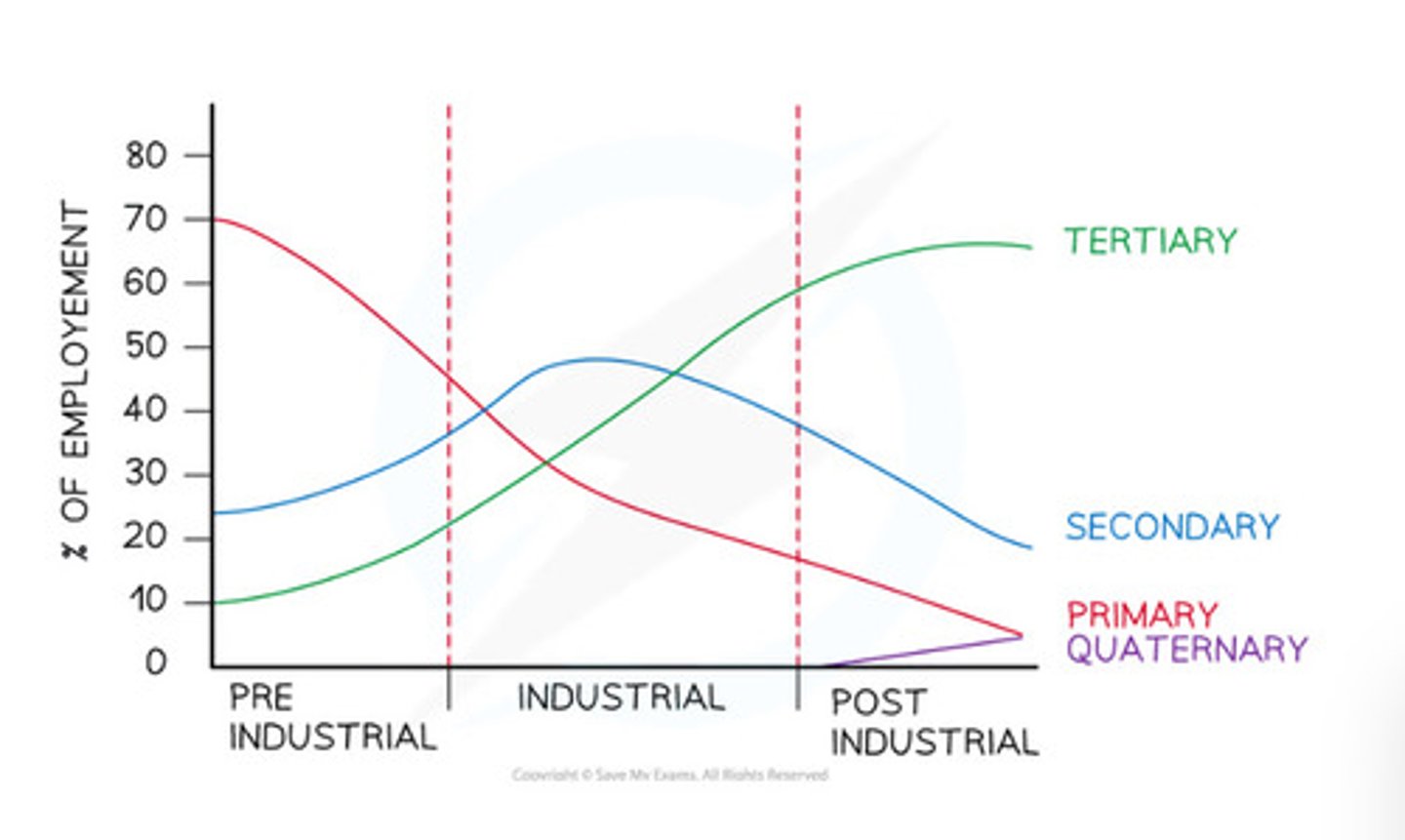
How has the Primary sector changed
Pre industrial
-it was labour intensive so peaked then
Industrialisation
-Increase in mechanisation reducing the need for labour
Post industrialisation
-decline continued
How has the Secondary sector changed?
Pre industrial
-People forced out of primary sector found in jobs into secondary
Industrialisation
-Peaked as manufacturing was at its height
-Then it starts to decline as most secondary jobs moved abroad due to mechanisation
How has the Tertiary sector changed?
Industrialisation
-steadily increased, as more people are need to sell increasing number of goods
Post industrialisation
-Recent fluctuations due to mechanisation and customer desire
How has the Quaternary sector changed?
Post industrialisation
-growth only begins to occur here as there is increased technology and skill involved
-growth in this sector can lead to further decline in other sectors
China Energy Management- Housing
Strategies
-Passive housing, means buildings don't require any conventional heating therefore using less energy
-Consume 90% less energy than existing buildings
China Energy Management- Industry
Strategies
-China will invest $1.7 trillion to promote the importance of strategic emerging industries over the next 5 years
China Energy Management- Transportation
Strategies
-$3.1 billion in subsidies was given to the new energy vehicle industry (NEV) in 2017 to help boost sales of electric vehicles reducing the sales of other vehicles which are polluting the air
- And all taxis electric from 2025
UK's Energy Management- Housing
Strategies
-'future homes standard for England' will have 80% lower emissions than current building standards (beginning 2025), therefore creating more efficient housing as it reduces the need for cooling and heating in an ever warming climate
-the longer term goal is for houses to be net zero
UK's Energy Management- Transportation
Strategies
-£2 billion of funding to encourage cycling with currently over 300 schemes, reducing the use of polluting vehicles therefore helping reduce the amount of greenhouse gases released into the environment
-Polluters pay tax-ulez and congestion charge to try encourage people to use public transport or electric vehicles therefore reducing the amount of pollution released into the environment
UK's Energy Management- Industry
Strategies
-The UK is home to the worlds first two floating offshore wind farms it plans to increase this by 12x, increasing the use of renewable energies such as wind therefore reducing the need for non renewable energies
-Government funding of £1 billion for net zero innovation within industry