Partial Pressures & Diffusion Gradients
 Call Kai
 Learn
Learn Practice Test
 Spaced Repetition
 Match
Match Flashcards
 Knowt Play
1/8

There's no tags or description
Looks like no tags are added yet.
Name | Mastery | Learn | Test | Matching | Spaced | Call with Kai |
|---|
No analytics yet
Send a link to your students to track their progress
9 Terms
What is partial pressure?
The share of total pressure contributed by one gas.
What determines the direction of gas diffusion?
Gases diffuse from higher partial pressure to lower partial pressure.
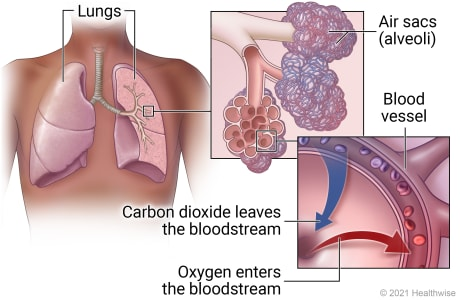
Where does gas diffusion occur in the human respiratory system?
At capillaries, especially the alveolar and systemic capillaries.
Why does oxygen move from alveoli into pulmonary capillary blood?
Because alveolar PO₂ is higher than venous blood PO₂.
Why does carbon dioxide move from pulmonary capillary blood into alveoli?
Because venous blood PCO₂ is higher than alveolar PCO₂.
Why does oxygen move from systemic capillary blood into tissues?
Because blood PO₂ is higher than tissue PO₂.
Why does carbon dioxide move from tissues into systemic capillary blood?
Because tissue PCO₂ is higher than blood PCO₂.
What key PO₂ values should you know?
Inspired air ≈ 160 mm Hg, alveoli ≈ 104, arterial blood ≈ 100, tissues/venous blood ≈ 40.
What key PCO₂ values should you know?
Alveoli and arterial blood ≈ 40 mm Hg; tissues and venous blood ≈ 45 mm Hg.