covalent substances and covalent bonding
 Call Kai
 Learn
Learn Practice Test
 Spaced Repetition
 Match
Match Flashcards
 Knowt Play
1/25

There's no tags or description
Looks like no tags are added yet.
Name | Mastery | Learn | Test | Matching | Spaced | Call with Kai |
|---|
No analytics yet
Send a link to your students to track their progress
26 Terms
The covalent bond
bonding between non-metals only
Electronegativity of non-metals is high - they all want to gain electrons but not donate
Share pairs of valence electrons to produce full outer shells
Covalent bonding
when the Electronegativity is almost the same then nobody gets to win the tug of wat
No transfer of electrons
Sharing of electrons
Properties of hydrogen
→ Low melting point
gas at room temp
MP: -259 degrees Celsius
→ doesnt conduct electricity
→ low density
Properties of covalent molecules
very low melting points and boiling points → some of the bonding in non-metal compounds must be very weak
Absence of electrical conductivity in any phrase → non-metal compounds do not contain ions or delocalised electrons
Features of covalent bonds
Occurs between non-metallic elements
Form molecules rather than lattices
Diatomic molecules: hydrogen
has 1 electron
It needs another 1 electron for a full outer shell
By sharing electrons btwn 2 H atoms → both will have full shell
As 2 electrons are shared this = single bond
Diatomic molecules - oxygen
oxygen has 6 electrons in outer shell
Needs another 2 electrons for full outer shell
By sharing 2 electrons form each atom btwn 2 oxygen atoms → both have full shell
4 electrons shared = double bond
Lewis structures - electron dot diagrams - for atoms
the atoms nucleus and all inner shell electrons are replaced by elements symbol
Outershell electrons - represented by dots or small crosses around symbol in square arrangement
→ dots arranged in pairs if more than 4 outer electrons
Molecular compunds - more than 2 atoms - drawing Lewis structures
Calculate total no. Of valence electrons of all atoms in compound
Identify central atom - atom with least complete valence shell = central atom
Draw the outer atoms around central atom & place one pair of electrons btwn each joining atom
Arrange the other electrons around outer atoms first & then central atom until all electrons = distributed
Count electrons around each atom
If any atom doesnt have a full shell shift pairs of electrons from non-bonding space to bonding space → or place remaining electron pairs onto central atom
If you want → change bonding pairs of electrons to lines
Polyatomic molecules - CH4
carbons has 4 electrons in outer shell
It needs around 4 electrons for a full outer shell
Hydrogen has 1 electron
Needs another electron for full outer shell
By sharing one electron w/t each hydrogen atom → all will have full shell
As 2 electrons are shared → these - single bonds
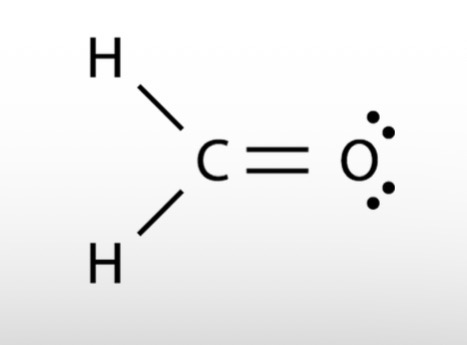
Polyatomic molecules: CH2O
put carbon in the middle with one pair of electrons between the atoms
Add the electrons around the outside atoms (O)
Count the electrons around each atom:
H: 2
O: 8
C: 6
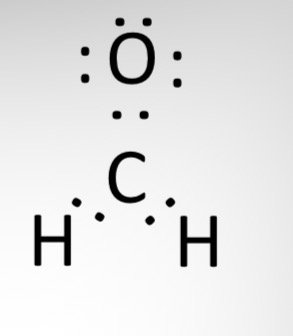
Polyatomic molecules: CH2O - continuation
move one pair to share between C and O
Redraw with lines for bonds
Representing covalent molecules - representing covalent molecules - electron dot diagrams
two dimensional
Does not indicate shape
Tedious and slow to produce
Not useful for large molecules
Representing covalent molecules - representing covalent molecules - Valence structure
two dimensional
Does not necessarily indicate shape
Can be tedious and slow to write for larger molecules
Important lone pairs may be difficult to distinguish from non-important ones
Representing covalent molecules - representing covalent molecules - structural formula
two dimensional
Doesn’t necessarily indicate shape
CNA be tedious and sow to write for larger molecules
Representing covalent molecules - representing covalent molecules - Space-filling
doesn not show the boding between atoms
Relative sizes of atoms involved are only approximate
Representing covalent molecules - representing covalent molecules - Ball and stick
can be physically difficult to produce for larger molecules
Kits to produce can be expensive
Shapes of molecules
techniques such as x-ray crystallography give us images that can be put together with complex mathematical equations
We can also use modelling based on what we know about the octet rule & Lewis dot diagrams
What determines the shape of molecules
the hate of molecules are determined by the repulsion between electron pairs in the outer shell of the central atom
Lone pairs repel more than bonded pairs
Valence shell electron pair repulsion (VSEPR) model
bonding and non-bonding electrons will repel each other due to their like negative charges
Molecules will arrange themselves in space that requires least energy possible
Therefore arrange as far away from each other as possible
VSEPR theory
States the electron pairs in the molecule repel each other and take up positions as far from one another as possible
Shape of covalent molecules
VSEPR theory states that since electron pairs repel, shape of molecule depends on no. Of electron pairs around each atom
These electron domains are arranged to minimise electrostatic repulsion
Getting the shape steps -
Count the no. Of valence electrons for all atoms present
Put the atom which can take the most bonds in the middle
Place the other atoms around main element
Draw one bond to each outer atom from the centre atom
Add lone to each outer atom until it has correct number
Put any remaining electrons on one central atom
Find the parent geometry
Find molecular geometry
Structure name - parent geometry tetrahedral (4 electron groups)
tetrahedral - 4 bonding groups, 0 lone pairs
Trigonal primarid - 3 BG, 1 LP
bent - 2 BG, 2 LP
Linear - 1 BG, 3 LP
Structure name - parent geometry trigonal planar (3 electron groups)
trigonal planar - 3 BG, 1 LP
Bent - 2 BG, 1 LP
Linear - 1 BG, 2 LP
Structure name - parent geometry - linear - (2 electron groups)
linear - 2 BG, 0 LP