Exam 2 - Natural Selection and Speciation
 Call Kai
 Learn
Learn Practice Test
 Spaced Repetition
 Match
Match Flashcards
 Knowt Play
1/29

There's no tags or description
Looks like no tags are added yet.
Name | Mastery | Learn | Test | Matching | Spaced | Call with Kai |
|---|
No analytics yet
Send a link to your students to track their progress
30 Terms
What is a gene pool?
Gene pool is all of the genetic information like the different genes and alleles within a population
How do different evolutionary mechanisms influence the composition of a gene pool?
Natural selection, genetic drift, gene flow, and mutation all change allele frequencies in a population, which alters the gene pool over time
How do the gene pool of an evolving population compare to the gene pool of a non-evolving population?
In a non-evolving population the allele and genotype frequencies do not change over time and evolution does not occur → Hardy Weinberg assumption
In an evolving population the allele and genotype frequencies do change over time and lead to evolution
How do new species arise, and how can we recognize them?
When there is a geographical barrier a species is not able to reproduce with others from the other side of the barrier and this will eventually lead to differences within those populations
Over time this creates a reproductive barrier where organisms are not able to interbreed → if they cannot interbreed then they are considered different species
What is a species?
A species is a group of organisms that share genetic and morphological similarities and are able to reproduce with each other and not with other species
An example is the eastern meadowlark and western meadowlark because although they look similar they have different songs and behaviors which creates a reproductive barrier
What is a speciation event?
A speciation event is when new distinct species form due to reproductive isolation that prevents gene flow between populations
This can be caused by geographic barriers
When speciation occurs it splits one species into two and they share a common ancestor
How does microevolution differ from speciation?
Microevolution is changes in allele frequencies from one generation to the next and does not create a new species
Speciation involves enough change to create a new species and takes much longer
Microevolution is adaptation within a species; speciation is the creation of new species
How does reproductive isolation affect gene flow and the production of offspring?
If there is a reproductive barrier then organisms are less likely to reproduce → decreases gene flow and can lead to new species
If they do reproduce they may produce a hybrid organism which may be sterile (alive but cannot reproduce)
Are species fixed and stable at all times?
No, species are dynamic and change due to natural selection, mutation, and environmental pressures
Example: polar bears and grizzly bears can produce hybrid offspring (some are viable and fertile) due to overlapping ranges from climate change
Can the biological species concept be applied to asexual organisms or fossils?
The biological species concept does not work for asexual organisms or fossils because it requires evidence of interbreeding
What is the morphological species concept?
Defines species based on observable physical traits and can be used for asexual organisms and fossils
What is the ecological species concept?
Defines species based on ecological niche and adaptations to a specific environment
What is the phylogenetic species concept?
Defines species as the smallest group that shares a common ancestor and forms one branch on the tree of life
What is the biological species concept?
Defines species based on reproductive isolation and ability to interbreed
What are the two types of reproductive barriers that keep species separate?
pre-zygotic barriers
post-zygotic barriers
What are types of pre-zygotic barriers?
Zygote is not formed yet
Habitat isolation – live in different environments
Temporal isolation – mate at different times
Behavioral isolation – different mating behaviors (ex: meadowlarks)
Mechanical isolation – incompatible reproductive structures
Gametic isolation – sperm and egg meet but cannot fuse
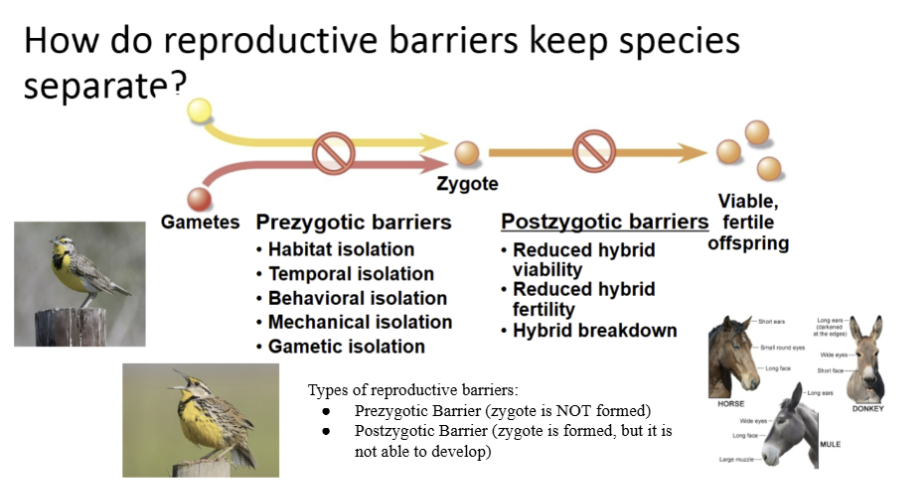
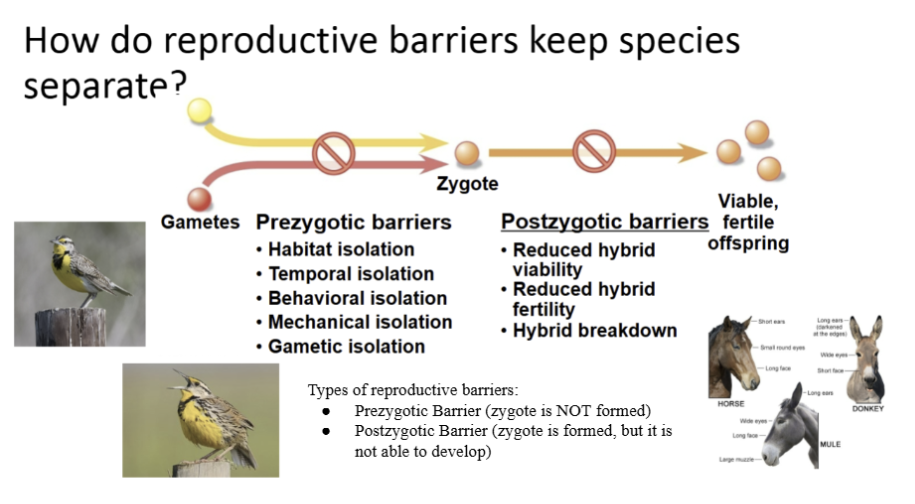
What are types of post-zygotic barriers?
Reduced hybrid viability – offspring does not develop properly
Reduced hybrid fertility – offspring is sterile
Hybrid breakdown – first generation is viable but later generations are weak or sterile
What is the time frame for formation of new species and how do new traits arise?
New species form through speciation due to reproductive isolation and can take thousands to millions of years
New traits arise from mutations, sexual reproduction, and environmental pressures
What is allopatric speciation?
Allopatric speciation is the formation of new species due to geographic isolation where a physical barrier (mountains, rivers) splits a population and limits gene flow
The groups evolve independently and eventually cannot reproduce even if reunited
What is sympatric speciation?
Sympatric speciation is the formation of new species in the same geographic location without physical barriers
Reproductive isolation occurs due to factors like niches/resource use, mate choice, or genetic changes
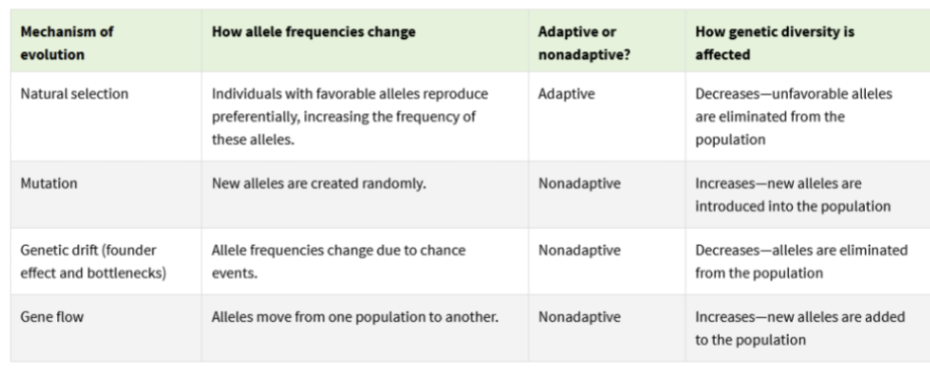
What causes changes in allele frequency?
Natural selection, genetic drift, gene flow, and mutation
What is gene flow?
Gene flow is the transfer of alleles between populations due to migration
This increases genetic diversity
Urbanization can reduce gene flow by creating barriers, leading to inbreeding
What is genetic drift?
Genetic drift is RANDOM change in allele frequencies, especially in small populations
It can reduce genetic diversity
Types: bottleneck effect and founder effect
What is the founder’s effect?
When a small group leaves a population and forms a new one, carrying only some alleles → reduced genetic diversity
What is the bottleneck effect?
When a population is drastically reduced due to events like disasters → reduced genetic diversity
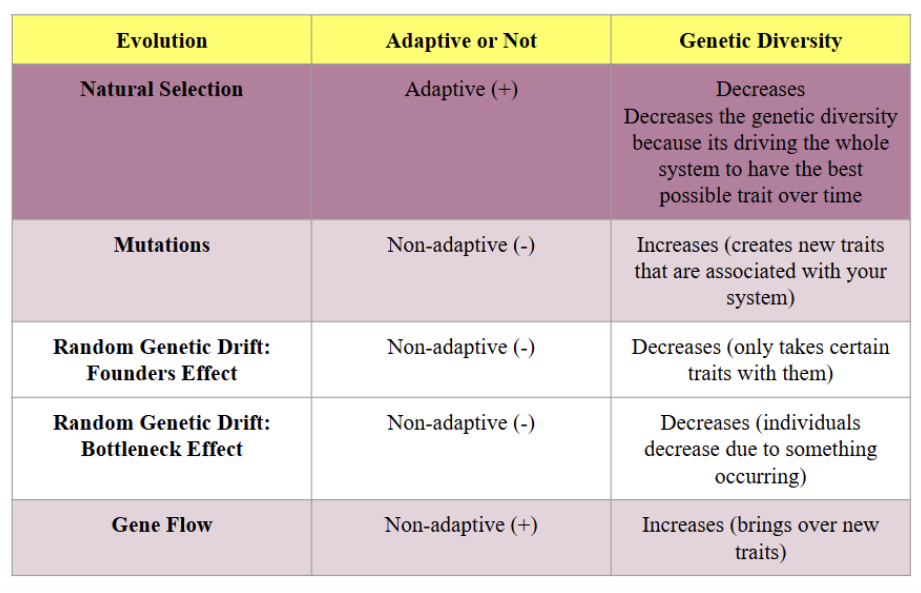
Which mechanisms lead to adaptation and which are not adaptive?
Adaptive – natural selection
Nonadaptive – mutation, genetic drift (founder and bottleneck), gene flow (random changes, not based on fitness)
What is inbreeding depression?
When closely related individuals reproduce leading to harmful recessive alleles being expressed
Causes reduced fitness, malformations, and lower reproduction
Urbanization increases inbreeding by limiting gene flow between populations
The Hardy Weinberg equilibrium equation measures what?
Measures allele and genotype frequencies in a population
What are the five necessary conditions of the Hardy Weinberg equilibrium?
No mutation
No natural selection
Large population (no genetic drift)
No gene flow
Random mating
Table for type of evolution, adaptive or not, increase or decrease in genetic diversity: