L4 Faulting and the Earthquake Cycle
 Call Kai
 Learn
Learn Practice Test
 Spaced Repetition
 Match
Match Flashcards
 Knowt Play
1/20

There's no tags or description
Looks like no tags are added yet.
Name | Mastery | Learn | Test | Matching | Spaced | Call with Kai |
|---|
No analytics yet
Send a link to your students to track their progress
21 Terms
What are tecotnics, and how do they serve to build mountains through contraction?
The relative movement between different blocks of the upper crust (15 - 20km);
Contraction can operate at boundaries between plate blocks to form thrust faults which eventually build topography.
What is an example of tectonic thrust faults building mountains?
Alpine fault, South island, New Zealand. Thrust fault with a constrast in relief between the upthrown hanging wall and the downthrown footwall blocks.
In what other way can contraction at plate boundaries build topography, and what is an example of this?
Contraction causes folds as shortening occurs between blocks;
An example of this is the Zagros mountains in Iran, where resistant limestone is folder over softer sedimentary rock.
What is a contrasting process to contraction which occurs at plate boundaries (normal faults) to build topography?
Extension.
The crust is thinned vertically whilst it is expanded horizontally.
The footwall is the block that is topographically below the fault (lifted up due to unloading and flexural uplift), and the hanging wall is dropped - creation of relief involves a small isostatic uplift too.
What are strike-slip faults, and how do these create topography? Give an example of this.
One block slides horizontally past another;
A bend or change in direction of the fault (subsistence of uplift) can create topography;
Santa Cruz mountains between Santa Cruz and San Fransisco - formed by an approximate 5 degree bend in the San Andreas fault.
What are the four tectonic methods of mountain building (summary)?
Contraction at thrust faults occurs between plate boundaries;
Contraction at plate boundaries creates folds as shortening occurs;
Extension causes vertical thinning and horizontal expansion at normal faults; and
Strike-slip faults can change direction/
What other three methods may also contribute to mountain building?
Volcanic eruptions;
Erosion; and
Dynamic topography due to mantle processes.
How do erosion and volcanic eruptions help to build mountains?
Erosion - negative load on the lithosphere causes rock uplift, especially when erosion is non-uniform.
Volcanic eruptions - tephra and ash accumulation.
How do mantle processes help to build mountains, and what is an example of this?
Dyamic topography can occur due to mantle processes such as plumes which influence relief from below;
Iceland - mantle plume below the mid-ocean ridge causes the ocean floor and land surface to sit at higher elevations than usual.
Describe the movement of tectonic plates.
Often have fixed velocities which cause them to move continuously;
Movement along boundaries however is not as continuous as it is frictional - normally operates in a stick-slip motion as the sides of the fault are loaded by relative plate motion. Creates episodic movement.
Why are most earthquakes limited to depths of <15 - 20km?
Stick-slip behaviour, and the strength profile of the upper crust.
Exception is subduction zones.
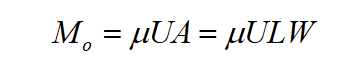
What equation defines the seismic moment of an earthquake, and how can this be broken down?
U = average slip;
A = area of the fault ruptured; and
u = constant.
Where do the largest earthquakes often occur, and why is slip in individual earthquakes important?
The largest earthquakes often occur at subduction zones;
Slip and moment magnitude are often proportional to rupture length - if you know how long a fault is the likely slip and magnitude of future earthquake events can be predicted; and
Slip in individual earthquakes is important as it is repeated over long periods of time to build topography.
What is a case study example of this scaling relationship betwee fault length and moment magnitude?
1556 Huaxian earthquake, China;
Approx. 80,000 deaths;
Population in the area has increased since the 1500s to > 15 million - a repeat of this event would be catastrophic;
Estimated that the length of the responsible fault is approx. 100km, meaning the magnitude can be scaled to approx 7.
What is the first key point about slip for earthquake surface processes?
Slip decreases along strike towards the fault tips in a single earthquake.
What are the consequences of this slip pattern?
In long-term fault displacements - largest displacement near the centre of the fault, decreasing to zero at the tips.
How does slip change with distance away from the fault?
Slip decreases away from the fault, both in a single earthquake (top) and after epeated earthquakes (bottom).
How does fault displacement relate to fault length?
Fault displacement is more or less linearly proportional to total fault length, meaning that long faults have the most displacement. This relationship holds over 8 orders of magnitude.
How do faults grow over time?
Extend their tips; or
Connecting with other faults.
How does fault growth affect slip rates?
Slip rates vary in the same way as displacement, both horiztonally and cross-strike; and
Often shown as throw rate - the vertical component of slip rate.
Why is undertsanding patterns of slip important considering mountain growth?
The vertical component of fault slip rate (rock uplift rate) creates relief as it causes differential movement of the Earth’s surface;
Multiple earthquakes form mountains, and fault slip/slip vary in predictable ways around growing faults; and
Steady state of a system can be reached when rock uplift and erosion are balanced.