ECO LAB_Grassland Vegetation & Freshwater Analysis
 Call Kai
 Learn
Learn Practice Test
 Spaced Repetition
 Match
Match Flashcards
 Knowt Play
1/102

There's no tags or description
Looks like no tags are added yet.
Name | Mastery | Learn | Test | Matching | Spaced | Call with Kai |
|---|
No analytics yet
Send a link to your students to track their progress
103 Terms
quadrat method
one of the most widely used means of attaining quantitative information about the compositions and structure of plant communities
species-area curve
can be used to determine the size of the quadrat
Shannon-Wiener Diversity Index
The species diversity can be assessed using the
species richness
the number of species in the given area
species evenness
the degree to which species are distributed equally
minimum size of the quadrat
where the number of species starts to be the same
determine the richness of the area
formula of Frequency

the more important the plant is in the community
higher the frequency, ____
formula of Relative Frequency

Abundance of a species
compares the number of plants of that species with the total number of plants of all species in the study area
Formula of abundance

Density
Closely related to abundance but more useful in estimating the importance of a species is the ___. It is defined as the number of plants of a certain species per unit area
formula of density

formula of relative density
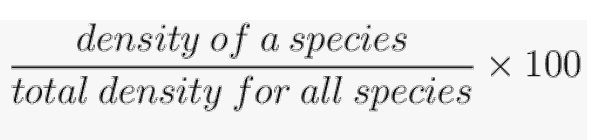
Percent Cover
the proportion of the total area occupied by the species
formula for Cover

Relative cover
gives a better indication of the importance of a species than does the absolute value
formula of Relative cover

Importance value
sum of the Relative frequency, relative density, relative cover, and relative abundance
Grassland
They belong to terrestrial biomes which are characterized by lands dominated by grasses rather than large shrubs or trees
Tropical Grassland
Types of Grassland:
Savannas
Grasslands with scattered trees are found in Africa, South America, and northern Australia
Hot, tropical areas with temperatures averaging from 24 ºC –29ºC (75ºF –84ºF) and an annual rainfall of 51–127 cm (20–50 in)
Savannas have an extensive dry season and consequent fires
Temperate Grassland
Types of Grassland:
Found throughout central North America (prairies) and in Eurasia (steppes)
Have annual fluctuations in temperature with hot summers and cold winters
Annual precipitation ranges from 25.4 cm to 88.9 cm (10–35 in)
Dominant vegetation tends to consist of grasses. The treeless condition is maintained by low precipitation, frequent fires, and grazing
aquatic ecosystem
can be classified as a freshwater or marine ecosystem
Lotic
refers to running waters such as rivers, streams, and springs
lentic
refers to standing waters like lakes, lagoons, and ponds
physical parameters
light penetration, temperature, current, color, and total suspended solids (TSS)
epilimnion
penetrated by light
warm, typically oxygen rich
recurrent surface scum
floating weed masses
Surface waters of constant temperature (usually warm) mixed throughout by wind and wave circulation
hypolimnion
unpenetrated by light
zone completely void of oxygen
old water temperatures
accumulating organic muck
weds prevalent
unusable by fish and all aerobic organisms
The deeper high-density water (this is usually much colder, although in tropical lakes the temperature difference between surface and bottom water may be only 2-3 ⁰C
Metalimnion (Compensation depth)
boundary between the epilimnion and hypolimnion where there is an equal amount of dissolved oxygen and carbon dioxide
zone of decreasing water temperature
zone of decreasing dissolved oxygen
A fairly sharp gradational zone between the two
plankton and silt
Light penetration is affected also by the number of solids present in the water thereby making the water turbid due to the presence of ____ or the presence of ___ due to erosion
chemical factors
dissolved oxygen (DO), salinity, alkalinity, hardness, and nutrients
dissolved oxygen (DO)
produced by the phytoplankton or by diffusion from the atmosphere.
it is the amount of oxygen from the atmosphere and from aquatic plants
Can enter into the system through direct diffusion and as a by-product of photosynthesis
Removed through respiration and decomposition
N, P, K, Ca, Mg
Most of the elements present in the like _____ and others are produced due to the leaching of rocks, erosion, and fertilizers and pesticides, wash out.
Total Dissolved Solids (TDS), conductivity, and salinity
measures N, P, K, Ca, and other elements
littoral zone
nearshore area where sunlight penetrates all the way to the sediment and allows aquatic plants (macrophytes) to grow.
most productive area of the lake
influences the movement and processing of material flowing into the lake from terrestrial runoff, groundwater, or stream connections
comprises a large proportion of the total lake area
emergent vegetation
rooted in the upper littoral zone
live near the water’s edge and along the banks of rivers and often have deep and dense roots that stabilize shadow soils at the water’s edge
floating vegetation
is found in the middle littoral
have leaves that float on the water’s surface. their roots may be attached to the substrate or floating in the water column
submerged vegetation
often grows in the lower littoral
also rooted to the bottom but their leaves grow entirely underwater
Nektons
are swimming organisms and, thus can choose where they go. It includes organisms such as fish, amphibians, turtles, large zooplankton, and insects.
Planktons
are organisms that can go where the water takes them.
formula of total number of planktons

formula of enumeration factor
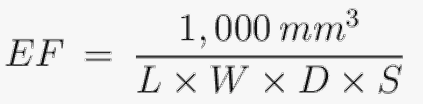
L
Interpretation of the formula of enumeration factor:
length of one strip of the Sedgewick Rafter counting chamber
W
Interpretation of the formula of enumeration factor:
width of one strip of the Sedgewick Rafter counting chamber
D
Interpretation of the formula of enumeration factor:
depth of one strip of the Sedgewick Rafter counting chamber
S
Interpretation of the formula of enumeration factor:
Formula of the abundance of the littoral macrophytes

Freshwater ecosystem
it is a body of water with very low salt concentration
Limnetic Zone
The open water area in lakes
Benthic zone
bottom part consisting of organic sediments and soil
considered as the’ digestive system’ of lakes
Euphotic Zone
portion of water that receives sunlight
where algae and other aquatic plants thrive (in addition to the littoral zone)
Profundal Zone
located under the thermocline where the sunlight does not penetrate the water
depends on the age and water clarity
typically has a low population of fish because of the lack of oxygen
Stratification
It is the development of relatively stable light and warm layers above colder deeper layers within bodies of water.
Secchi depth
a reasonable approximation of the photic zone
an estimator of compensation depth (depth at which output from photosynthesis is equal to the costs of respiration for the plant: below this depth plants do not persist) for plants
Temperature
varies also within the water column where it is affected by light penetration
Stenothermic
organisms with narrow-range temperature tolerance
Eurythermic
organisms with wide-range temperature tolerance
Total solids
refer to waterborne particles that vary in particle size and can be suspended or dissolved in water
Total suspended solids (TSS)
non-filtrable, Everything that is retained by a filter is considered suspended solids
Total dissolved solids (TSS)
filtrable
Turbidity
It is the degree of opaqueness developed in water by means of suspended matter
Settling suspended matters
those substances which in motionless water, will settle to the bottom sooner or later
Non-settling suspended matters
Finely divided solids or those materials whose specific gravity is less than water
Biochemical Oxygen Demand
it represents the amount of oxygen consumed by bacteria and other microorganisms while they decompose organic matter under aerobic (oxygen is present) conditions at a specified temperature
inversely proportional
BOD and DO are _______ to each other
Elevation
the amount of oxygen in elevation increases. Since streams get much of their oxygen from the atmosphere, streams at higher elevations will generally have less oxygen
Salinity
salty water holds less oxygen than fresh water.
It is the quantity of dissolved salt content of the water
Temperature
cold water holds more dissolved oxygen than warm water
Turbulence
more _____ creates more opportunities for oxygen to enter streams
pH
It is the quantity of hydrogen (H+ ) ions in the water.
Halophytes
plants that naturally inhabit saline environments and benefit from having substantial amounts of salt in the growth media
Halophiles
organisms represented by archaea, bacteria, and eukarya for which the main characteristic is their salinity requirement, halophilic “salt-loving”
Nitrogen
It is the limiting nutrient during photosynthesis.
Enters into aquaculture through rainfall, in-situ N2 fixation, river runoff and diffusion from sediments, uneaten feeds, and fish wast
Ammonia
is the initial product of the decomposition of nitrogenous organic wastes and respiration.
is directly correlated with temperature and pH
Nitrites
These are completed through nitrification done by aerobic, gram-negative, chemoautotrophic bacteria found naturally in the system.
Nitrates
is formed through nitrification process (i.e. oxidation of NO2 into NO3 by the action of aerobic bacteria.
Stable, highly soluble in water, least toxic
High levels can lead to osmoregulation, oxygen transport, eutrophication, and algal bloom.
Phosphorus
in bodies of water, it typically exists in the form of phosphates.
Another limiting factor in plants
High levels can lead to osmoregulation, oxygen transport, eutrophication, and algal bloom.
Hardness
It is the measure of the quantity of divalent (salts with 2 positive charges) ions such as calcium, magnesium and/or iron in water
Calcium carbonate
is a general term that indicates the total quantity of divalent salts present and does not specifically identify whether calcium, magnesium, and/or some other divalent ions are causing water hardness.
Trophic Status
It is the overall level of biological productivity within a lake and is a key characteristic of water quality.
Oligotrophic lakes
contain low levels of phosphorus and usually support limited biological production (that is, low algal biomass) and thus low concentrations of chl-a.
Mesotrophic lakes
have moderate levels of phosphorus and support greater biological production and chl-a. These lakes have moderate water clarity.
Eutrophic lakes
have even greater concentrations of phosphorus and chl-a.
Hypereutrophic lakes
have concentrations of phosphorus and chl-a beyond even that of eutrophic lakes.
Benthos
bottom dwellers
epifauna
type of benthos that live on the substrate (organism)
epiflora
type of benthos that live on the substrate (plant)
infauna
type of benthos that live on the inside the substrate, buried or burrowing in the sediment
phytoplankton
plankton that is plant-like an an photosynthesize
zooplankton
plankton that is animal like
sacroplankton
plankton that feeds on decaying matters
Meroplankton
plankton that is temporary, larval stages of larger organisms that spend part of their life cycle as plankton
mesoplankton
small, free-floating aquatic organisms
microplankton
plankton that is 20-200 micrometers in size
Limnoplankton
plankton that lives in Freshwater (ponds and lakes)
rheoplankton
plankton that lives in Running water (rivers and streams)
heleoplankton
plankton that lives in swamps and marshes
haliplankton
plankton that lives in Salty waters (oceans)
hypalmyroplankton
plankton that lives in Brackish water (estuaries)
epiplankton
plankton that live near the surface of the water