Psych Paper 1
 Call Kai
 Learn
Learn Practice Test
 Spaced Repetition
 Match
Match Flashcards
 Knowt Play
1/50

Earn XP
Description and Tags
all psych paper 1 study + theory flashcards
Name | Mastery | Learn | Test | Matching | Spaced | Call with Kai |
|---|
No analytics yet
Send a link to your students to track their progress
51 Terms
cognitive processing - MSM
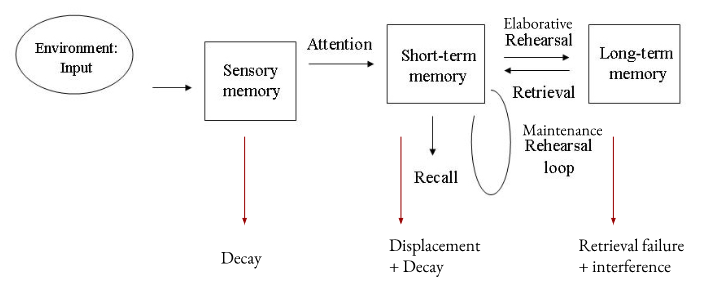
memory made up of 3 stores + 2 processes to transfer info. between stores (attention + maintenance/elaborative rehearsal)
sensory: temp. store holding info from environment for 0.5-1s in the modal form it’s received. needs to receive attention to begin process of transferring to LTM - otherwise decays
modality specific
STM: if attention paid to stimuli, info enters thru SM. temp. store that can hold 7 “chunks” of info for 30s. if info. rehearsed, it’s transferred to LTM. if not rehearsed/more info disrupts rehearsal, info. may be displaced
maintenance rehearsal loop for temp. immediate use
encoded acoustically
LTM: if rehearsed in STM thru elaborative rehearsal, memory stored here. unlimited capacity + duration, can retrieve info. from LTM → STM when needed to b recalled (providing retrieval failure/interference doesn’t occur)
encoded semantically
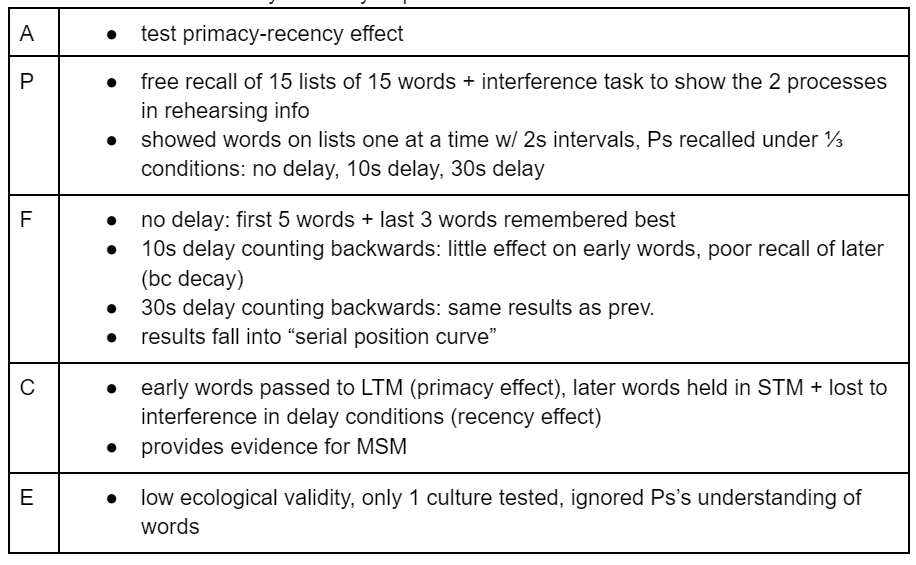
glanzer & cunitz
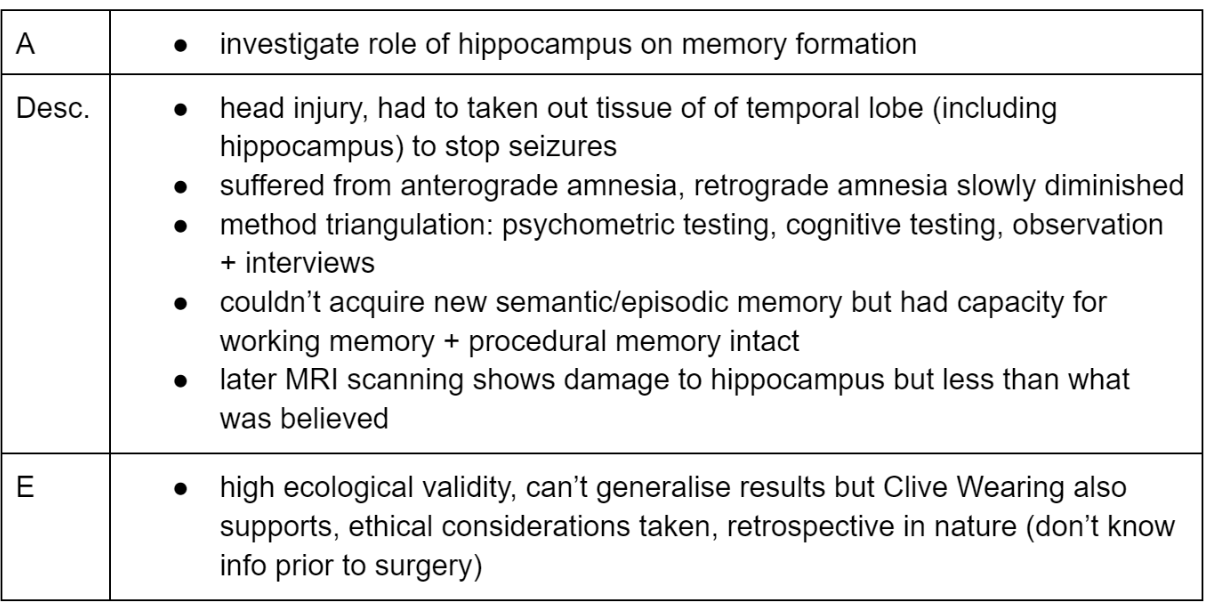
milner/HM
MSM TEACUP
historical sig. of model, as subsequent research based off of MSM (even contradictory)
sig. research to supporting existence of separate stores w/ diverse RM (experimental/longitudinal) (good T, E, A)
oversimplified (
C), each store considered independent, no explanation for reconstructive memory/distortion. in some cases, rehearsing info. extensively ≠ transfer to LTM. also no explanation for e.g. reflexes/emotional info. (A, P)A to education/ads/chunking
Ubc glanzer&cunitz is WEIRD
cognitive processing - WMM
STM more complex than just one single store, made up of multiple stores
CE: v. lim. store that directs attention (at automatic/supervisory level) and allocates info. based on modality. can focus/divide/switch attention
PL: limited capacity. auditory info. + written/spoken lang. store
phonological store → inner ear (holds words heard). can receive info from SM, LTM, articulatory process
articulatory process → inner voice (holds words heard/seen, repeats it)
VsS: limited capacity. visual/spatial info. store from SM or LTM
visual cache → form/colour info.
inner scribe → process spatial/movement info
EB: links info. to form integrated memory w/ time sequencing + moves it to LTM e.g. memory of event
landry & bartling
[A] investigate if articulatory suppression affects recall accuracy of dissimilar letter sequences in serial recall
[P] undergrad psych students divided into experimental (articulatory supression) and control groups (silent recall). saw list of dissimilar 7-letter sequences (5s), 5s wait, then write. experimental repeated 1,2 aloud while doing the task. avg % correct recall was calculated
[F] experimental group had lower recall accuracy (76% vs 45%) bc phonological loop was disrupted by verbal interference
[C] articulatory suppression prevents rehearsal bc phonological loop overloaded, leading to less recall accuracy
[E] high internal val. → causal but strictly controlled setting doesn’t model RW situation (mundane realism), psych. students may have predicted aim of study (demand characteristics)
cognitive processing - schema theory
proposed by bartlett, dev. by piaget…mental framework that help individuals…
organise knowledge, assist recall, guide behaviour, predict situations (by having prior knowledge of events), make sense of events
derived from prior knowledge/experiences. simplify reality + culture specific
scripts → schemas about events in time. if don’t go according to expectations, we get annoyed/confused/angry
children learn using existing schemas using accommodation (existing schema replaced) or assimilation (info. added to schema)
levelling (omitting minor details)/sharpening (exaggerating certain details) to fit into schema
schemas can influence memory at all stages (encoding/storage/retrieval) - brewer & treyens
schema theory TEACUP
T, E (bio. research supports way brain categorises info thru visual cortex)
A (helps understand memory distortion, applied to abnormal/health/relationship psych)
reconstructive → eyewitness testimony/field of law
C(too vague, hypothetical, cannot be observed, lass tangible than other phenomena)U (applied across cultures but WEIRD research)
P (predicts behaviour e.g. what will be remembered best/typically left out but not exact)
predict factors that can distort memory e.g. leading Qs
reliability of cognitive processing - reconstructive memory
memories not copy but reconstruction
reconstruct → activate schemas relevant to event, which may distort memory
efforts after meaning: we try to make the past more logical/coherent/sensible
info. processed to understand it → memory is imaginative reconstruction of experience
acommodate → we change memories to keep schemas intact by levelling (removing details/downplaying) + sharpening (adding details/exaggerating)
loftus: nature of Qs in police interrogations can influence Ps memory → leading questions (suggestive) + misinfo. effect: post-event info. facilitates schema processing, may influence recall accuracy
barlett
[A] prove memory reconstructive, schemas influence recall, demonstrate role of culture in schema processing
[P] British students presented Native American story → allocated Ps to either serial/repeated reproduction
[F] no sig. diff. in conditions. recited version left out/replaced details relating to NA culture (e.g. canoe → boat). Ps filled gaps in memory w/ own cultural schemas (assimilation). word count went from 330 → 180 (levelling). added emotion to convey main themes (sharpening)
[C] remembering is active: info. changed by trying to fit into existing schemas to create meaning. more complex info’s elements distorted/forgotten. we try to find familiar patterns in experiences using existing schemas to reconstruct mem.
[E] no IV/DV/control (no standardised) (T/C not good → less control, EVs may have affected recall, weakening validity and support). experimental but high eco. val. bc findings of schema can still be transferred IRL (bc it simulates being exposed to info. second-hand)
loftus & palmer
[A] investigate whether leading Qs influence speed estimations
[P] students watched short films of driving accidents from driver’s ed videos. after each film, Ps asked to estimate speed of cars in accident, being asked ‘how fast were the cars going when they smashed / collided / hit / bumped / contacted each other’, with the intensity of the verb different in each condition
[F] mean estimates highest for ‘smashed’ (more intense verb), lowest for ‘contacted’
[C] eyewitness memory reconstructive and susceptible to distortions by post-event info. e.g. leading Qs, thus influencing memory recall
verbs e.g. smashed activated cognitive schema of severe accident that influenced memory of event. schema played role in encoding + recall of memory
[E] highly controlled → low eco. val. (films made for teaching purposes, don’t reflect RW accidents so Ps did not experience authentic emotions of a real accident)
but control CVs, maintaining internal val. + allows establishment of causal relationship
cognitive processing - DPM
highlights 2 systems of thinking: rational (controlled) vs. intuitive (automatic)
System 1 → ignores absent evidence, focuses on what it sees – “automatic”, based on schemas. quick, prone to errors, generates impressions, takes heuristics
done bc:
humans are cognitive misers (lazy)
when things are difficult, experience ego depletion
cognitive load too high → too much stuff going on
= law of least effort
System 2 → requires concentration/effort, works w/ abstract concepts + logic, reliable but slow, uses conscious reasoning
TEACUP
reductionist – doesn’t explain if/how modes of thinking interact/influence of emotion
some argue instead of 2 systems there is ‘continuum of reasoning’
applicable to extent; provides framework; A to ads
P which system is used in which context
definitions of system 1 + 2 not always clear e.g. fast = system 1, but experts may be fast + use system 2 (C)
reliability of cognitive processing - anchoring bias
rely too heavily on 1st piece of info. offered (anchor) use that as reference to make subsequent decision/judgements
once anchor set → judgements made by adjusting to anchor, bias towards interpreting other info. tend to remember 1st thing (bc sys. 1)
T, E → can be exp. manipulated + exp. demo. effect of anchors on decisions
A → marketing, pricing e.g. real estate
C → anchor easy to operationalise but sometimes diff. to set effective anchors
P → predicts choices in decision-making but magnitutude of bias not fully determined
tversky & kahneman
[A] investigate how anchoring bias (heuristic) influences estimation (even when Ps aware of sequence)
[P] highschoolers split into ascending/descending condition and asked to estimate 8! in 5s. theorised that 1st no. would bias estimate
[F] median for ascending group 512, descending 2250. both underestimated
[C] first number created anchor that affected estimation → shows anchoring heuristic (system 1/bias). hence irrelevant values can bias decision once anchor set/sys 1 used
[E] low eco. val. bc artificial task (5s absurdly short - extent findings applied?). independent samples - maths competence uncontrolled, may influence results
englich & mussweiler
[A] investigate whether a prosecutor’s recommended sentence would influence judicial decision-making
[P] young trial judges with <1 year experience given case of alleged rape. given 15 min. to form opinions ab. case after reading case materials, then given questionnaire. half Ps told prosecutor demanded a sentence of 2 (low anchor condition) vs. 34 months (high).
pilot study conducted on group of experienced judges, who provided a rational judgement (17 months)
[F] Ps in low anchor provided avg. sentence of 18 months, while those in high anchor = 28 months
[C] anchoring heuristic influences judgement + affects even experts in their work, demo. system 1 thinking. the pilot group demo. system 2 thinking by forming a rational decision w/o anchor’s influences
[E] true experiment + good internal validity → strong causal relationship established
high ecological validity due to construction of RW scenario + real judges. small sample size susceptible to distortions + results can only be gen. to less experienced judges
pilot group established reasonable + fair anchors, helping experimental design
emotion & cognition - FBM
detailed, vivid snapshot of moment when surprising/emotionally arousing event happened
special mech. hypothesis → neural mechanism triggers emotional arousal bc event surprising/important (amygdala) + creates a permanent record
FBM diff. to ordinary memories + resistant to forgetting
mechanism of formation (vivid memory) + maintenance (sustained through (c)/overt rehearsal)
importance-driven model → expanded on og, saying personal significance of event plays key role in encoding flashbulb memory
A → understand eyewitness testimony, trauma, media influence on memory
E → support how FBM vivid+confidence, + demo. distortions in FBM
C → diff. to obj. operationalise ‘emotionally sig. memories’ as FBM bc emotional sig. varies (difficult to draw line between FBM + ordinary)
U → diff. to generalise bc WEIRD sample, unsure ab culture-specific FBM
brown & kulik
[A] investigate whether emotionally significant events are remembered more vividly+detailed than mundane events
[P] 80 American adults (40 Black, 40 White) asked to recall the personal circumstances in which they first heard about major public events (e.g. assassination of JFK or MLK).
Researchers examined the level of detail, emotional intensity, and significance of the event.
[F] high emotional intensity → vivid detail, esp. for participants who had a personal connection
[C] emotionally significant events are encoded with greater vividness and clarity
[E] retrospective in nature + relied on unverifiable self-reports susceptible to distortion. questioned on very sig. national event → SDB to appear in favourable light. (gender + cultural) sampling bias (American M) → diff. to gen.
neisser & harsch
[A] investigate whether FBM susceptible to distortion
[P] uni students given questionnaires ab details of challenger 24 disaster hours after event + 2.5 years later. 2nd questionnaire asked ab Ps confidence in memory recall
[F] majority of Ps 2nd questionnaire didn’t match 1st, yet Ps claimed confidence + asserted memories correct
[C] emotional intensity associated w/ higher confidence but reduced accuracy. suggest memories vivid bc event rehearsed many times
[E] longitudinal case study allows for investigation of FBM over time BUT difficult to replicate + generalise. post-event info. may have influenced recall, yet was uncontrolled V → weakening validity
neg. impacts of technology on cognition
recent research suggests technology has a sig. impact on cognition, especially on memory. one neg…sparrow et al demo….one pos…blacker et al demo…this essay will…
declarative (semantic/episodic) and procedural but third type (TMS)
include knowledge of where info. can be found + how to access it. collaboration essential to retrieval of information
often seen in relationships, which allow access to info. when needed (no need to transfer to LTM) (have specific roles regarding encoding/storage/retrieval of info.)
frequent use of internet rep. TMS → reduces reliance on individual stores leading to digital amnesia/google effect → tendency to forget info. bc one trusts technology to store/retrieve it
sparrow et al.
[A] investigate whether memorisation takes less effort if one is aware it can be retrieved from external source (google)
[P] Ps asked to type 40 trivia facts on computer. 2x2 independent samples design (2 IVs at 2 diff. levels). either told computer would store everything/info. would be erased. within this asked to remember/not asked
[F] Ps who believed info. could be retrieved from computer → less effort into memorising (more wrong)
[C] difference in how well people memorise when told external source will save it
[E] “level of effort” difficult to measure (effect on recall exists, but uncertain why), P variability, high internal but low eco.
pos. impacts of technology on cognition
video games can improve cognitive processes such as decision-making, breaking down (analysis)/categorising/putting together (synthesis) information, as well as making conclusions/inferences (story elements + hints).
esp. visual memory bc trains mind to process info. faster, adapt to changing environments, switch between tasks
esp. w/ fast-paced, unpredictable games that require multitasking e.g. action
blacker et al.
[A] investigate whether video games could help develop visual working memory
[P] M uni students randomly allocated to ½ conditions: action/no action game. asked to dev. skills for at least 1hr for 30 days. Before/after asked how motivated they were + game performance obs. + visual memory tested via change detection task
[F] both groups had same motivation levels + improved in game performance over time but action game Ps demonstrated sig. improvement in task, other condition did not
[C] action video games may improve visual memory thru dev. of selective attention [write all the stuff it helps w/]
[E] high internal val. + reliable (T,E) but only M uni students used (U), social desirability possible during pre-study (dev. not accurate) + low C validity, only looking at short-term changes (may teach violence/destroy attention span)
at least 1 hr not controlled → possible those in action condition enjoyed game more and played more and thats why they dem. inc. performance → weakening val.
performance in task compared against same P → reduces P Vs diminishing val.
evaluation
T bc presence/absence of tech. can be experimentally manipulated
E to support neg. impact of tech on cognitive processes (experimental research infers causality) BUT low bc new field
A bc tech big part of lives + schools integrate tech into curriculum (must observe impacts)
now we know neg. effect → can try to lessen GE
P bc predicts effects of tech/social media on people
not U → new study, chance of confirmation bias (may wanna prove beliefs ab tech so results in accordance w/ theory), not reliable → new area of study, needs more research
C bc experiments but Sparrow is loose concept
brain/behaviour - techniques to study (MRI)
MRI uses magnetic radiowaves to map brain structure (distribution of H atoms in brain)
no side effects, non-invasive, no radioactive tracer
high spatial res (1-2mm)
analysed by voxel-based morphometry (VBM - counts voxels/3D pixels of white/grey matter) or pixel counting (to count area)
STUDY - MAGUIRE
brain/behaviour - localisation
specific parts of brain have specific functions related to specific behaviours (thought, actions, etc.)
strict localisation theory → v. small, specific areas carry out diff. roles (if damaged, difficult to carry out connected function)
behaviour complex + involves many parts of brain – areas work together to create functions
if one part damaged, other areas take over (neuroplasticity) → less damage
brain/behaviour - neuroplasticity
= ability to create new neural pathways based on environmental stimulation (social interactions and learning opportunities), demonstrated through any form of learning
learn new skill → neurons form new neural pathways
stop skill → neural pruning, brain eliminates unused pathways (use it/lose it)
if one part is damaged, brain activity associated w/ a given function can move to diff. location due to neuroplasticity (people recovering from brain injury)
draganski
[A] investigate whether learning new skill causes structural changes in brain, supporting neuroplasticity/pruning etc
[P] Adult Ps w/ no prior juggling experience randomly assigned to ½ conditions: juggling group (learned for 3 months) and control group. MRI scans taken before training, after 3 months of training, 3 months after stopping training
[F] Ps in juggling condition demo. inc. grey matter vol. in brain areas associated w/ visual motion processing after training (mid temporal lobe). after stopping → grey matter vol. dec. but remained higher than baseline. no sig. changes in control group
[C] adult brain ‘plastic’ and can change structurally in response to learning new skills. but are use-dependent and neural networks pruned when skill practising ceased.
localisation of function?
brain/behaviour - neurotransmitters
neurons transmit electrochemical impulses (produces sensory info. + response to stimuli)
action potential reaches axon terminal, presynaptic neuron releases neurotransmitters into synapse where they bind to receptors on post-synaptic membrane
n.t. then recycled or degraded
if n.t. blocked/replaced → affects message → affects behaviour
Ach linked to synaptic plasticity in hippocampus that has a role in memory/learning
agonist: chemical. binds to receptor site & mimics actions of neurotransmitter to produce signal/response
exogenous (external agonist) vs. endogenous (alr in NS)
antagonist: drugs that block receptor site, preventing neurotransmitter function (no AP)
synapse - gap between neurons (where neurotransmitter travels)
inhibitory: dec. likelihood of neuron firing by hyperpolarisation (e.g. GABA)
excitatory: inc. likelihood of neuron firing by depolarisation (e.g. acetylcholine)
antonova
[A] investigate role of hippocampus + Ach in spatial memory (supporting localisation?)
[P] healthy adult Ps completed a virtual reality navigation task (requiring spatial memory) under ½ conditions: receiving scopolamine (inhibit Ach) or placebo. brain activity measured using fMRI during task. procedure repeated weeks later with conditions swapped
[F] Ps injected w/ scopolamine demo. reduced hippocampus activation + impaired task performance. placebo → normal hippocampus activity + better task performance
[C] Ach may play role in encoding of spatial memory as the hippocampus had more activation in placebo condition w/ normal Ach levels. Blocking Ach disrupts hippocampal functioning (localisation, agonist/antagonist, inhibitory/excitatory)
hormone - adrenaline
adrenaline → stress hormones secreted by adrenal glands that play a role in emotional memory formation by activating the sympathetic nervous system
stimulus threatens → hypothalamus activates pituitary gland, which releases hormones to activate adrenal glands → releases adrenaline into bloodstream → inc. heart rate, BP, respiration
plays role in FBM formation + improves recall of emotionally sig. info.; when adrenaline reaches brain → activates amygdala to signify that important event has occurred → amygdala attaches emotional sig. to otherwise neutral stimuli, creating FBM
mcgaugh & cahill
[A] study role of adrenaline + amygdala in consolidation of emotionally charged memories
[P] Ps divided into 2 conditions, both of which saw 12 slides accompanied by diff. stories. then asked to rate their emotional response on a scale of 1–10. 2 weeks later Ps asked Qs ab story’s details to test memory e.g. father’s job? janitor/surgeon/lab tech.
1st → Ps heard boring story ab woman+son who visited father in hospital where they witnessed staff in a disaster prep. drill of simulated accident
2nd → graphic, upsetting story involving boy in car accident where his feet were severed and surgically reattached
[F] Ps who heard more emotionally arousing story had better recall of story’s details
[C] adrenaline, a stress hormone, activated the amygdala (which plays sig. role in creation of emotionally arousing memories) to influence participants’ memory - those in the second condition had improved recall of the story because it was emotionally arousing
pheromone - androstadienone/estratetranol
chem. substances/cues produced/released into. environ. by an animal that initiates social/reproductive behaviour in others of the same species
while no pheromone’s molecular structure has been identified in humans + humans don’t possess necessary organs to identify them, research into putative pheromones indicates their presence to some degree.
androstadienone (AND) = putative pheromone linked to attraction
steroid in M sweat/urine that heightens sympathetic nervous system, alters cortisol lvls, promotes + mood in females. also activates hypothalamus in het F, hom M but not het M, hom F
estratetraenol (EST) = F equivalent in urine
AND/EST thought to play role in human sexual behaviour
zhou et al.
[A] investigate effect of AND/EST on human sexual behaviour by affecting gender perception and attractiveness
[P] 4 groups of healthy non-smokers incl. 24 het/hom M/F presented with a point-light walker task + asked to identify sex of figure in motion. performed task at same time of day for 3 consecutive days while exposed to ⅓ conditions: either AND/EST mixed w/ cloves, or control mixed w/ cloves
[F] het F + hom M exposed to AND more likely to identify figure as masc than control group. AND had no sig. effect on het M + hom F
opposite results for EST
[C] AND/EST may have some effect on human sexual perception and behaviour. study demonstrates how putative pheromones influence sexual behaviour in humans, as Ps attracted to men were more likely to identify PLW as M in the presence of AND, but same did not hold true for those not attracted to men
genetics/behaviour - 5-HTT
no gene codes behaviour, but specific genes may contribute to specific behaviours in response to the environment
if individual has genetic predisposition to a disorder (bc genotype) → interactions w/ environmental stressors may cause genes to be expressed
diathesis-stress model
5-HTT REGULATES serotonin transport around brain; mutations change serotonin transport by affecting reuptake of serotonin in brain synapses
serotonin pathways involved in controlling mood, emotions, sleep, anxiety; mutations may cause atypical fluctuations in these behaviours
short allele variants thought to be linked to incidence of depression in relation to environmental stressors
reduced efficency in serotonin transport → individual more susceptible to depression
caspi et al.
[A] investigate whether there is evidence for GxE interaction for 5-HTT mutations
[P] longitudinal study following 26 y.o. New Zealanders div. into 3 groups based on 5-HTT alleles: 2 short, 1 long 1 short, 2 long. all Ps had been assessed for mental health every other year until 21. Ps asked to fill in ‘stressful life events’ questionnaire to report major stressors between 21-26 + assessed for depression
[F] Ps w/ 1+ short alleles demonstrated more depressive symptoms + suicidal ideation in response to stressful life events + more likely to dev. depression than Ps w/ 2 long alleles who experienced similar stressful life events
[C] simply inheriting gene not enough to cause depression but gene’s interaction w/ environmental stressors inc. likelihood of dev. depression (demonstrating GxE interaction)
[L] 5-HTT affects how ppl respond to stress, influencing likelihood of dev. MDD by interacting w/ environmental stressors
genetics/behaviour - twin/kinship studies
measure freq. of behaviour across + within generations to determine whether behaviour runs in families and try to find genetic root for it
twin studies compare MZ (share 100% of DNA) to DZ (50%). if MZ more similar (in obs. trait) → suggests genetic influence on behaviour
study effect of genetics on behaviour by determining concordance rates (% of pairs that share trait). MZ twins have higher concordance rate than DZ if behaviour has genetic link, but never 100% bc environmental factors influence expression of genes
holland et al.
[A] investigate whether anorexia has a genetic link by comparing concordance rates between if MZ + DZ twins
[P] 25 MZ + 20 DZ twins were given diagnostic interview for anorexia separately. at least 1 twin had to have anorexia. completed questionnaires ab. eating habits + personality traits. family pedigree constructed for each pair of twins to determine prevalence of anorexia in close relatives
[F] 56% concordance rate for MZ, only 5% for DZ. MZ had lower mean min. BMI + higher scores for ‘drive to thinness’ and ‘body dissatisfaction’ on questionnaires
[C] indicates genetic link for anorexia. both rates well below 100% → genes not wholly responsible, rather provide disposition to behaviour.
genetics/behaviour - parental investment theory
theory of natural selection → M’s intent is to spread DNA + F’s intent is to maximise survival potential of fertilised egg [explains human mating + sexual behaviour]
parental investment theory → natural selection accounts for sex diff. in sexual behaviour
women (invest more time/energy into raising offspring) → more selective in choosing mate, seek mate that will protect offspring (consider physical/material traits)
men (less parental investment) → interested in spreading DNA, more open to sexual activity to inc. reproductive chances
clark & hatfield
[A] investigate existence of gender diff. in approach to casual sexual activity
[P] 48 M/F. team of M/F confederates (ranging from mildly unattractive–moderately attractive) approached strangers of opposite sex on college campus, said ‘i’ve noticed u around campus + find u very attractive.’, then followed with 1/3 Qs selected randomly ‘would u go out/come over to apartment/sleep with me?’
[F] M/F Ps were equally willing to date. in other 2 Qs, 70% of M Ps but no women willing to have casual sex. confederate attractiveness had no effect on P response
[C] a gender diff. does exist in approach to casual sex, providing evolutionary explanation of sexual behaviour
[L] men were more likely to pursue short-term mating to spread DNA, while women were more selective to investigate whether potential partners could provide resources/protection for offspring. willing to go on date but not have casual sex bc they have more parental investment
diff. evolutionary pressures shape sexual behaviour, M/F adopt diff. mating strategies to inc. respective repro. success
individual/group - SIT
we don’t have 1 personal self, but several social selves corresponding to group memberships
each identity comes with associated concepts that guide our thoughts/feelings/behaviours
sense of self depends on which of p+s identities is salient (depends on context)
SIT predicts that when 1 s identity becomes salient it influences behaviour
mechanisms of forming SIT: social categorization → organising people into groups based on similar characteristics (+ ourselves) (creates ingroups vs. outgroups)
social identification → adoption of group identity
social comparison → comparing ingroup to outgroup to determine value of membership
+ tendency for people to use group memberships as source of self-esteem
maintain/enhance it by outgroup discrimination or in-group favouritism
rogers & frantz
[A] investigate whether white European immigrants in Zimbabwe adopt prejudiced attitudes toward local African population over time
[P] stratified sample of Ps that had lived in Zimbabwe for varying lengths of time (5-40+ yrs) responded to a survey with examples of laws/customs in which Europeans/Africans were treated diff. Likert scale choices ranging from it being important to maintain current segregation or discontinue it
[F] majority of Ps favoured retaining segregation. longer residence (5-9 years) was associated with stronger support for maintaining segregation
[C] new immigrants inc. adopt local norms/prejudices of general European population the longer they live in the society, suggesting social conformity to group norms plays a role in the formation of stereotypes.
stereotypes ab African population were integrated into identities of newcomers as they began to identify w/ new group + accept ‘social role’
individual/group - SCT
we learn/imitate behaviour thru observational learning (models who provide e.g. of behaviour) based on a behaviour’s consequences
vicarious reinforcement - more likely to imitate behaviour w/ + consequences
learn based on the consequences of someone else’s behaviour
model stands out in contrast to others, behaviour must be consistent and reinforced, liked by observer/observer identifies w/ model
mediating processes to determine whether to acquire new behaviour
Attention: need to pay attention to behaviour/consequences
Retention: individual must remember behaviour in order to apply it in future. takes time
Reproduction: must be able to perform behaviour that model demonstrates
Motivation: must be motivated to perform behaviour (reward/punishment)
bandura
[A] investigate whether children learn aggression from observation + imitation as supported by the SCT
[P] children placed in a room with a bobodoll under ⅓ conditions: one with an aggressive model (adult models acted aggressively towards doll), a non-aggressive model (adult model played w/ blocks, ignored doll), control group.
then moved to another playroom to arouse aggression by saying …, then to 3rd w/ bobodoll to observe aggression
[F] children in aggressive condition demo. more aggressive behaviours than those in other conditions. boys more physical, girls more verbally aggressive. children more likely to imitate same-sex adult models
[C] behaviour can be learned through obs./imitation w/o direct reinforcement, demonstrating the role of models in shaping behaviour
individual/group - formation/effect of stereotypes
Formation
SIT categorises groups → need for positive distinctiveness → we attach neg. stereotypes to outgroup (outgroup discrimination + homogeneity)
SCT explains formation as learned behaviour
learn from models (enculturation), imitate models bc want to adhere to group norms
grain of truth hypothesis
gatekeepers (media, models) help create schemas ab person based on group membership
form stereotype by personal experience w/ 1 individual from 1 group → generalisation to whole group
Effect
stereotype threat → individual worries that own behaviour is confirming - stereotype about own group → leads to spotlight anxiety + underperformance/distress
steele & aronson
[A] investigate how stereotype threat affects test performance of AfAm
[P] sample consisted of white + AfAm students. Ps given standardised test under ½ conditions: told test of intellectual ability (stereotype threat condition) or problem-solving skills (non-threat condition)
[F] AfAm performed sig. worse than white Ps in first condition, no sig. diff. between Ps in 2nd condition. white Ps performance unaffected by test framing.
[C] AfAm performed worse bc awareness of negative stereotypes surrounding intellectual ability created stereotype threat + impaired performance
cultural origins of behaviour - cultural dimensions (individualism/collectivism)
= pattern of values in a culture that affects behaviour/cognition
concept introduced by hofstede as a way to compare and discuss cultures
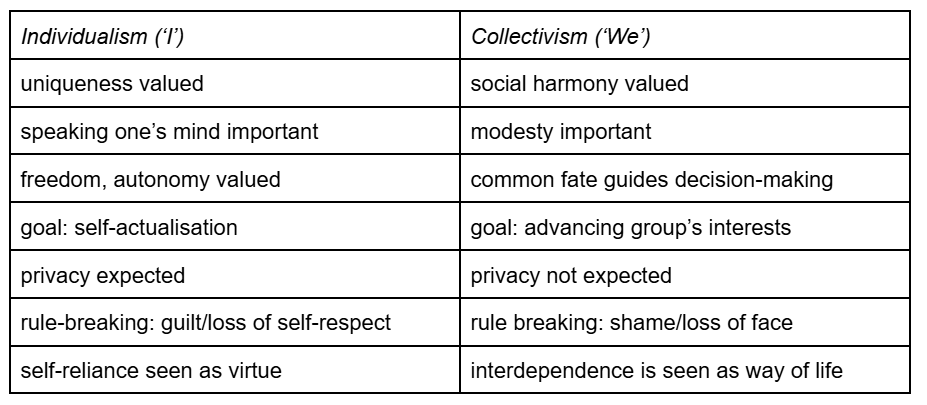
individualism → uniqueness and autonomy valued, self-reliance is seen as a virtue. individual defines personality in terms of own characteristics, and speaking one’s mind important
collectivism → social harmony, group cohesion, modesty valued. interdependence is seen as the way of life, and the ‘goal’ is to advance group interests instead of being self-sufficient.
one effect = conformity (higher in collectiv. bc interdependence/cohesion/social harmony)
berry
[A] investigate how culture influences conformity by comparing two different types of cultures to support role of dimensions on behaviour
[P] 3 diff. cultures: temne of sierra leone (collectivist), inuit of baffin island (individualist) + scots (control group) completed variation of Asch’s conformity task, where they were shown series of lines + asked to match 1 to ref. line. on certain trials, Ps given suggestions by researcher (people from ur culture chose this) to see if they conformed. one suggestion was right, but others were wrong
[F] temne showed highest lvls of conformity, inuit lowest, scots between. not much variation within cultures
[C] collectivist culture (temne) had higher conformity → emphasised group harmony/cohesion (even when quizzed individually) while individualist culture (inuit) had lower conformity → valued independence. supports hofstede’s theory that dimensions influence behaviour, as the type of culture directly affected the lvl of conformity
[research done before Hofstede’s theory]
cultural influences on behaviour - enculturation
lifelong process by which individuals learn own culture (from parents, school, friends, media, religion) in order to function within culture successfully
via observation, formal instruction, direct experience through + reinforcement
enculturation + behaviour bidirectional
this + social cognition enable cultural transmission (theory of learning according to which individuals acquire sig. amt. of info by just interacting w/ culture)
enculturating gender stereotypes → form of schemas (shaped by caregivers via enculturation but when circle widens, so does influence, so schemas can be broken thru accommodation)
studied thru case studies (obs. + interviews) bc it allows Ps to determine what is most relevant in their lives and bc it’s difficult to operationalise
wood et al.
[A] to investigate gender role enculturation as a result of parenting + toy selection, supporting role of enculturation in shaping gender identity
[P] 2-6 y.o. given selection of gendered toys + adult played with them: half the girls w/ mother, other mother, non-mother, other half w/ fathers. same for boys
researchers analysed which toys children chose + adult’s response
[F] adults reinforced gender-consistent toys. fathers more likely to discourage cross-gender play, mothers more subtle but still did
[C] gender roles socially constructed + reinforced through parenting – hence, enculturation plays key role in shaping gender identity from young age
cultural influences on behaviour - acculturation
process of psych (individual) + cultural (social) changes as result of interaction w/ new culture
in terms of majority (dom.) / minority (non-dom.) culture
2 dimensions:
desire for cultural maintenance (CM) → wish to preserve distinctive aspects of cultural identity
desire for intergroup contact (DC) → wish to have contact w/ other culture
acculturative stress → difficulties in process, stemming from differences between individuals and host culture
discrimination can heighten A.S. bc process seen as too demanding/impacts individual’s self-concept, coping
less desire for DC + isolation
lueck & wilson
[A] investigate factors that predict A.S. in asian immigrants + asian-americans
[P] semi-structured interviews (face-to-face or online) measured level of A.S. and examined factors such as the impact of lang. proficiency/pref., discrimination, social networks, family cohesion, socioecon. status.
[F] 70% of Ps reported A.S. lower stress levels linked to bilingualism, strong social support, integration. higher linked to only using 1 language, discrimination, economic struggles
[C] lvl of A.S. influenced by language proficiency, discrimination, social support, and bicultural identity+integration can help reduce it, supporting importance of acculturation in mental wellbeing