6. RGP Examination and Patient Education - Contact Lenses I Summer 2026
 Call Kai
 Learn
Learn Practice Test
 Spaced Repetition
 Match
Match Flashcards
 Knowt Play
1/69

There's no tags or description
Looks like no tags are added yet.
Name | Mastery | Learn | Test | Matching | Spaced | Call with Kai |
|---|
No analytics yet
Send a link to your students to track their progress
70 Terms
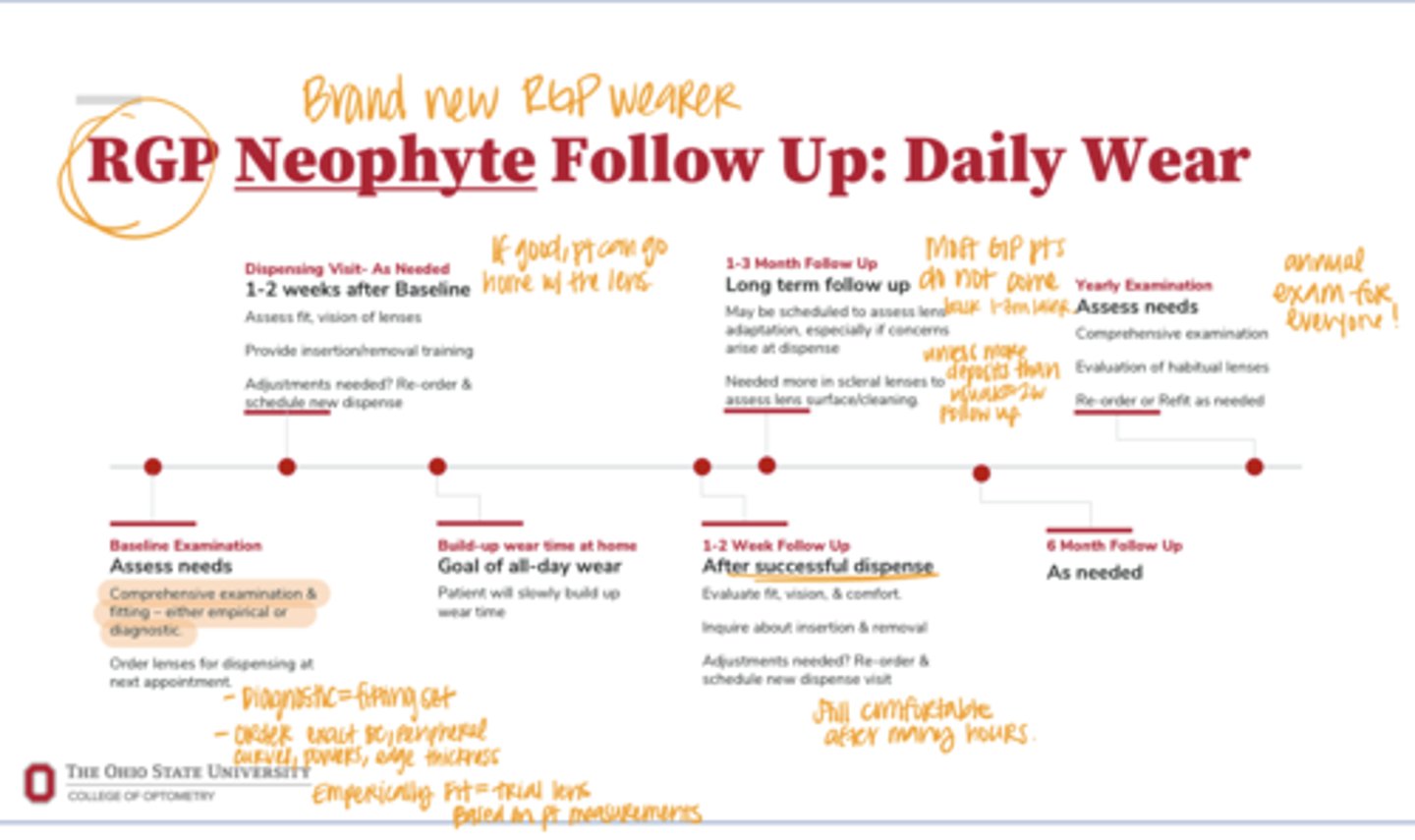
What is the F/U Schedule for RGP Neophyte?
-Baseline Exam & Fitting -- Either Empirical or Diagnostic
-F/U 1-2 wks after baseline to assess vision, fit, and make needed adjustments
-1-2week F/U after successful dispense
-Usually does not need long term F/U appt
-Yearly comprehensive exam
True or False:
The F/U schedule for RGPs is similar to soft lenses
True
RGPs are worn for at least ____ months
12
True or False:
Patients might need interim visits to check for deposits and/or clean their lenses
True
Research shows that RGP wearers are (more/less) likely to adapt to lenses if proparacaine is used at both fitting and dispensing visit
More
True or False:
RGP lenses are as comfortable as soft lenses after 2 weeks of wear
True
RGP Lens Adaptation Period
-Days 1-2: 4 hours
-Days 3-4: 6 hours
-Days 5-6: 8 hours
-Days 7+: !0 hours
What are the major steps in the manufacturing of a RGP?
-cutting and prep of the polymer
-machining
-cutting and polishing the base curves
-front curve cutting and polishing
-finishing
-In office modification?
The (front/back) surface provides the appropriate power to the RGP
front
Where is polymer cutting and prep completed?
by the polymer manufacturer
What do polymer manufacturers have to do?
Evaluate the purity and quality of raw materials
Refrigerate the material
Test for impurities using distillation
Polymerization
Can you get variability in the polymer manufacturing process?
Yes
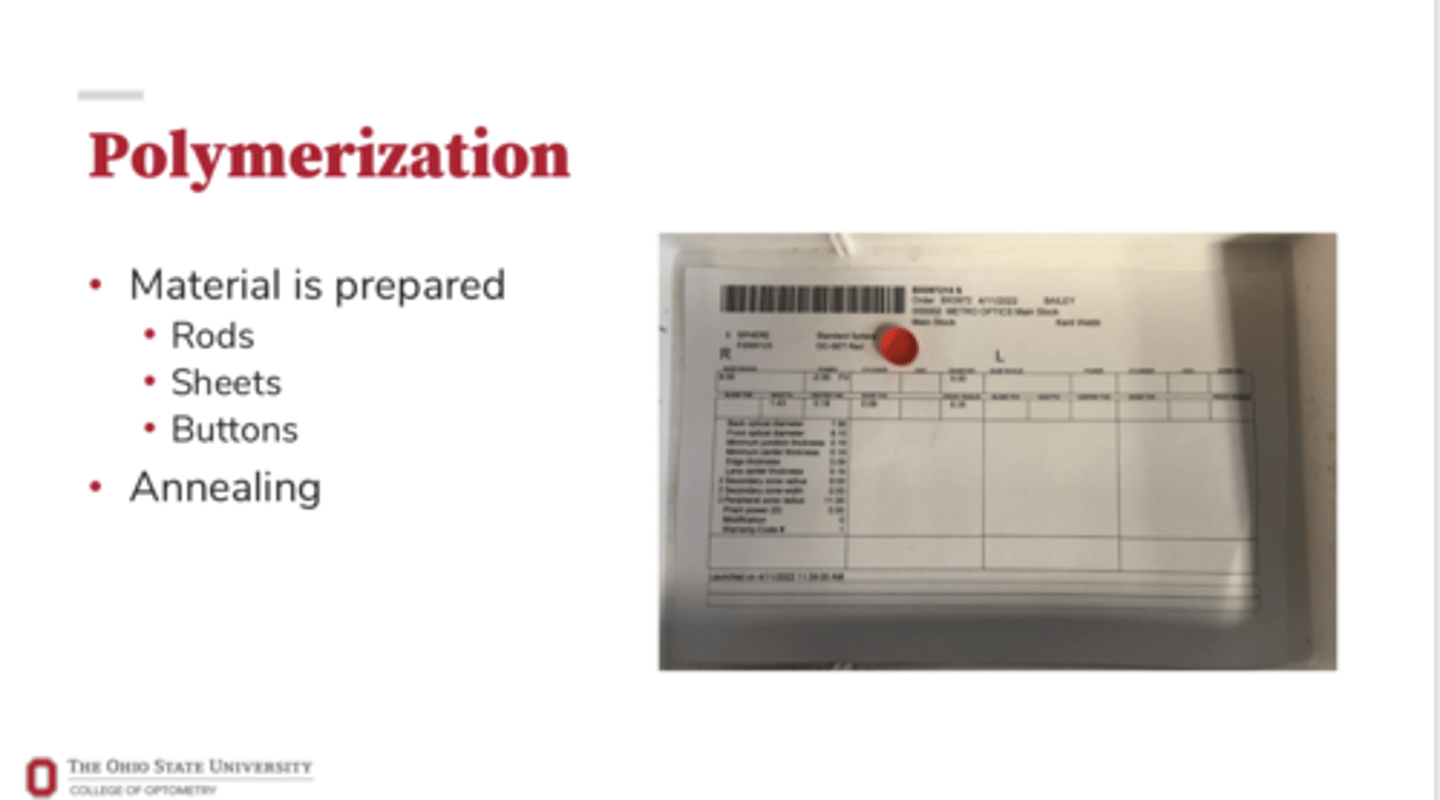
RGP lenses begin the manufacturing process as what?
-rods
-sheets
-buttons
Machining of RGPs is usually done by _____
lathe cutting
Can lathe cutting be inconsistent? Why?
Yes -- it is produced with slow, shallow cuts and needs constant application of liquid air coolant. Temp or humidity can create inconsistencies
True or False:
Some RGPs are molded like soft CLs
true
What is the benefit of molding RGPs like soft CLs?
eliminates inconsistencies
Improvements in ____ techniques is needed to improve material stability
curing
What is combination machining/molding?
Molded BACK SURFACE with a lathed FRONT SURFACE AND LENTICULARS
High Dk in a RGP = (more difficult/easier) to manufacture
more difficult
Why are RGPs with higher Dk harder to manufacture?
-slower speeds
-slower polishing
-need to reduce heat on these lenses
They use a lathe to cut the (concave/convex) base curve of a RGP
concave
How do they polish the base curves of lenses?
-pitch
-soft waxes
-pellon pads
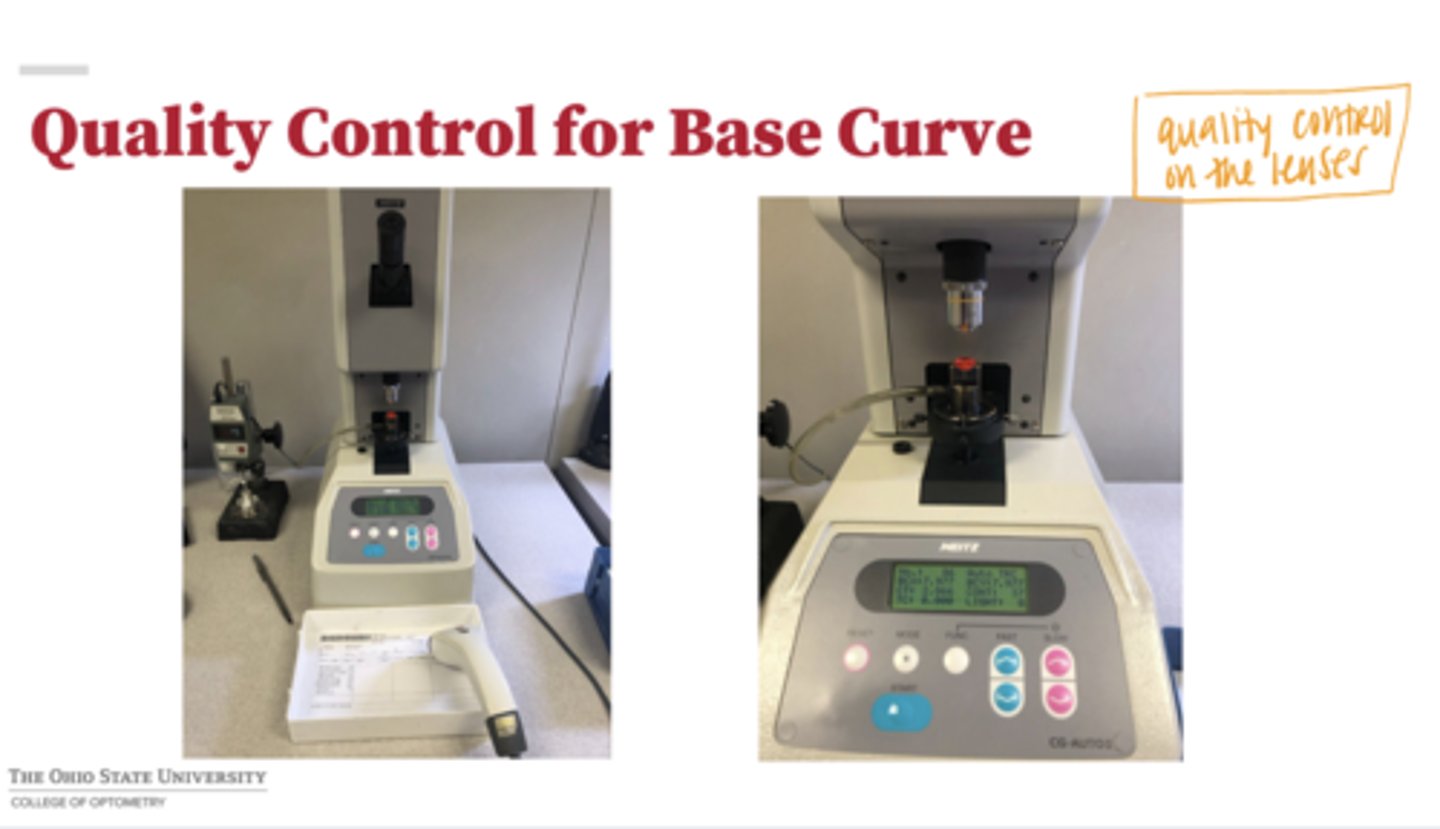
Do they do quality control for the base curves of RGPs?
Yes
How are the front curves cut on RGPs?
-Mounting button on an arbor with water soluble wax
-Process is similar to base curve cutting
-Black is reduced to the final thickness during this step
-Lenticulation is performed during this step
Is the front curve of an RGP polished?
Yes
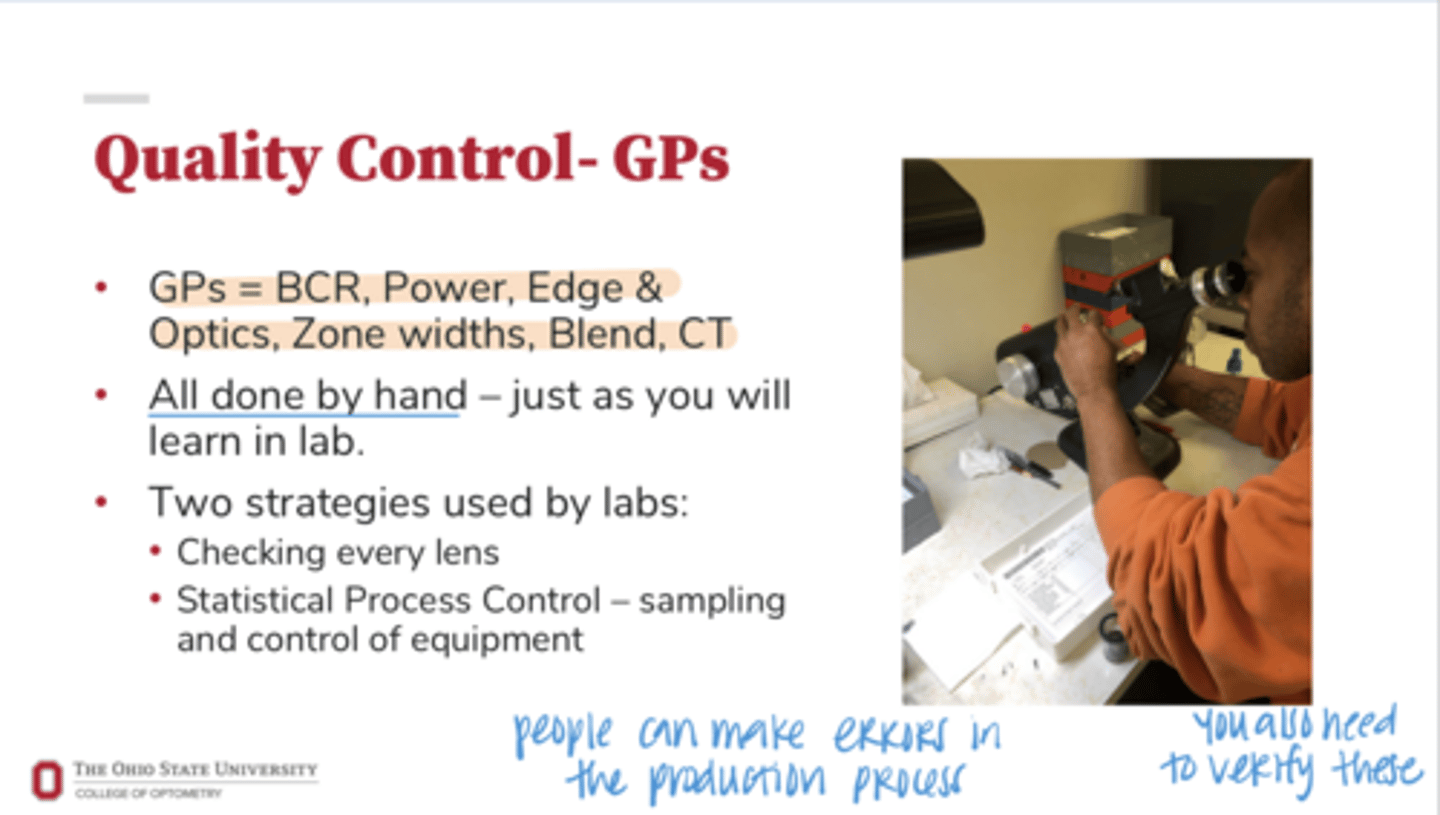
What parameters are usually verified on a RGP?
-BCR
-Power
-Edge
-Optics
-Zone Widths
-Blend
-CT
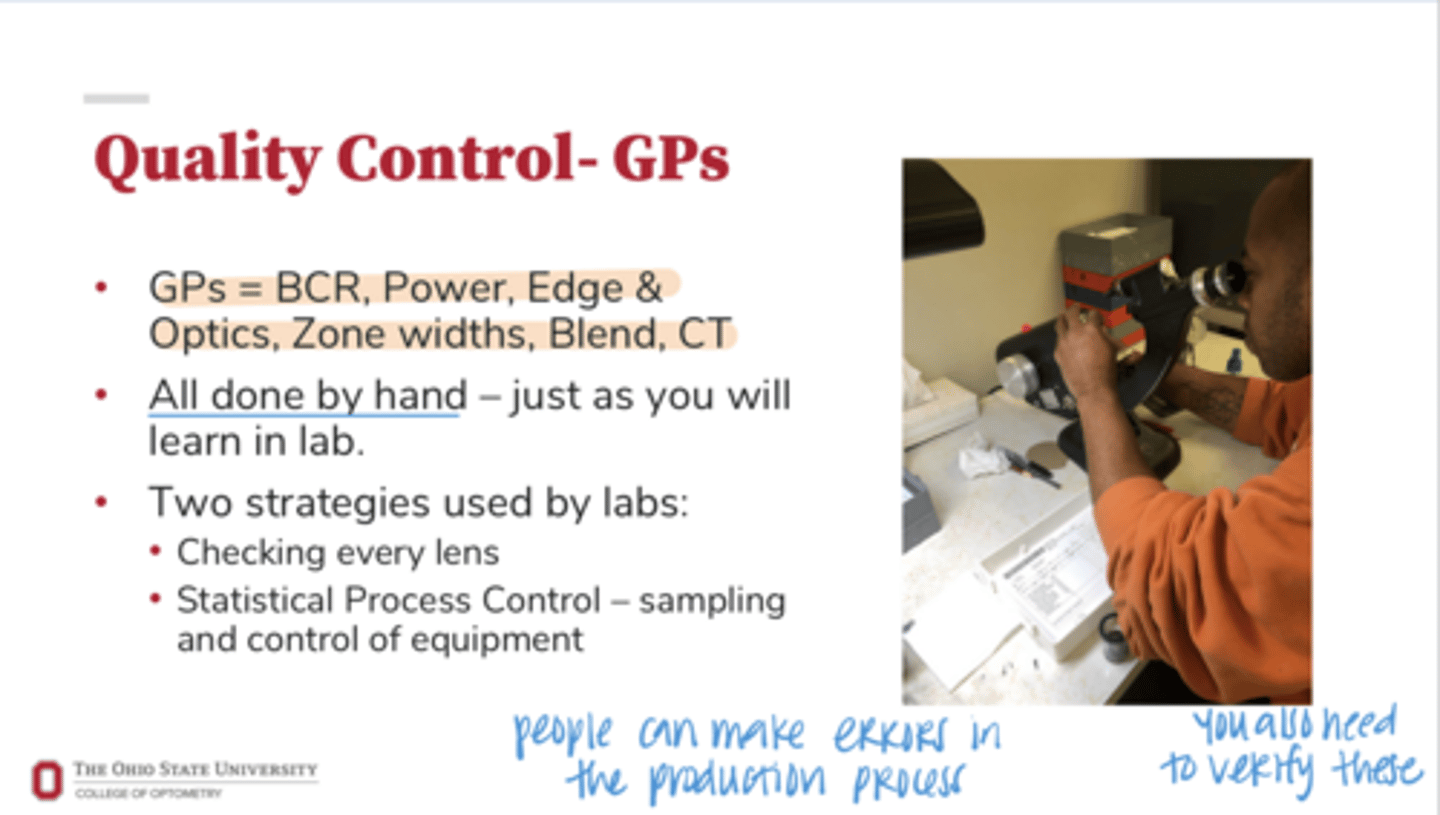
Is verification of RGPs done by hand or machine?
by hand
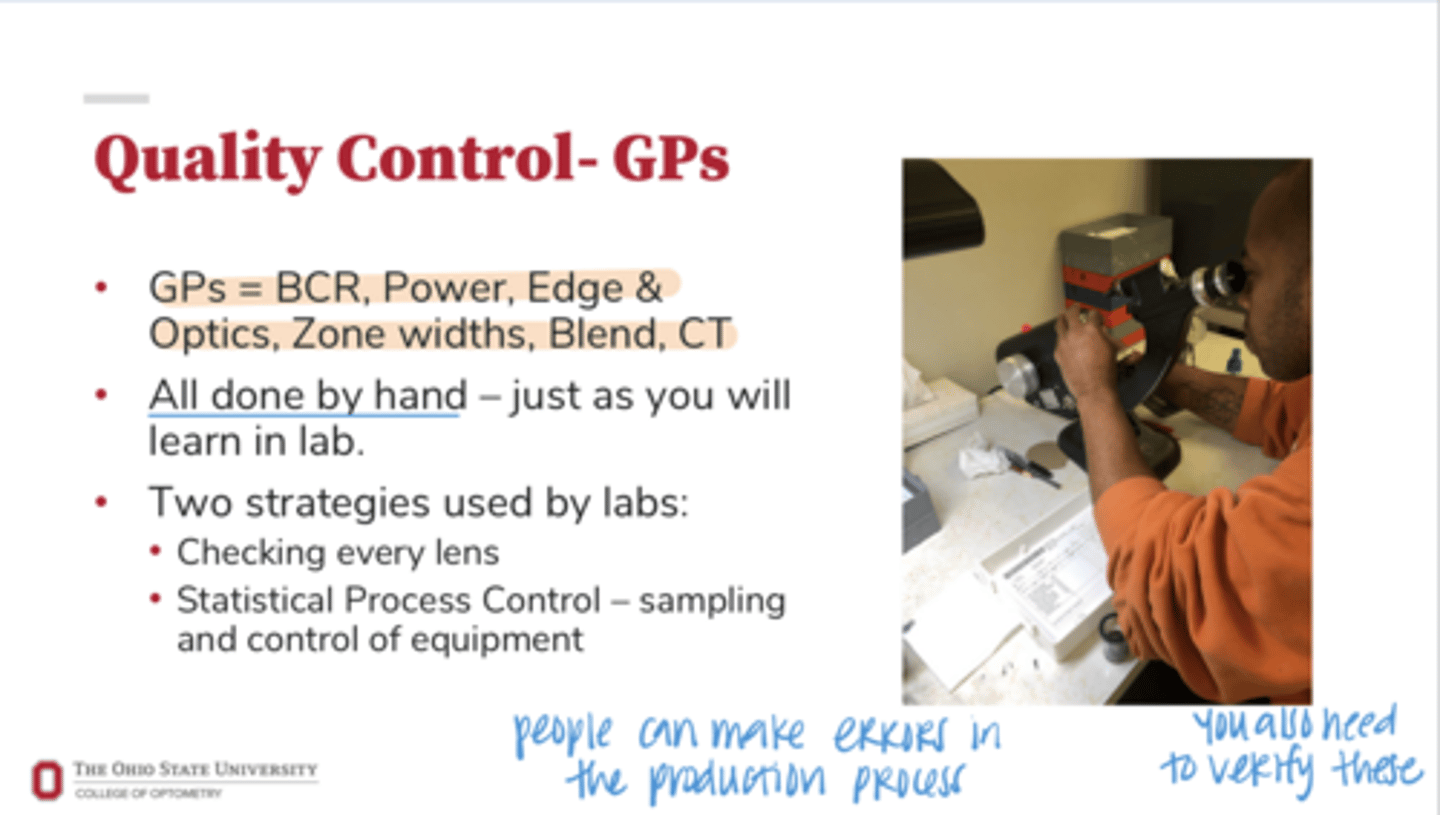
What is the strategy of labs for verifying RGP lenses?
-checking every lens
-statistical process control -- sampling and control of the equipment
Why are in office modifications of RGPs offered in some places?
-faster for you
-faster for the patient
What RGP lenses should you NOT modify in office?
-high Dk lenses
-lenses w plasma or other coatings
What are the 2 surface coatings/treatments discussed in this module?
1) plasma
2) polyethylene glycol (PEG)
How does plasma work?
-similar to SCL, but not as permanent
-materials are treated with cold plasma gas in rxn chamber
What is plasma coating for RGPs?
-matter consisting of electrons
-highly excited ionized gas
-fourth state of matter
How are plasma coated RGP lenses shipped to practioners?
wet
What is the benefit of plasma coating RGP lenses?
-designed for various manufacturing purposes (cleaning contamination from substrates)
-improved lubricity
-improved wetting
-increased bond strength
Why should you recommend plasma treatment on RGPs of your patients?
-removes remaining residues from manufacturing process
-remarkably clean surface
-large decrease in wetting angle measurements
-improved on eye wettability
Is plasma coating permanent on the surface of RGPs?
short term -- probably several weeks
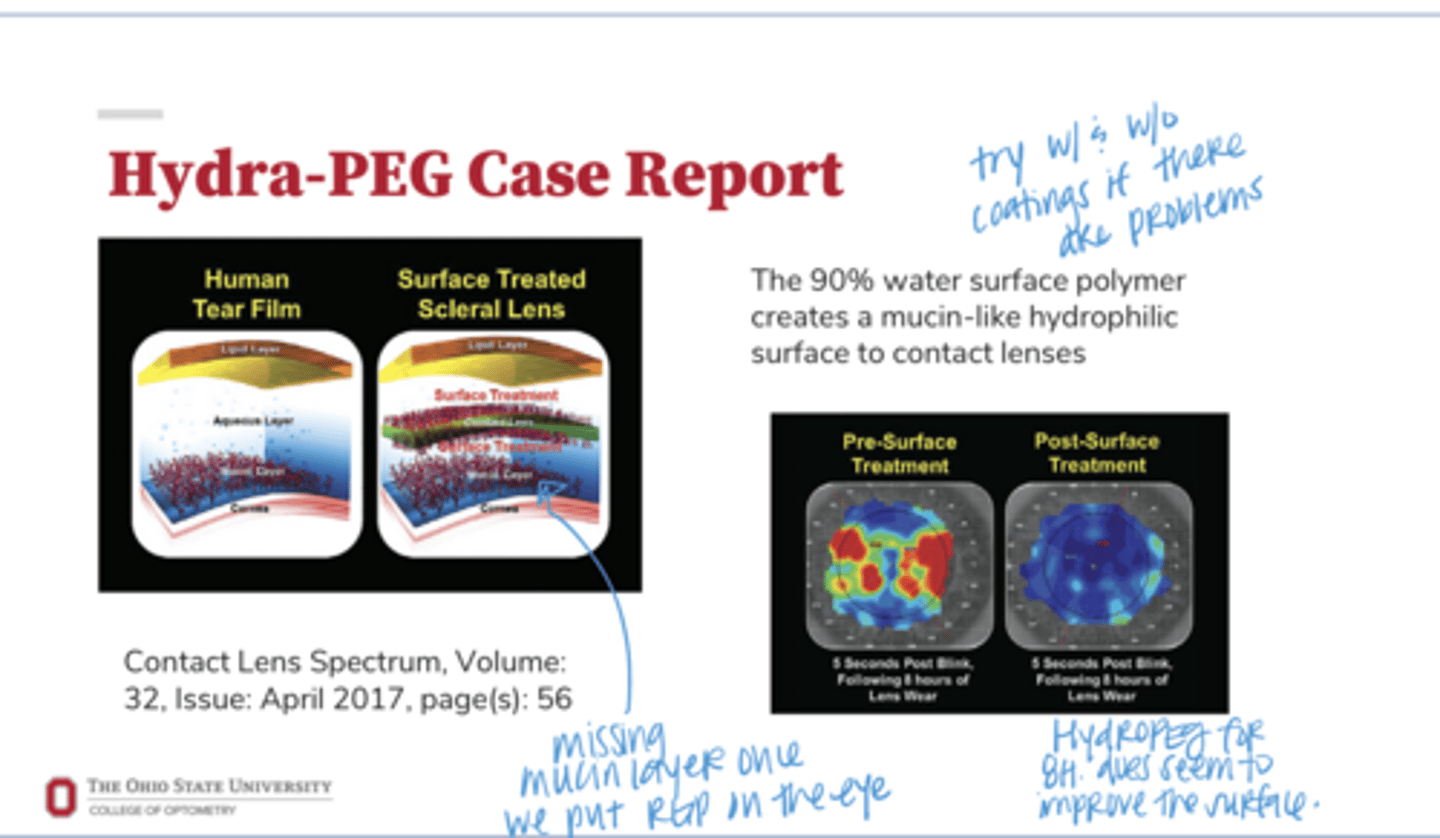
What is hydra-PEG?
-Coats the contact lens with a "mucin like" hydrophilic shell
-Improved surface wettability
-Applied to soft and GP lenses
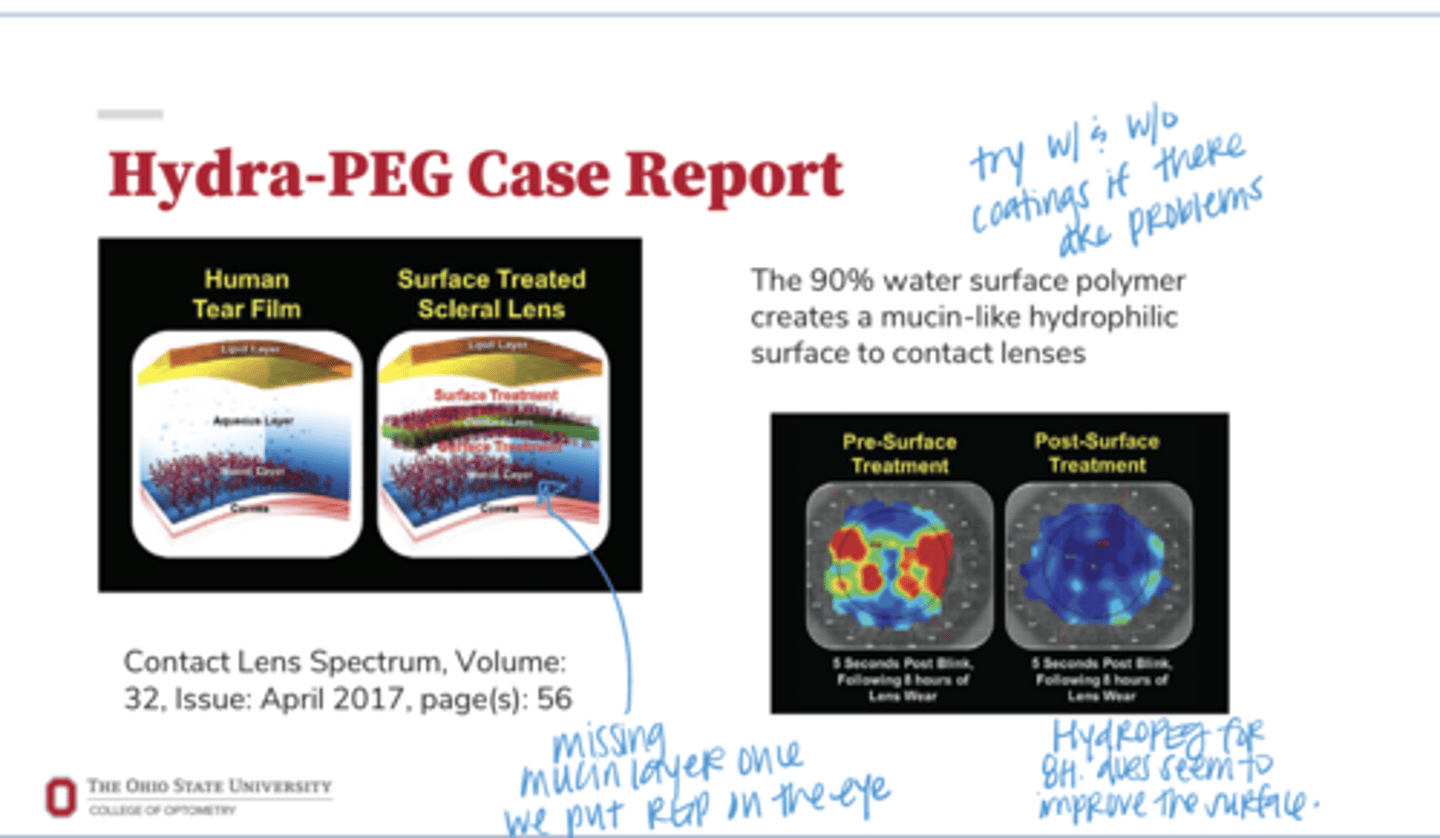
What is the purpose of hydra-PEG as a coating of RGPs?
the 90% water surface polymer creates a mucin-like hydrophilic surface of contact lenses
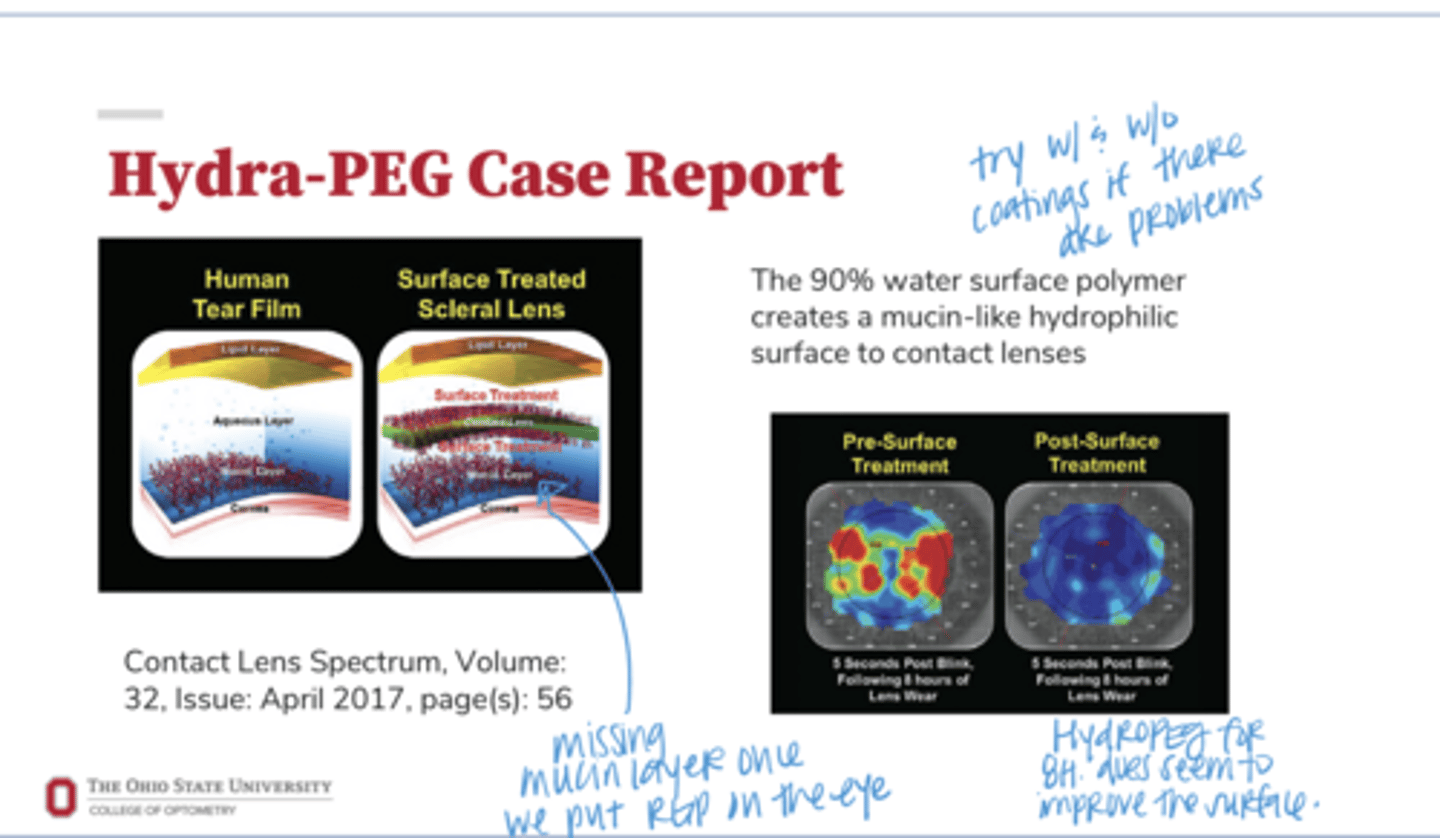
What is important about the care of plasma and Hydra-PEG treated RGPs?
-non-abrasive cleaners have to be used (no polish in the lab & only Boston Simplus)
-After 6 months you can use whatever you want because the coating will be gone
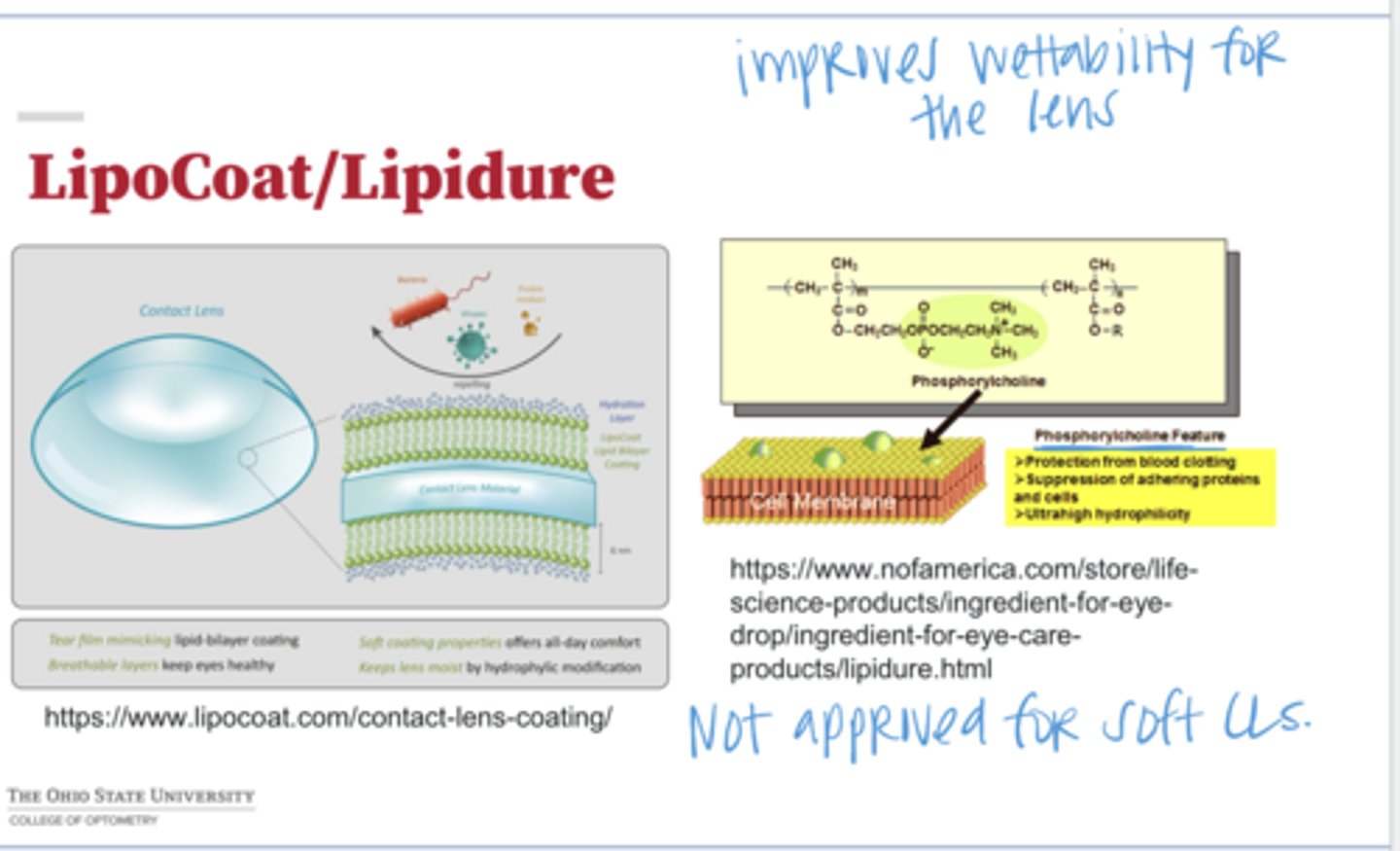
LipoCoat/Lipidure for RGPs (Pic)
LipoCoat/Lipidure for RGPs (Pic)
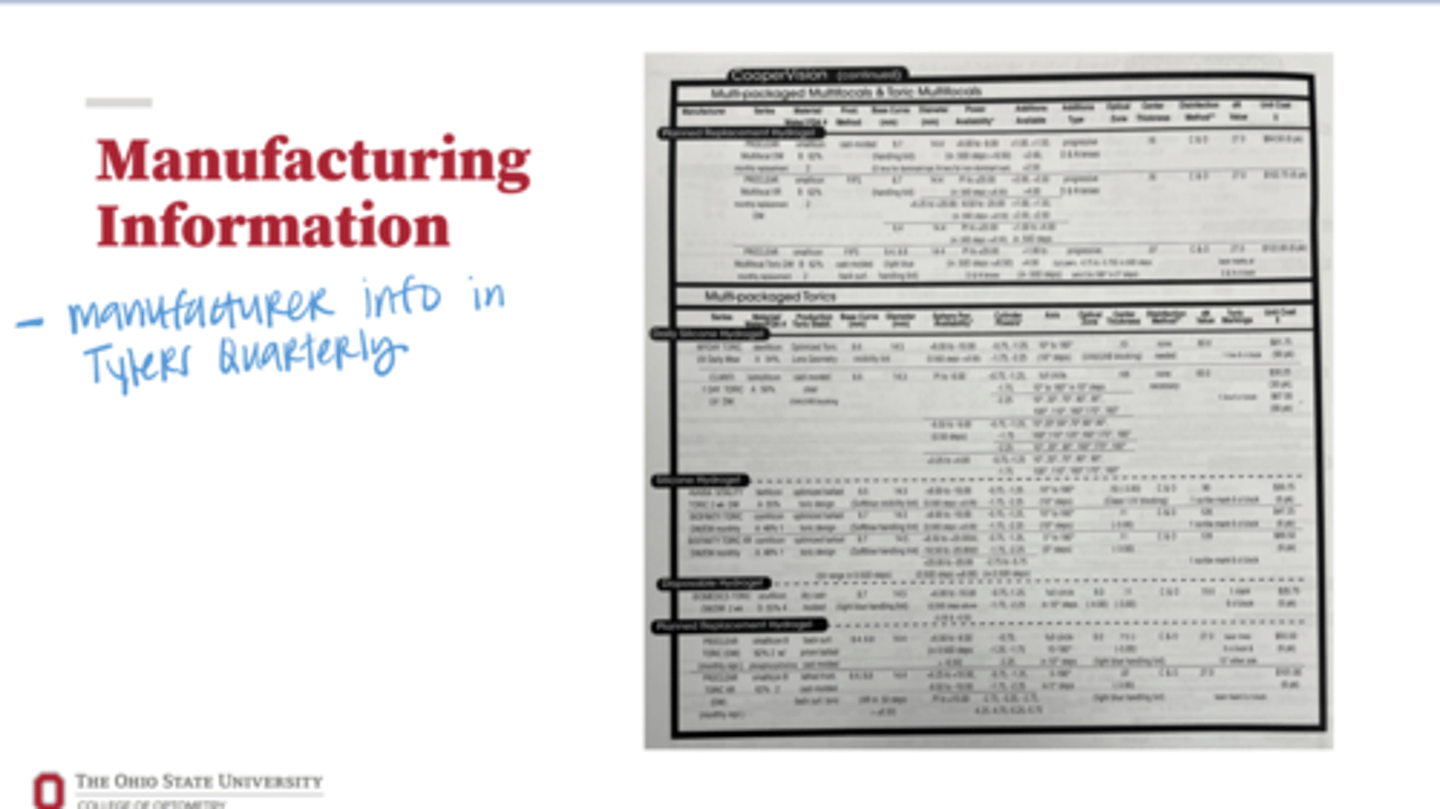
Manufacturing Info in Tyler's Quarterly for RGPs (Pic)
Manufacturing Info in Tyler's Quarterly for RGPs (Pic)
The first FDA approved soft contact lenses were _________
spin cast
Soft contact lenses (that were spin cast) produced _____ back surfaces
aspheric
What are the 2 Modern Methods for CL Hydrogel Manufacturing?
-disposable lenses are molded
-custom/planned replacement are lathe cut/polished
Extended Range (XR) is an exception to a disposable lens that is molded. How are these lenses manufacturered?
-back molded
-front lathed
What is the advantage to lathe cutting and polishing?
can make any design; custom order
What are the disadvantages to lathe cutting and polishing?
-higher cost
-less reproducible, although CAD CAM helps
-lower volume than molding
-lower Dk
-less frequent replacement
How are lathe cut hydrogels produced?
-button is lathed and polished similar to RGP
-hydrated and then autoclaved
HEMA has a ____% expansion and this swelling may not be isometropic. Shape may vary with power and CL will be somewhat aspheric.
12
What are the 2 types of manufacturing with molds?
-Cast molding
-Injection molding
How are CLs manufacturered with molding techniques?
-entire lens is typically molded all at once
-Front or back may be molded and then opposite surface lathe cut and polished
-Male tool will mold the posterior surface of the lens
-Female tool will mold the anterior surface of the lens
True or False:
Tools for molding can be disposable (plastic) or reusable (quartz)
true
What are the advantages to molded lenses?
-high volume
-low cost per lens (after the large initial investment)
-highly reproducable
What are the disadvantages to molded lenses?
-limited parameters
-high cost to get started
Cast molding is (higher/lower) volume than lathing
higher
Cast molding is (higher/lower) volume than injection molding
lower
What is measured into the cavity during cast molding?
liquid polymer
Are female and male tools still used with cast molding?
yes -- male for back surface and female for the front surface of the lens
How is cast molding done?
-Polymer is cured with UV, heat, platinum, etc
-Lenses are released from the molds
-If necessary the lenses are edged and hydrated
-Surface treated depending upon the polymer type
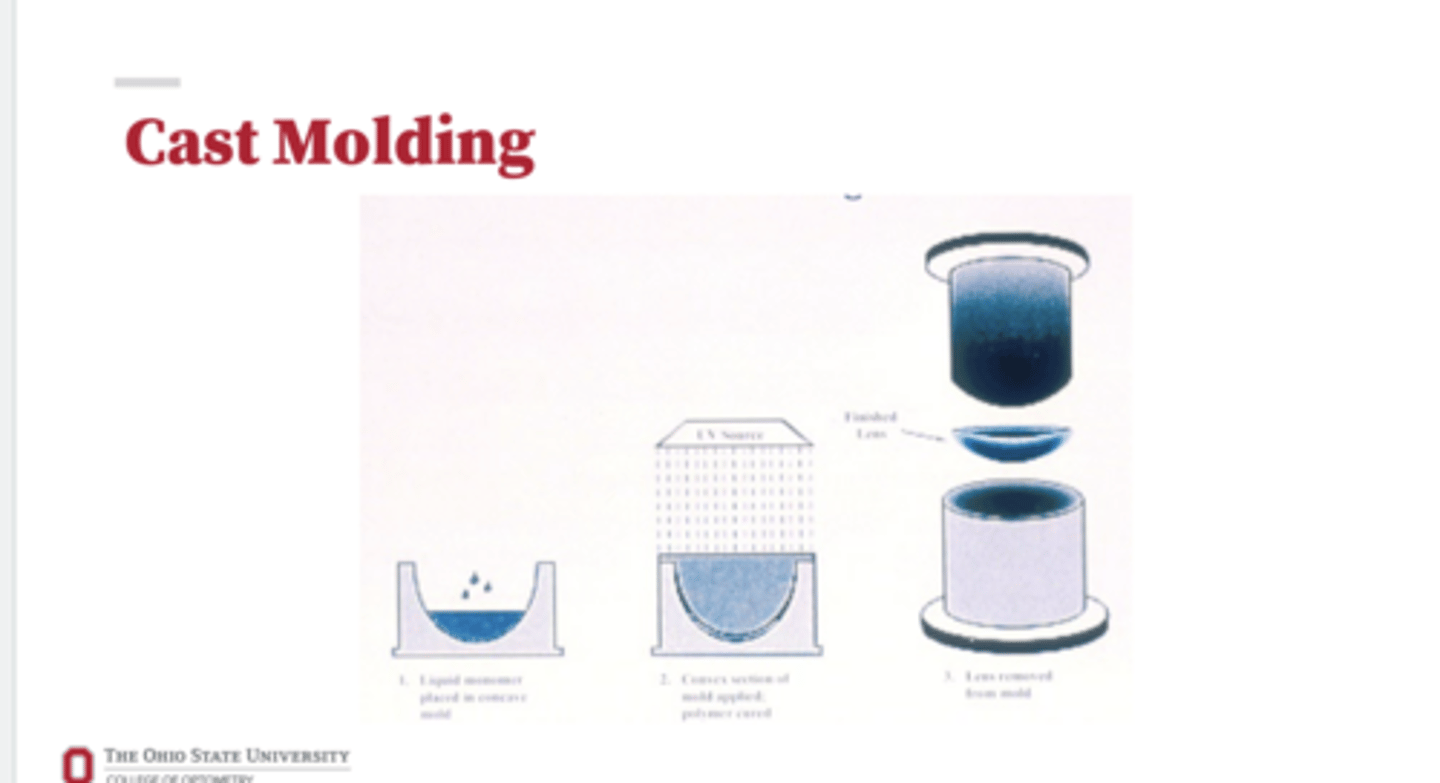
Cast Molding (Pic)
Cast Molding (Pic)
How is automated molding done?
-all automated
-lens cost is <$1
-Many tools (male and female) are assembled in plates with cavities to hold tools precisely
-Polymer injected between the tools and cured
-Lens is released into the package, hydrated, inspected, labeled and autoclaved
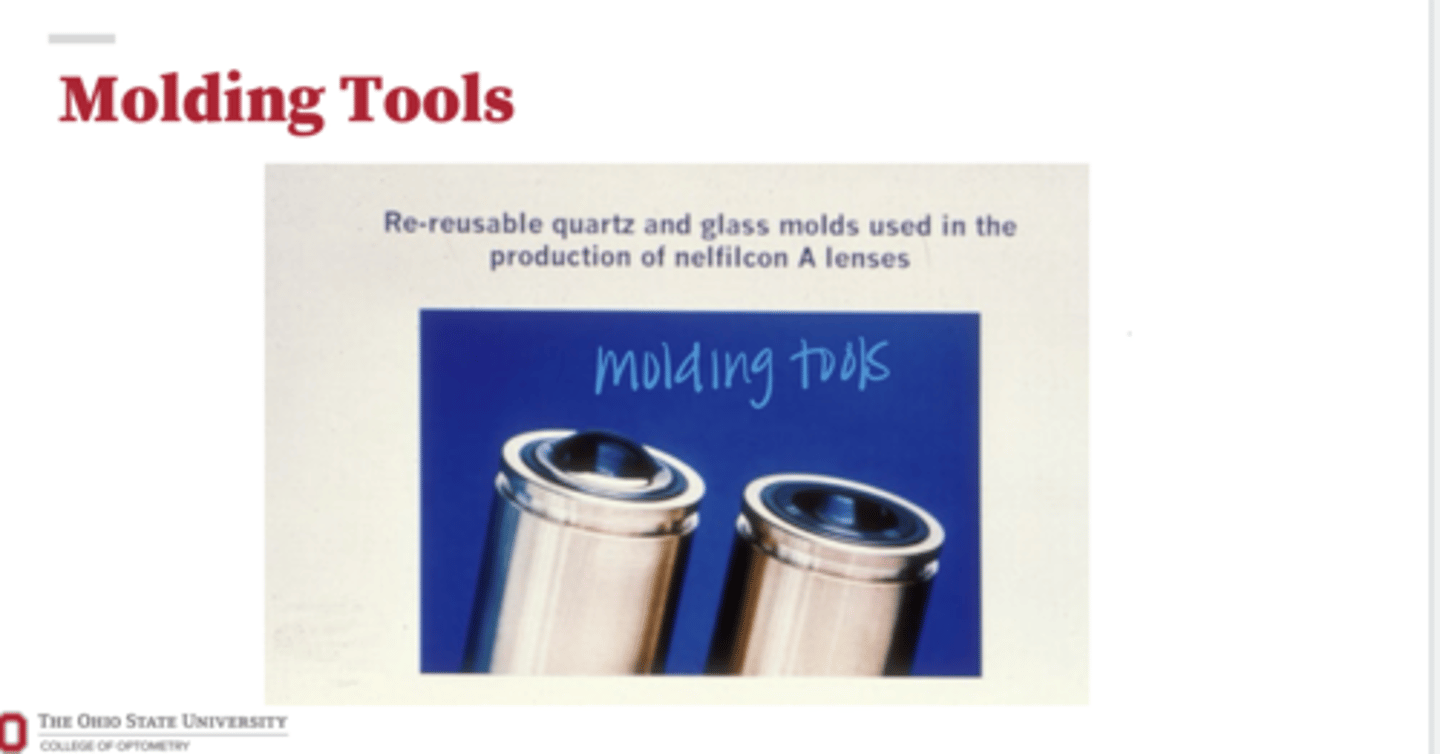
Molding Tools (Pic)
Molding Tools (Pic)
How is quality control of hydrogels completed?
-In modern high-volume systems, SPC and video imaging robots do the QC with minimal human involvement
-Polymer undergoes substantial QC for purity & physical properties
-FDA inspects manufacturing plants and requires reporting at least anually
Ways in which silicone lenses are manufacturered?
Molded and then treated with surface plasma
Molded with wetting agent incorporated during the curing process
Molded in multi-step process to create permanent water surface
All RGP lenses begin the manufacturing process as a blank.
Button
If a lab uses this strategy only a small number of the contact lenses in a batch are selected and verified.
Statistical Sampling
What type of cleaner should be used for plasma and PEG coated lenses?
Non-abrasive
Which type of RGP lens may be more difficult to manufacutre and need special attention during verification?
Higher Dk lenses because they’re softer and more difficult to manufacture