Kognity Unit 1 Intro to business management
 Call Kai
 Learn
Learn Practice Test
 Spaced Repetition
 Match
Match Flashcards
 Knowt Play
1/63

There's no tags or description
Looks like no tags are added yet.
Name | Mastery | Learn | Test | Matching | Spaced | Call with Kai |
|---|
No analytics yet
Send a link to your students to track their progress
64 Terms
Capital-Intensive + Example
A production process that relies more on machinery, equipment, and technology than human labor.
Example: An automobile factory using robotic assembly lines.
Labour-Intensive
A production process that relies more on human effort than machines.
Example: Hand-picking fruit on a farm or a small tailoring shop
Inputs (2)
The inputs of a business are all the resources needed to create a product.
These resources belong to one of three categories: physical (raw materials), financial, humans, Enterprise (Idea)
Outputs
The final goods or services produced by a business or production process.
Business Processes:
HR(hires & conmpensates workers), Marketing(selling), Finance (adequate funds), Operations (making product)
List the 4 business sectors
Primary sector
Secondary sector
Tertiary sector
Quaternary sector
Primary sector (2)
The primary sector refers to the extraction, or production, of raw materials from the Earth. includes agriculture, fishing, forestry, mining and drilling
Secondary sector (2)
The secondary sector refers to manufacturing and processing, where raw materials are made into products for sale.
carmakers, electronics businesses
Tertiary sector
The tertiary sector refers to any business that sells a service. The tertiary sector includes businesses that sell clothing and food, as well as education, healthcare, legal services, travel and transportation. Many, but not all, businesses in the tertiary sector are small. Large businesses in the tertiary sector include companies like Walmart, which sells a variety of goods, and banks.
Quaternary sector
A modern part of services focused on knowledge, information, research and data (e.g., IT, research, media). Often seen as part of the tertiary sector. Some disagreement exists on what is included.
Chain of Production
The stages a product goes through from raw materials to finished goods and delivery to consumers.
Example: Wheat → flour → bread → sold in a store.
Entrepreneurship
A person who organizes human, physical and financial resources to start a business
Intrapreneurship:
A person who develops new ideas, processes or products for a business in which they already work.
GDP
Gross domestic product: total value of all goods and services produced within a country during a year
Backward vertical integration + ex
When a business takes control of suppliers (earlier in its production chain).
Example: Minute Maid owning orange farms.
Forward vertical integration
When a business takes control of distribution or retail (later in its production chain).
Example: A food producer opening its own grocery store.
Horizontal integration
When a business merges with or buys competing companies at the same stage of production.
Example: Pepsi owning Mountain Dew and 7UP; Loblaws acquiring competitors.
Why would a business choose vertical integration?
To reduce costs, gain more control over suppliers and distribution, improve efficiency, ensure steady supply, and increase profits.
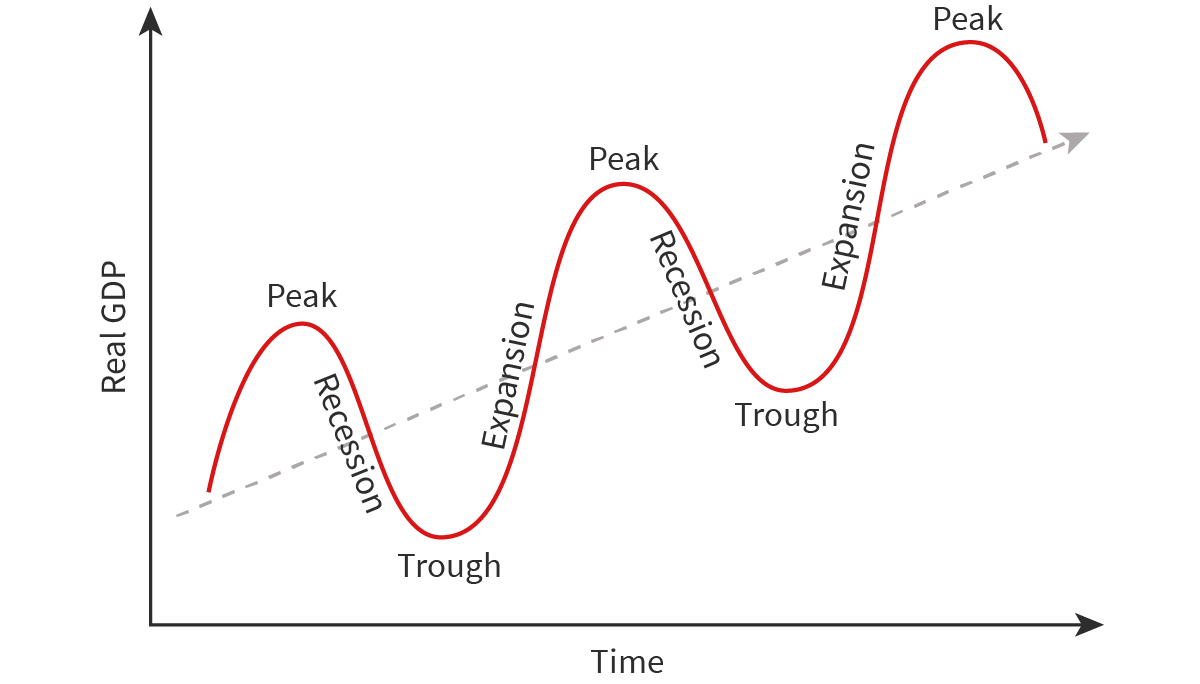
Business cycle
The natural rise and fall of economic activity over time, showing changes in growth and decline in the economy.
Example: Expansion (growth) → peak → contraction (decline) → trough (lowest point) → recovery.
Private sector
Businesses owned by individuals or companies, not the government. Includes corporations (for-profit and non-profit), partnerships, and charities. Focus on Profit
Example: McDonald’s, small local businesses, and charities like food banks.
Public sector
Services owned and controlled by the government to serve everyone. Focuses on access to essential services and protecting citizens.
Example: Education, healthcare (hospitals), and road infrastructure.
Sole trader (sole proprietorship)
A business owned and run by one person. Owner keeps all profits but has unlimited liability.
Example: A local hairdresser or freelance tutor.
Partnership
A business owned by two or more people who share profits, responsibilities, and liabilities.
Example: A small law firm or dental practice.
Corporations (privately & publicly held)
Corporations are legal entities which exist separately from its owners, who are called shareholders. Can be recognized by its abbreviations following the logo ex. Inc, Ile, plc, Itd etc
Privately held = shares not sold publicly.
Publicly held = shares traded on the stock market. Owners have limited liability.
Example: Privately held: small family company; Publicly held: Apple or Tesla.
For-profit organizations
Businesses that aim to make money (profit). Includes sole proprietorships (sole traders), partnerships, and corporations.
Profit (Net Income) formula
Total Revenue − Total Costs (expenses).
For-profit social enterprise
A private sector business that earns profit but also has a social or environmental goal built into its model.
Example: TOMS Shoes — for every pair sold, a pair is donated to someone in need.
Types of for-profit social enterprises (3)
Private social enterprises: private companies with a social/environmental mission (e.g., TOMS Shoes donating a pair for each pair sold)
Government-contracted firms: private businesses hired by the government to provide services (e.g., private recycling services)
Cooperatives: businesses owned and run by members who share profits and decision-making (e.g., housing or consumer co-ops)
Non-profit social enterprise (surplus revenue)
An organization that aims to provide a service or support a cause, not make profit. Any extra money is reinvested into the mission.
Relies on donations and funding
No clear ownership/control like private businesses
Surplus revenue = Total revenue − Total costs
Example: Charities, food banks, community organizations
Charities
Organizations that provide aid and relief to people in need (e.g., Red Cross)
Cooperative
A business owned and run by its members (customers/workers/users). Members share profits and have a say in decisions (often 1 vote each).
Example: Housing co-op or consumer co-op (grocery co-op).
NGO
(Non-Governmental Organization)
Back: A private organization that works to support a social or environmental cause, not to make profit.
Example: Greenpeace, Amnesty International.
Non-profit social enterprise vs NGO
Non-profit social enterprise: Runs like a business to provide services, reinvests money into its mission.
NGO: Focuses on advocacy and causes, not business operations.
Vision Vs. Mission
Vision:
What business wants to achieve in the future (long term)
Ex. Microsoft - "to help people and businesses throughout the world realize their full potential"
Mission Statement
What we are doing now to reach our vision
Ex. Microsoft -" to empower every person and every organization on the planet to achieve more"
Aims
Long term goals
Objectives (Strategic, Tactical, Operational)
Objectives are specific goals that help a business achieve its mission and vision by giving direction and a plan.
Strategic: Long-term goals (upper management) — Example: Expand into 3 new countries in 5 years
Tactical: Medium/short-term goals (middle management) — Example: Launch a marketing campaign this year
Operational: Day-to-day goals (lower management) — Example: Produce 500 units per day
SMART Objectives
Back: A way to set clear and effective goals:
S: Specific
M: Measurable
A: Achievable
R: Relevant
T: Time-bound (set a deadline)
Ethical Objectives
Goals that ensure a business acts responsibly toward society and the environment (e.g., fair treatment of employees, no discrimination, respecting customers).
CSR
Corporate Social Responsibility (CSR)
A business obligation to act as a “good corporate citizen” by having a positive impact on society and the environment. It is broader than ethical objectives and focuses on benefiting communities as a whole.
Example: Reduce Carbon Footprint
Linear production
A “take–make–waste” system where resources are taken from the earth, made into products, and then disposed of as waste.
Example: Mining metals → making phones → throwing them away.
Circular production
A system that reduces waste by reusing, recycling, or repurposing materials so outputs become inputs again.
Example: Recycling plastic bottles into new bottles or clothing.
Internal stakeholders
People inside a business who are directly involved in its operations.
Example: Employees, managers, owners.
External stakeholders
People or groups outside the business who are affected by or have an interest in it.
Example: Customers, suppliers, government, community.
Economies of Scale
When a business becomes more efficient as it grows, leading to a lower average cost per unit as output increases.
Key idea: Bigger production = lower cost per item.
Average cost per unit Formula
Total costs (fixed costs + variable costs) ÷ Quantity produced
Fixed costs
Costs that stay the same no matter how much a business produces.
Example: Rent, salaries, insurance.
Variable costs
Costs that change depending on how much a business produces.
Example: Raw materials, packaging, shipping.
Diseconomies of scale
When a business becomes too large and less efficient, causing the average cost per unit to increase as output grows.
Example: Poor communication and coordination in a very large company leading to delays and higher costs.
Internal growth
Growth by expanding the business from within.
Examples: Opening new branches, offering new product range.
External growth
Growth by combining with or taking over other businesses or forming partnerships.
Examples: Merger/acquisition, horizontal/vertical integration, conglomeration, joint ventures, strategic alliances, franchising.
Merger
When two businesses agree to combine and form one new company.
Example: Two competing firms join together to become a single larger business.
Acquisition
When one company buys and takes control of another company. The acquired company becomes part of the buyer.
Example: A large corporation buys a smaller competitor.
Takeover
When one company gains control of another company, often by buying most or all of its shares.WITHOUT PERMISSION
Example: A large firm buys enough shares of a smaller company to control it.
Conglomeration (diversification)
When a business merges with or buys a company in a completely different industry.
Example: A food company buying a clothing brand.
Joint Venture
Two businesses agree to create and operate a new separate project and create a separate business division to do so for a set period of time.
ex. Sony and Honda: 'Afeela" electric vehicles
Franchising
Business that uses the name, logo, and trading systems of an existing business
Franchisor (head office)
Franchisee
Franchisee
A person or business that buys the right to operate under the franchisor’s brand and follows its system.
Example: A local McDonald’s restaurant owner.
Franchisor
The company that owns the brand and business model and allows others to use it. Provides support, rules, and training.
Example: McDonald’s corporate office.
Strategic alliance
An agreement between businesses to work together and share resources to achieve shared goals. No new company is created and each firm stays independent. Can include more than two businesses and membership can change.
Example: Starbucks with Target or Barnes & Noble; airline alliances.
Ansoff Matrix
A tool used to show ways a business can grow using 4 strategies: Market penetration, Market development, Product development, Diversification
Market penetration:
sell more existing products in existing markets
Market development:
sell existing products in new markets
Product development:
create new products for existing markets
Diversification
new products in new markets (highest risk)