THEOLOGY: Pluralism and Theology
 Call Kai
 Learn
Learn Practice Test
 Spaced Repetition
 Match
Match Flashcards
 Knowt Play
1/62

There's no tags or description
Looks like no tags are added yet.
Name | Mastery | Learn | Test | Matching | Spaced | Call with Kai |
|---|
No analytics yet
Send a link to your students to track their progress
63 Terms
What did Alan Race say were the 3 perspectives of how Christians might approach dealing with other faiths in his work, 'Christiand and Pluralism' (1982)
-exclusivism
-inclusivism
-pluralism
What is exclusivism?
The belief that only Christians will be saved
What is inclusivism?
The idea that Christianity is the one true faith and the usual way to salvation but it is possible for non-Christians to be saved. Other religions are partially true.
What is theological pluralism?
The view that there are many ways to salvation, of which Christianity is one path.
What is the epistemological problem?
To what extent are the truth claims of non-christian religions also considered to be true within Christian theology.
What is the soteriological problem?
Can people of non-christian religions or who have no religious belives receive God's salvation?
What is sotierology?
the study of salvation
Why do humans believe what they do?
-natural theology
-revealed theology
-phenomenological view (religion not separate to society and culture)
What do Christian Exclusivists claim?
-other religions cannot lead people to the right relationship with God
-Christ brought salvation to the world, only by hearing the gospel and having faith in Christ can we achieve salvation
-no other path, requires giving up old life
-it is a DUTY to share the gospel as Christianity is of vital importance for everyone's soul otherwise they will be damned
-Jesus is the mediator between humans and God
3 requirements of Exclusivism for anyone to be able to reach salvation
-There must be faith in Christ since salvation comes from Christ alone (Solus Christus)
-This faith in Christ must come from hearing the Gospel either in this life or the next
-The believer in Christ must be a member of the Christian Church
Doctrine of justification by faith
Salvation can be attained by faith alone rather than good works. If non-christians can do works and gain salvation, this makes the incarnation, crucifixion and resurrection of Jesus pointless.
What is the essence of truth?
By nature, truth is exclusivist and it if true, all other claims become false. Therefore, the question becoms which religion is actually true?
What is 'Narrow' Exclusivism>?
Only the Christians within their own denomination will be saved.
-explore limited election within this
Hendrik Kraemer (EXCLUSIVIST)
-ecumenical Christian missionary
-'The Christian message in a Non-christian world' 1938
-Non-Christians must convert to Christianity
-other religions are misguided attempts to the truth
Karl Barth (EXCLUSIVIST)
-Protestant Theologian
-advocate for revealed Theology
-Christ is God's living word, he is the one who saves us and brings the revelation to us
-Belief in Christ is the only way, not through human effort alone, we need revelation through Christ
-Church can help spread the gospel
Catholic Church's exclusivism
'extra ecclesia nulla salus' - there is no salvation outside the Church
-Other religions point towards goodness and truth. They are a preparation for the gospel (Catechism)
What did the Vatican II (1962-1965) introduce?
a more positive and open response to other world faiths and denominations
What is 'Broad' Exclusivism?
all people who accept Christ through their faith will be saved.
John 1 4:6
'I am the way, and the truth, and the life. No one comes to the Father except through me'
Acta 4:12
'Salvation is found in no one else, for there is no other name under heaven given to mankind by which we must be saved'
2 Corinthians 5:18
'And all this is from God who has reconciled us to himself and given us the ministry of reconciliation'
Strengths of Exclusivism
-Christianity is internally coherent and consistent
-Biblical evidence
-The church acts as a mediator between God and humanity
-Rules out conflict within religion
-If true, this is a conviction of truth and seems fair to be an evangelist
Weaknesses of Exclusivism
-If God is free to do whatever he chooses then it is illogical to say he cannot act through other religions.
-Depends heavily on a literal and simplistic interpretation of the Bible as authority (it has previously been proven that the Bible is edited).
-Doesn't consider teachings of an omnibenevolent God if he condemns those who have not heard of Jesus
-causes conflict as it is dismissive of other religions
John 14:2
'My Father's house has many rooms; if that were not so, would I have told you that I am going there to prepare a place for you?'
What did William Lane Craig say?
God has middle knowledge as part of his perfect knowledge. He knows everyone's heart and what people would have done in different circumstances (or if they had the chance to hear the gospel).
But: Evangelism and missionary work becomes futile and does this take away free will?
Who was Karl Rahner?
-Catholic theologian in 1904-1984
-one of the leading voices in the vatican II
-Wrote Lumen Gentium 'Light to the Nations'
-would be regarded as an inclusivist
What is the solus christus principle?
-Rahner defended this:
-Christ is necessary for salvation
votum Ecclesia
-the desire to be in the Church: this was enough to reach salvation
-those of other faiths have this, but do not know how to do this properly
Issues Rahner saw with Exclusivism
1) excludes anyone who lived before Christ
2) anyone that has never heard about God's revelation through Christ
Rahner's exclusivism seeping through
Once someone hears about Jesus then they must become a Christian to be saved. Otherwise it is ignorance or an excuse for rejecting the Gospel.
Catechism of Catholic Church
'Those who through no fault of their own do not know the Gospel of Christ or His Church, but who nevertheless seek God with a sincere heart and, moved by grace, try in their actions to do His will as they know it through the dictates of their conscience—those too may achieve eternal salvation'
Kramer's view of other religions
other religions are misguided attempts to the truth, they are cultural constructs.
What is an 'Anonymous Christian?'
Non-christians who live according to their conscience and experience God's grace can achieve salvation, even if they do not explicitly identify as Christians
Rahner's anonymous christians approach developed
-this is a way to resolve his issue of those who have not heard of Christ
e.g. Abraham, Moses, Job were aware of God's grace but did not name themselves to be christians.
-they turned to Christ without knowing it through their attitudes and moral behaviour
Issue of a leap in logic with anonymous christians
-internally coherent that those who have not heard of Jesus cannot reach salvation
-picks up on the right issue
-but makes a jump to that they must be christians, might equally belong to any other religion
-we cannot tell that they would have been christians, they should have freewill to choose and we don't have their consent to assign them to a religion
Who was Von Balthasar?
-Fierce critic of Rahner
-Collleague of Rahner's
Balthasar's beliefs
-Church should not go into hiding in the modern secular world or present a watered-down version of the Gospel to appease athiests/other faiths.
-it should stand out and be couraegeous in its claims that salvation is only through Christ
Romans 1:16
"I am not ashamed of the gospel, because it is the power of God that brings salvation to everyone who believes"
Balthasar's criticism
Karl Rahner's idea of "anonymous Christians" weakens the uniqueness and urgency of explicit Christian faith. He believed it reduces revelation to a universal human openness to grace, blurs the distinctiveness of the Church, and undermines mission by implying that conscious faith in Christ is not decisively necessary for salvation.
Pluralism explained
-many diff religions can have value and lead their followers to salvation
-diff religions share the same ultimate goal
-beliefs and practices are a result of culture; differences in these are superficial
Elephant
Each person has a partial understanding which they believe to be true. This is reflective of religions as each thing they possess the truth. It is perspective and none has a full picture.

Who was John Hick?
-started out as an Evangelical Christian
-Working in Brum: impressed by faith and service of muslims, sikhs and hindus
-noticed their genuine commitment and morality
-questioned 'Would the God of love really deny such people of salvation?'
-Proposed that Theology should have a 'Copernical Revolution'
What did Copernicus do?
Shifted Science to the thought that earth is not the centre, rather the earth orbits the sun which is the centre
Hick's Mountain Paths
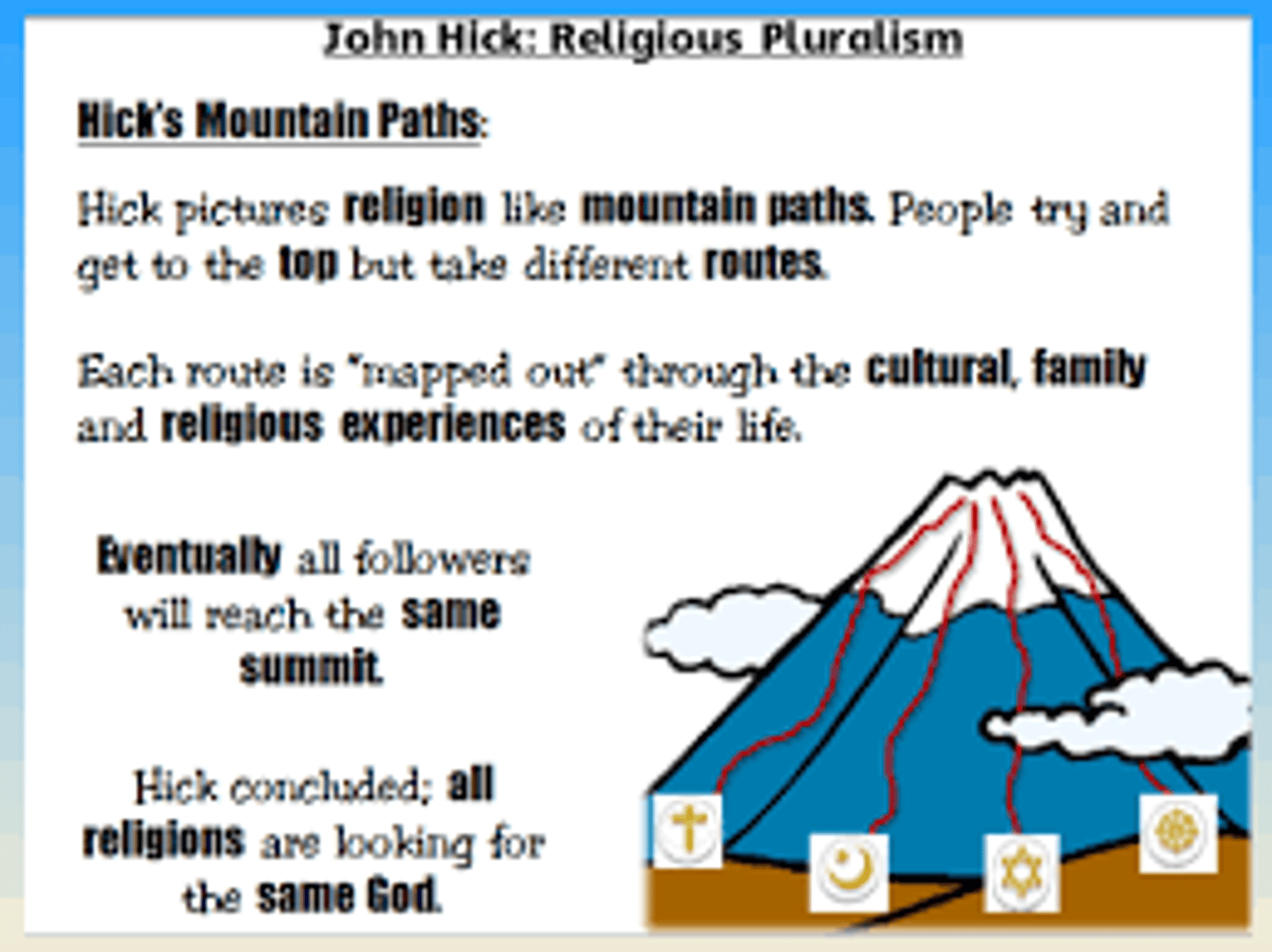
Kant's Noumenal World
-Immutable, constant, perfect things
-God's true nature is here
-Inaccessible to humans, hence why we do not know His nature fully
Kant's Phenomenal World
-The world as it appears to us
-Mutable and transient
Hick's idea of religion in the phenomenal world
-All religions fall short of the truth
-No-one is fully capable of knowing God
-Religion is a human attempt to understand God
-Religions are human constructs: they are relative to cultural upbringings and geography
Hick on Christianity
-Should move from Christcentric to Theocentric
-Christianity should not be understood as 'the Truth' as it has too many flaws, like other religions
-Views that Jesus is God Incarnate, resurrected and crucified are myths (fictitious story that points to truth).
-all religious claims are symbols which are individually meaningful, not contradictory.
Hick quote about religion being based on geography
'if I had been born in India I would probably be a Hindu; if in Egypt, probably a Muslim; but I was born in England and am, predictably, a Christian. However, these different religions each profess to be true. Are we then to say that one is true and others false?'
Hick's interpretation of Jesus
Hick rejects that Jesus was the second person of the Trinity and therefore unique. He thought jesus was a good man, a divinely inspired prophet. No more important than Muhammad and Buddha.
Raimon Panikkar's Pluralism
-No single religion has a monopoly on truth.
-Religions are not simply different expressions of the same thing (not relativism or strict universalism).
-Truth emerges through dialogical encounter — genuine interreligious dialogue transforms all participants.
-Valued openness
Panikkar quote
'I left Europe as a Christian, I discovered I was a Hindu and returned a Buddhist without ever having ceased to be a Christian'
-emphasised the mystery of the divine without destroying different cultural traditions and diversity
-tried to find his religious identity by losing it
Paul Knitter's view
All religions share a soteriological aim of liberating people from suffering, injustice, intolerance, and falsehood.
Strengths of Religious Pluralism
-promotes interfaith dialoge and understanding
-encourages mutual respect, peac and cooperation
-reduces religious conflict
-more inclusive and diverse religious landscape
Weaknesses of Religious Pluralism
-ignores that fundamental beliefs of different religions are often incompatible e.g. abrahamic religions about Jesus
-what about atheists?
-McGrath: undermines distinctiveness of individual religions by suggesting all paths are equally valid. Loss of unique religios identity and traditions.
-leads to relativism and subjectivity where there is no objective truth
-dilutes the core teachings and practices of each faith
Necessity of Jesus in salvation
Faith in Jesus is essential for salvation. Not just belief but good works also.
Sufficiency of Jesus in salvation
Faith in Jesus is enough/sufficient for salvation and nothing else is required. Only belief
Cake analogy
Flou is necessary to make a cake, it is not sufficient on its own
Luther on salvation
Faith alone is needed for salvation. God alone is in control of your salvation.
Catholics on salvation
Faith and works are needed for salvation. Person and God are in control of salvation.
1999 Lutheran and Catholic Church
-good actions come out of faith
-need to demonstrate the fruit of faith which is action
Points for A loving God might deny people salvation
-God's love is not the same as our love. Benevolence is about justice and 'tough love' which might mean that some are not saved
-If salvation is for all the religion is not logical nor is life because the purpose of life becomes to choose God
-True relationship with God comes from the free choice to have it. A truly loving God would not deny freedom of choice
-If salvation is only for those elected, God's love will not save everyone
Points for A loving God would not deny people salvation
-All people are made imago dei so God loves all and treats all equally
-Hick's pluralism: others may have grown up in diff cultures, this is not fair
-If god denied people salvation then the problem of evil would be worse because god would be condemning his creation to infinite suffering
-God is beyond our finite understanding