oat orgo unit 5

0.0(0)
Studied by 0 people
call kaiCall Kai
learnLearn
examPractice Test
spaced repetitionSpaced Repetition
heart puzzleMatch
flashcardsFlashcards
GameKnowt Play
Card Sorting

1/22

flashcard set

Earn XP

Description and Tags

Peanut butter is falling out of every orifice. I'm sorry. That was a bit personal.

Last updated 4:24 AM on 6/8/26
Name
Mastery
Learn
Test
Matching
Spaced
Call with Kai

No analytics yet

Send a link to your students to track their progress

23 Terms

1
New cards

addition

adding two groups on either side of a double bond (opposite of elimination)

2
New cards

hydrohalogenation

a hydrogen and halogen are added across a double bond.

3
New cards

markovnikov product

Non-hydrogen group bonds to the MORE substituted alkene carbon.

4
New cards

anti-markovnikov product

Non-hydrogen group bonds to the LESS substituted alkene carbon.

5
New cards

markovnikov addition of H&X

H bonds to less substituted carbon to make the carbocation more stable.

X = halogen

  • Exception: HBr + ROOR = anti-markovnikov product.

<p><span style="background-color: transparent;">H bonds to less substituted carbon to make the carbocation more stable.</span></p><p><span style="background-color: transparent;">X = halogen</span></p><ul><li><p><span style="background-color: transparent;">Exception: HBr + ROOR = anti-markovnikov product.</span></p></li></ul><p></p>
6
New cards

H2O addition

H and OH are each added across a double bond, which makes an alcohol.

  • Reagents:

    • Dilute H3O+ or H2O + H2SO4 for alkene to alcohol.

    • Concentrated H3O+ or H2O + H2SO4 for alcohol to alkene.

7
New cards

Acid catalyzed hydration mechanism

knowt flashcard image
8
New cards

acid catalyzed addition of alcohols

adds an ether, rearrangement is possible, markovnikov addition, can be syn or anti.
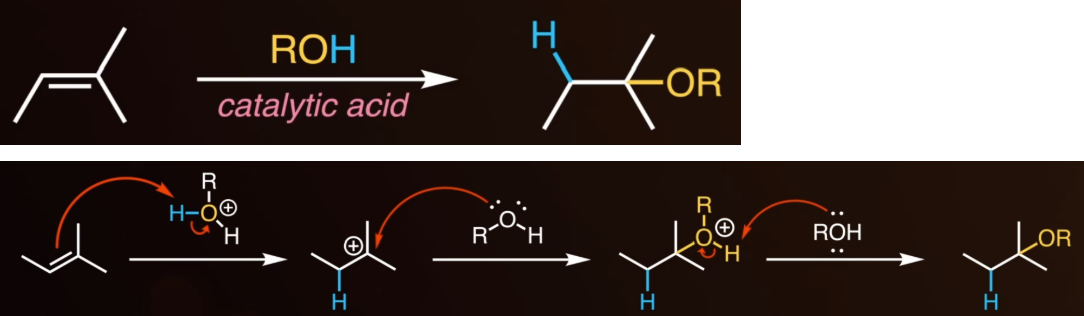
<p><span style="background-color: transparent;">adds an ether, rearrangement is possible, markovnikov addition, can be syn or anti.</span></p>
9
New cards

Oxymercuration-demercuration

markovnikov, rearrangement is not possible, can by syn or anti.

  • Reagents: Hg(OAc)2 + H2O + THF + NaBH4

10
New cards

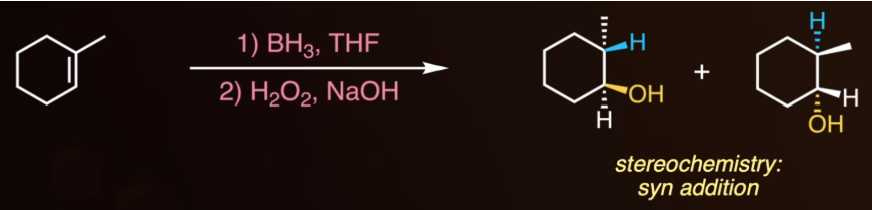
hydroboration oxidation

results in syn addition of H and OH, anti-markovnikov, no rearrangement possible.

  • Reagents: BH3 + THF and H2O2 + NaOH

<p><span style="background-color: transparent;">results in syn addition of H and OH, anti-markovnikov, no rearrangement possible.</span></p><ul><li><p><span style="background-color: transparent;">Reagents: BH<sub>3</sub> + THF and H<sub>2</sub>O<sub>2</sub> + NaOH</span></p></li></ul><p></p>
11
New cards

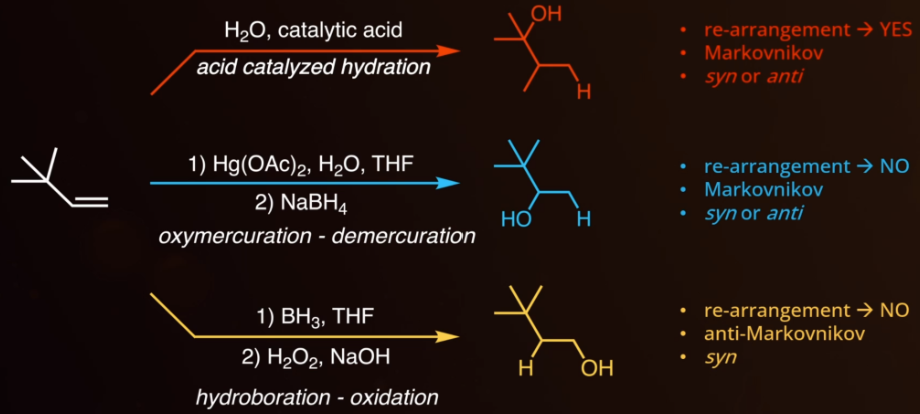
H2O addition reaction comparison

knowt flashcard image
12
New cards

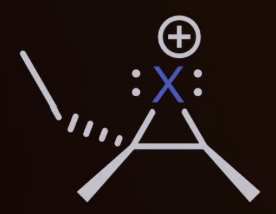
halonium ion

knowt flashcard image
13
New cards

Dihalogenation

alkene to vicinal dihalide (2 halogens connected to adjacent carbons), results in anti addition. A holonium is the intermediate. It gives both enantiomers.

  • Reagents = X2 and CCl4. X = any halogen
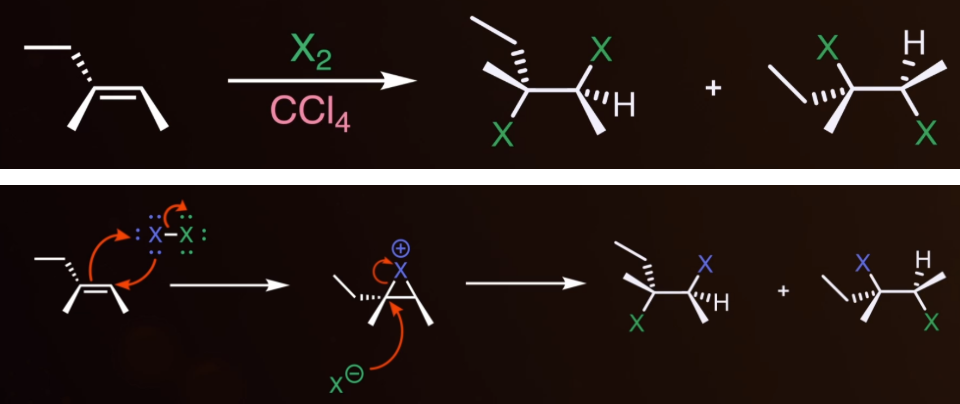
<p><span style="background-color: transparent;">alkene to vicinal dihalide (2 halogens connected to adjacent carbons), results in anti addition. A holonium is the intermediate. It gives both enantiomers.</span></p><ul><li><p><span style="background-color: transparent;">Reagents = X<sub>2</sub> and CCl<sub>4</sub>. X = any halogen</span></p></li></ul><p></p>
14
New cards

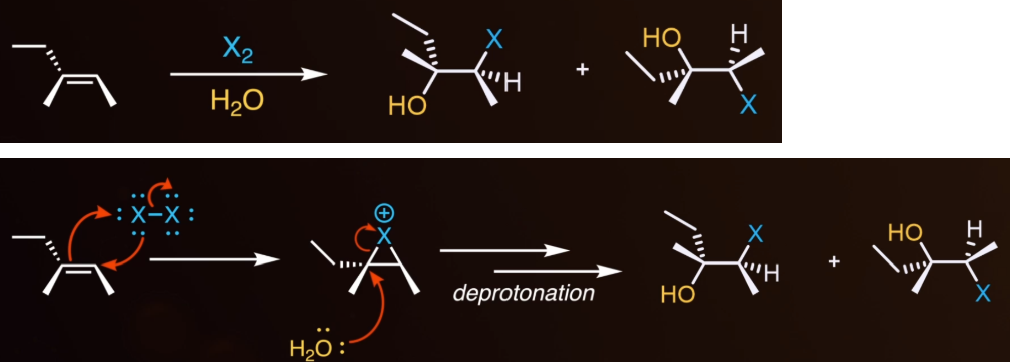
Halohydrin formation

alkene to halohydrin (OH on one side, halogen on the other), gives both enantiomers with anti addition. OH bonds to the more substituted carbon, and a halonium is the intermediate.

  • Reagents: X2 and H2O

<p><span style="background-color: transparent;">alkene to halohydrin (OH on one side, halogen on the other), gives both enantiomers with anti addition. OH bonds to the more substituted carbon, and a halonium is the intermediate.</span></p><ul><li><p><span style="background-color: transparent;">Reagents: X<sub>2</sub> and H<sub>2</sub>O</span></p></li></ul><p></p>
15
New cards

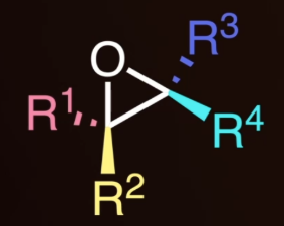
epoxide

reactive and unstable

<p><span style="background-color: transparent;">reactive and unstable</span></p>
16
New cards

epoxide formation

start with an alkene, and use RCO3H or mCPBA as the reagent, and the epoxide can form on either side of the alkene.

<p><span style="background-color: transparent;">start with an alkene, and use RCO<sub>3</sub>H or mCPBA as the reagent, and the epoxide can form on either side of the alkene.</span></p>
17
New cards

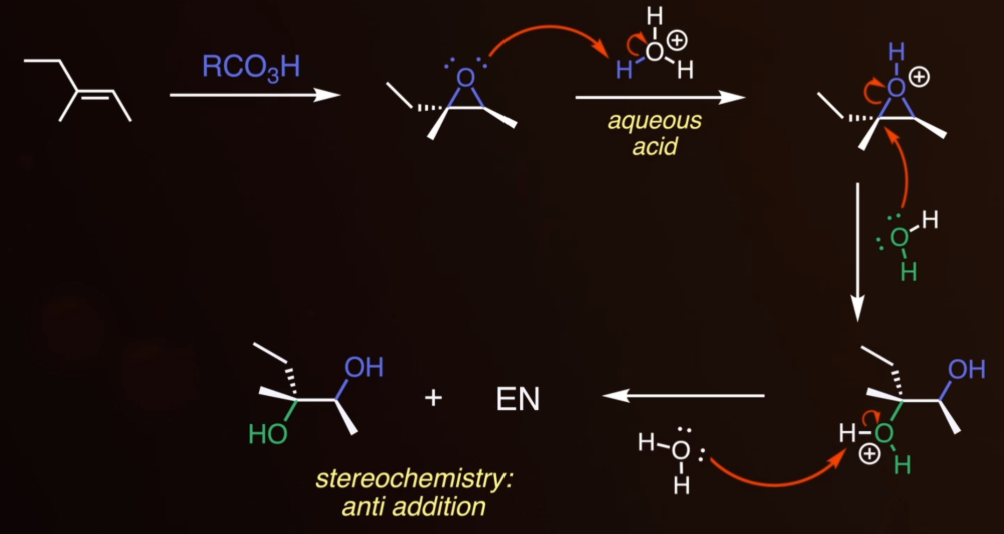
anti dehydroxylation

start with an alkene and use 1: RCO3H and 2: H3O+ or NaOH. It makes a vicinal diol (2 OH on neighboring carbons) with anti addition and an enantiomer.
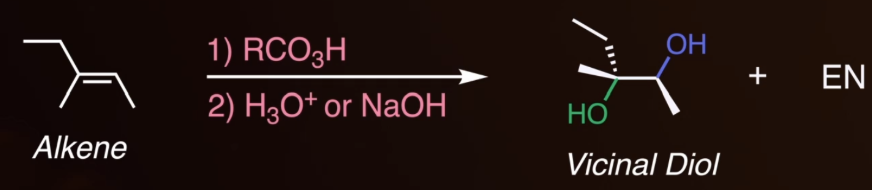
<p><span style="background-color: transparent;">start with an alkene and use 1: RCO<sub>3</sub>H and 2: H<sub>3</sub>O<sup>+</sup> or NaOH. It makes a vicinal diol (2 OH on neighboring carbons) with anti addition and an enantiomer.</span></p>
18
New cards

anti dehydroxylation mechanism

knowt flashcard image
19
New cards

syn dehydroxylation

start with alkene, then use OsO4 + H2O2 as reagents or KMnO4 + NaOH + cold as reagents, and 2x OH do syn addition with an enantiomer.
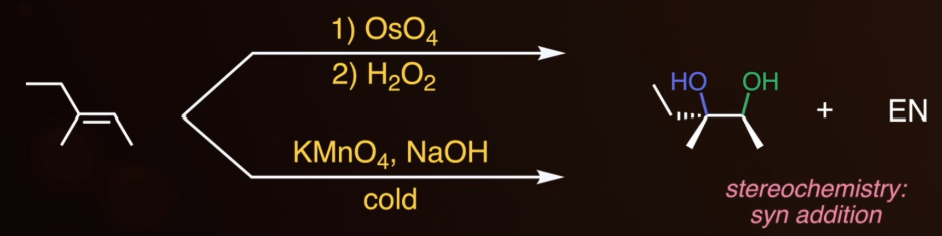
<p><span style="background-color: transparent;">start with alkene, then use OsO<sub>4</sub> + H<sub>2</sub>O<sub>2</sub> as reagents or KMnO<sub>4</sub> + NaOH + cold as reagents, and 2x OH do syn addition with an enantiomer.</span></p>
20
New cards

epoxidation and dihydroxylation summary
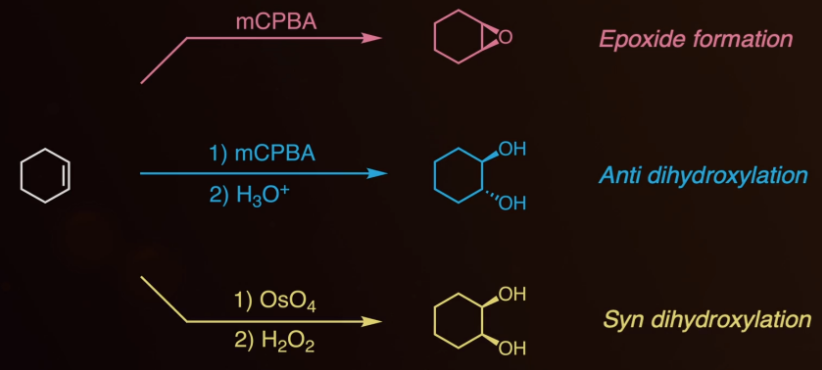
knowt flashcard image
21
New cards

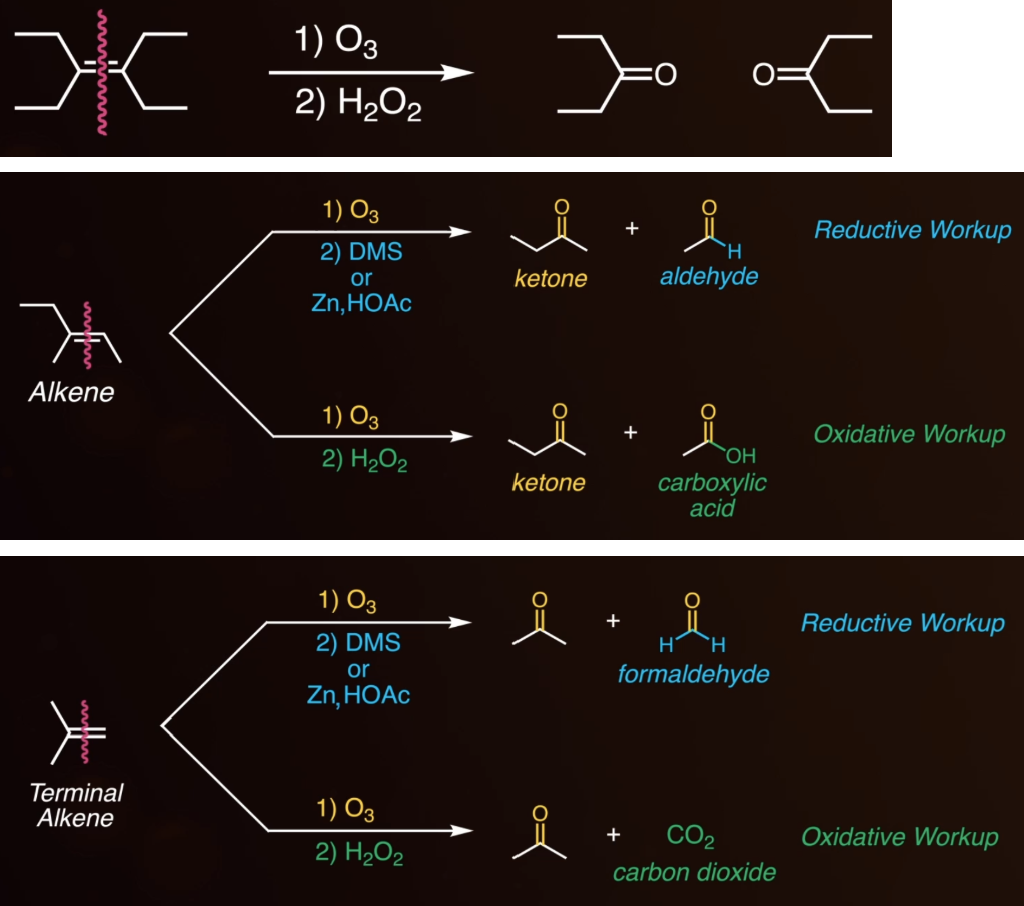
ozonolysis cleavage

alkene is cut down the middle to make two carbonyl containing compounds.

  • Reagents:

    • 1: O3

    • 2: H2O2 for oxidative (carboxylic acid or carbon dioxide)

    • 2: DMS or Zn,HOAc for reductive (aldehyde or formaldehyde)

  • Fully substituted: makes two ketones

  • Non-fully substituted: makes an aldehyde if DMS or Zn,HOAc, or a carboxylic acid if H2O2.

  • Terminal alkene: terminal side makes a formaldehyde if DMS or Zn,HOAc, or carbon dioxide if H2O2.
<p><span style="background-color: transparent;">alkene is cut down the middle to make two carbonyl containing compounds.</span></p><ul><li><p><span style="background-color: transparent;">Reagents:</span></p><ul><li><p><span style="background-color: transparent;">1: O<sub>3</sub></span></p></li><li><p><span style="background-color: transparent;">2: H<sub>2</sub>O<sub>2</sub> for oxidative (carboxylic acid or carbon dioxide)</span></p></li><li><p><span style="background-color: transparent;">2: DMS or Zn,HOAc for reductive (aldehyde or formaldehyde)</span></p></li></ul></li><li><p><span style="background-color: transparent;">Fully substituted: makes two ketones</span></p></li><li><p><span style="background-color: transparent;">Non-fully substituted: makes an aldehyde if DMS or Zn,HOAc, or a carboxylic acid if H<sub>2</sub>O<sub>2</sub>.</span></p></li><li><p><span style="background-color: transparent;">Terminal alkene: terminal side makes a formaldehyde if DMS or Zn,HOAc, or carbon dioxide if H<sub>2</sub>O<sub>2</sub>.</span></p></li></ul><p></p>
22
New cards

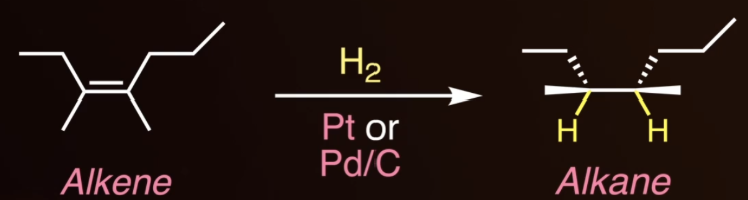
catalytic hydrogenation

2 hydrogens are added to bring an alkene to an alkane

  • Reagents: 1: H2, 2: Pt or Pd/C

  • Results in syn addition

<p><span style="background-color: transparent;">2 hydrogens are added to bring an alkene to an alkane</span></p><ul><li><p><span style="background-color: transparent;">Reagents: 1: H<sub>2</sub>, 2: Pt or Pd/C</span></p></li><li><p><span style="background-color: transparent;">Results in syn addition</span></p></li></ul><p></p>
23
New cards

Elijah’s cleavage

knowt flashcard image