Math formulas
 Call Kai
 Learn
Learn Practice Test
 Spaced Repetition
 Match
Match Flashcards
 Knowt Play
1/71

There's no tags or description
Looks like no tags are added yet.
Name | Mastery | Learn | Test | Matching | Spaced | Call with Kai | Chat |
|---|
No analytics yet
Send a link to your students to track their progress
72 Terms
Def of a real variable function
A= domain
R= codomain
Rule associating every element of A with a real number

Range vs Codomain
Range is the set of values taken by the function while the Codomain consists of all real numbers
Definition of Surjectivity
f is surjective when the range=the codomain
Multiple inputs may correspond to the same output here
Every x value corresponds to at least one y value in the codomain
Definition of Injectivitiy
f is injective when: for every x1 and x2 included in A (where x1 does not equal x2), f(x1) does not equal f(x2)
Injectivity can be seen by using the horizontal line test
These functions are also invertible

Definition of Bijectivity
A function is bijective if it is both surjective and injective
A function is increasing if…
(see image for general definiton)
f is strictly increasing if f(x1) < f(x2)

A function is decreasing if…
(see image for general definiton)
f is strictly increasing if f(x1) > f(x2)

Bounded Below
If K belongs to R s.t. f(x) is greater than or equal to k for all values of x which are less than A
the values of the function will always be greater than the k value
Bounded Above
If k belongs to R s.t. f(x) is less than or equal to k for all values of x which are less than A
the values of the function will always be less than the k value
Definition of a bounded function
a function is bounded if it is bounded both above and below
Definition of a sequence
A sequence is a function which assigns every natural number with a real number
an : N —> R
The values taken by a sequence are called the terms of a sequence
an= {a0, a1, a2, … an}
The graph of a sequence
The natural number and its corresponding pair
= {(n, an) : n belonging to N}
Properties of sequences
an is positive if an is greater than or equal to n belonging to N
an is negative if an is less than or equal to n belonging to N
Boundedness of a Sequence
an is unbounded if it is unbounded

Monotonicity of a sequence

Definition of a geometric sequence
A sequence of real numbers s.t. the ratio between the consecutive terms is constant
i.e. it has a multiplier

Properties of a geometric sequence
q>1 increasing exponential behavior, unbounded
q=1 an= 1, constant
0<q<1 decreasing exponential behavior, bounded
-1<q<1 oscillates between positive and negative, bounded by K belonging to R; where R is greater than or equal to 1
Formula for the sum of terms in a geometric sequence

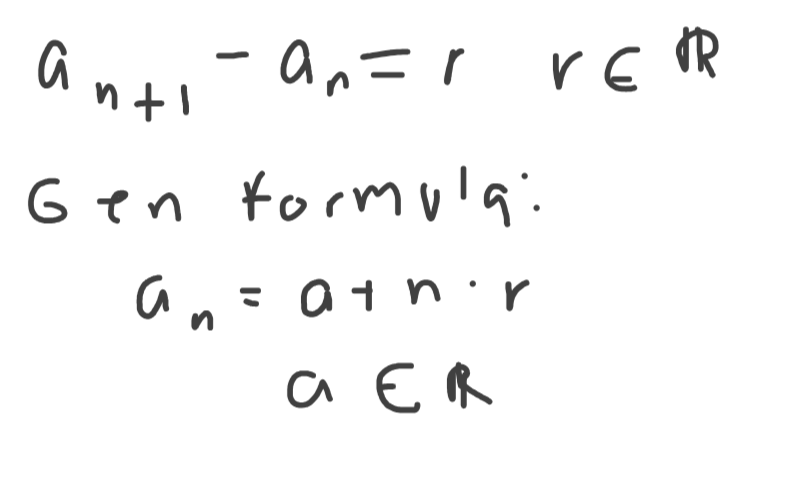
Definition of an Arithmetic sequence
A sequence of real numbers s.t. the difference between the two numbers is constant
Definition of a sequence defined by Recursion
A sequence is defined by recursion if an initial value is assigned and a law is used to compute an+1 from an (or an from an-1)

Definition of a Global Extreme
f(x0) is the maximum/minimum value
The point must belong to the domain
The same definition applies for a strict max/min but the sign changes to < or >

Max/Min with a neighborhood of points
The same definition applies for a strict max/min but the sign changes to < or >
Global extrema = local extrema

Definition of Convex Functions
For a function to be concave or convex it must be defined on that interval
Image is the definition for strict convexity. A function is just convex if there is a less than or equal to symbol

Definition of Concave Funtions
Constant functions (f(x)=k) are both concave and convex
Image is the definition for strict concavity. A function is just concave if there is a less than or equal to symbol

Definition of an Inflection Point
X0 belonging to I is an inflection point if there exists Nr(x0) where f changes from concave to convex or convex to concave
Definition of a convergent sequence
A sequence converges to the real number L if for any y, e is greater than 0, the distance of an from L is less than e when n is large enough (when n —> infinity)
Definition of a divergent sequence
A sequence diverges to ± infinity for all real numbers N, we have an>M (an<M) when H is large enough an>M (an<M), for all n > n0
Definition of the limit of a real variable function

Uniqueness of Limits
If an has a limit (finite or infinite) then it is unique
Existence of limit of a monotonic sequence
A monotonic sequence is always regular
If an is increasing bounded above or decreasing bounded below an converges
If an is increasing unbounded above it diverges to + infinity
If an is decreasing unbounded below it diverges to - infinity
Existence of a limit for monotonic functions
Let a<c<b and let f be monotonic on the interval (ab)
a) the limits lim as x—>c+ of f(x) and lim as x—> c- of f(x) both exist
b) the limits lim as x—> a+ of f(x) and lim as x—>b- of f(x) both exist
Zero value theorem
Let f be defined on [a,b], continuous on [a,b] s.t f(a)*f(b)<0 so there exists c included in (a,b) s.t. f(c)= 0
If f is continuous on [a,b] and strictly monotonic the zero is unique
Weiastrass theorem
If a function is defined on a continuous, bounded, and closed interval f has a global max and global min in the interval
Difference quotient
Let x move to the x0+h, with h>0 or h<0
When f values f(x0+h), the variation of f: Δf=f(x0+h)-f(x0)
Ratio: Δf/h = Δf/Δx = (f(x0+h)-f(x0))/h
Definition of a derivative with h

Equation of a tangent line at point (x0, f(x0))
x0= starting point
y= f(x0) + f’(x0)(x-x0)
Theorem of derivability and continuity at a point

Definition of a stationary point

Fermat’s Theorem

Definition of differentiability

Def of 1st derivative
The linear term m(x0)*h is called the first differential of f at x0 with the increment h
Theorem of derivability and differentiability

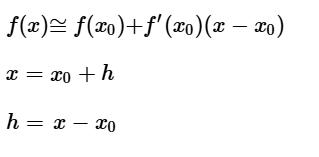
Taylor’s formula of the first order with Peano’s remainder

Taylor’s formula of the first order WITHOUT Peano’s remainder
Limit definition of a second order derivative

Taylors formula of the second degree
Note: this is also called Maclauren’s formula
Maclauren’s formula is just Taylor’s formula of the second degree in the neighborhood of zero

Definition of inflection points without derivatives
x0 ∈ Domf is an inflection point if f is concave (convex) in a left neighborhood and convex (concave) in a right neighborhood
Definition of orthogonal vectors

Definition of a linear combination of vectors

Definition of a convex linear combination

Definition of linearly DEPENDENT vectors
a set of vectors is linearly dependent if at least one of them can be written as a linear combination of the others
Definition of linearly INDEPENDENT vectors
A set of vectors is linearly independent if none of them can be written as a linear combination of the other
Theorem of Linear DEPENDENCE

Theorem of Linear INDEPENDENCE

Definition of a matrix
A matrix (mxn) is a table of m rows and n columns of real numbers
Definition of a square matrix
A square matrix A(nxn) is symetric if the elements with are opposite with respect to the main diagonal are equal
Definition of Transpositon
Given A(mxn), the transpose of A, AT is a matrix n/m whose rows are the columns of A and whose columns are the rows of A
Definition of Addition
A(mxn) + B(mxn)= C(mxn) s.t. Cij = aij + bij
Product by a scalar
K*A(mxn)= C(mxn) s.t. Cij= K*aij
Determinant of a SQUARE matrix
The determinant of A(nxn), detA or |A|, is a real number associated to the matrix calculated as:
if n=1 A=[a11] detA= a11
if n=2 detA = a11*a22 - a12*a21
Leplace rule
if n is greater than or equal to 3
The determinant is the sum of the product of each element of any row or column of the matrix, but the corresponding cofactor or algebraic complement
Binet Theorem
If A, B are matrices of order n then |A*B| = |A|*|B|
Definition of a singular square matrix
A(nxn) is said to be singular if |A|=0
Theorem of linearly DEPENDENT vectors with square matrix
n vectors of Rn are linearly dependent iff the determinant of the square matrix containing the vectors is equal to zero
Theorem of linearly INDEPENDENT vectors with square matrix
n vectors of Rn are linearly independent iff the determinant of the square matrix containing the vectors is different from zero
Definition of an inverse matrix
Given A(nxn), the inverse matrix of A, if it exists, is a matrix B(nxn) s.t. A*B=B*A=In
In is the identity matrix
Notation A-1
Definition of the Rank of a Matrix
the rank of A(mxn) is the maximum number of linearly independent vectors (either row or column vectors)
alternative definition: the rank of A(mxn) is the maximum order of a submatrix (square) with a determinant that is not equal to zero
Kroneker algorithm
A(mxn) has rank r iff all the minors of order r+1 which are obtained augmenting (adding rows/columns) the submatrix of order r, are equal to zero
Cramer’s theorem
Given Ax=b where A(nxn) with |A| not equal to zero
Ax=b has 1 and only 1 solution calculated as x= A-1*b
Cramer’s rule

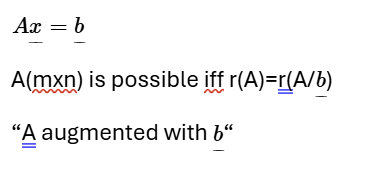
Rouche’- Cappelli Theorem