Kinesiology Gait Cycle
 Call Kai
 Learn
 Practice Test
 Spaced Repetition
 Match
 Flashcards
 Knowt Play
1/70

There's no tags or description
Looks like no tags are added yet.
71 Terms
What is Gait Cycle? How many percentage can person represent the gait cycle?
Gait cycle = the most fundamental unit of walking
represented as 0-100%
How can you tell phase and support of gait cycle?
Phases - a single limb is the reference
Support - considers both limbs
What does stance phase mean?
Stance phase means that foot (in contact) on the ground; 60%
What does swing phase mean?
Swing phase means that foot NOT in contact with ground; 40%
What does double-limb mean?
both feet in contact with ground; 20%
What does single-limb mean?
only one foot in contact with ground (80%)
As gait speed increases, % time in double limb support [increase or decrease]
decreases
As gait speed decreases, % time in double limb support [increase or decrease]
increases
Tell me comparison of terminology of gait cycle (8 RLA cycle)
initial contact (IC)
roading response
midstance
terminal stance
preswing
initial swing
midswing
terminal swing
What does event of stance phase mean? (4)
heel strike/ heel contact
foot flat
heel off
toe off
What does event of swing phase mean? (3)
early swing/ acceleration
midswing
late swing/ deceleration
When the person’s heel touches on the ground, what phase and percentage of this gait cycle?
initial contact - point at which the heel strikes ground (0% gait cycle)
When the person’s foot flat on the ground, what phase of this gait cycle?
roading response - first point in stance time that foot is flat on ground
When the person stands following of foot flat, what phase and percentage of this gait cycle?
midstance - point at which BW is over support limb (double-limb); 30%
When the person’s heel off on the ground, what phase and percentage of this cycle?
terminal stance - point at which heel leaves ground (~40%)
When the person’s toe off on the ground, what phase and percentage of this gait cycle?
preswing - point at which toe leaves ground (~60%)
Describe the early swing (initial swing) phase including with the percentage of the gait cycle
Acceleration phase: toe off → midwing (~60-75%)
Describe the midswing phase including with the percentage of the gait cycle
When LE passes under body (~75-85%)
Describe the late swing (terminal swing) phase including with the percentage of the gait cycle
Deceleration phase: After midswing, limb decelerating for Heel contact (~85-100%)
For loading response phase (LR), can you describe what is happening in this phase? describe weight transfer and other key things.
describe weight transfer to stance limb (lC→LR is double-limb support)
foot flat position
shock absorption occurs as forward momentum (moving to forward and flexing hip, knee, ankle)
What are the critical events of weight acceptance between IC to LR phase?
heel first contact (Dorsiflexion → Plantarflexion)
hip stability; controlled knee flex and plantarflexion
What are the critical events of mid stance → terminal stance?
Single limb support = midstance + terminal stance
controlled tibial advancement (=midstance)
controlled ankle dorsiflexion with heel rise; trailing limb (=terminal stance)
Explain RLA of swing phase including with motion (3 phases)
initial swing (Acc): end of double limb support (toe off)→ max knee flex; 62-70%
mid swing: max knee flex → tibia vertical; 70-80%
terminal swing: tibia vertical → just prior to IC; 80-100%
What are the critical events of swing phase?
preswing: passive knee flexion; ankle PF
initial swing: hip flexion; knee flexion
midswing: more hip flexion and ankle DF
terminal swing: knee extension
What is the step length?
distance between heel contact of opposite LEs; 72 cm
What is the stride length?
distance from one heel strike to the next on the same LE; 144cm
this affected by leg length, height, age, sex, etc.
What is the step width?
distance between midpoints of L and R heels (base of support); 8-10cm

Images of healthy step length and step length of painful hip
healthy step length - seems symmetry
painful hip - decreases step length which also can cause decreasing the next step length, too


Images of step length between healthy and hemiparesis
decrease step length
extend hip on the paretic limb because of weakness on this side of limb


Images of step length between healthy and Parkinson’s disease
decrease step length and tiny step forward length

Review: Name the percentage of gait cycle!
Stance time
Swing time
Single-limb support time
Double-limb support time
60%
40%
80%
20%
Double-limb support time decreases in older adults and people with balance disorders
Double-limb support time decreases with increasing gait speed and running.
Stride and Step Duration
Step duration = second/ step
~0.5 sec
decrease with painful stance LE
Stride duration = gait cycle duration
~<1 sec
What is cadence? What is the norm of walking speed?
Cadence = # of steps per time
1.87 steps/sec or 110/min
decrease step length = increase cadence
Walking speed
rate of forward progression, without considering direction
1.2-1.5 m/s or ~3mph
1.2 m/s = cross the street safely
0.47-0.68 m/s: normal gait speed one year post hip fracture
In sagittal plane, what is the maximum flexion and extension of hip? what does it occur to the pelvic tilt?
max flexion = 20 degree - just prior to IC
max extension =10-20 degree - heel off (terminal stance)
Pelvic tilt: less than 5 degrees each direction
Anterior: hip moves into apparent extension (looks like hip extending)
Posterior: hip moves into apparent flexion (looks like hip flexing)
What are compensations of limited hip extension ROM?
anterior pelvic tilt at heel off
lumbar lordosis increases (extends)
What are compensations of limited hip flexion ROM?
anterior pelvic tilt at heel off
decreasing lumbar lordosis
What is the maximum degree of knee flexion and extension? What phase does occur in the maximum degree of knee flexion and extension?
The max extension = 0 degree
IC, heel-off, late swing (terminal swing)
The max flexion = 60 degrees
midwing
What are compensations of limited knee flexion ROM?
increase ipsilateral hip flexion
hip hike (trunk side bend and rotation)
circumduction gait (回旋運動); vaulting
What are compensations of limited knee extension ROM?
contralateral hip and knee flexion
increase quads demand since knee is flexed
What is the maximum degree of ankle dorsiflexion and plantarflexion?What phase does occur in the maximum degrees of each motion?
Ankle dorsiflexion = 5-10 degree; occurs after midstance
Ankle plantarflexion = 20 degree: toe-off (preswing)
What is the maximum degree of great toe dorsiflexion and plantarflexion?What phase does occur in the maximum degrees of each motion?
1st MTP: 45-60 degree hyperextension; occurs between heel-off and toe-off
0 degree (neutral) during swing phase
Greater ankle dorsiflexion is needed during the [stance or swing] phase of gait.
stance
The best view of sagittal plane kinematics would be from the ____.
side
The best view of frontal plane kinematics would be from the _______.
front or behind
In the frontal plane, how many degree does pelvis-on-femur (hip) AB or ADduction?
~5 degree
In the frontal plane, what happens if pelvis drops on swing limb in early stance?
stance hip AD (imaging the closed-chain of hip)
In the frontal plane, what happens during late stance and swing phases on the hip and pelvis?
stance (standing leg) hip progressively AB
pelvis elevates on swing limb
What happens if pelvis-on-hip movement would excessive?
Trendelenburg Gait
Patient diagnosed L5 nerve root compression with subsequent discectomy and laminectomy. When patient performed Trendelenburg gait (weak on the L side of hip), which side should patient bring a cane? Which muscles affected?
Patient should place a cane on R side.
Her left side of hip AD muscles, AB muscles, and glute med would weak. It would cause hip drop on the R side.

When the patient has compensated Trendelenburg gait, what would cause?
minimize the external torque demands resulting from body weight on the AB muscles.
my words: lean the back and pelvis towards the weak side and keep the pelvis elevating on the strong side.
At IC, calcaneus is [everted or inverted] 2-3 degrees.
Then, rapid [eversion or inversion] 2 degrees → shock absorption & adaptation
6 degrees [eversion or inversion] reached between terminal stance (heel-off) and pre-swing (toe-off) → Rigid lever for propulsion (one side of ankle rigid inversion)
inverted
eversion
inversion
Review: What does kinetics mean?
describe the effect of forces on a segment
ultimately responsible for the kinematics
What does external force produce? How does it measure?
external force produces external torque/moment
it’s measured with scales, force platforms.
ex) Ground Reaction Force (GRF)
What does internal force produce? How does it measure?
Internal force produces internal torque/moment to resist external torque/moment
muscle
responds to GRF
Controls or generates movement
estimated with dynamometers, mathematical calculations, EMG
ligaments, capsule, other ST and bony structures
What is the ground reaction force (GRF)?
force of the ground pushing back on the foot.
equal and opposite to the line of gravity (LOG) in static standing posture
produce external moment/torque
What is the center of pressure (COP)?
location of the GRF vector
based on weighted average of all downward acting forces (foot placement, gravity, ankle muscles)
When the line of gravity (LOG) passes directly through a joint axis, _________ is created around that joint.
If the LOG passes at a distance from the axis an __________ is created.
The external moment will cause rotation of the superimposed body (重なりあわせた) segments around that joint axis unless it is opposed by a counterbalancing _________ (muscle contraction).
no external gravitational torque
external moment
internal moment
External and Internal Moments Rules
Fill in the blank of sentences or choose the word.
The magnitude of the gravitational moment of force [increases or decreases] as the distance between the LOG and joint axis increases.
If the LOG is ANTERIOR to a joint axis, the external gravitational moment will cause __________ of the proximal segment (flexion or extension)
If the LOG is POSTERIOR to the joint axis, the moment will cause _______ of the proximal segment (flexion or extension).
increases
anterior motion
posterior motion
Quiz!
When you try to heel off on the ground, what external moments on the ankle and 1st MTP happen? what about internal moments?
When you try to toe off on the ground, what external moments on the ankle and 1st MTP happen? what about internal moments?
As the external moments, more dorsiflexion moment at the ankle and extension on the 1st MTP. Internal moments on the ankle would be plantarflexion, and 1st MTP’s internal moment would be flexion
external moment on the ankle would be dorsiflexion and extension on the great toe. Internal moment on the ankle would be plantarflexion and flexion on the great toe.
If kinematics and external moment occurs in the same direction
eccentric contraction to control movement
If kinematics and external moment occurs in the opposite direction,
concentric contraction to generate movement
What about constant position of the kinemactics and external moment?
isometric contraction to stabilize segment

What muscles stabilize the thigh?
What muscles extend the knee?
What muscles act motions on ankle?
Glute max and adductor magnus stabilizes thigh
Hamstring counteract extension torque (quads may contact in prep for LR)
Tibialis Anterior & Long Toe Extensors (pretibial muscles)
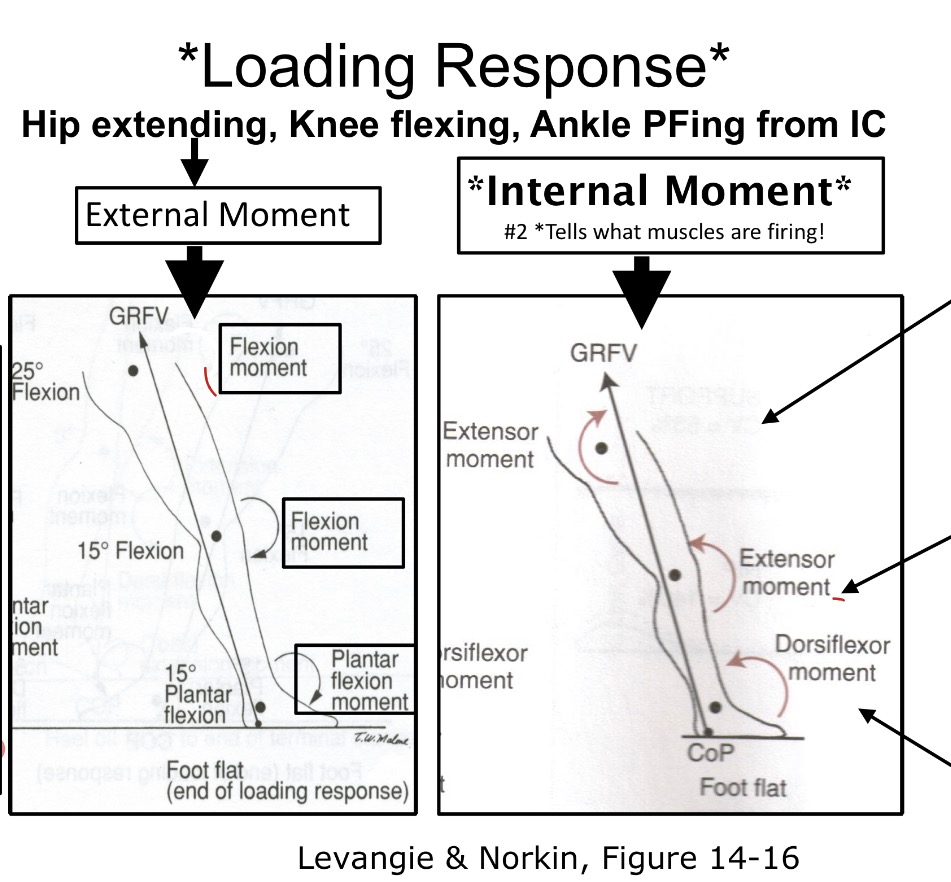
What muscles ?
What muscles flex the knee?
What muscles act motions on ankle?
Extending and flexor external moment to concentric glute max, adductor magnus, and hamstrings
Flexing and flexsor external moment so eccentric quads
Plantarflexing and plantarflexors of the external moment so eccentric dorsiflexion (tibialis anterior)
What causes Backward Trunk Lean of Gait Deviation?
Cause:
WA (weight acceptance) or SLS (single-limb support): Intentional to decrease the demand on the hip extensors (puts the LOG posterior to the hip joint axis)
Single limb advancement (SLA): intentional to advance the limb
What significant Backward Trunk Lean of Gait Deviation?
WA (weight acceptance) or SLS (single-limb support): may increase energy cost, decreases forward momentum
SLA: may increase energy cost
What functional activity would increase activity of the hip extensors?
walking on the hill
What problems on the ankle would happen in single limb support?
excess DF/PF
excess inversion/eversion
heel off
no heel off
toes inadequate extension
toes clawed/ hammered
What problems on the knee would happen in single limb support?
excess flexion
wobbles
hyperextends or extension thrust
varus/valgus
What problems on the hip would happen in single limb support?
inadequate extension
internal/external rotation
adduction/abduction
What problems on the pelvis would happen in single limb support?
posterior/ anterior tilt
lacks backward rotation
excess forward/ backward rotation
contralateral pelvic drop