Quiz 3 History
 Call Kai
 Learn
 Practice Test
 Spaced Repetition
 Match
 Flashcards
 Knowt Play
1/13

There's no tags or description
Looks like no tags are added yet.
14 Terms

Hindu Temple Complex
City: Angkor Wat, Cambodia
Constructed as a Hindu temple dedicated to Vishnu. The five central towers symbolize Mount Meru, the sacred mountain believed to be the center of the universe. The axial layout, rising levels, and increasingly sacred spaced create a physical journey towards the divine.

Kandariya Temple
City: Kharjuraho, India
examples of Hindu temple architecture from the Chandela dynasty. Built in the 11th century, it is known for its towering, mountain-like spire that symbolizes the sacred home of the gods. Its detailed stone carvings of Hindu deities and figures demonstrate the importance of religious devotion and artistic craftsmanship in medieval Indian architecture.

Great Stupa
City: Sanchi, India
Commissioned to house relics associated with the historical Buddha. Its central dome, vertical chattra, and surrounding walkway create a sacred space for circuambulation, or walking meditation. Its simple interior contrasts with its elaborately carved gateways, emphasizing the transition from the distractions of everyday life towards spiritual reflection.

Buddhist Temple
City: Borobudur, Indonesia
Major Buddhist monument. The multiple square terraces transition into circular platforms and culminate in a large central stupa, symbolizing the spiritual journey towards enlightenment. Its carved narrative reliefs teach Buddhist beliefs and stories about the Buddha’s previous lives, making the monument both an architectural experience and a public teaching tool.

Ise Shrine
City: Mie, Prefecture
Dedicated to the Shinto sun goddess and is one of Japans most sacred shinto sites. Its buildings are traditionally reconstructed every 20 years through a process called Shikinen Sengu, preserving ancient constuction techniques while allowing structures to be completely renewed. This practice represents the shinto ideas of renewal, continuity, and the relationship between nature and architecture.
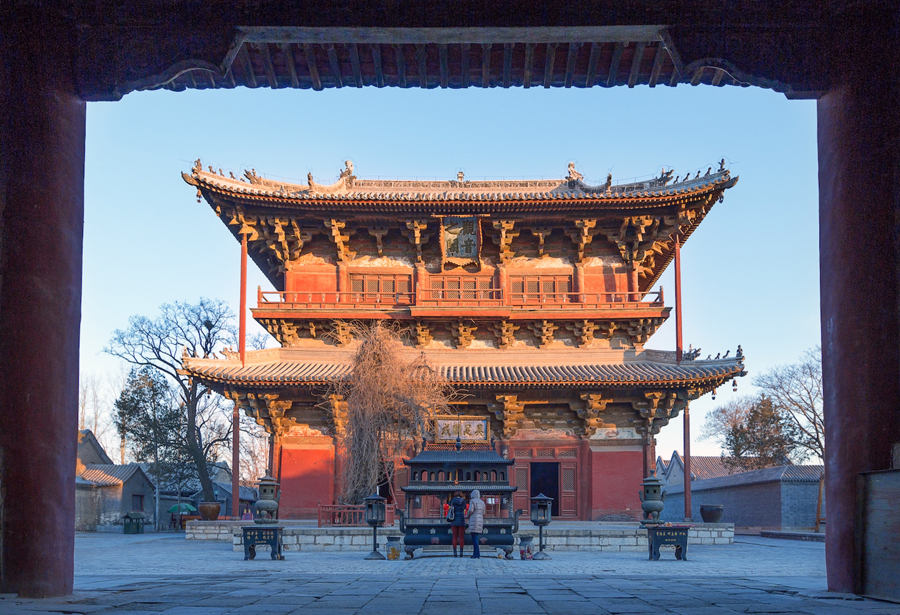
Guanyin Pavilion at Dule Temple
City: Jixian, China
important example of Chinese Buddhist architecture built during the Liao dynasty. It is known for its impressive wooden structure and large statue of Guanyin, the goddess of mercy, inside. It demonstrates the importance of Buddhism and the advanced woodworking skills of ancient China.

Dry garden at ryoan-ji
City: Kyoto, Japan
famous Zen Buddhist garden in Kyoto, Japan, designed for meditation and reflection. It uses carefully placed rocks, gravel, and empty space instead of water and plants to represent a natural landscape. It demonstrates Zen Buddhist beliefs about simplicity, peace, and finding meaning through meditation.

Taian Teahouse
Kyoto, Japan
small Japanese tea house designed by the famous tea master Sen no Rikyū. It is known for its simple, rustic design and small entrance that requires guests to bow when entering. It reflects Zen Buddhist ideas of simplicity, humility, and the importance of the Japanese tea ceremony.

Fogong Pagoda
City: Yingxian, China
Buddhist wooden pagoda built during the Liao dynasty in China. It is known for being one of the oldest and tallest surviving wooden pagodas in the world. Its design demonstrates the advanced woodworking and engineering skills of ancient Chinese architecture.

Forbidden City
location: Beijing, China
imperial palace complex in Beijing, China, built during the Ming dynasty. It served as the home of Chinese emperors and the center of government for hundreds of years. Its grand courtyards, symmetrical layout, and traditional buildings represent the power and authority of the emperor.

Garden of the humble administrator
City: Suzhou, China
one of the most famous examples of traditional Chinese garden design, located in Suzhou, China. It uses ponds, bridges, rocks, and pavilions to recreate natural landscapes and create a peaceful retreat from everyday life. It demonstrates how Chinese gardens combined architecture and nature to reflect harmony, balance, and the beauty of the natural world.

Tempio Malatestiano
City: Rimini, Italy
Architect: Leon Battista Alberti
represents the return of classical Roman architecture during the Renaissance. Its design uses ancient Roman elements such as arches, columns, and a grand classical facade. It demonstrates how Renaissance architects looked back to ancient Greece and Rome for inspiration while creating new Christian buildings.

Dome of the florence cathedral
City: Florence, Italy
Architect: Filippo Brunelleschi
major engineering achievement of the Renaissance. It was the largest dome built since ancient Rome and was constructed without traditional wooden scaffolding. Its innovative design demonstrated the return of classical ideas and the advancement of engineering during the Renaissance.

palazzo rucellai
City: Florence, Italy
Architect: Leon Battista Alberti
important example of Renaissance palace architecture and classical influence. Its facade uses three levels of columns and pilasters inspired by ancient Roman architecture. It demonstrates the Renaissance focus on symmetry, proportion, balance, and the revival of classical design.