Acids, Bases and Neutralisation
 Call Kai
 Learn
 Practice Test
 Spaced Repetition
 Match
 Flashcards
 Knowt Play
1/9

Earn XP
Description and Tags
https://www.youtube.com/watch?v=dLqGwSq4GyA
10 Terms
Key idea about acids
They contain the element hydrogen, when acid is dissolved in water, hydrogen is released as the hydrogen ion H+. The acid molecule dissociates (splits), we also release negative ion , in the case of hydrochloric acid it would be chlorine. It is a strong acid as well as nitric and sulfuric
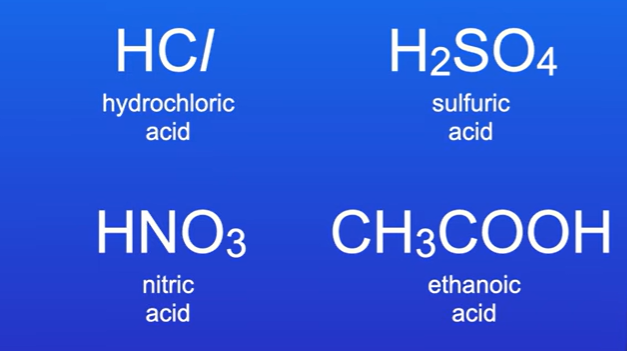
The four main acids
Hydrochloric acid - Hcl
Sulfuric acid- H2SO4
Nitric acid- HNO3
Ethanoic acid - CH3COOH
Why is ethanoic acid a weak acid
Only a small percentage of the acid molecules dissociate
Examples of bases
Includes metal oxides , metal hydroxides, metal carbonates and ammonia

What makes a chemical a base
A base can neutralise an acid to produce a salt

Key points about neutralisation reaction
When we form the salt, the metal ion in the metal oxide has replaced the hydrogen ions in the acid, in this case the copper ion from copper oxide replaced hydrogen ions in sulfuric acid to form salt copper sulfate
The oxide ions from metal oxide and hydrogen ions from acid have formed water
What are the 3 products made from reacting acid with metal carbonate
Salt, carbon dioxide and water
What are alkalis
Bases that dissolve in water
All group 1 metal hydroxides are soluble in water and can form alkalis

Whats ammonia
Its a gas, but highly soluble in water, produces the alkali ammonium hydroxide.
Key feature of all alkalis
In solution, they release the hydroxide ion OH-
When alkaline reacts with acid, we make salt and water
