geology study guide 2
 Call Kai
 Learn
 Practice Test
 Spaced Repetition
 Match
 Flashcards
 Knowt Play
1/53

There's no tags or description
Looks like no tags are added yet.
54 Terms
Garnet crystals grow inside a rock that is heated and squeezed deep underground without melting. This is: [LO6]
metamorphism
Where do natural diamonds form? [LO5]
Deep in the mantle, more than 150 km down
Obsidian is natural, solid, and inorganic, yet it is not a mineral. Which rule does it fail? [LO1]
Orderly internal structure
What makes native element minerals different from all other minerals? [LO4]
They contain only one element
Select ALL of the elements that are among the eight most common elements in Earth's crust.
Silicon
Oxygen
Iron
Aluminum
Calcium
Why are silicate minerals the most common minerals in Earth's crust? [LO2]
Their main ingredients, oxygen and silicon, are the two most abundant elements in the crust
Why is diamond the hardest natural mineral, while graphite rubs off on paper? [LO5]
Diamond's carbon atoms are strongly bonded in every direction; graphite's form sheets with weak links between them
Which mineral is a framework silicate made only of silicon and oxygen, and is very common in beach sand? [LO3]
Quartz
Which of the following is NOT one of the three main ways minerals form, as covered in class? [LO6]
Erosion
Olivine turns a beach in Hawaiʻi green. Hawaiʻi is built by a volcano fed by a column of hot rock rising from deep in the mantle, far from any plate edge. This setting is a: [LO7]
hot spot
Which sequence lists these building blocks in order from the SMALLEST to the LARGEST? [LO1]
element → mineral → rock
Cinnabar is made of mercury and sulfur. Which family does it belong to?
Sulfide
Copper (from chalcopyrite) and gold are often mined from the same giant deposits. Where do these deposits typically form? [LO7]
Where heavy ocean floor sinks beneath a continent, under volcanoes
Why does mica peel into thin, flexible layers? [LO3]
Its tetrahedra are linked into flat sheets that are weakly held together
Deep underground, a rock is heated until it melts completely. Later, the melted rock cools and becomes solid. What type of rock forms? [LO2]
Igneous rock

On Figure 6.3, the igneous rock circle is split in two, with "Extrusive" on the top half and "Intrusive" on the bottom half. Why is it drawn this way? [LO3]
Extrusive rock forms at Earth's surface, and intrusive rock forms underground.
Which of these would form a sedimentary rock? Select all that apply.
Layers of mud that are buried and compacted
sand grains that are buried and cemented together
Minerals that precipitate out of seawater
Imagine the sun stopped heating Earth's surface but Earth's interior stayed hot. Which part of the rock cycle would stop? [LO5]
Weathering, erosion, and transportation, so new sediment and sedimentary rock would stop forming

A student wrote: "My metamorphic rock had to melt next, because every rock must pass through all three rock types. The magma was then buried, compacted, and cemented into sedimentary rock."
Using Figure 6.3, select every statement that correctly identifies an error.
A rock does not have to pass through every stage; it can take many paths or stop changing.
Magma can only cool into igneous rock; burial, compaction, and cementation act on sediment.
Which of these can be part of a rock? Select all that apply. [LO1]
Plant remains
Fossils
Mineral crystals
Volcanic glass
Broken pieces of other rocks

What does the texture of the rock in this photo tell you about how it formed?
Some crystals grew slowly before the magma rose closer to the surface, then the rest solidified quickly

Using Figure 7.13: a rock contains about 50% calcium-rich plagioclase, 35% pyroxene and 15% amphibole. Its crystals are too small to see. What is it?
Basalt

A fine-grained gray rock has been identified as andesite. Using Figure 7.13, which minerals would you expect to find in it? Select all that apply.
Biotite
Amphibole
Plagioclase feldspar

Using Figure 7.13: a rock contains about 35% potassium feldspar, 30% quartz, 15% sodium-rich plagioclase, and small amounts of muscovite, biotite and amphibole. Its crystals are too small to see. What is it?
Rhyolite

Compare the rock photos in the felsic column of Figure 7.13 with those in the mafic column. Which statement best explains the difference in color?
Felsic rocks are lighter because they are mostly light minerals like quartz and feldspar; mafic rocks are darker because they contain much more pyroxene and other dark minerals

A magma contains 60% SiO2, 16% Al2O3, 6% FeO, 5% CaO and 4% MgO. How would it be classified?
Intermediate
A sheet of basalt cuts straight across several layers of sandstone. Which formed first?
The sandstone layers
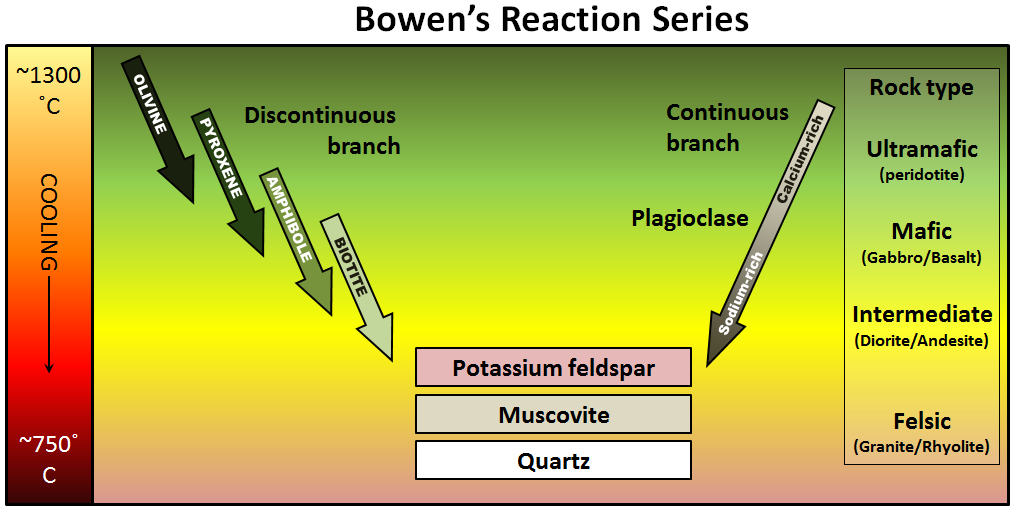
A plagioclase crystal has a calcium-rich core and a sodium-rich rim. Using the plagioclase arrow in Figure 7.7, what does this tell you?
The crystal kept growing as the magma cooled, so the core formed first and the rim later
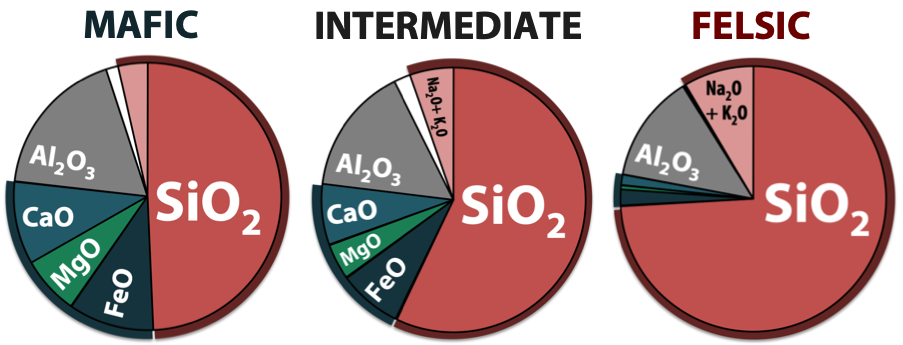
Using the magma composition pie charts, about how much of a mafic magma is SiO2 (silica)?
About one half
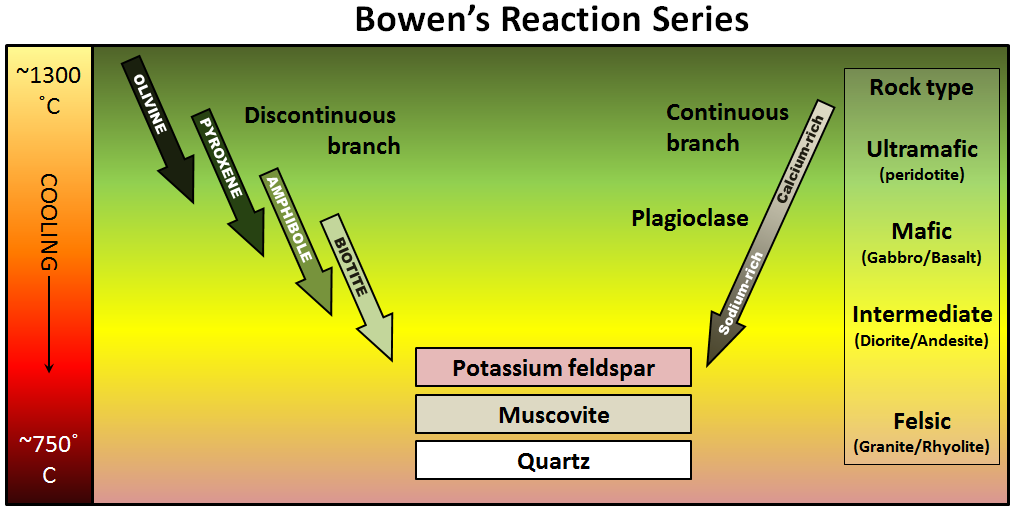
A rock is made mostly of potassium feldspar, muscovite and quartz. According to the rock-type column on the right side of Figure 7.7, what type of rock is it?
Felsic

Figure 7.4, left graph: the arrow moves a piece of mantle rock from the lower dashed box to the upper one. What changed?
Its pressure decreased while its temperature stayed about the same

Figure 7.4, left graph: follow the curve where dry mantle rock begins to melt down toward greater depth. What happens to the temperature needed to start melting?
It goes up, so higher pressure makes rock harder to melt

Read the paragraph, then answer the question.
Kīlauea volcano on Hawaiʻi's Big Island began erupting in December 2024 and continued in short, powerful episodes in which lava shoots high into the air from vents inside the summit crater. On June 1, 2026, the eruption's 48th episode began, sending a lava fountain at least 150 meters (about 500 feet) high. The U.S. Geological Survey's Hawaiian Volcano Observatory reported that most of the fragments fell back inside the crater or along its rim. Hawaiʻi sits over a hot spot, far from any plate boundary, where a plume of hot mantle rock rises from deep below.
The left graph, because mantle rock rises in the hot-spot plume and the pressure on it drops

Stone stores sell many igneous rocks under the name "granite." A countertop labeled "salt-and-pepper granite" is tested and found to contain about 55% plagioclase, 20% amphibole, 10% quartz, and small amounts of biotite and muscovite. Its crystals are big enough to see. Using Figure 7.13, what would a geologist call it?
Diorite
Olivine crystals form early in a magma chamber and sink to the bottom. What happens to the liquid magma left above them?
It becomes richer in silica
A mafic magma rises into continental crust that is rich in quartz and feldspar. If it melts and absorbs some of that crust, the magma will become:
more felsic
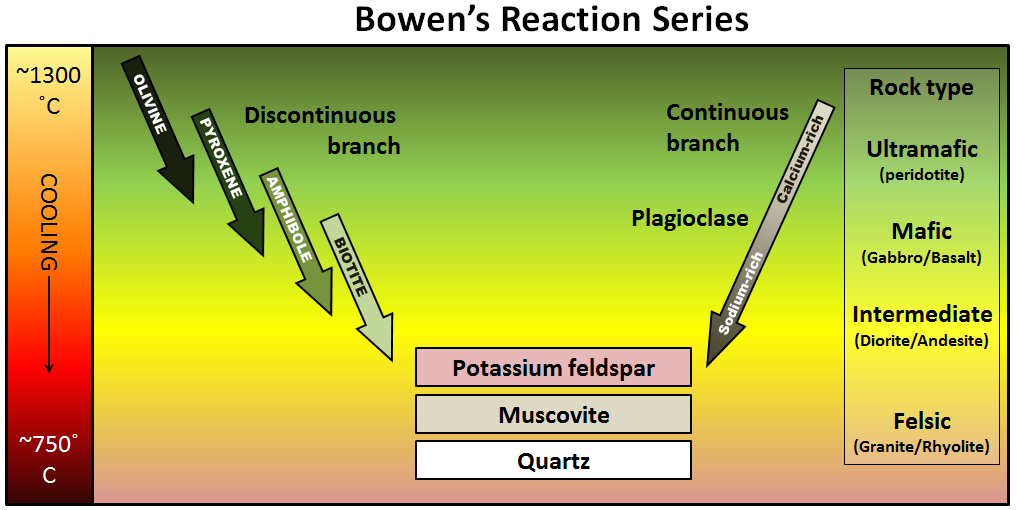
A magma cools until olivine and pyroxene crystallize, and those crystals settle out. Using Figure 7.7, which minerals could still form from the leftover liquid? Select all that apply.
Quartz
Biotite
Amphibole
Potassium feldspar

Figure 7.4, right graph: according to the graph, what does adding water to mantle rock do?
It moves the melting curve to lower temperatures
The granite domes of Yosemite peel off in huge curved sheets, like layers of an onion. What causes this? [LO2]
The granite expanding after the rock that once covered it was eroded away
Most beach sand around the world is made of quartz. Why? [LO5]
Quartz resists weathering, so it survives after other minerals break down
Why should you avoid rinsing a halite (rock salt) sample in water? [LO3]
It would dissolve
Water that has soaked through soil weathers rock faster than fresh rainwater. Why? [LO3]
Organisms in soil add carbon dioxide and organic acids, making the water more acidic
A town in a rainy climate wants a carved stone monument that will keep its lettering longest. Which stone is the best choice? [LO4]
Granite (mostly feldspar and quartz)

Using the graph: at least how many years would the slow rock cycle need to remove the carbon that burning fossil fuels adds in just ONE year? [LO6]
About 100 years
Tropical rainforests have very thick soils, yet those soils are often poor for farming. Why? [LO4]
Heavy rain washes many nutrients out of the soil
Coal forms from swamp plants, not from the leaves on a dry forest floor. Why?
Still swamp water is low in oxygen, so dead plants do not fully rot away
Observations of a rock: sand-sized grains; about 99% quartz; very well rounded; all about the same size. What is the best interpretation?
The sand traveled a long way and was sorted by steady waves or wind, as on a beach or desert dune
Observations of a rock: grains are 5–10 cm across; grains are angular, with sharp corners; big and small grains are jumbled together. Which past environment fits best?
The base of a cliff or an alluvial fan, close to where the rock broke off
Observations of a rock: grains are too small to see; it feels smooth; it splits into thin, flat sheets. Which interpretations are supported? Select all that apply.
It could have formed in a lake, a floodplain, or on the deep ocean floor
It was deposited in quiet, low-energy water
Gypsum layers exposed at the surface of Chile’s Atacama Desert are at least 14 million years old. Gypsum dissolves in water. What does the age of the gypsum tell scientists?
The area has been extremely dry for at least 14 million years; enough rain would have dissolved the gypsum
Which environment typically collects clay, carbonate mud, and silica mud, carried in by ocean currents?
Deep ocean floor (abyssal plain)
Groundwater flows slowly through a layer of buried sand. Over time, calcite crystals grow in the gaps between the sand grains and lock them together. Which step is this?
Cementation
Which statements about lithification are true? Select all that apply.
It happens hundreds to thousands of meters below the surface
Compaction squeezes water out of the spaces between grains
Quartz and calcite are common cement minerals