EXAM 2 Study Guide
 Call Kai
 Learn
Learn Practice Test
 Spaced Repetition
 Match
Match Flashcards
 Knowt Play
1/63

There's no tags or description
Looks like no tags are added yet.
Name | Mastery | Learn | Test | Matching | Spaced | Call with Kai | Chat |
|---|
No analytics yet
Send a link to your students to track their progress
64 Terms

A
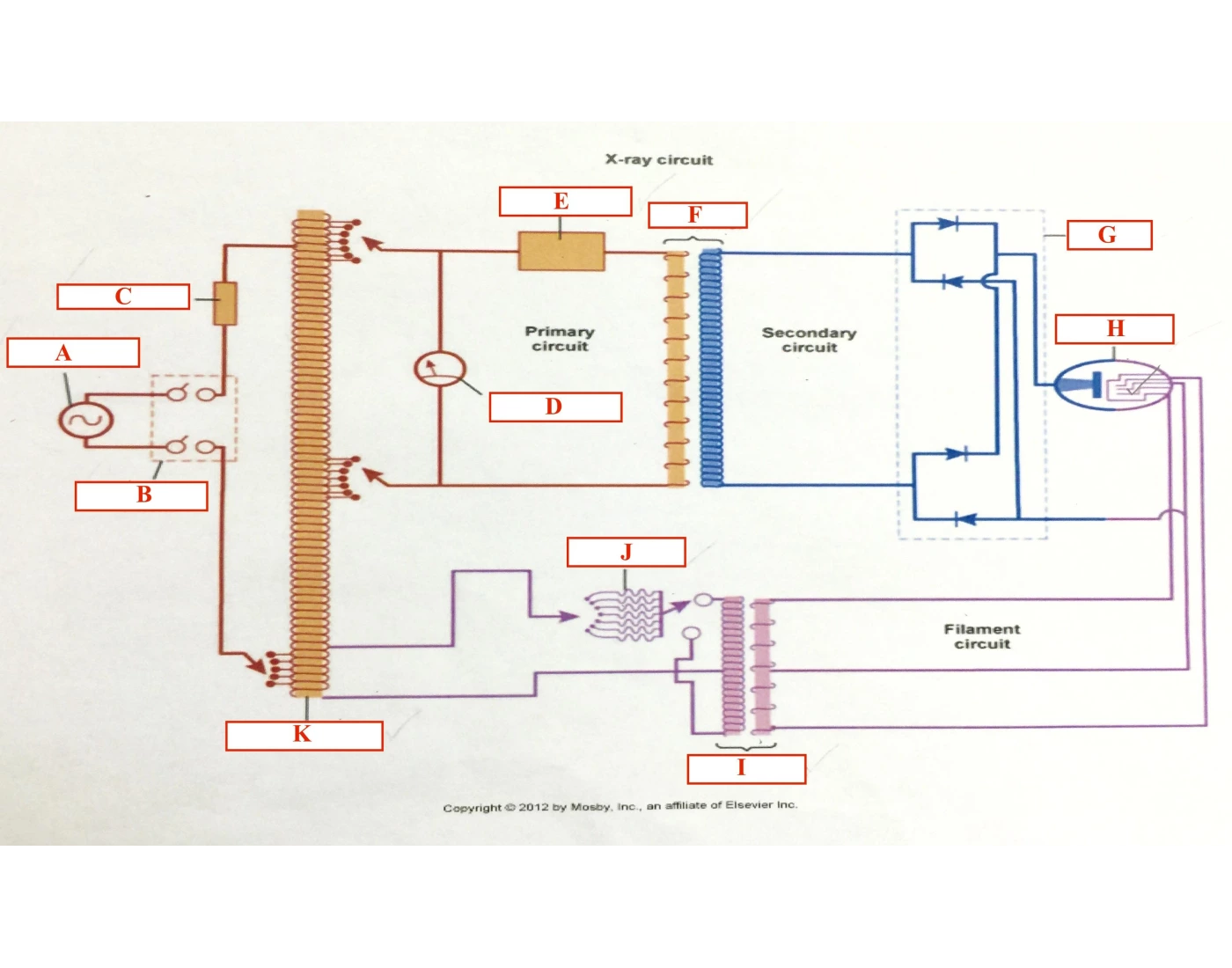
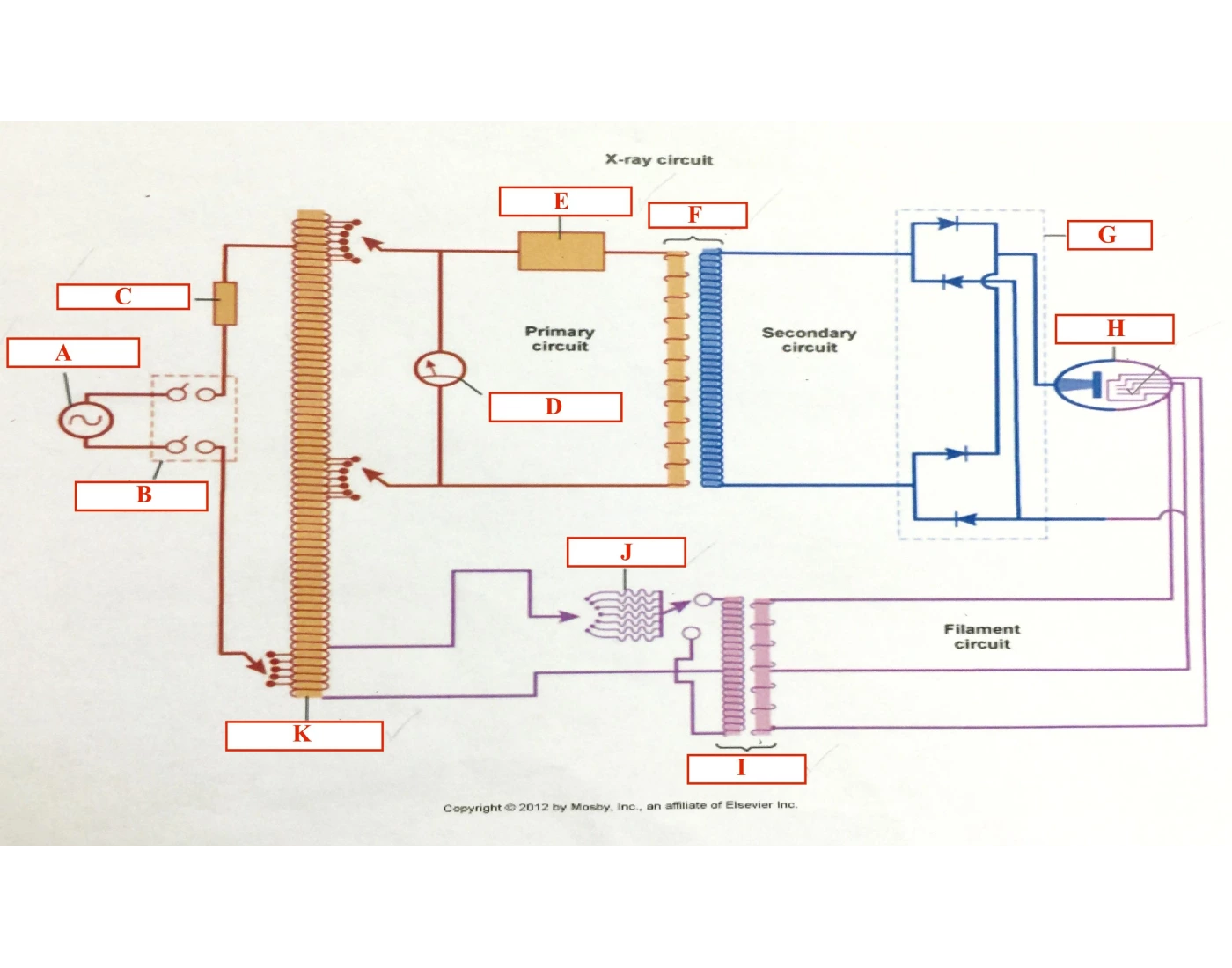
Power source

What type of phase power is illustrated?
Single phase power
uses a single AC waveform
pulsating x-ray beam
drops to 0 per cycle = 100% voltage ripple
low energy & low penetrability = little diagnostic value

What type of phase power is illustrated?
Three phase power:
combines three overlapping AC waveforms
multiple waveforms that maintain nearly constant high voltage
voltage never drops during exposure
What are the types of three-phase power?
6-pulse three phase: reduces voltage ripple to 3.5%-13%; maintains 87%-100% of selected kVp
12-pulse three phase: reduces voltage ripple down to ~3.5%; maintains 96.5%-100% of selected kVp

Blue highlighted
line voltage compensator
usually wired to the autotransformer and automatically adjusts the power supplied to the x-ray machine to 220 volts

C
Circuit breaker
K
Autotransformer

Pink and Green highlighted
Pink: Major kVp selector
large adjustments, increments of 10 kVp
Green: Minor kVp selector
fine tune adjustments, increments of 1-2 kVp

E
Exposure timer / circuit timer
What is the AEC
automatic exposure control
placed between patient and IR
automatically terminates x-ray exposure the exact moment the IR receives the necessary amount of radiation to take a diagnostic image
x-ray passes through the patient and strike the ionization chamber to allow free electrons to create an electrical charge that triggers the AEC
Where is the AEC located within the x-ray circuit?
in the primary circuit where the exposure timer sits

F
Step-up transformer

Purple highlight
Filament circuit
I
Step-down transformer

J
Rheostat (mA selector)

G
Rectifier


Explain the figure
Half-wave rectification
blocks the negative half of the AC cycle, preventing voltage from swinging negatively
wastes 50% of available electric power
doubles exposure time = undesirable

Explain the figure
Full-wave rectification
inverses the negative half-cycle into a positive pulse to remain continuously relative to the cathode
utilizes 100% of electrical power
cuts exposure time in half
Define voltage ripple
the energy that fluctuates from zero (on the line) to the maximum voltage (peak of wave)
single phase power = 100% ripple (huge dips)
three-phase power = low ripple (minimum dips)
high frequency generators = nearly 0% ripple (nearly no dips)
What are the external components of the x-ray tube?
Glass envelope
Protective housing
Support structures

7
Glass envelope
inside the heavy protective housing
maintains a vacuum to ensure accelerating electrons do not collide with air/gas molecules which can cause burnout
usually made of Pyrex glass or metal

9
Target window (tube port)
thinned area on bottom side of envelope below the anode target
allows useful x-ray beam to exit the glass enclosure with minimal absorption before entering the collimator
Describe the protective housing
lead-lined casing that surrounds the envelope with an oil bath
provides mechanical support, thermal cushion, and isotropic radiation control (leakage/secondary radiation)
Describe the support structures
external track, floor, or ceiling mounting assemblies attached directly to the protective housing
ceiling support system (longitudinal/transverse), floor-to-ceiling (column), c-arm

6
Cathode
x-ray beam intense
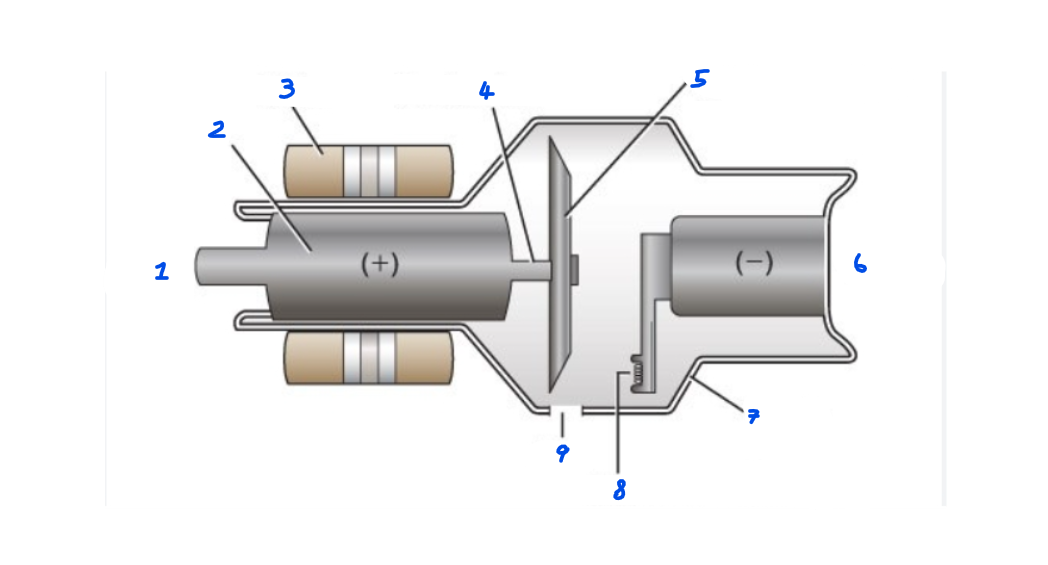
8
Filament in focusing cup
Explain small focal spot
smaller AFS and EFS
high spatial resolution
lower heat dissipation
lower mA techniques only (hands, wrists, feet)
Explain large focal spot
larger AFS and EFS
reduced spatial resolution (blur)
higher heat dissipation
high mAs techniques (chest/abd/spine)

What is the line-focus principle
angling the face of the anode target maintains a large AFS size and creates a small EFS and increases spatial resolution
Describe thermionic emission
literal boiling off of electrons from a filament by a flow of electrical current
What is the electron cloud
a gathered cluster of free electrons that are attracted to the anode target and hovering around the cathode waiting to be pushed across the x-ray tube
What is the space-charge effect
self-limiting factor caused by the space charge reaching a size commensurate with the current used and making it difficult for additional electrons to be emitted

1
Anode
x-ray beam weaker
two types: stationary overheats, rotating dissipates heat as it rotates

5
Anode target (tungsten target)

What is the anode heel effect
angling the target face causes the intensity of the x-ray beam to be less on the anode side because the “heel” of the target is in the path of the beam
What causes target failure
high heat exposures (99% of projectile electron KE is converted to thermal heat)
lacking warm-up procedures (cold anode)
physical or structural damage to the tungsten surface (exceeding melting point)

4
Anode stem/neck

2
Rotor

3
Stator
part of an induction motor made of electromagnets arranges in pairs around the rotor
rotates through mutual induction
What are the properties of x-ray?
photon characteristics
no mass, no charge
lots of energy, travel at speed of light
electromagnetic spectrum
share the same fundamental nature as visible light, gamma rays, and radio waves
wavelength and frequency relationship
wavelength is inversely proportional to frequency and energy but the velocity stays the same
polyenergetic beam
consist of million of photons across a wide range of different energy levels
What are target interactions
different from x-ray interactions
happens within the tube when projectile electrons interact with the target x-ray produced
What are the types of target interactions
Characteristics
projectile electron ejects an inner shell electron from a target atom
outer shell electron drops to fill vacancy
release of photon with energy equal to exact difference of BE between two shells
requires > 69.5 kVp to knock out tungsten inner shell
Bremsstrahlung
projectile electron is attracted to the nucleus
slows down and changes direction
energy lost is released as an x-ray photon
requires any # kVp to create x-rays
What is required to make x-ray photons
Source of electrons
current (mA) passes through tungsten cathode filament causing thermionic emission
Acceleration (kVp)
applying high voltage across the x-ray tube to create a strong potential difference
Deceleration
energy is transformed into x-ray photons via Bremsstrahlung and characteristic interactions
What is a characteristic cascade
process of outer-shell electron filling inner-shell vacancies which creates a cascading effect
Know how technique changes the production of X-Rays (or type of X-Rays produced)
mAs
controls the volume of projectile electrons hitting the target per second
changing mAs = changes radiation quantity/intensity but no effect on beam quality
kVp
controls the kinetic energy of projectile electrons
changing kVp = changes beam quality + quantity
What are the properties of the x-ray beam
quality, quantity, emission spectrum, and filtration
Explain beam quality
refers to the penetrating power of the beam and varies directly with changes in kVp and filtration

What is the half-value layer
thickness of absorbing material (3-5 mm aluminum) necessary to reduce the energy of the x-ray beam to ½ of its original intensity (mAs)
Describe beam quantity
refers to the total number of x-ray photons in a beam and is affected by mAs, kVp, distance, and filtration

What is the x-ray emission spectrum
graphic representation of the x-ray beam as a whole, combining relevant parts of the discrete and continuous emission spectra

Describe discrete x-ray emission spectrum
photon energy depends strictly on the specific difference in electron BE of target atom
produced by characteristic x-rays compose of predictable photon energies

Describe continuous emission spectrum
incoming projectile electrons lose amounts of KE depends how close they pass to the target nucleus
produced by Bremsstrahlung radiation containing continuous range of photon energies extending from the maximum selected kVp to 0
Describe heterogeneous/polyenergetic emission
describes the primary x-ray beam as consisting of many different photon energies
caused by both continuous Bremsstrahlung interactions and discrete characteristic interactions simultaneously at the anode target
Describe characteristic peak
a distinct vertical spike on the spectrum graph
represents useful K-shell characteristic x-rays for a tungsten target
only appears on graph when technique is set to > 69.5 kVp
Factors that affect the spectrum
beam quantity (mAs) - intensity
controls volume of projectile electrons flowing from cathode to anode per second
graph: changing mAs raises amplitude height
beam quality and quantity (kVp) - avg photon energy
controls potential difference across the tube for projectile electrons
graph: changing kVp also raises almplitude height and shift the curve up→right
filtration
aluminum absorption of undesirable low-energy photons
hardens beam = decreases quantity + increasing quality
generator type
three-phase and high-frequency generators maintain voltage near peak levels
decreasing voltage = increases intensity (quantity) + avg photon energy (quality)
target atomic number
targets with higher atomic # = higher BE
higher Z targets = increase x-ray quantity + quality
Describe filtration
any material (usually aluminum) designed to effectively absorb photons from the x-ray beam
What are the types of filtration
inherent filtration
glass or metal enclosure of an x-ray tube
added filtration
thin sheet of aluminum positioned between protective x-ray tube housing and the x-ray beam collimator
compensating filter
additional filter added by the radiographer to compensate in the differences in subject radiopacity
What are the minimum requirements for each type of filter
standard material
aluminum or Al/eq or HVL
total filtration formula
inherent + added = total filtration
regulatory standard
general diagnostic x-ray equipment requires a minimum total filtration of ~2.5mm Al/eq
MATH
Transformer Law
MATH
Heat Units
MATH
Energy of a characteristic photon
MATH
Energy of a bremsstrahlung photon
MATH
Energy of a photon after passing through a HVL
MATH
Half value layer required to reduce the beam by a certain amount