Chapter 4 The Three-Dimensional Structure of Proteins
 Call Kai
 Learn
Learn Practice Test
 Spaced Repetition
 Match
Match Flashcards
 Knowt Play
1/165

There's no tags or description
Looks like no tags are added yet.
Name | Mastery | Learn | Test | Matching | Spaced | Call with Kai | Chat |
|---|
No analytics yet
Send a link to your students to track their progress
166 Terms
Covalent bonds linking amino acid residues in a polypeptide chain
Primary structure
Recurring structural patterns
Secondary structure
3D folding of polypeptide
Tertiary structure
2+ polypeptide subunits
Quaternary structure
What does the function of a protein depend on?
Amino acid sequence
Amino acid sequence confers _______.
3D structure
3D structure confers ____.
Function
Most human proteins are _____.
Polymorphic
Have amino acid sequence variants
Polymorphic
classic method of sequencing amino acids
Edman degradation
A sequence variant changes several amino acid residues in a polypeptide. Which consequence best follows from the relationship among protein structure levels and function?
It changes only the protein's recurring secondary patterns, without affecting its function.
It may alter the protein's three-dimensional folding and thereby change its function.
It directly creates additional polypeptide subunits in the protein.
It changes the sequencing method used to identify the amino acid order.
It may alter the protein's three-dimensional folding and thereby change its function.
Limited number of _______ predominate under biological conditions.
Conformations
What is the most stable conformation?
Lowest free energy (G)
Proteins in any functional, folded conformations
Native
What is a protein’s conformation largely stabilized by?
Weak interactions
Tendency of a protein to maintain a native conformation
Stability
Unfolded proteins have ____ conformational entropy.
High
What holds proteins together?
Noncovalent interactions
Chemical interactions stabilize native conformations. What is uncommon?
Strong disulfide (covalent) bonds
Chemical interactions stabilize native conformations. What is numerous?
Weak (noncovalent) interactions
What are some examples of weak (noncovalent) interactions?
Hydrogen bonds, hydrophobic effect, ionic interactions
What happens if a protein is not stable in a solution?
Precipitates out
Packing of hydrophobic amino acids away from water favors ______.
Protein folding
Predominating weak interaction
Hydrophobic effect
Highly structured shell of H2O around a hydrophobic molecule
Solvation layer
The solvation layer _____ when nonpolar groups cluster together.
Decreases
The solvation layer _____ causes a favorable increase in net entropy.
Decrease
Hydrophobic R chains form a ________.
Hydrophobic protein core
Repeating secondary structures (alpha helices and beta sheets) optimize _____ bonding.
Hydrogen
Is a salt bridge stronger in nonpolar or polar environments?
Nonpolar environment
Interaction of oppositely charged groups
Ion pair
Ion pair =
Salt bridge
Strength (wanting to interact with each other) increases in an environment of ___ dielectric constant, E
Lower
Water has a ___ dielectric constant, which means it’s ready to be dissolved and form charges.
Higher
E ~ 80 (high dielectric constant)
Polar aqueous solvent
E ~ 4 (low dielectric constant)
Nonpolar protein interior
Would a Lysine in hydrophobic core be happy?
No, would rather be in soluble areas (+1 charge)
Which explanation best describes why folding can stabilize a protein through both its hydrophobic core and polar interactions?
Hydrophobic clustering increases net entropy, while buried ion pairs are strengthened in the low-dielectric interior.
Hydrophobic clustering decreases net entropy, while ion pairs are strongest in the aqueous environment.
Hydrophobic groups form surface solvation layers, while ion pairs are weakened in the low-dielectric interior.
Hydrophobic interactions optimize secondary-structure hydrogen bonds, while ion pairs require a high-dielectric environment.
Hydrophobic clustering increases net entropy, while buried ion pairs are strengthened in the low-dielectric interior.
Individual van der Waals interactions are weak but combine to promote _____.
Folding
Dipole-dipole interactions over short distances
van der Waals interactions
Individual van der Waal interactions contribute ___ to overall protein stability.
Little
____ number of van der Waal interactions can be substantial.
High
What are the hydrophobic portions of an unfolded protein surrounded by?
Solvation layer (ordered shell) of water molecules
When the protein folds, these water molecules have a greater degree of freedom for movement and becomes ____ in the surrounding solvent, ______ their entropy.
Disordered, increasing
The peptide bond is ____ and ____.
Rigid and planar
3 covalent bonds separate the alpha carbons of adjacent amino acid residues:
C alpha - C - N - C alpha
There is resonance between what two atoms?
Carbonyl oxygen and amide nitrogen
Peptide C — N bonds cannot ____ freely.
Rotate
6 atoms of the ______ lie in a single plane.
Peptide group
What prevents rotation, limiting range of conformations in peptide bonds?
Partial double-bond character of C — N peptide bond
We don’t want ____ residues in same plane.
Bulky
Why is there almost no rotation around the peptide
C-N bond?
the bond has partial double-bond character from resonance
the R groups on either side collide
hydrogen bonding across the bond holds it fixed
the alpha carbons are too bulky to allow rotation
it is a true double bond
the bond has partial double-bond character from resonance
What are the 3 dihedral angles?
Phi, psi, and omega
between -180 and +180 degrees
Phi and psi
±180 degrees for trans
Omega
Many phi and psi values are prohibited by ______.
Steric interference
Phi and psi cannot both = ______
0 degrees
Which description best explains how peptide-backbone geometry restricts its possible conformations?
The three dihedral angles can each vary freely between -180° and +180°.
The trans peptide bond has omega near ±180° while steric interference excludes some phi and psi combinations, including phi = psi = 0°.
The omega angle varies continuously, whereas pi and psi are fixed at 0° in the trans state.
Steric interference restricts omega to 0° but allows every combination of psi and psi.
The trans peptide bond has omega near ±180° while steric interference excludes some phi and psi combinations, including phi = psi = 0°.
Describes the spatial arrangement of the main-chain atoms in a segment of a polypeptide chain
Secondary structure
Phi and psi remain the same throughout the segment
Regular secondary structure
What are the common types of secondary structure?
Alpha helix, beta conformation, beta turn random coils
In an alpha helix, R groups point ___ from the helix.
Away
Simplest arrangement, maximum number of hydrogen bonds
Alpha helix
In an alpha helix, backbone wound around an imaginary ________ axis.
Longitudinal
In an alpha helix, ______ protrude out from the backbone.
R groups
In an alpha helix, each helical turn = ____ residues.
3.6
In an alpha helix, each helical turn = 3.6 residues, ~___ A.
5.4
Alpha helix are ______.
Right-handed
_________
R groups protruding away from the helical backbone
Most common
Right-handed
Theoretically less stable, not observed in proteins
Extended left-handed
Are all R groups outside even if they’re polar or nonpolar?
Yes
What properties hold alpha helices together?
Hydrogen bonding
Between hydrogen atom attached to the electronegative nitrogen atom of residue n and the electronegative carbonyl oxygen atom of residue n + 4.
Intrahelical hydrogen bonds
Intrahelical hydrogen bonds confers significant ____.
Stability
A peptide segment contains oppositely charged side chains four residues apart. Which explanation best accounts for its potential a-helix stability?
The side chains prevent backbone hydrogen bonding by increasing residue spacing.
The carbonyl terminus forms hydrogen bonds directly with the charged side chains.
Backbone hydrogen bonds occur from residue n to n+4, while side-chain ion pairs can add stability.
Hydrophobic interactions destabilize the helix because residues n and n+4 align closely.
Backbone hydrogen bonds occur from residue n to n+4, while side-chain ion pairs can add stability.
What affects the stability of the alpha helix?
Amino acid sequence
Amino acid residues have an intrinsic propensity to form an _______.
Alpha helix
What can stabilize or destabilize an alpha helix?
Interactions between R chains spaced 3-4 residues apart
Charge, size, and shape
Destabilizes an alpha helix
Formation of ion pairs and hydrophobic effect
Stabilizes an alpha helix
What two amino acids will not form an alpha helix?
Proline and glycine
Introduces destabilizing kink in helix
Nitrogen atom is part of rigid ring
Rotation about N—Calpha bond not possible
Proline
High conformational flexibility, takes up coiled structures
Glycine
In an alpha helix, small electric _____ in each peptide bond align through hydrogen bonds.
Dipoles
Where are the negatively charged amino acids found in an alpha helix?
Near NH3+ terminus
Where are the positively charged amino acids found in an alpha helix?
Near COO- terminus
An alpha helix is often stabilized by the hydrophobic effect when one side faces the hydrophobic core while the other faces the aqueous solvent. Based on ideal helical geometry, which of the following primary sequences is most likely to fold into a stable amphipathic helix?
LAVIFWM
EDKRSTQ
LEAKVRI
GPGPGPG
VVVEEEV
LEAKVRI
You are engineering a stable alpha helix for a synthetic protein. You decide to mutate a central Leucine residue to a Proline. Why will this specific mutation severely destabilize or break the a helix?
Proline's side chain is too bulky, causing severe steric clash with the carbonyl oxygen of the preceding residue.
Proline's cyclical structure forces the peptide bond into a trans configuration, which is incompatible with the right-handed twist of the helix.
Proline lacks an available amide hydrogen to participate in the intrahelical hydrogen bonding network, and its restricted angle prevents the necessary backbone coiling.
Proline introduces a permanent positive charge at physiological pH, causing electrostatic repulsion within the tightly packed helical core.
Proline actively recruits water molecules into the hydrophobic core, disrupting the thermodynamic stability of the helix.
Proline lacks an available amide hydrogen to participate in the intrahelical hydrogen bonding network, and its restricted angle prevents the necessary backbone coiling.
What organizes polypeptide chains into sheets?
Beta conformation
Backbone extends into a zigzag
Beta conformation
Single protein segment
Beta strand
Several strands in Beta conformation side by side
Beta sheet
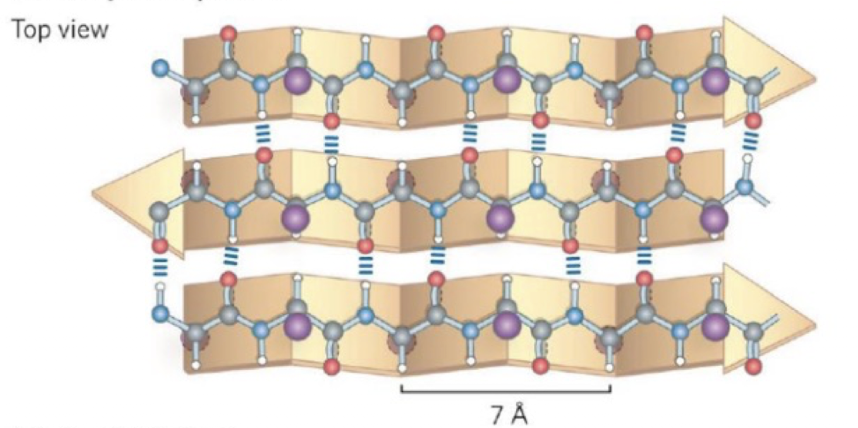
Antiparallel beta sheet

Parallel beta sheet
Beta sheets can be ______ or _____.
Antiparallel and parallel
Opposite orieintation
Antiparallel
Occurs more frequently in beta sheet
Antiparallel
Same orientation
Parallel
Connect ends of two adjacent segments of an antiparallel beta sheet to create a 180 degree fold.
Function of beta turns
Involves exactly 4 residues. A stabilizing hydrogen bond forms between the carbonyl oxygen of the first residue and the amide hydrogen of the fourth residue.
Structure of beta turns