Metabolism of CHO pt. 1
 Call Kai
 Learn
Learn Practice Test
 Spaced Repetition
 Match
Match Flashcards
 Knowt Play
1/208

There's no tags or description
Looks like no tags are added yet.
Name | Mastery | Learn | Test | Matching | Spaced | Call with Kai | Chat |
|---|
No analytics yet
Send a link to your students to track their progress
209 Terms
FED STATE CHO METABOLISM OVERVIEW
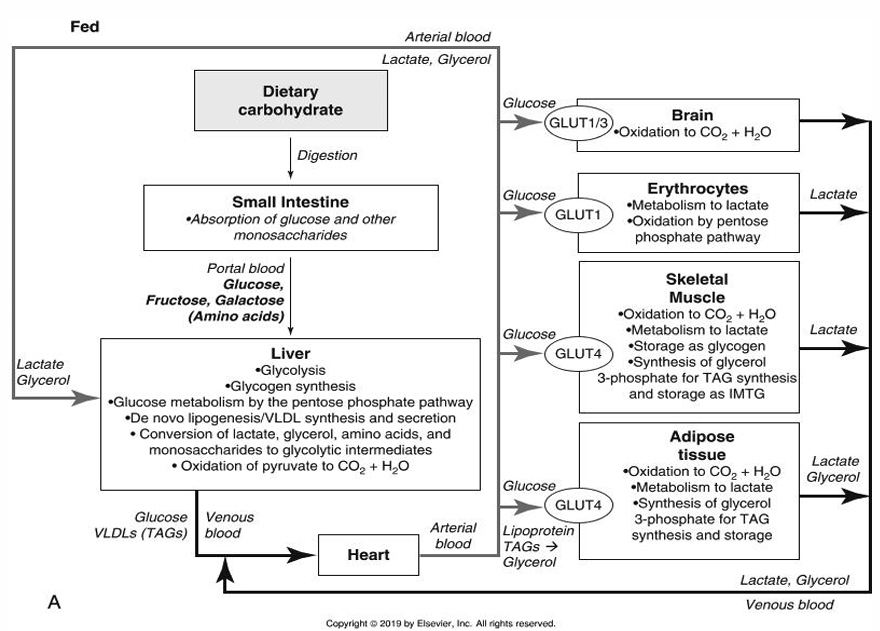
ingested CHO from diet gets absorbed as
monosaccharides (glucose, fructose, galactose)
the liver can participate in what CHO pathways when in fed state (6)
glycolysis
glycogen synthesis
pentose phosphate pathway to produce NADPH
make de novo lipids (lipogenesis/VLDL) and secretion
conversion of lactate, glycerol, glucogenic AA, and monosaccharides to glycolytic intermediates
complete oxidation of pyruvate to CO2 and H2O
from liver, what will be released in fed state
glucose (along with TAG from VLDL)
glucose from the liver will go to what main tissues?
brain, erythrocytes, muscle, adipose
in brain, glucose is absorbed via what transporter?
GLUT 1 and 3
in brain, what is the fate of glucose during fed state
complete oxidation
in erythrocyte, glucose is absorbed via
GLUT 1
in erythrocyte, what are the fates of glucose during fed state? (2)
metabolized to lactate
oxidized by pentose phosphate pathway
in skeletal muscle, glucose enters cell via
GLUT 4
GLUT4 is dependent on
insulin**
in skeletal muscle, what are the fates of glucose during fed state? (4)
Completely oxidated
Metabolized to lactate
Stored as glycogen
Used to synthesize glycerol-3-p for TAG synthesis and stored in muscle
in adipose tissue, glucose is absorbed via what transporter?
GLUT 4
GLUT 4 is dependent on
insulin
in adipose tissue, what are the fates of glucose during fed state?
Completely oxidated
Metabolized to lactate
Used to synthesize glycerol-3-p for TAG synthesis and stored
the brain, erythrocyte, skeletal muscle, and adipose tissue all release what into the blood to be taken to liver
lactate
adipose tissue also releases what to be taken to liver
glycerol
why does adipose tissue release glycerol into blood
lacks glycerol kinase, so cannot phosphorylate it and keep it within cell
during fed state, organs consume what % of glucose
skeletal muscle
liver
brain
skeletal muscle (30-35%)
Liver (25-30%)
brain (10%)
OVERVIEW OF GLUCOSE METABOLISM DURING FASTED STATE

what 2 main organs work during fasted state to provide glucose?
liver and kidney (gluconeogenesis)
the kidneys undergo what pathways during fasted state (CHO related) (3)
Undergo gluconeogenesis
Convert lactate, glycerol, glutamine carbon into glucose and glycolytic/anaplerotic intermediates
Release glucose via urine
kidneys will receive what from the blood during fasted state
glycerol, lactate, glutamine
liver will release what to the liver
glucose
glucose will receive what nutrients via the blood
Glycerol, lactate, alanine, and AA's via blood
the liver will undergo what CHO pathways during fasted state (3)
Degrade glycogen
Undergo gluconeogenesis
Release glucose via hepatic duct
Convert lactate, glycerol, glutamine carbon into glucose and glycolytic/anaplerotic intermediates
the liver will release what via the blood to go to other tissues during fasted state
Glucose
VLDLs (TAG)
Glucose released into blood will go what tissues? (4)
brain, erythrocytes, skeletal muscle, and adipose tissue
in the brain, glucose will have what possible fate
completely oxidized
in the erythrocytes, glucose will have what fates (2)
Metabolized to lactate
oxidized by pentose phosphate pathway
in the skeletal muscle, during fasted state the muscle will undergo what pathways (3)
Glycogen breakdown (until stores run out)
Switch to FA oxidation (from TAG it has stored)
Proteolysis and release of AA's (glutamine and alanine)
during fasted state, muscle will release what into blood to be taken to liver
lactate and AA’s
in the adipose, during fasted state the muscle will undergo what pathway (1)
Will undergo lipolysis (TAG --> NEFA and glycerol )
during fasted state, what will be released form adipose tissue to the blood
free FA’s and glycerol
SOURCES OF GLUCOSE
what is the CENTRAL organ that controls glucose homeostasis (aprox. 6 mmol)
liver
during fed state, what are the sources of glucose? (3 categories)
dietary CHO
excess AA
glycerol from chylomicrons and VLDL
dietary CHO sources that are sources of glucose (3)
absorbed glucose
absorbed fructose and galactose (converted to glucose)
during fasting/starvation, what are the sources of glucose? (5)
Hepatic glycogenolysis
Hepatic and renal gluconeogenesis
Glycerol from TAG
AA from muscle protein breakdown → gluconeogenic substrates
Lactate → glucose
GLUT TRANSPORTERS
what are GLUT transporters
5 Isoforms that differ from tissue to tissue and in kinetic properties
aka glucose transporters
what is a isoform?
transporters that have the same function but differ in location and kinetics
what are the GLUT isoforms (5)
GLUT 1-5
GLUT 1 is found in what organ(s)
RBC (and brain)
GLUT 2 is found in what organ
liver and pancreas
GLUT 3 is found in what organ
brain
GLUT 4 is found in what organ
muscle and adipose
GLUT 5 is found in what organ
small intestines (fructose uptake)
GLUT transporters are what type of transport
facilitative diffusion
facilitative diffusion is dependent on
concentration gradient
how is the concentration gradient for GLUT transport maintained? (2 enzymes)
hexokinase and glucose phosphatase
role of hexokinase in GLUT concentration gradient
hexokinase will phosphorylate glucose taken into the cell, which will decrease glucose concentration in the cell (increase G6P), which allows for more glucose uptake
role of glucose phosphatase in GLUT concentration gradient?
G6P is converted into Glucose, which increases amount of glucose concentration in the cell —→ less uptake
how is glucose absorbed in enterocytes? released into blood?
absorbed via active transport of sodium-glucose cotransporter 2 (SGLT2)
released to blood via GLUT 2
GLUT 2 is found in what tissues (3)
liver and kidney and basolateral membrane of enterocyte
GLUT 2 km?
high Km (high affinity)
GLUT 2 having high Km allows for what
uptake of large amounts of glucose into cell
GLUT 2 and insulin
GLUT 2 is insulin independent
GLUT2 response to high glucose in blood
GLUT 2 brings glucose in liver converts into glycogen or lipid synthesis
GLUT2 response to low glucose in blood
GLUT2 exports de novo glucose / glycogenolysis from liver to other tissues
GLUT 4 is found in what tissues (3)
muscle, adipose, heart
GLUT 4 responds to
insulin (insulin dependent)
GLUT 4 Km
low Km (responds at physiological levels of glucose-lower concentrations)
GLUT 1 and 3 are _________ expressed
widely (many tissues)
GLUT 1 and 3 have what Km
low
GLUT 1 and 3 do what
constantly bring glucose into cells (especially at basal levels)
when we talk about GLUT 4, we refer to its actions in what tissues
skeletal and adipose tissue
GLUT 4 is stored where (not tissue but cell)
within vesicles
what happens to GLUT 4 within cell when insulin is present? not present? (steps)
GLUT 4 is stored within cell in membrane vesicles
When insulin binds to receptor, vesicle with GLUT 4 will move to the plasma membrane
When insulin levels drop, glucose transporters (GLUT 4) are removed from membrane by endocytosis (reform vesicles)
The smaller vesicles fuse with larger endosomes
Patches of endosomes enriched with GLUT bud off to become small vesicles
Cycle starts again when insulin binds to receptor

during FED state, what happens to GLUT 4 synthesis
lots of GLUT 4 is transcribed and translated within the nucleus

GLUT 4 will move to what part of the cell when insulin is present (not cell activated)
cytosol

having lots of GLUT 4 present, will result in what when cell is stimulated by insulin
GLUT 4 moves into membrane and uptakes lots glucose

during fasting state, what happens to GLUT 4 synthesis
transcription and translation of GLUT 4 is decreased (less made)
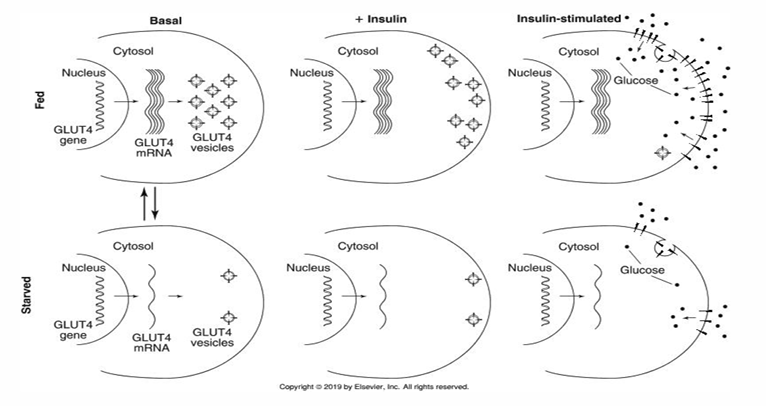
when insulin stimulates the cell during fasting state, what happens in terms of GLUT 4
GLUT 4 moves into membrane but brings in less glucose
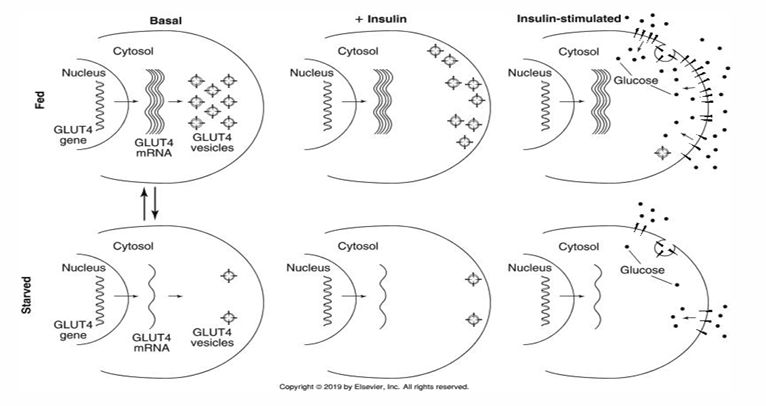
GLUT 4 production is downregulated when?
insulin resistance and prolonged fasting
GLUT 4 production is upregulated when?
CHO feeding and exercise
HEXOKINASE 4
Hexokinase are ______
isozymes
what is an isozyme?
different enzymes that participate in the same reaction but differ in location and kinetics
what is the function of hexokinase?
phosphorylates glucose into Glucose-6-phosphate
hexokinase types
1-4
hexokinase 4 is present in what tissues
liver and pancreas (beta cells)

hexokinase 2 is present in what tissues
muscle and adipose
in the liver, during fed state what brings in glucose?
GLUT 2 (high Km)
once glucose is brought into the cell, what will happen to glucose
hexokinase will phosphorylate it to G6P

hexokinase 4 has ____ km
high (not inhibited by product)

what does the phosphorylation of glucose do (what is the importance)? (3)
decreases glucose concentration in cell (maintains gradient)
Traps glucose (as G6P) in cell
Activates glucose for subsequent reactions

G6P in the cell can undergo what pathways (fed state)
Glycogen synthesis
Glycolysis (make 2 pyruvate)
Pyruvate --> FA synthesis

how can glucose lead to FA synthesis (simple summary)
glucose —> pyruvate —> acetyl CoA
Acetyl CoA + OAA —> citrate (citric acid cycle)
citrate leave cycle—> leave mitochondria—> enter cytosol
citrate break down to acetyl CoA + OAA
acetyl CoA —> malonyl CoA via ACC
malonyl CoA —> FA synthesis
the beta cells of the pancreas serve as a
glucose sensor
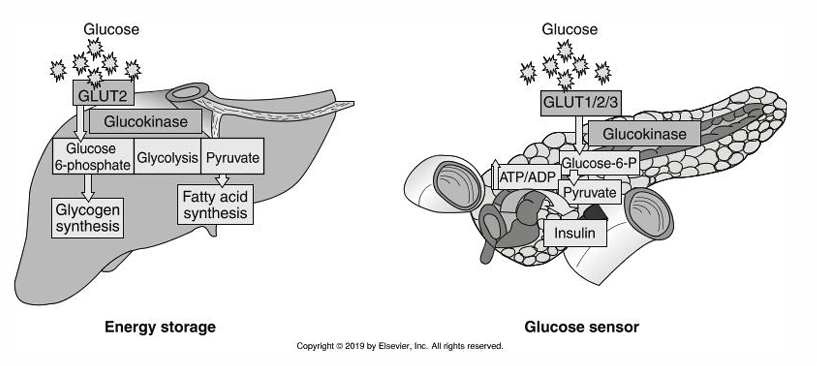
glucose enters the pancreatic beta cells via what transporters
GLUT 1,2,3

what happens to glucose absorbed in beta cells?
phosphorylated via Hexokinase 4 to G6P

G6P will undergo what pathway (fed state) in pancreas
glycolysis (produce ATP)

G6P undergoing glycolysis in pancreas will result in
increased ATP:ADP (and AMP) ratio

Increased ATP:ADP(or AMP) ratio will result in
stimulation of insulin secretion via beta cells

hexokinase 4 is upregulated by
insulin**

hexokinase 4 has __Km, which means __ affinity, which results in __ glucose uptake into cell
low, low, high
hexokinase 4 and feedback inhibition
not inhibited by product (G6P)
GLUCOSE METABOLISM IN DIFFERENT CELL TYPES
red blood cells will use glucose how? (2)
G6P —> pentose phosphate pathway
G6P —> lactate production
