Bunsen Burner Study Guide
 Call Kai
 Learn
 Practice Test
 Spaced Repetition
 Match
 Flashcards
 Knowt Play
1/8

Earn XP
Description and Tags
9 Terms
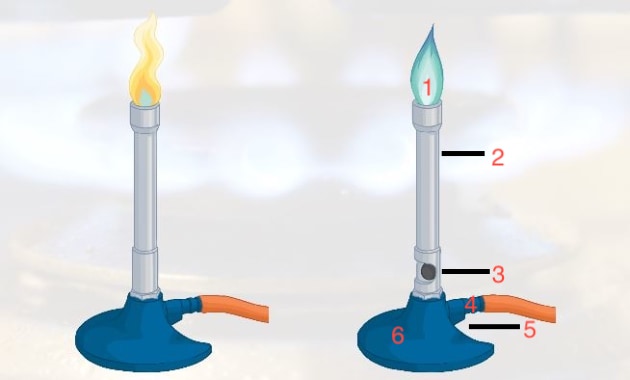
Name the different parts of the Bunsen Burner
Inner cone (hottest part of flame)
Barrel
Oxygen inlet
Gas inlet
Flame adjuster
Base
Bohr Theory
electrons occupy only specific energy levels
when an atom absorbs sufficient energy, an electron can “jump” to a higher energy level
higher energy levels = less stable
if a lower energy level is available the electron will “fall” back
(400 to 700 nm = visible light)
(White light is a continuous spectrum)
The color of the light depends on specific energy change taking place
The lab
The emission of energy in the visible portion of the spectrum as those electrons return to lower energy levels produces a colored flame
Order of lab
Clear off the desk of papers
Get goggles or safety glasses
Get beaker and fill halfway with water for used matches
Get Bunsen burner
Get matches
When lighting a Bunsen burner, which do you do first?
- Light the match
Where should the person who is turning on the gas jet stand?
- Behind the sink
Which direction of the handle means the gas is on?
- Parallel to the jet
Observations in Lab
Ba⁺²: yellow-orange
Cu⁺²: Green/Cyan
Sr⁺²: Red
Li⁺¹: Pink-red
K⁺¹: Link Pink/Peach
Na⁺¹: Dark orange
Ca⁺²: Orange
What does a flame test indicate about the energy changes taking place among the electrons in a metallic ion?
Heat metallic ions w/ flame excites electrons. Electrons then comes back to “rest” - energy released in form of visible light
List the colors of visible light from shortest to longest wavelengths. Which color has the highest energy? Which color has the lowest frequency?
Violet (shortest, highest E), indigo, blue, green, yellow, orange, red (longest, lowest E)
How do you think metallic salts are used in fireworks?
Creates different colors
When heating milk on a gas stove, some milk splashes out and the flame turns orange. Explain why this occurs.
Milk contains calcium which, when burned in a flame it turns orange