Checkpoint 3 Study Guide
 Call Kai
 Learn
 Practice Test
 Spaced Repetition
 Match
 Flashcards
 Knowt Play
1/53

There's no tags or description
Looks like no tags are added yet.
54 Terms
Decibel intensity level (dB IL)
Standard reference intensity is Ir = 10-12 w/m2 (in air)
Corresponds approximately to the threshold of human hearing at 1 kHz for an average young listener
Units - w/m2
Formula - 10 log (Ix/ Ir)
Sound pressure level (dB SPL) units
Standard reference pressure is Pr = 2 × 101 or 20 micro pascals
Corresponds approximately to the threshold of human hearing at 1 kHz for an average young listener
1 mPa (micro pascal) = 10-6 Pa (Pascal)
Units - force/unit area (N/m2 or Pascal)
Formula - 20 log (Px/Pr)
Solving using dB IL formula and dB SPL formula
If absolute and reference value units are w/m2, use dB IL formula
If absolute and reference value units are Pa, use dB SPL formula
If Ix > Ir or Px > Pr, then the decibel value will be positive
If Ix < Ir or Px < Pr, then the decibel value will be negative
0 db IL and/or 0 db SPL mean the reference and absolute values are the same (NOT SILENCE)
Relationship between dB IL and dB SPL
Intensity is proportional to pressure squared
If intensity increases by some factor, pressure increases by the square of that factor
Any given sound will have the same dB value whether expressed in dB IL or dB SPL
Doubling and tripling dB IL
You can not simply double or triple dB IL because only the absolute intensity (Ix) is increasing
Doubling absolute intensity causes a 3 dB increase
Tripling absolute intensity causes a 4.8 dB increase
Psychoacoustics
The study of the relationship between the physical properties of sound and the sensations produced in the listener
Frequency (physical) → pitch (sensation)
Amplitude (physical) → loudness (sensation)
Why do we need to hear?
Provides information about objects, events, and activity in our environment
Warns us of danger
Alerts us to changes in our environment
Allows us to communicate (verbally, emotionally, musically)
Journey of sound in the environment to the brain
Sound → Outer and Middle Ear → Cochlea → Auditory Nerve → Brain
Sound → Cochlea encodes the physical aspects of sound
Cochlea → Brain transduces sound into neural signals for the brain
Brain processes
Group into streams and objects - separate streams and objects
Localizes - figures out where sound comes from
Focuses on signals of interest - filters out distractions
Interprets the signals - makes sense of sound
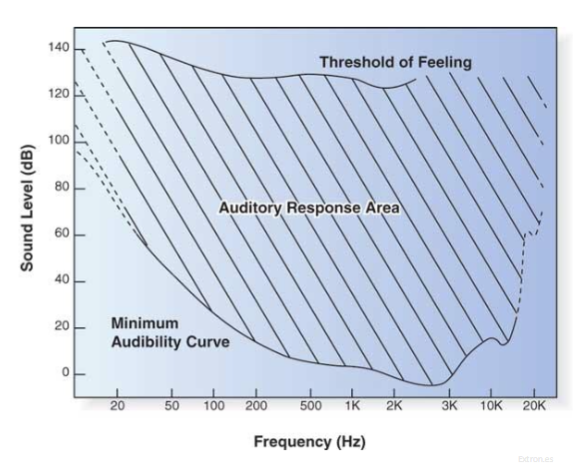
Auditory response area
Frequency range - 20 Hz - 20,000 Hz (20kHz)
Conversations - 250 Hz - 4,0000 Hz
Dynamic range - the difference between the minimum audible sound pressure level (hearing threshold) and the maximum tolerable sound pressure level (pain threshold)
At its widest, 100+ dB
Varies with frequency
Not all frequencies can be heard at the same dB level
High threshold at high and low frequencies (less sensitive)
Low threshold at mid frequencies (more sensitive)
Absolute threshold (reiz limen)
The minimum detectable level of sound in the absence of any other external sounds
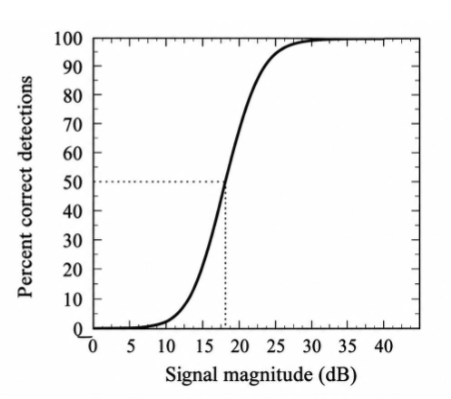
Level at which sound can be detected 50% of the time
Headphone types for measuring thresholds
Supra-aural - sits on the pinna
Circumaural - fits completely over and around the pinna
Insert - inserted into the ear canal
Psychometric function and threshold detection
Shows relationship between stimulus intensity and probability of correct detection
Curve is usually sigmodal - low performance at very low intensities, rapid increase around the threshold, and a plateau near 100% at high intensities
Detection threshold - stimulus level that yields a specific performance criterion, most commonly 50% correct
Modified Hughson-Westlake Procedure
An adaptation of the Method of Limits
Most common method in clinical audiology - frequencies tested typically range from 250 Hz to 8,000 Hz
Procedure
Start at expected threshold (40 dB HL)
Decrease intensity by 10 dB until no response
Increase by 5 dB until response returns
Repeat to find lowest threshold with a response - lowest level with 2 positive responses on ascending runs
RETSPL table
Shows average normal hearing thresholds in dB SPL at various frequencies under the 3 headphone types
Threshold values are all equally (just barely) audible

Decibels Hearing Level (dB HL)
0 dB HL represents the average absolute threshold of young, ontologically normal listeners
Takes into account frequency and method of stimulus
Higher dB value indicates worse hearing
dB SPL to dB HL and dB HL to dB SPL
dB SPL → dB HL
Find the RETSPL for given frequency
dB SPL - RETSPL = dB HL
dB HL → dB SPL
Find the RETSPL for given frequency
dB HL + RETSPL = dB SPL
Loudness
Perceptual correlate of sound intensity/amplitude
Determined by amplitude and frequency
Unit of loudness level is the phon
Equal loudness contours - each frequency-intensity point along an equal loudness contour is of equal perceived loudness in phons
x-axis - frequency (Hz)
y-axis - dB SPL

Pitch
Perceptual correlate of frequency
Pitch of a complex tone is related to its fundamental frequency (fo)
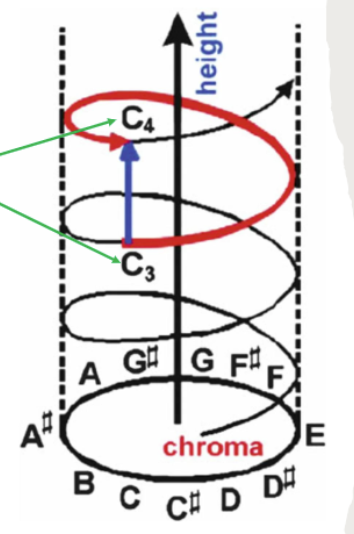
Dimensions of pitch - height, chroma, strength
Pitch height
Refers to how high or low a sound is perceived and is primarily determined by the frequency of the sound wave
Higher frequencies are heard as high pitches
Lower frequencies are heard as lower pitches
Dimension is linear, allowing sounds to be arranged along a continuum from low to high
Pitch chroma
Refers to cyclical quality of pitch - how notes separated by one or more octaves sound similar
Each successive “A”, “B”, “C”…is an octave higher than the previous
An octave is doubling or halving frequency
When octave is reached there is a sense of “returning” or stability
Pitch strength
The clarity or strength of the pitch sensation
Strong pitch - clear, pure tones (ex. tuning fork) and complex tones
Weak pitch - noisy or complex sounds where pitch is harder to identify (ex. narrow band noise, church bells)
Timbre
Very east to hear, but extremely difficult to define
Definition - attribute of auditory sensation which enables a listener to judge that two nonidentical sounds, similarly presented and having the same loudness and pitch, are dissimilar
Varies with characteristics of the overtones
Harmonics vs overtones
Harmonics - frequencies that are whole-number multiples of the fundamental frequency
Overtones - frequencies above the fundamental frequency, whether or not they are harmonics
Principle of Resonance
Resonance occurs when a system vibrates in response to an external periodic force
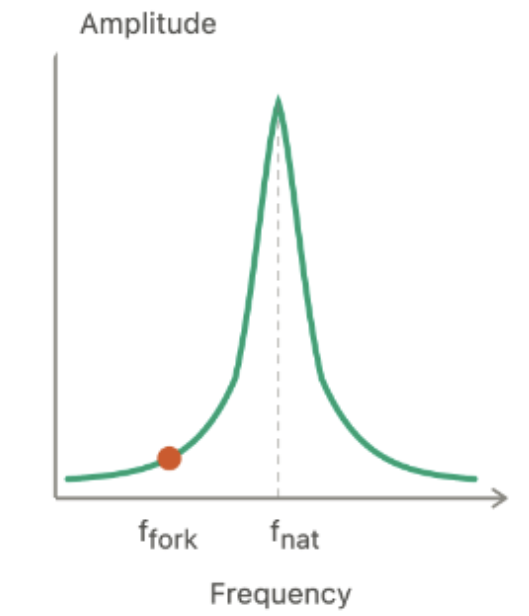
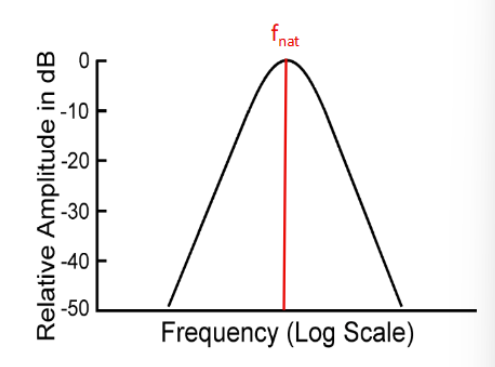
Every elastic system has a natural (resonant) frequency (fnat) determined by its mass and stiffness
When a driving force is applied, the elastic system, it vibrates at the frequency of the applied force, not its own natural frequency
The closer the frequency of the applied force to the natural frequency of the elastic system, the greater the amplitude of vibration (perceived loudness increases)
Filtering (frequency-selective systems)
Filter - any system that selectively allows certain frequencies to pass while reducing others
Most physical objects (even everyday surfaces) can act as filters, and filters can also be electronic or digital
Filters shape the output by modifying the amplitude of different frequency components
The effect of a filter is described by its transfer function (frequency response curve)
When a broadband signal (ex. white noise) passes through a filter, the output becomes frequency-limited (band-limited)

Transfer function (frequency response curve)
Shows relationships between frequency and amplitude
Fnat has a relative amplitude of 0 dB
Amplitudes are diminished for frequencies farther away from fnat
Filter parameters
Center frequency (fc) - midpoint of filter’s passband and maximum system response amplitude
Upper cutoff frequency (fu) - frequency above the fc where the amplitude is 3 dB less than the maximum
Lower cutoff frequency (fl) - frequency below the fc where the amplitude is 3 dB less than the maximum
Bandwidth (BW) - difference between the fu and fl; range of frequencies passed
Attenuation rate (roll-off) - how quickly frequencies are reduced measured by slope of filter curve (units - dB/octave)

Types of Filters
Low-pass filter - allows low frequencies, attenuates high frequencies
High-pass filter - allows high frequencies, attenuates low frequencies
Band-pass filter - allows a specific range of frequencies
Band-reject filter - removes a specific range of frequencies
What happens if you stimulate a system at many frequencies simultaneously?
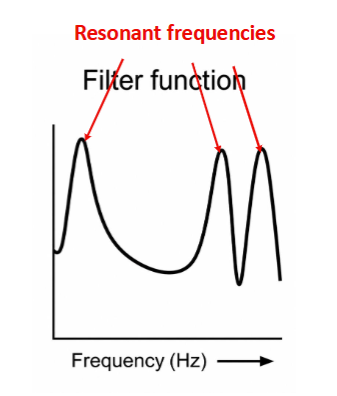
Frequencies at or near fnat(s) of the system will resonate - greater amplitude and larger perceived loudness
Frequencies very different from fnat(s) of the system will not resonate as much - reduced amplitude and softer perceived loudness
Vocal folds
Create sound, or the vibrator
Produce glottal tone
Contains fundamental frequency and all odd harmonics
Vocal tract
Shapes the sound, or the resonator
Formants - resonant frequencies of the vocal tract (natural frequencies)
Frequencies close to vocal tract resonant frequencies are amplified (resonate)
Frequencies far from vocal tract resonant frequencies are weakened
Changes shape and size of vocal tract
Opening the mouth wider changes resonant frequencies
Moving the tongue changes shape of oral cavity
Rounding the lips changes length and shape of vocal tract
Source Filter Theory of Speech Production (source)
Source - vibration of the vocal folds
Provides voicing (fundamental frequency and harmonics)
Fundamental frequency - the number of complete cycle of opening and closing of the vocal folds in one second
Fo is constantly varying throughout an utterance
Average fo - 100 Hz adult male, 220 Hz adult female, 300 Hz and higher for children
Controls pitch and loudness of the voice
Glottal tone produced by vocal fold vibrations is complex periodic

Source Filter Theory of Speech Production (filter)
Filter - the vocal tract
Acts as a resonator or a filter that shapes the source spectrum, creating regions of spectral prominence called formants (F1, F2…)
Frequency locations of formants vary constantly during an utterance, because the shape of the vocal tract is always changing
Different vowels are produced by changing the shape of the vocal tract (tongue placement, lip rounding) which changes formant frequencies
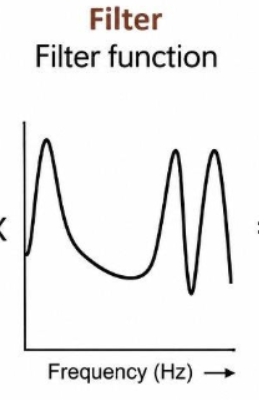
Formant frequency formula
Fn = (2n - 1) x c/4L
n = formant number
c = speed of sound (350 m/s)
L = length of vocal tract
Adult male 17.5cm
Adult female 15cm
Neonate 8cm
Source Filter Theory of Speech Production (filter and source relationship)
Source and filter are controlled independently of one another, but together they determine the acoustic output of speech

Harmonics vs formants
Harmonics are associated with the vocal folds (source)
Formants are associated with the vocal tract (filter)

Vocal tract shape and vowels
Any construction in the vocal tract will affect its resonances and the output spectrum
First three formants (F1, F2, F3) tend to be most important in vowel perception

Sound wave graphs
Waveform - x-axis is time, y-axis is amplitude, and it does not show frequency
Spectrum - x-axis is frequency, y-axis is amplitude, and it does not show time
Spectrogram - x-axis is time, y-axis is frequency and amplitude is representing through shading
Bright/hotter shades (red, yellow) - higher amplitudes
Coolers shades (purple, black) - lower amplitudes

Consonants vs vowels
Speech sounds are broadly classified into vowels and consonants
Vowels are typically produced with a relatively open vocal tract
Consonants are produced by creating a construction or closure somewhere in the vocal tract which affects airflow and sound produced
How are consonants produced?
Completely block air flow - /p/, /t/, /k/
Narrow the vocal tract and create friction - /f/, /s/, /ʃ/
Allow air to pass through the nose - /m/, /n/
How do consonants differ from one another?
Manner of articulation - way of constriction (nasals, approximants, fricatives, stops, affricates)
Place of articulation - location of constriction in vocal tract
Voicing - whether or not vocal folds are vibrating
Manner of articulation
Describes how the airflow is modified or obstructed in the vocal tract
Nasals - air flows through the nose
Approximants - articulators approach each other, but not enough to create friction
Fricatives - narrow constriction creates turbulent airflow
Stops - airflow is completely blocked and than released
Affricatives - begin as stops and release into a fricative-like sounds

Voicing
Refers to whether the vocal folds vibrate during the production of a consonant

Place of articulation
Refers to the location in the vocal tract where the constriction or closure is made during the production of a constant

Nasals
Airflow is blocked at some point in the oral cavity
Lips for /m/
Alveolar ridge for /n/
Velum for /ŋ/
All are voiced
Sound resonates in the nasal cavity, producing a characteristic nasal murmur

Fricatives
Narrow constriction
Turbulent airflow
Frequency distribution and amplitude of frication noise vary depending on place of constriction
May be voiced or voiceless

Approximants
Typically voiced
Vocal tract is more constricted then for vowels, but not narrow enough to produce turbulent airflow
Contains identifiable formants (F1, F2, F3)

Stops process of production
A brief period of complete closure in the vocal tract
Release burst (air is released)
Aspiration (only in voiceless stops)
Onset of voicing for the following vowel

Stops (Voice Onset Time)
VOT - time between release burst and the onset of vocal fold vibration
VOT for voiceless stops - 20-25 to 100ms (positive VOT)
VOT for voiced stops - -20 to 20ms (negative or short-lag VOT)

Affricates
/tʃ/ is voiceless - /tʃoʊk/ or choke
/dʒ/ is voiced - /dʒoʊk/ or joke
Combines features of a stop and a fricative

Affricates production process
Brief, complete closure in the vocal tract
Release of the closure (burst)
Sustained turbulent airflow (frication)
Coarticulation
Definition - occurs when articulatory movements for neighboring speech sounds overlap in time
As a result, the production of one sound is influenced by the sounds that come before or after it
Example - “key” vs “coo”
Both words begin with the same phenome (/k/), but the tongue is positioned differently depending on following vowel
“Key” /ki/ - tongues moves toward the front of the mouth in anticipation of the front vowel /i/
“Coo” /ku/ - tongue moves toward the back of the mouth in anticipation of the back vowel /u/
Filtering and distortion
Intelligibility of speech is maintained well even when speech signal is filtered and/or distorted
Sine-wave speech - an artificially acoustic signal created by replacing the main formants with 3 or 4 pure-tone sine waves
