Comptia pentest chapter 5: conducting pentest attacks
 Call Kai
 Learn
 Practice Test
 Spaced Repetition
 Match
 Flashcards
 Knowt Play
1/17

There's no tags or description
Looks like no tags are added yet.
18 Terms
First step in pentesting is to always?
pentester needs to look at is to double check the scope of the pentest.
High value asset (AV) are
Some examples of high-value assets include:
Customer data - This can include Personal Identifiable Information (PII) such as names, addresses, phone numbers and email addresses.
Intellectual property - Company secrets, recipes, and other proprietary company information.
Authentication systems - Passwords, MFA systems, and biometrics are examples of authentication systems.
Financial systems - Anything to do with the financial aspects of the organization, such as what system is used to handle business transactions.
Critical infrastructure - Servers, network systems, and cloud services are all examples of critical infrastructure.
Regulatory compliance data - Many organizations must stay in compliance with regulatory agencies. For example, medical organizations need to remain in compliance with HIPAA.
Common Servces the pentester uses
Web servers such as Apache and IIS
Databases such as SQL
File servers such as FTP and SMB
Email servers
Remote access services
Vulnerable encryption methods
MD5, SHA1, DES, WEP, RC2, LM hash, CRC and blowfish
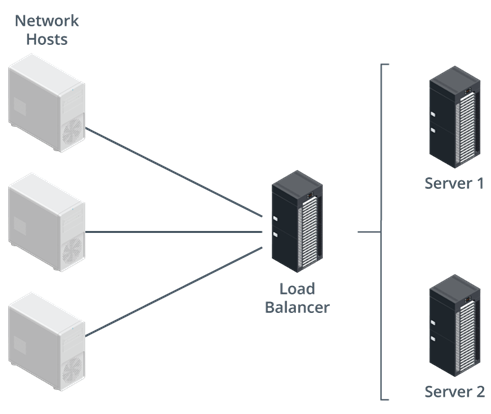
Load balancer
stabilize network traffic across two or more servers. As shown in the graphic, balancing the load prevents any one server from getting too many requests:
Firewalking
technique that uses a combination of traceroute and port scanning to discover the details of the internal network. Firewalking works by first determining the number of hops a packet takes to get to the firewall. Once this is known, the pentester will send packets that are set to target specific ports or protocols with the TTL set to one hop past the firewall.
If the firewall allows the packet through, the target responds, indicating that the port or protocol is permitted.
If the firewall blocks the packet, no response is received, or a message that the destination is unreachable is returned.

SOAR system
can take this a step further and can actively respond to potential security threats, compared to SIEM System
metaploit commands
RHOSTS - (remote) target names or addresses
LHOST - attacker ("listener") address
RPORT - target port
LPORT - attacker listener port
SMBUser - a username for SMB-based attacks
SMBPass - a password for SMB-based attacks
msfvenom
customize exploits is msfvenom which is included with the Metasploit Framework. Msfvenom can be used to generate payloads for multiple platforms and supports a variety of payload formats. One feature of msfvenom is the ability to easily customize payloads by specifying options such as payload type, target architecture, encoding, and output format.
Before an attack commences, proper documentation and planning should be done. These diagrams are essential in visualizing the attack; create low level diagram
The diagram should include all phases of the pentest, including:
Reconnaissance / Enumeration
Scanning / Vulnerability Assessment
Exploitation
Post-Exploitation
Reporting
During the reconnaissance, enumeration, and scanning phases of the pentest, many diagrams of the network systems and how they are all interconnected will have been generated. These maps should all be used to help fully see and understand how the network is organized.
An attack path map should contain the following components:
Nodes that represent all known network devices.
Connections and relationships between each nodes. This can include network links, communication channels, and trust relationships.
Attack paths that show the potential paths an attacker can take to move through the network to reach high-value targets.
Attack vectors showing the methods and techniques used to exploit vulnerabilities. This can include phishing attacks, malware, privilege escalation, and more.
PowerUpSQL
uses PowerShell modules to discover, enumerate, pull credentials, and exploit Microsoft SQL Servers.
bash commands
The following is an example of a simple Bash script named admin-hash-pull that outputs a Windows Administrator's LM/NTLM hash from a dump file:
#!/bin/bash
echo "Pulling Admin password hash from dump file..."
grep "Administrator" /root/dumps/winsrv_hash_dump.txt | cut -d ":" -f3-4 > admin-hash.txt
echo "Admin LM/NTLM hash extracted!"
The first line of the script indicates what type of interpreter the system should run, as there are several scripting languages beyond just Bash. The echo lines simply print messages to the console.
The grep command searches for any line in the hash dump text file that contains the text "Administrator." This command is then piped to the cut command which trims the output to only show the LM/NTLM hash values. These results are sent to a file called admin-hash.txt.
Impacket tool
how Python scripts can be used by the pentester. Impacket is a collection of Python scripts and libraries that can be used to perform a wide variety of tasks, such as:
Network enumeration
Credential dumping
Remote command execution
Exploitation
Scapy tool
another powerful Python based tool used in pentesting for network packet manipulation, crafting, and analysis. Some of the key features of Scapy include:
Crafting custom network packets from scratch, specifying every field in the packet headers. This is useful for testing network protocols and for creating custom traffic patterns.
Packet sniffing
Support of numerous protocols, including Ethernet, IP, TCP, UDP, ICMP, ARP, DNS, HTTP, and more.
Network discovery
As a Python library, Scapy can be integrated into Python scripts.
Breach and Attack Simulation (BAS)
allows organizations to simulate real-world attack scenarios in a controlled environment using specialized tools and software. The primary goal is to identify vulnerabilities and weaknesses in an organization's security before they can be exploited.
popular BAS platforms include:
Atomic Red Team is an open-source project that provides a library of simple, prescriptive, and flexible tests. Each "atomic test" is designed to be as simple as possible, allowing users to understand and execute them with minimal setup and are mapped to the MITRE ATT&CK framework.
Infection Monkey is an open-sourced BAS tool that mimics the behavior of a human attacker. It is designed to be both comprehensive and easy to use by automatically simulating a variety of attack techniques, including exploitation of vulnerabilities, lateral movement, and data exfiltration.
Caldera is an open-sourced tool developed by the MITRE corporation. It is designed to simulate sophisticated cyber attacks against enterprise networks by emulating the behaviors and techniques of real-world threat actors.