(18) Muscarinic Agonists
 Call Kai
 Learn
Learn Practice Test
 Spaced Repetition
 Match
Match Flashcards
 Knowt Play
1/26

There's no tags or description
Looks like no tags are added yet.
Name | Mastery | Learn | Test | Matching | Spaced | Call with Kai | Chat |
|---|
No analytics yet
Send a link to your students to track their progress
27 Terms
Muscarinic receptors
Muscarinic receptors are GPCRs.
There are M1–M5 receptors, located throughout the body.
Muscarinic receptors - main idea
Because muscarinic receptors are widespread: (drug activates/blocks muscarinic receptors)
effects can happen in multiple organs
heart + GI + glands + eyes can all be affected.
muscarinic receptors bind to acetylcholine
acetylcholine (ACh) is endogenous, meaning your body naturally makes it, and neurotransmitter.
Agonist vs Antagonist Effects
System | Agonist | Antagonist |
|---|---|---|
Heart | ↓ HR, ↓ cardiac output | ↑ HR |
GI | ↑ smooth-muscle contraction | ↓ contraction (constipation/urinary retention) |
Glands | ↑ sweating, lacrimation, salivation | ↓ gastric/mucociliary/salivary secretions (dry mouth) |
Eye | Pupil constriction | Pupil dilation (blurry vision) |
Easy memory
Agonist = squeeze + secrete (GI/GLAND)
Antagonist = relax + dry (GI/GLAND)
THERAPEUTIC APPLICATIONS (what the drugs are used for.)
Agonists
Miosis for eye surgery
Lower intraocular pressure
Glaucoma
Promote urination
Antagonists
Bradycardia
Prevent nausea/vomiting
motion sickness
post-operative
Control respiratory secretions
COPD
Clinical class difference
Antagonists
→ larger/more clinically relevant class
→ better oral bioavailability
Agonists
→ generally require more local delivery
Define
Pharmacophore
3D arrangement of the minimum features/interactions required for binding.
MUSCARINIC AGONIST PHARMACOPHORE
Ionized amine
H-bond acceptor
Ing's Rule of 5
MUSCARINIC AGONIST PHARMACOPHORE (draw it)


Ionized amine
Acetylcholine has a quaternary ammonium → already positively charged.
The ionized/cationic amine is required for binding.
most essential pharmacophore component because it participates in several important receptor interactions.
anchors drug in receptor
Quick refresher:
quaternary ammonium: nitrogen has FOUR carbon attachments → N⁺
H-bond acceptor
either ester oxygen can serve as the acceptor.
ING'S RULE OF 5
For muscarinic AGONISTS only!
counting rule
Start at the cationic nitrogen
count through the structure
count heavy atoms only (non-hydrogen atoms.)
HOW ACh BINDS THE MUSCARINIC RECEPTOR? - topic overview
MOST IMPORTANT — Ion-ion interaction
Pi-cation interaction
Hydrogen bond
Ion-ion interaction
ACh positive amine + negative Asp negative → ion-ion bond
Pi-cation interaction
ACh positive amine + Tyr π electrons in aromatic → pi-cation interaction (3)
Hydrogen bond
ACh ester + Tyr phenol (hydrogen-bond donor) = H-bond
Acetylcholine problems
Nonselective
Acetylcholine activates: Muscarinic receptors + nicotinic receptors
→ off-target activity
Ester is unstable → rapidly hydrolyzed by esterases
very short DOA
It’s also acid labile
acidic stomach → ester hydrolysis and poor oral use
Quaternary ammonium (permanently positively charged) → poor membrane penetration
BUT: excellent water solubility
The 3 agonist SAR regions
AMINE — LINKER — ESTER

agonist SAR
AMINE
Quaternary ammonium — most active
Always ionized (+)
Positive charge → strong muscarinic receptor binding
Poor membrane/BBB penetration
Tertiary amine (at least 2 methyl groups attached to N) — can still have useful agonist activity
Ionized/protonated (+) form → muscarinic receptor binding/activity
Un-ionized/neutral form → better skin/membrane/brain penetration
Groups attached to N
Small groups → favors agonist
Larger/bulkier groups → shifts toward antagonist activity

agonist SAR
LINKER
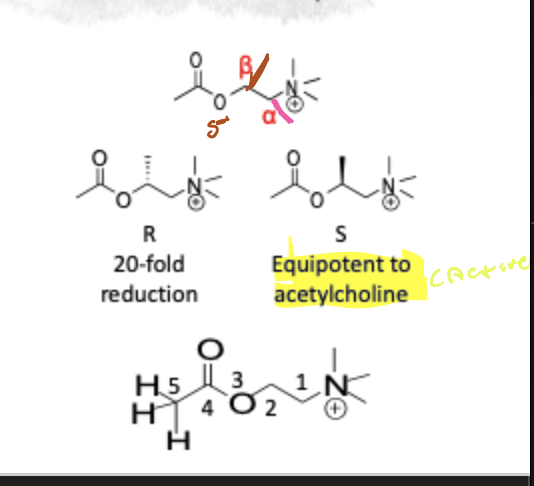
α-methylation: ↓ muscarinic activity
adds steric bulk →disrupts Asp ion-ion interaction
β-methylation: better muscarinic selectivity
strengthens the interaction involving the ester oxygen + Tyr
adds some steric protection from esterases;
β-methyl stereochemistry: S (Strong)
S isomer = active / equipotent to acetylcholine
R isomer = ~20-fold reduction in activity
Ing's Rule of 5
Make the structure too long/bulky → lose agonist character and move toward antagonism
agonist SAR
Ester
Regular ester
esterase hydrolysis: short duration
Fix: ester → carbamate
resonance stabilization
harder to hydrolyze: longer duration of action

REVIEW: MOST IMPORTANT AGONIST DISTINCTION
β-METHYL = SELECTIVITY
CARBAMATE = DURATION
AGONIST DRUG CHART
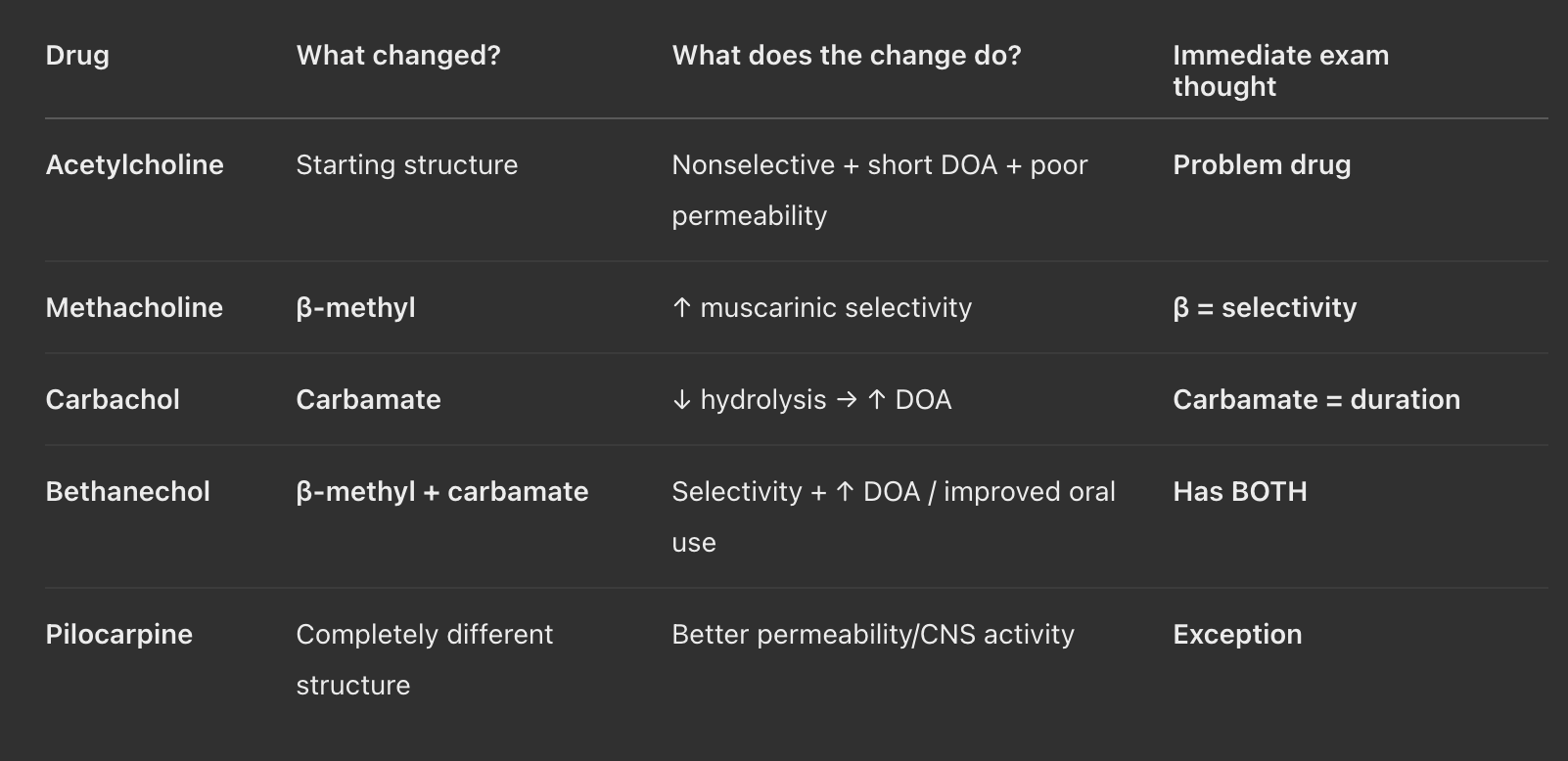
Methacholine: S isomer = active
Methacholine - draw
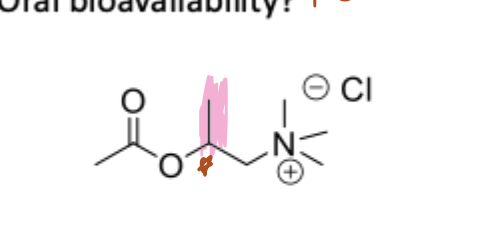
Carbachol - draw

Bethanechol - draw

Pilocarpine - tell me more
Structure
Has a lactone
lactone = cyclic ester
hydrolysis
epimerization (R form is less active)
Has an imidazole instead of quaternary ammonium
Has ionized and unionized form
ionized - binding (does not follow normal SAR rule)
unionized - CNS penetration
does not follow normal SAR
Pilocarpine - draw
