Physics - Electricity
 Call Kai
 Learn
 Practice Test
 Spaced Repetition
 Match
 Flashcards
 Knowt Play
1/72

There's no tags or description
Looks like no tags are added yet.
73 Terms
What is Electric Current?
The rate of flow of charge in a wire or component. The current is due to the passage of charged particles, which are called CHARGE CARRIERS.
What is the direction of conventional current?
From positive to negative.
What is the direction of the actual current?
Negative to positive.
What is the symbol for current and what does it mean?
A - Amperes. It is defined in terms of the magnetic force between two parallel wires when they carry the same current. The symbol for current is I.
What is the symbol for charge and what does it mean?
C - Coulomb. Equal to the charge flow in one second when the current is 1A. The symbol for charge is Q.
State the equation linking charge, time and current stating amount for each.
∆Q=I∆t, t = seconds.
What is the magnitude of the charge of an electron?
-1.6x10^-19 (taken as positive in calculations)
What is an Insulator?
In an insulator, each electron is attached to an atom and cannot move away from it. When a voltage is applied across an insulator, no current passes because electrons cannot move.
What is a metallic conductor?
Most electrons are attached to atoms but some are delocalised — these are the charge carriers. When voltage is applied, conduction electrons are attracted to the positive terminal.
What is a semiconductor?
In a semiconductor, the number of charge carriers increases with temperature, so resistance decreases. A pure semiconducting material is an intrinsic semiconductor.
What is potential difference?
The work done (or energy transferred) per unit charge. The unit is 1 joule per coulomb.
State the equation that links work done, charge flow and voltage across the component.
V=W/Q
Define emf.
The emf of a source of electricity is the electrical energy produced per unit charge passing through the source. Symbol = ε.
State the equation that links energy, charge and emf. State its purpose.
E=Qε. For a source of emf ε in a circuit, the electrical energy produced when charge Q passes through the source = Qε.
How does energy transfer take place in an electric heater?
Work done on the device is transferred as thermal energy. Charge carriers repeatedly collide with atoms, causing the atoms to vibrate more and the resistor to heat up.
How is energy transferred in an electric motor?
Work done on the motor is transferred to the load and surroundings. Electrons are forced through the motor coil against the opposing magnetic force.
How is energy transferred in a loudspeaker?
Work done on the loudspeaker is transferred as sound energy. Electrons move through the coil against the force from the magnet.
State the equation that links work done, charge and voltage. Write other forms of the same equation.
W=QV, W=(I∆t)V, W=IV∆t
State the equation that links power, current and voltage.
P=IV
Define Resistance and state what causes it.
Resistance is the difficulty of making current pass through a component. Caused by collisions between charge carriers and fixed positive ions.
State the equation that links resistance, voltage and current.
R=V/I
What is a resistor?
A component designed to have a certain resistance, which remains the same regardless of the current through it.
What is a voltmeter?
Used to measure the pd across a component and must be in parallel. Usually has infinite resistance.
What is an ammeter?
Used to measure current across a component and is in series. Usually has zero resistance.
What is Ohm's Law?
The pd across a metallic conductor is proportional to the current through it, provided physical conditions do not change. An ohmic conductor obeys Ohm's Law.
State the equation linking resistance, resistivity, length and cross-sectional area.
ρ = (RA)/L. R ∝ L, R ∝ 1/A, unit of ρ = Ωm.
How do you determine the resistivity of a wire?
Measure the diameter d at several points to calculate A. Measure resistance R for different lengths L and plot R vs L. Resistivity = gradient × A.
What is a superconductor?
A material with zero resistivity at or below a critical temperature, known as superconductivity.
Why does a superconductor behave the way it does?
Below the critical temperature, the wire has zero resistance and no pd across it, so the current has no heating effect.
Where can superconductors be used?
High-power electromagnets (MRI, particle accelerators), lightweight motors, and lossless power cables.
What is a cell?
A source of electrical energy; a battery is a combination of cells.
What is a diode and a light-emitting diode?
A diode allows current in one direction. A LED emits light when conducting; forward direction conducts, reverse direction does not.
What is a thermistor?
A resistor whose resistance varies with temperature. Intrinsic semiconductor thermistors like silicon decrease resistance as temperature rises.
What is a light-dependent resistor (LDR)?
A resistor whose resistance decreases with increasing light intensity.
How do you investigate current-voltage characteristics?
Use a variable resistor/potential divider, ammeter in series, voltmeter in parallel. Vary current or pd, record values, and plot graph. Potential divider allows current/pd to go to zero.
What results will an Ohmic conductor produce on a current-pd graph?
Straight line, resistance constant; current proportional to pd.
What results does a filament lamp give on a current-pd graph?
Curve with decreasing gradient; resistance increases as it gets hotter.
What results will a thermistor and a LDR give on a current-pd graph?
Thermistor at constant temp: straight line. Higher temp → steeper gradient. LDR behaves similarly with light intensity.
How can a diode be tested for IV characteristics?
Measure in forward and reverse bias. Forward: conducts above 0.6V. Reverse: very small current.
What is the relationship between resistance and temperature in metal?
Resistance increases with temperature; more ion vibration hinders charge carrier flow. Positive temperature coefficient.
What is the relationship between temperature and resistance in an intrinsic semiconductor?
Resistance decreases with temperature; number of charge carriers rises. Negative temperature coefficient.
What is the rule for current entering a junction and leaving a junction?
Total current leaving a junction equals total current entering it.
What is the rule for current regarding components in series?
Current entering = current leaving each component; same through all series components.
What is the rule for pd across components in series and parallel?
Series: total pd = sum of pds. Parallel: pd same across components. Conservation of energy applies.
What is the rule for resistance in series?
Total resistance = sum of individual resistances.
What is the rule for resistance in parallel?
1/Rt = 1/R1 + 1/R2 + … inverse sum of individual resistances equals inverse total.
What is the equation linking rate of heat transfer to current and resistance?
Rate of heat transfer = I²R
Why does resistance cause heating?
Charge carriers collide with ions, transferring energy; pd accelerates carriers after each collision.
State an equation that links voltage, resistance and power.
P = V²/R
What is internal resistance?
Opposition to current flow in a source; causes pd loss and energy dissipation inside the source.
What is electromotive force?
Electrical energy per unit charge produced by a source.
Why is the pd across terminals less than the emf of the source?
Due to internal resistance.
What is the equation linking emf, resistance, internal resistance and current?
ε = I(R + r), which equals terminal pd + lost/wasted pd.
State the equation linking power, current, resistance, emf, and internal resistance.
Iε = I²R + I²r
When does a source deliver maximum power to a load?
Maximum power occurs when load resistance = internal resistance of the source.
Describe the current-voltage graph for a cell.
Y-intercept = emf. Gradient = internal resistance (positive). Line straight, negative gradient as lost pd rises.
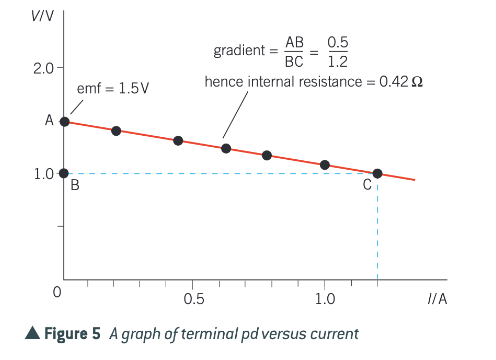
For a circuit with a single cell and resistors, how do you calculate cell current?
Cell emf / total circuit resistance
For a circuit with a single cell and resistors, how do you work out current and pd for each resistor?
Series: pd = I × R for each resistor. Parallel: current = pd across combination / resistor.
What is net emf? How is total internal resistance calculated?
Cells same direction: net emf = sum. Opposite: net emf = difference. Total internal resistance = sum of individual internal resistances.
What is the difference in calculations for circuits with one cell vs multiple cells?
Multiple cells: current = net emf / total resistance.
What is the current through each cell in parallel identical cells?
Current through each = I/n, where I = total current, n = number of cells.
What is the equation for the lost pd in parallel identical cells?
(Ir)/n
What is the equation for the terminal pd across each cell in parallel identical cells?
V = ε - (Ir)/n
Characteristics of a circuit with one or more diodes?
Forward-biased diode: pd 0.6V and conducts. Reverse-biased: infinite resistance. In a circuit with resistor, voltage follows bias conditions.
What are Kirchoff's Laws?
Junction: total current in = total current out. Loop: sum of emfs = sum of potential drops.
What is a potential divider?
Two or more resistors in series with a source; divides pd. Can supply fixed pd, variable pd, or pd varying with a physical condition.
State the equation showing ratio of pds across resistors = resistance ratio.
V1 / V2 = R1 / R2
How does a potential divider supply fixed pd?
Voltage across a resistor is a constant fraction of total voltage determined by resistor ratio.
How can a potential divider supply a variable pd?
Use a variable resistor to change voltage fraction across the resistor.
What can a potential divider supplying variable pd be used for?
As audio volume control or to vary brightness of a bulb.
What is a sensor circuit?
Produces output pd changing with a physical variable like temperature or light intensity.
How does a temperature sensor work?
Part of potential divider; resistance changes with temperature, altering output voltage.
How does a light sensor work?
Circuit includes potential divider, variable resistor, LDR. LDR resistance falls with increased light, so pd across it falls.