BEST 200 MIDTERM 2
 Call Kai
 Learn
 Practice Test
 Spaced Repetition
 Match
 Flashcards
 Knowt Play
1/442

There's no tags or description
Looks like no tags are added yet.
443 Terms


The cell wall has different polymers mixed together at the nanoscale

What are fibrils in the cell wall?
Bundle of aligned cellulose polymers
By what is the cell wall “sugar” components protected by and in what form?
Cell wall “sugar” components are protected by lignin and in polymer form, making cellulose recalcitrant.
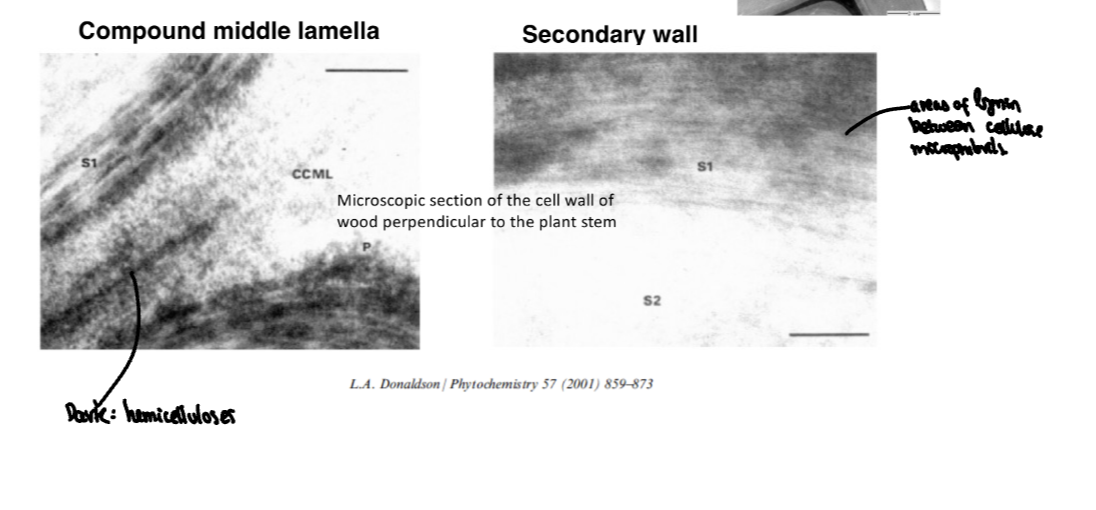
Recalcitrance (important)
The resistance to conversion of cell wall polymers into fermentable sugars.
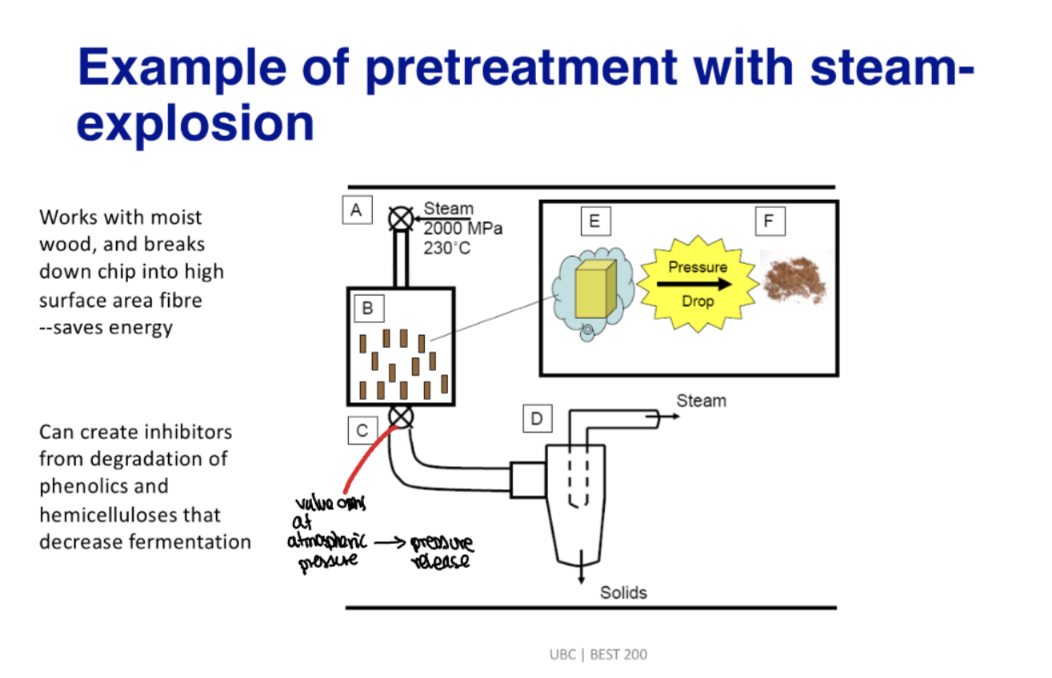
What is pretreatment?
Physical or chemical treatment that opens up plant cell walls to access useful components.
ex: mechanical comminution, steam explosion, CO2 explosion, ozonolysis, organosolv, biological, alkaline and acid hydrolysis
Pretreatment = opening up the plant cell wall to unlock useful materials for the bioeconomy.
Most common methods of pretreatment cheapest to most expensive
Dilute acid hydrolysis
Lime/alkaline treatment
Steam explosion
Organosolv pulping
Ionic liquid
Deep eutectic solvents
Why does biomass need pretreatment?
Plant cell walls are strong and difficult to break down.

What is the goal of pretreatment?
To make cellulose, hemicellulose and lignin easier to access and separate.
Does pretreatment need to completely destroy the cell wall?
No. It can partially remove components, such as lignin, to make cellulose more accessible.
What is the goal of an ideal pretreatment?
Break open biomass efficiently,
corrosion or moisture is not an issue,
cheaply and without damaging useful components,
high quality,
low energy demands,
scalable,
works well with wet wood,
samples can be fractionated before/after hydrolysis/fermentation.
Why should pretreatment avoid inhibitors?
They interfere with saccharification and fermentation.
What is BioTMP™?
A process that uses heat and mechanical force to separate wood fibres.
How does extrusion pretreatment work?
A rotating screw applies heat, pressure and force to break apart biomass.
cellulose is naturally packed tightly, making it difficult to break down into glucose
Pretreatment helps open up the biomass, but exposing cellulose is not always enough. We also need to make its tightly packed structure accessible to enzymes.
Remember: Cellulose is tightly packed → enzymes struggle to access it → glucose is difficult to release.

What is cellulose made of, and how are its glucose units connected?
Many glucose units connected by glycosidic bonds
What is hydrolysis?
Breaking glycosidic bonds using water to release individual glucose molecules.
How can hydrolysis be catalyzed?
By acids or enzymes
Why is hydrolysis important for bioethanol production?
It converts cellulose into glucose, which can then be fermented into ethanol.
What is the role of acid in catalyzed hydrolysis?
H⁺ protonates the glycosidic bond, making it easier to break.
Acid helps break the bond → water reacts → glucose is released!

In catalyzed hydrolysis, What happens after the glycosidic bond breaks?
A reactive intermediate forms, which reacts with water.
What is the final result of acid-catalyzed hydrolysis?
Glucose molecules are liberated from cellulose.
Enzymatic catalyzed saccharification of cellulose
What microorganism is known for producing cellulase enzymes?
Trichoderma reesei, a fungus.
Enzymatic catalyzed saccharification of cellulose
Fungus produces cellulases → cellulases break cellulose → glucose is released → glucose can be fermented into bioethanol.
Enzymatic catalyzed saccharification of cellulose
What are cellulases?
A collection of enzymes that work together for saccharification.
Enzymes (proteins) that break down cellulose into sugars.
They speed up the breaking of glycosidic bonds in cellulose.
Enzymatic catalyzed saccharification of celluloseWhy is water needed for enzymatic saccharification?
Water is required to break the glycosidic bonds through hydrolysis.
Specific cellulases attack different locations along the cellulose fibrils:
EG cuts cellulose chains=more ends → CBH releases cellobiose → β-glucosidase breaks cellobiose and releases glucose molecules!
What are some industrial uses of cellulases?
Textiles, detergents, pulp and paper, and animal feed.
Which microorganisms produce commercial cellulases?
Mainly fungi, but also some bacteria.
What are cellulosomes?
Groups of enzymes organized together to break down cellulose.
Example of one cellulosic ethanol plant
GranBio
30-60 million liters of biofuel/year
A set of technologies (pre-treatment, enzymatic hydrolysis and fermentation) enables the transformation of sugar cane residues.

What are platform chemicals?
Better understood as the building blocks/basis for almost anything you are synthesizing.
platform chemicals for C1
methane
methanol
carbon monoxide
aka gases

platform chemical for C2
ethylene

platform chemical for C3
Propylene

platform chemicals for C4
1-butene,
2-butene
1,3-butadiene
isobutene`

platform chemicals for C6-C8 = Aromatics
Benzol (solvent)
Toluol
Xylene
→ BTX
o-Xylol
m-Xylol
p-Xylol
What is a biorefinery?
A system that sustainably processes biomass into multiple products and energy.
What is biomass?
Biological raw materials, such as wood, crops, agricultural waste, and seaweed.
What is the essential aspect of a biorefinery?
Integration of different processes and technologies
What types of products can a biorefinery produce?
Chemicals, materials, bioenergy, biofuels, food, and animal feed.
What does full utilization of biomass mean?
Using as many biomass components as possible to minimize waste
Why must biorefineries integrate different technologies?
To process different biomass components and maximize the production of valuable products.
Overview of pathways for a biorefinery

3 main components defining a biorefinery
Raw material/ feedstock
Primary refining
Secondary refining
EXAMPLE:
A sugar biorefinery combines two processes:
Primary refining: Processes sugar crops to extract and produce sugar.
Secondary refining: Uses microorganisms to ferment some of the materials and produce useful products, such as chemicals and biofuels (especially ethanol).
In simple words: A sugar biorefinery first extracts sugar, then uses biological processes to turn materials into other valuable products, like ethanol and chemicals.
3 main components defining a biorefinery —Raw material/ feedstock
Defines platform of bioeconomy: sugar, starch, straw, etc…
3 main components defining a biorefinery —Primary refining
Usually initial mechanical treatment and extraction
3 main components defining a biorefinery —Secondary refining
Taking intermediate product and conversion into useful product.
Examples of components of biorefinery
What are feedstocks in a biorefinery?
Raw biomass materials used as inputs, such as crops, residues and seaweed.
Examples of components of biorefinery
What are the four main biorefinery processing categories?
Thermochemical, biochemical, chemical and mechanical/physical.
Examples of components of biorefinery
What is thermochemical processing?
Using heat to transform biomass, e.g. pyrolysis and gasification.
Examples of components of biorefinery
What is biochemical processing?
Using microorganisms or enzymes, e.g. fermentation and anaerobic digestion.
Examples of components of biorefinery
What are platform products?
Intermediate building blocks used to produce other valuable products.
Examples of components of biorefinery
What are C5 sugars?
Five-carbon sugars, such as xylose and arabinose.
Examples of components of biorefinery
What are C6 sugars?
Six-carbon sugars, such as glucose and fructose.
Examples of components of biorefinery
What are examples of energy products?
Bioethanol, biodiesel, biomethane, hydrogen, electricity and heat.
Examples of components of biorefinery
What are examples of material products?
Biomaterials, polymers, resins and bio-based chemicals.
Examples of components of biorefinery
What is the overall goal of a biorefinery?
Convert biomass into multiple valuable products while minimizing waste.
Starch is a combination of two different glucose polymers:
Linear amylose
Branched amylopectin (highly crystalline branches)
Different Platforms for Biochemical Biorefineries
Sugar
Starch
Lignocellulose

Different Platforms for Biochemical Biorefineries —SUGAR
primary: mechanical treatment → fractionation (pull out sucrose)→secondary: Fermentation → Recovery
Different Platforms for Biochemical Biorefineries —STARCH
primary: mechanical treatment → fractionation (pull out sucrose)→secondary: Enzymatic hydrolysis → -hexoses-Fermentation→Recovery
Different Platforms for Biochemical Biorefineries —LIGNOCELLULOSE
primary: pretreatment → fractionation (pull out sucrose)→secondary: Enzymatic hydrolysis (cellulose/hemicellulose/lignin/extractives)
in cellulose and hemicellulose:
→ -hexoses-Fermentation→Recovery
cellulose and hemicellulose→ biofuels
lignin → bioenergy
extractives → bioproducts
Typical approach to grain biorefinery
*During saccharification: occurs by a 2 step process = steep kernels in dilute acid + amylase (enzyme)
amylase → used to depolymerize starch polymer into glucose (very effective conversion rated 100x better than cellulase enzymes)

What is saccharification?
Breaking down polysaccharides into monosaccharides.
What are the two types of carbohydrates remaining after initial processing?
Simple/partially depolymerized sugars and intact polysaccharides.
Why is glucose an important platform sugar?
It can be fermented by microorganisms to produce biofuels and chemicals.
Why can't ordinary baker's yeast ferment cellulose directly?
It lacks the enzymes needed to break down cellulose into glucose.
What is the difference between maltose and cellobiose?
Both contain two glucose units, but maltose has an α-1,4 bond and cellobiose a β-1,4 bond.
Why can ordinary baker's yeast ferment maltose but not cellobiose/amylose/cellulose?
Yeast has maltose-degrading enzymes but lacks cellobiose-degrading enzymes.
maltose is a dimer of starch→ So, more precisely, maltose is a disaccharide produced when starch is broken down. It is not a repeating unit of starch itself.
Remember: Starch → breakdown → maltose → glucose (if further broken down).

Enhanced yeast strains used to ferment monosaccharides (sugar)
Baker's yeast (Saccharomyces cerevisiae) turns glucose into ethanol (alcohol).
Scientists have modified some yeast to also use xylose, a 5-carbon sugar (C5).
Yeast has been improved over many years, so it can produce lots of ethanol and tolerate high amounts of it without dying.
In short: Yeast converts sugars into ethanol, and modified yeast can use more types of sugar.

Corn-based biorefinery

What is another biobased product form glucose, a biocompostable bioplastic?
Lactic Acid for polylactic acid (PLA)
Which bacterium produces butanol through ABE Bacterioum based fermentation?
Clostridium acetobutylicum.
What does ABE stand for and what is capable of producing them?
Acetone, Butanol, Ethanol
Microbes produce them.
What is ABE fermentation?
A bacterial process that converts sugars into acetone, butanol, and ethanol.
What is butanol used for?
Making chemicals, paints, coatings, polymers, plastics, and synthetic rubber.
Ethanol production from straw (lignocellulose), with residuals as energy

What was Project LIBERTY?
A commercial-scale biorefinery in Iowa that converted corn residue into cellulosic ethanol.
What biomass did Project LIBERTY use?
Corn residue (stalks, leaves and cobs).
How much ethanol was it projected to produce annually?
Up to 25 million gallons of cellulosic bio-ethanol annually or 350 liters per ton of biomass $1/liter
Why was Project LIBERTY important?
It demonstrated that agricultural waste could be converted into biofuel on a commercial scale.
What is Organosolv treatment?
A chemical process that separates cellulose and lignin from biomass.
→Main products: clean cellulose and high-quality lignin
Why are lignin-based products important for biorefineries?
They create additional revenue and help make biorefineries profitable.
What are the characteristics of Organosolv lignin?
Relatively uniform, low molecular weight and high quality.
What is the difference between Organosolv and Kraft lignin?
Organosolv generally produces purer, less modified lignin,
Kraft lignin is more chemically modified
What is the thermal platform?
Using heat to convert biomass into fuels and chemicals.
2 main products: synthesis gas (syngas) and bio-oil.
Thermal platform = heat biomass → syngas or bio-oil.
What is syngas made of?
Carbon monoxide (CO) and hydrogen (H₂).
What is bio-oil?
A liquid mixture of small chemical compounds produced by heating biomass.
What affects the products formed during thermal conversion?
Heating temperature and heating rate.
What is the role of catalysts during thermal platform?
help make more uniform products
Plants commonly have 2 forms of abundant polymers from glucose (polyssacharides):
starch and cellulose
Plants commonly have 2 forms of abundant polymers from glucose: Starch and Cellulose
Starch is known as a energy reserve polymer for plants
→ must have some reversible nature to “unzip” back into glucose.

Plants commonly have 2 forms of abundant polymers from glucose: Starch and Cellulose
Cellulose is known as a structural polymer for plants
→ Must meet demanding mechanical performance for plant survival.

Starch and Glucose:
What type of glycosidic linkage is found in starch?
Alpha (α) linkages.
How do α-linkages affect the structure of starch?
They allow the polymer backbone to bend and form a helical structure.
What type of glycosidic linkage is found in cellulose?
Beta (β-1,4) linkages
How do β-linkages affect the structure of cellulose?
They create straight, extended polymer chain
What is the main chemical structural difference between starch and cellulose?
Starch has α-linkages; cellulose has β-1,4 linkages between glucose units.
Why do starch and cellulose have different properties?
Their different linkages create different molecular shapes and structures.