2.2: (Cell) Membranes
 Call Kai
 Learn
 Practice Test
 Spaced Repetition
 Match
 Flashcards
 Knowt Play
1/21

There's no tags or description
Looks like no tags are added yet.
22 Terms
Permeability of membranes: what can pass through, what cannot?
partially permeable
small, non-polar molecules can pass through the gaps between the phospholipids
large, polar molecules must pass through channel proteins and carrier proteins
Main components of cell membranes
phospholipid bilayer
intrinsic and extrinsic proteins
glycoproteins and glycolipids
cholesterol
What is a phospholipid bilayer?
a double layer of phospholipids
Structure of phospholipids
a molecule of glycerol
a phosphate group, which forms the phosphate head
two fatty acid tails, making up the lipid tail
Hydrophobic vs hydrophilic regions of phospholipids
the phosphate head is hydrophilic
the lipid tail is hydrophobic
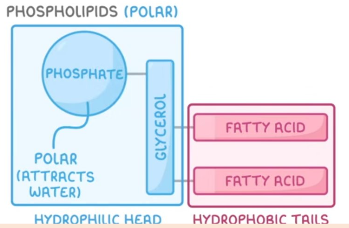
What makes the phosphate head hydrophilic and the lipid tail hydrophobic?
the phosphate head is polar, so can interact with polar water molecules
the lipid tail is non-polar so cannot interact with polar water molecules
How do the hydrophilic heads and hydrophobic tails arrange themselves in the phospholipid bilayer?

Intrinsic/integral proteins
proteins embedded in the membrane
span the whole bilayer
includes channel and carrier proteins
Function of intrinsic proteins
to transport large molecules and ions across the membrane
Extrinsic/peripheral proteins
found on the outer or inner surface of the membrane
only found on one side of the bilayer
Function of extrinsic proteins
to help with cell signalling or provide structural support
Structure of cholesterol
four carbon based rings
Role of cholesterol in cell membranes
found between the phospholipids
regulates membrane fluidity and stability in response to temperature fluctuations
Response of cholesterol to low temperature
increases fluidity of the membrane by stopping the phospholipid tails packing too closely together
→ this stops the membrane becoming too rigid
Response of cholesterol to high temperature
reduces fluidity of membrane
→ cholesterol molecules bind to the hydrophobic tails causing them to pack more closely together
What are glycoproteins and glycolipids and where are they found?
glyco = have carbohydrates attached
glycoprotein: proteins with carbohydrate attached
glycolipids: lipids with carbohydrate attached
(glycoproteins are generally more branched)
found on the surface of the cell
Function of glycoproteins and glycolipids
cell adhesion
→ attachment of cells to each othercell recognition
→ how cells identify and recognise each othercell signalling
→ how cells communicate with each other
Diagram of a cell membrane

Davidson-Danielli model of the cell membrane
cell membrane is a phospholipid bilayer sandwiched between two continuous protein layers
the protein layers coated both membrane surfaces
Limitations to the Davson-Danielli model
electron microscopy showed that proteins were scattered and did not from continuous layers
the discovery of intrinsic proteins spanning the bilayer contradicted the idea of surface protein layers
What is the current model of the cell membrane?
the fluid mosaic model
The fluid mosaic model
proposed that proteins are found within not outside the phospholipid bilayer
