exam 4 psychology of learning
 Call Kai
 Learn
 Practice Test
 Spaced Repetition
 Match
 Flashcards
 Knowt Play
1/72

There's no tags or description
Looks like no tags are added yet.
73 Terms
What are the three basic hypotheses for forgetting?
Decay hypothesis
Interference hypothesis
Retrieval-cue hypothesis
What is the decay hypothesis?
Memories weaken as a function of time, therefore harder to receive.
What is the interference hypothesis?
Competition from other memories blocks retrieval of the target memory.
What is the retrieval cue hypothesis?
At the time of retrieval, we lose access to the cues that would retrieve those memories. (The information used to query memory becomes less effective)
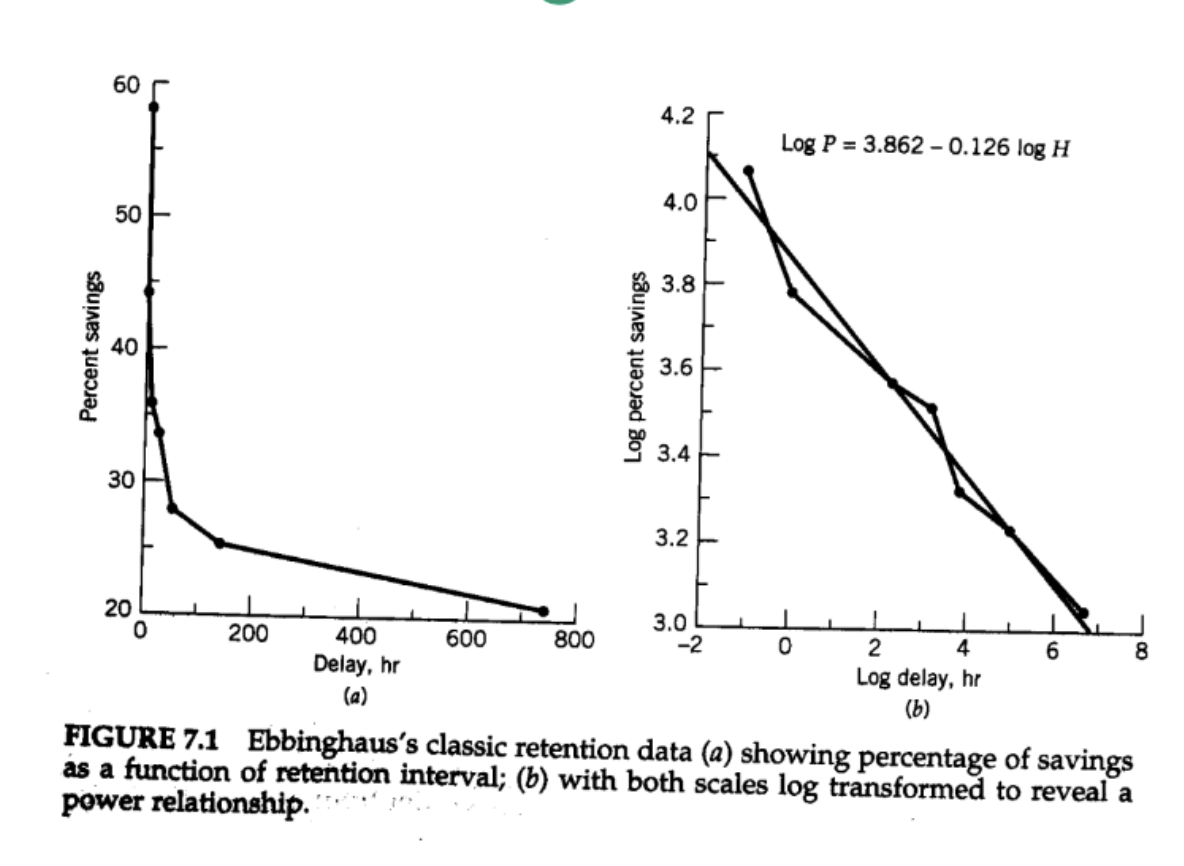
What does the retention function represent?
Shows how memory performance deteriorates with time - rapid forgetting followed by slow forgetting.

The period of time manifested is a function of…
strength of memory record and sensitivity of the memory measure. (the weaker the strength or more sensitivity means it will be forgotten sooner)
The power law of forgetting is __ kind of acceleration?
negative acceleration retention function
The Savings formula is:
Relearning trials/initial trials
The retention function indicates that..
amount forgotten decreases and time between study and test increases
The learning function indicates that..
practice shows less and less benefits as number of practice trials increases
Memories decay as a power function of time over…
which the memories are being retained.
What happens to forgetting when you practice more?
Parallel retention functions. Recall increases but rate of forgetting is the same.
What two experiments tested how practice influences forgetting?
Sentence memory experiment and word memory experiment.
What did the sentence memory experiment do?
Compared 3 vs 4 trials. People who studied studied 4 times recalled more sentences, but both groups forgot at the same rate. (Slamecka and McElree)
What did the word memory experiment do?
Two groups learned words for 1 second and 5 seconds. 5 second group learned more words but both groups has the same amount of forgetting. (Wixted and Ebbesen)
Retention functions for different kinds of practice are approximately…
parallel.
What is the main idea behind the environmental basis of the power law of forgetting?
Human memory may have adapted to patterns of information in the environment. We remember recent information better because its more likely to be useful.
Who researched environmental basis for forgetting?
Anderson and Schooler - NY Times test
What was the NY times experiment?
Anderson/Schooler. They looked at the recency of a word and the frequency of it. X is the log days since the last occurence of the word in the newspaper and Y is log probability of the word appearing on the target day.
- The downward slope indicates that as more time passes since the word first appeared, the probability of it showing up again decreases.
The parallel lines show that even with different frequencies, they have the same decreasing probability of showing up over time.
What is a neural base for the power law of forgetting?
LTP: long term potentiation - long term increase in the magnitude of the response of neurons to a high frequency stimulation in certain parts of the brain
What is LTP and how does it work?
long term increase in the magnitude of the response of neurons to a high frequency stimulation in certain parts of the brain.
with increasing practice trials of stimulation, greater responses follow.
What experiment tested the neural basis of laws of forgetting?
Barnes, 4 trials of stimulation vs 1 trial of stimulation. 4 stim group showed greater LTP maintained across retention intervals.
Downward slope: LTP decreased as time passed
Parallel lines: both groups showed similar rates of decline.
What is the spacings effect for retention function?
At short retention intervals, massed study and spaced study is about equal but spaced study is forgotten less quickly. The experiment used paired words.
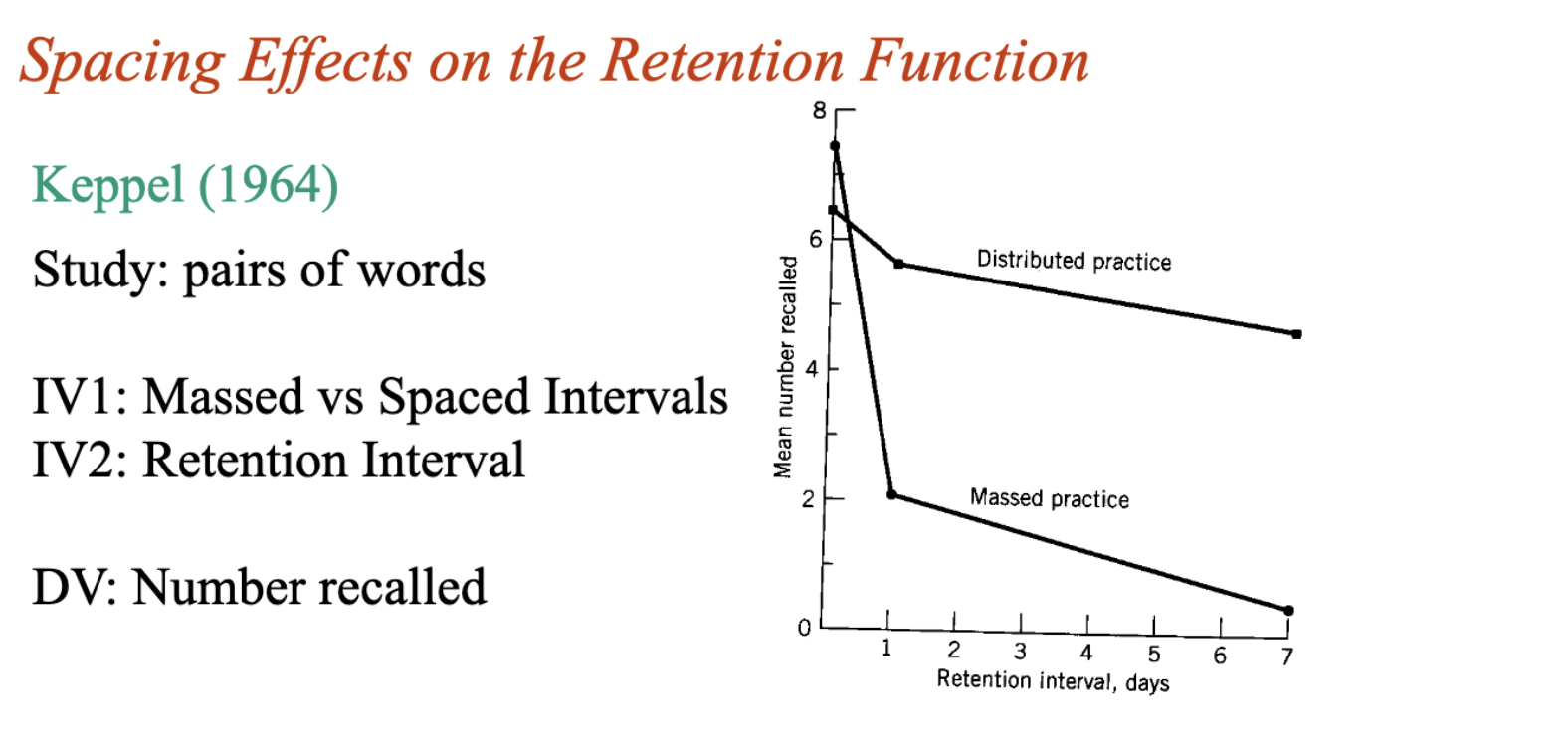
Spacing Effects and Varying Retention Time
Glenberg Experiment used continued cued recall. Results were best when the spacing time matched how long the information needed to be remembered. Longer spaced intervals helped with longer term retention while shorter spaced intervals helped with short term retention.
longer delays also lead to more forgetting

What did Bahrick do for Spacings Effect?
He tested spanish vocab pairs with zero, one day gap and 30 day gap between study cycles. Zero day was better with learning but 30 day gap was best with memory.
What experiment tested interference and forgetting?
Keppel & Underwood - proactive interference. No forgetting on the first trial. More forgetting occurs with the second and third trial since prior items interfered.
What is proactive interference?
An earlier acquired memory interferes with memory for later events. Study A-B then nothing. Study A-C. A-B hurts A-C.
What is retroactive interference?
Also known as Negative Transfer. A more recently acquired memory impedes recall of a memory of an older event. A-C hurts recall of A-B.
What is Acquisition?
how memories are stored. for associations, there is a specific memory record for each association.
Frog - tire
Tire - log
Frog - log
What is retrieval?
When a memory is cued, each record is activated. Activation will increase as record strength (RS) increases. And as Association (AS) between the record and the cue increases.
Record Activation = f (RS,AS)
What is the function of Record Activation?
Activation increases as Record Strength (RS) Increases. Association (AS) between record and cue also increases.
Record Strength (RS) = f(RS, AS).
Total association strength is …?
Limited and is shared amongst all memory records sharing that cue. AS = l/n.
L is lambda symbol.
The Rescorla Wagner theory explains how…
associative strength develops during classical conditioning, especially when multiple CS are together. - The idea is that the amount learned in each trial depends on how much associative strength has been developed already.
Early Trials: increase quickly cause there’s a huge difference between current and max strength
Later trials: slows cause AS is approaching a max
For Compound Stimuli: when conditioned together, each gets half the Max AS

When a cue is presented alone, the strength of association is greater than if…
it is presented with another cue, because they compete for limited strength.

What is the Rescorla Wagner equation?
Change in Va = a (l - Vab)
a = learning rate
l = max strength
Vab = combined current strength

What is prediction error? Rescorla Wagner..
(l - Vab). It is the difference between maximum possible and current associative strength = determined how much learning occurs.
What does the compound curve represent?
Each cue's individual associative strength, approaching λ/2 when two equally effective cues are conditioned together.
Memories that are most similar to the cue…
are the most likely to be retrieved.
What is cumulative proactive interference?
The progressive impairment of learning or remembering new information as interference from previously learned information accumulates. —— Learning different lists in the same environment makes recall more difficult because of the previously learned lists.
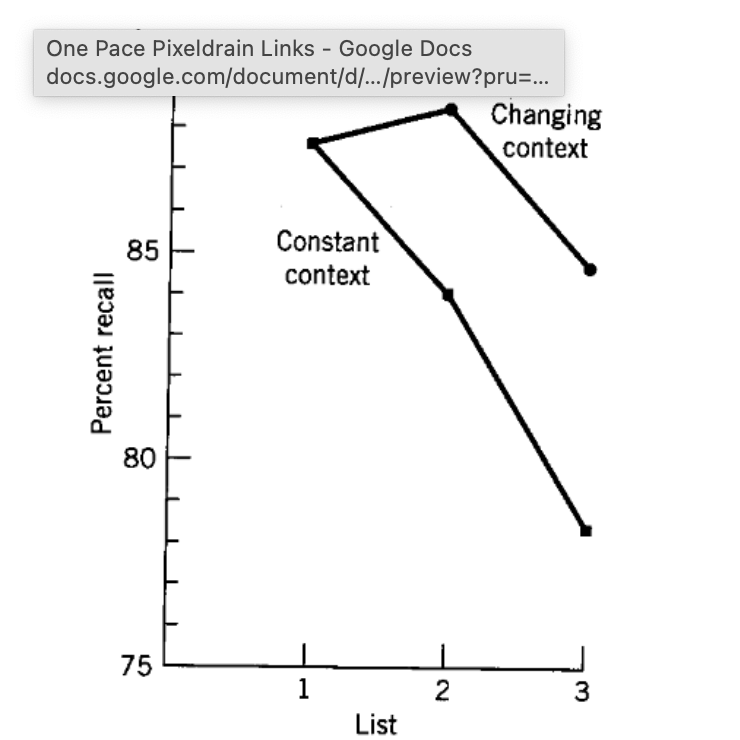
What is context-based interference?
Learning different lists in the same room can cause interference. The context is the same, so previously learned lists can cause issues with recall of the newer lists.
memory is impaired by interference of multiple memories associated with the same context clues.
What is Freud’s Repression Hypothesis?
People unconsciously block unpleasant or traumatic memories from conscious awareness as a psychological defense mechanism.
What is a fugue state?
Temporary episodes involving extensive autobiographical memory loss, sometimes associated with traumatic experiences.
What was the experiment that researched fugue states?
Loftus & Burns. Two films. Sample has better memory of details of the film where no murder occured.
What’s the limitation in emotional memory studies?
Poor memory for unpleasant experiences may result from inadequate initial encoding rather than repression or accelerated forgetting.
Researchers need to distinguish between information that was never adequately encoded and information that was successfully encoded but subsequently became inaccessible.
What’s the positive explanation for repression of emotional memories?
People forget their negative memories more than the positive ones. They might rehearse their positive experiences more than their negative ones, over December break.
So differences in rehearsal rather than repression?
What did Levinger and Clark find out in their negative word study?
Neutral words had better immediate recall but negative words had better recall after a week. - aka the reversal effect: relationship between emotional content and memory performance reversed after a delay, with negative information showing better retention.
What is the reversal effect?
relationship between emotional content and memory performance reversed after a delay, with negative information showing better retention. challenges freud’s belief of repressed negative memories.
Although subjects may show worse encoding of negatively memories,
there is not a well-established relationship between valence of memory and its retention.
Rather than a memory being positive or negative,
how emotionally arousing it is = will influence long-term memory.
High arousal can impair initial memory performance but
improve long-term retention of information that was successfully encoded.
What is emotional valence?
Whether an experience is positive, negative, or neutral.
What is emotional arousal?
The intensity of physiological and psychological activation associated with an experience.
How did researchers measure arousal?
By galvanic skin response (GSR) - specifically sweat gland activity
What is Reminiscence?
An improvement in memory performance over a retention interval, even without additional studying. (occurred for high arousal)
Arousal is greatest between?
12 and 8pm
What is a false memory?
A memory of an event that did not occur or is remembered inaccurately. False memories can develop through suggestion or misleading information.
What did Loftus & Pickrell (1995) demonstrate?
Researchers induced false childhood memories of being lost in a mall through suggestion, demonstrating that people can remember events that never occurred.
What is the weapon focus effect?
During a threatening event, attention narrows toward the weapon, reducing encoding of peripheral details, including the perpetrator's face.
What is the Yerkes-Dodson law?
Performance generally follows an inverted-U relationship with arousal: moderate arousal produces the best performance, while very low or high arousal can impair it.
How is eyewitness confidence related to accuracy?
High confidence does not guarantee accurate memory. Eyewitnesses can be confident about details they remember incorrectly.
How are associative interference theory and Rescorla-Wagner theory related?
Both involve competition for limited associative strength. Rescorla-Wagner explains simultaneous cues competing to predict an outcome, while associative interference explains different memories competing for activation from a shared cue.
What is the difference between massed and spaced practice?
Massed practice involves concentrated studying with little spacing. Spaced practice distributes learning over time and generally improves long-term retention.
What is episodic memory?
context dependent memory
What are retrieval cues?
used to probe memory
Free recall depends on?
context
Ex. List the words you studied
Cued recall and recognition depend on?
context and item.
cued is: What animal was on the list?
Recognition is: Was DOG on the list?
Free and cued recall vs retroactive interference?
Cued recall has less retroactive interference than free recall.
Much of memory failure can be attributed to
Loss of access to appropriate retrieval cues
Why is recognition easier than free recall?
Recognition provides item-specific cue, reducing retrieval competition
What is old-new recognition?
Participants decide whether an item is previously studied or not previously studied.
False alarm - it was stated as old even though its new
Correct rejection - it was stated as new and is new

What is the signal detection theory?
people evaluate how much evidence they have that an item was previously encountered to decide if they recognize something from memory

Explain the signal detection graph
Left curve - distractors - Items that were NOT previously studied. They generally produce weaker evidence of recognition.
Right curve - targets - Items that WERE previously studied. They generally produce stronger evidence of recognition.
What does the X axis represent in the signal detection graph?
degree of evidence. if you move to the right, then the