Macroeconomics Topic 3
 Call Kai
 Learn
 Practice Test
 Spaced Repetition
 Match
 Flashcards
 Knowt Play
1/39

There's no tags or description
Looks like no tags are added yet.
40 Terms
What is the definition of financial wealth?
The value of all of your financial assets minus all your financial liabilities.
What is a stock variable?
Measured at a point in time.
What is a flow variable?
A variable whose value is meaningful only when expressed over a particular period of time.
What are the two types of assets?
Money and Bonds.
What are the two types of money?
Currency
Coins
Bills
Deposit accounts
Write cheques
Use a debit card
What are the features of bonds?
They pay a positive interest rate, denoted by ‘I’.
Cannot be directly used for transactions.
Buying and selling bonds involves some cost.
For this model we must assume that there is only one type of bond, paying the interest rate ‘I’.
Through which factors should people decide in which proportions they should hold both money and bonds?
Their level of transactions.
The interest rate on bonds.
What are money market funds/ money market mutual funds?
These are ways in which people can hold bonds indirectly. These funds:
Pool together funds belonging to many people.
Use those funds to buy bonds.
What is the aggregate demand for money?
The demand for money in the economy is the sum of the individual demands for money by people and firms.
What can the overall level of transactions be related to?
Nominal income: the total amount of money earned or received in current currency units over a specific period, unadjusted for inflation or changes in purchasing power.
What is the equation for money demand?
Md=$YL(i)
Where:
Md is the demand for money. $Y is nominal income. L(i) is a function of the interest rate, it is decreasing in i.
What does an increase in the interest rate lead to? Why?
A decreased demand for money.
This is because when bonds offer a higher interest rate, people have an incentive to put their wealth into bonds instead of money.
What kind of relationship do money demand and nominal income have?
Money demand increases proportionally with nominal income.
e.g. if nominal income doubles, then money demand also doubles.
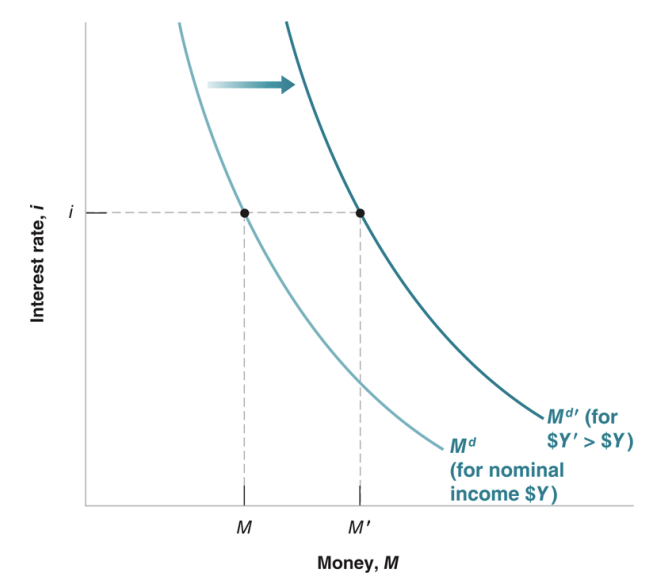
What does the Md curve represent?
The relationship between money demand and the interest rate.
What happens graphically when there is an increase in nominal income?
This shifts money demand to the right (increases the demand for money).
What does equilibrium require of M?
Ms = Md = M
How much and what type of money does the central bank supply?
They supply currency, an amount equal to M : MS = M
Where is the interest rate on the MS MD graph? Show this graphically?
The interest rate is at the point where the supply of money is equal to the demand for money.

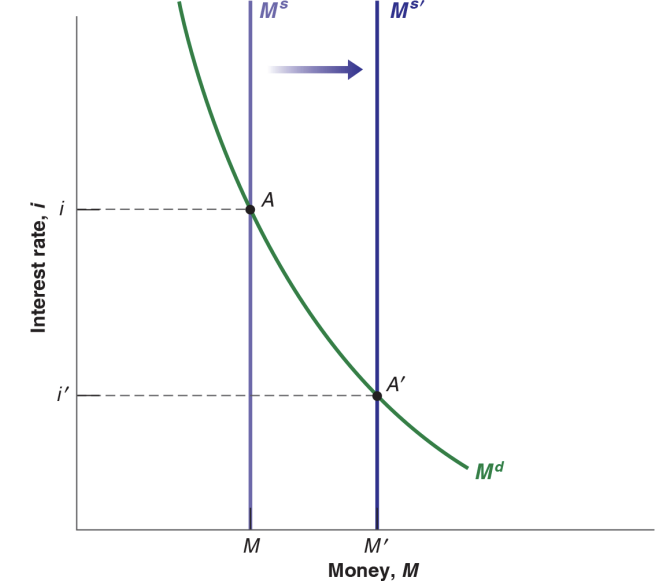
What happens to the interest rate if there is an increase in the supply of money? Show graphically.
An increase in the supply of money leads to a decrease in the interest rate.
What happens if there is an increase in nominal income on the interest rate? Represent graphically.
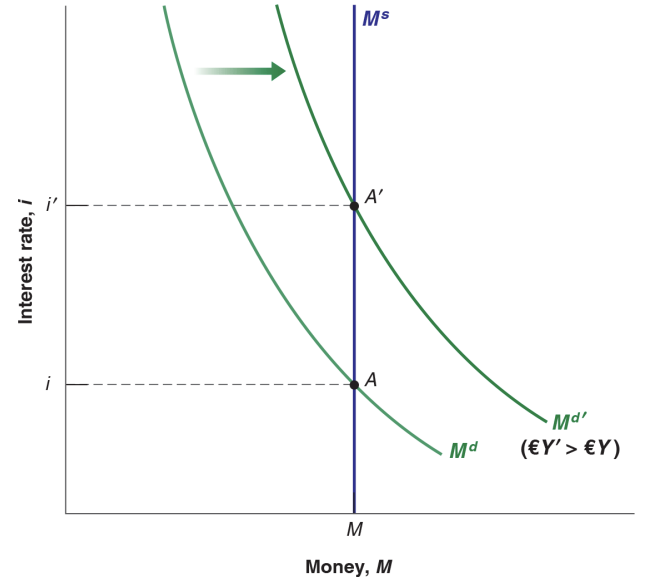
Given the money supply, an increase in nominal income leads to an increase in the interest rate.
What is expansionary policy?
Buying bonds puts cash into the economy, increasing the overall money supply.
What is contractionary policy?
Selling bonds takes cash out of circulation, reducing the overall money supply.
What is the equation rate for the interest rate for bonds? E.g. a 1-year bond paying £100 in a year.
i = (£100-PB)/PB and PB = £100/(1+i)
What is the relationship between bond prices and interest rates.
A higher bond price means a lower interest rate, a lower bond price means a higher interest rate.
How can bonds be used to influence the interest rate?
Buying bonds: Higher demand drives up bonds prices which means interest rates fall.
Selling bonds: Higher supply drives down bond prices which means interest rates rise.
What are the two ways a central bank can run policy?
A central bank can either pick a money supply (MS) and let market forces set the interest rate.
They can pick an interest rate directly rather than targeting the money supply.
What are the three ways in which raising interest rates fights inflation?
Borrowing & Saving. If there are higher borrowing costs and higher returns on savings, this means people spend less and invest less, this leads to the economy cooling down and inflation dropping.
Asset Prices. If stock prices and house prices drop, this means wealth drops, spending then cools down, leading to a drop in inflation.
Exchange Rate. If the euro gets stronger, importing goods becomes cheaper, leading to a drop in inflation.
What are financial intermediaries?
Institutions that collect money from savers and lend it out or buy financial assets.
What are the two ways in which banks hold reserves?
Deposits as liabilities. Money that people deposit into banks is a liability for the bank (they owe it to the customer).
Reserves. Banks keep a portion of cash in their vaults or in an account at the central bank.
Why do banks hold reserves?
Precautionary measure: daily cash deposits and withdrawals don’t match perfectly, so banks need cash ready for customers.
Reserve requirements: By law, banks must hold a percentage of their deposits as reserves.
What are the components of central bank money?
Currency in public hands + reserves held by banks.
What is the reserve ratio? What is it denoted by?
θ: The amount of reserves that banks hold per euro of deposit accounts.
What is the demand for reserves by banks formula? (Hd)
$Y: Nominal Income
L(i): function of the interest rate
θ: The amount of reserves that banks hold per euro of deposit accounts.

What is the equilibrium condition in relation to the central bank?
Central bank money supply (H) must equal central bank money demand (Hd)
What does equilibrium in the central bank money market look like graphically?
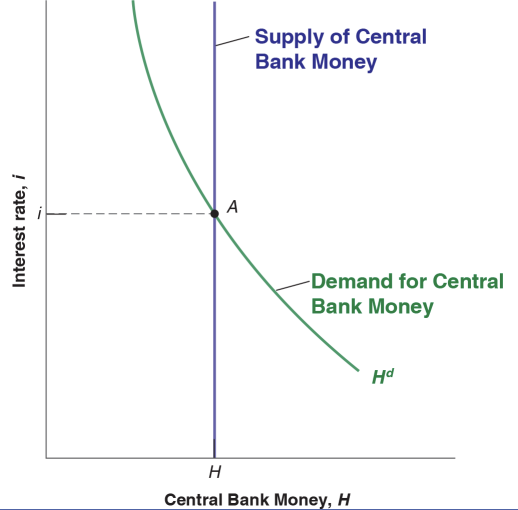
The equilibrium interest rate is such that the supply of central bank money is equal to the demand for central bank money.
Equilibrium Point A: Where supply H meets demand , fixing the interest rate (i).
How do commercial banks create money?
By using the money multiplier.
e.g. Central Bank: Buys £100 in bonds from Bank A --> Base money increases £100.
Bank A: Keeps 10% (£10) in reserve and uses the remaining £90 to buy bonds from Bank B.
Bank B: gets £90 deposit, keeps 10% (£9), uses remaining £81 to buy bonds from Bank C.
What is the formula for the money multiplier?

What is the Liquidity Trap?
A scenario where the interest rate reaches 0%. Once this happens, people don’t care whether they hold cash or bonds because both pay 0% interest.
How can the liquidity gap be shown graphically?

The demand for money becomes horizontal past point B.
When (i)=0, increases in money supply have no effect on the interest rate. It remains equal to 0.
Standard policy fails because pushing more money into the economy cannot push the interest rate below zero. Monetary policy loses its main lever.
What is quantitative easing?
When short-term hit 0%, central banks buy massive quantities of long-term assets (gov bonds, corporate bonds, stocks) to lower long-term interest rates directly and boost the economy.