Lab Final
 Call Kai
 Learn
 Practice Test
 Spaced Repetition
 Match
 Flashcards
 Knowt Play
1/50

There's no tags or description
Looks like no tags are added yet.
51 Terms
Applications of Foraminifers - Estuaries
Provide info on past salinity and temperature
Applications of Foraminifers - Continental shelf
Tell us about past water depths
Applications of Foraminifers - Bathyal
Tell about the oxygen levels and depth of CCD
Phylum Porifera (sponges) Major Advancement
Differentiated cells
Phylum Porifera (sponges) Lifestyle
Sessile and filter feeders
Osculum
Opening at the top; “little mouth” in the phylum Porifera
Cloaca
Central chamber; “sewer” in the phylum Porifera

Phylum foraminifera
Order fusulinida
Genus triticites

Phylum foraminifera
Order rotaliida
Genus nummulites

Phylum porifera
Genus Euplectella

Phylum Porifera
Genus Euspongia

Phylum Porifera
Genus Prismodictya
The arrow is pointing to the cloaca

Phylum Porifera
Genus Hydnoceras

Phylum Porifera
Genus Archaeocyathus

Phylum Porifera
Class Stromatoporoids
The pokey stuff is the mamelons, which are where water is exchanged
Phylum Cnidaria (Corals and Jellyfish) Major Advancement
True tissue; simple nerve net

Phylum Cnidaria
Order Alcyonacea
Genus Gorgonia (sea fan)

Phylum Cnidaria
Order Alcyonacea
Genus Tubipora (pipe organ coral)

Phylum Cnidaria
Order Tabulata
Genus Favosites (honeycomb)
Corallite
The individual skeletal tube that housed a single coral polyp

Tabulae
The horizontal partitions stacked inside corallite


Phylum Cnidaria
Order Rugosa
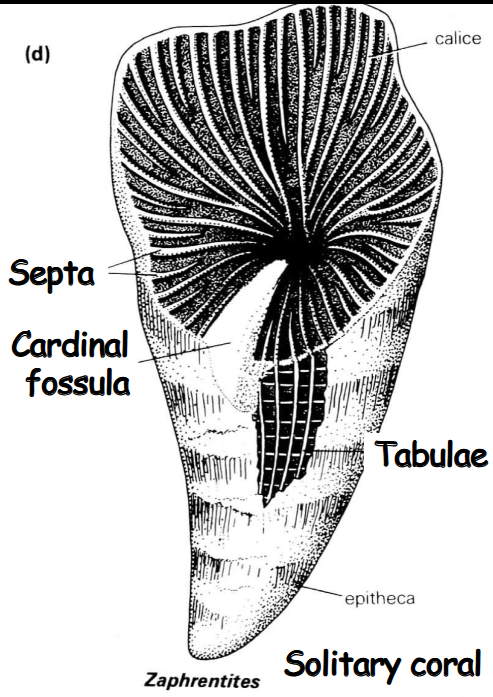
Genus Zaphrentis (horn corals)
Solitary coral
Septa
The internal partitions inside the cup-shaped (solitary rugose) coral skeleton
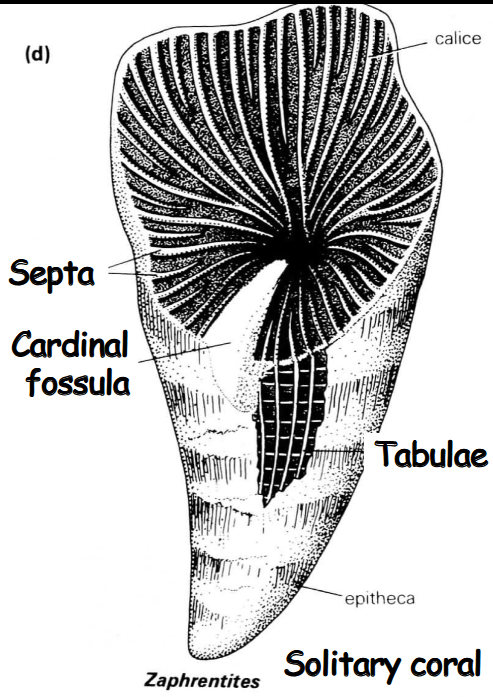
Tabulae
The internal horizontal plates or platforms that span across individual corallites

Fossula
A distinct structural gap or depression found within the skeletal anatomy of Rugose corals

Phylum Cnidaria
Order Rugosa
Genus Hexagonia
Colonial coral

Phylum Cnidaria
Order Rugosa
Genus Heliophyllum
Solitary coral

Phylum Cnidaria
Order Scleractinia
Genus Acropora (elk coral)
Pedicle
Muscle stalk for attaching onto substrate

Lophophore
An appendage extending from near the mouth with long, tentacle-like cirri. These cirri contain fine cilia that generate water currents that bathe the lophophore and carry food particles toward the mouth

Phylum Bryozoa Major Advancement
True organs (e.g., lophophore)
Beak
Pointed extremity of the shell, which marks the beginning of shell growth; radial costae diverge from it, and successive growth lines are progressively distant.

Hinge Line (Curved)

Growth Line
Cocentric markings of shell recording earlier stages of shell length

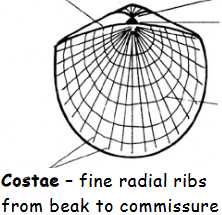
Costae
Fine radial ribs from beak to commissure
Hinge Line (Straight)

Fold
Elevated area of valve along the mid-line

Sulcus
Median depression of valve corresponding to the fold in the other valve

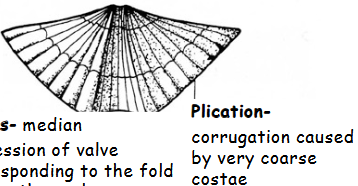
Plication
Corrugation caused by very coarse costae

Phylum Brachiopoda
Genus Rafinesquina
Surface ornamentation includes costae, and a straight hinge line is present

Phylum Brachiopoda
Genus waagenoconcha
Surface ornamentation: costae and pits for spines

Phylum Brachiopoda
Genus Leptaena
Surface ornamentation: concentric wrinkling of the growth lines; costae; straight hinge line

Phylum Brachiopoda
Genus Mucrospirifer
Surface ornamentation: costae, sulcus, straight hinge line, fold, and growth lines


Phylum Brachiopoda
Genus Rhynchotrema
Surface ornamentation: plication, sulcus, and fold

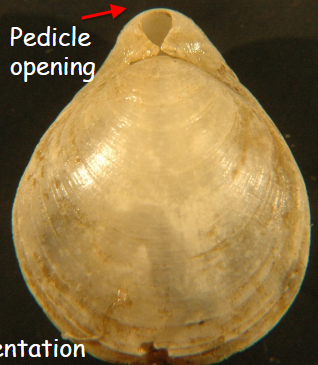
Phylum Brachiopoda
Genus Laques
No surface ornamentation

Phylum Bryozoa
Genus Tabulipora
Include the zooids

Phylum Bryozoa
Genus Fistolipora
Include the zooids and a cross-section
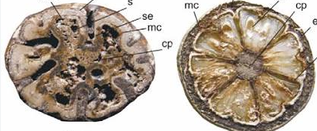

Phylum Bryozoa
Genus Prasapora
Include the zooids and the cross-section


Phylum Bryozoa
Genus Archimedes
Include the zooids and the cross-section

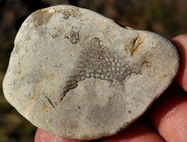
Phylum Bryozoa
Genus Fenestrella
Include the zooids
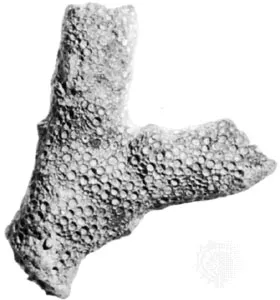
Phylum Bryozoa
Genus Hallopora
Include the zooids